
This post features the latest whitepaper from Reframe Venture’s Emerging Markets research stream. Our research outputs are shared regularly with newsletter subscribers.
Last year, Reframe Ventures surveyed its member funds to assess the state of responsible investment across emerging markets and to hear from our community about the issues most critical to them (ESG and beyond). Across 30 interviews, 21 survey respondents and countless in-person events and training sessions, a consistent set of themes emerged.
Responsible investment in emerging markets is certainly a landscape in transition. Across the board, stakeholders in emerging markets now largely agree that responsible investment is not simply ‘ethically commendable’ but ‘financially judicious’. Beyond development finance institutions (DFIs), regulatory authorities and institutional investors are making climate reporting mandatory, aligning with ISSB standards, tightening data governance requirements, and are demanding greater board engagement and oversight. Responsible Investing is increasingly seen not just as a ‘compliance and reporting requirement’ but an integral part of ‘investing well’ in emerging markets VC. As one LatAm-based GP put it: “It doesn’t really matter what you call ESG... you can change the name and call it sustainable investing... at the end of the day we want to build sustainable successful businesses”.
Yet while the benefits of ESG adoption are increasingly well documented and embraced, the operational reality remains fraught with tension. Respondents voiced concerns familiar from our 2024 whitepaper: frameworks are not yet fully fit for purpose, administrative burdens are disproportionate to fund size, internal frictions between ESG professionals and investment committees continue, and a shortage of locally trained ESG talent is acting as a blocker in some geographies. Our interviews surfaced additional pressures: AI integration and financing vehicles tied to complex climate monitoring/reporting requirements are driving demand for specialised expertise that remains costly and hard to access across emerging markets.
This whitepaper is structured in three parts. It begins with the structural anxieties facing investors in emerging markets, where the venture capital (VC) model faces liquidity and capital continuity challenges that precede, yet ultimately shape, ESG considerations. It then examines the specific challenges of ESG integration across the regions surveyed. Finally, it sets out what is needed to make responsible investment relevant to emerging market contexts: proportionality, materiality, and thoughtful design.
Across all geographies, the primary anxiety voiced by both LPs and GPs was liquidity. Capital continuity poses an existential risk to portfolio companies and to the funds themselves.
Emerging markets already contend with a constrained Series B+ / growth environment, limited secondary markets, and scarce IPO exit opportunities1. These structural limitations are compounded by macroeconomic pressures: currency volatility erodes returns and GP carry, while local high-net-worth individuals and family offices frequently favor dividend and revenue-based models (i.e. not PE), struggle to separate impact investing from philanthropy, or direct capital elsewhere. In the short term, fewer growth-stage rounds produce depressed valuations; over time, they incentivize “one-and-done” funds that never mature into institutional vehicles. This is especially acute in sub-Saharan Africa, where the majority of fund managers are emerging managers.
GPs also raised structural concerns about a VC model grounded in Silicon Valley’s power-law logic: the pursuit of asset-light, software-driven unicorns. Across the regions surveyed, the most pressing economic needs are not asset-light but infrastructure-heavy: energy access, logistics, agri-processing, healthcare delivery. These businesses require physical assets, longer capital cycles, and patient deployment, none of which sit comfortably within a conventional VC fund structure optimized for speed. As several GPs emphasized, the issue is not that venture capital is unsuitable for these markets, but must be integrated with alternate liquidity structures such as PE, evergreen funds, venture debt, or M&A-oriented buy-out options that support steady, durable growth.
These structural challenges have direct consequences for responsible investment:
Capacity constraints. Pressure toward lean, micro-VC structures limits both the bandwidth and the management fee needed for thoughtful ESG design and implementation.
Knowledge attrition. When emerging managers fail to raise a second fund, hard-won ESG learning is lost rather than institutionalised.
Talent gaps. Across Africa and the Middle East, funds report a shortage of mid-level management and local ESG officers. The bottleneck is not a lack of trained professionals but their tendency to migrate toward better-compensated roles in developed markets.
Lack of LP pressure. For GPs raising primarily from US LPs – common among LatAm funds – responsible investment pressure tends to be weaker. This can dilute DFI requirements across the capital structure, reducing overall ESG integration.
Yet structural headwinds also present strategic opportunities. Integrating responsible investment practices early can strengthen a fund’s long-term capital alignment beyond constrained domestic markets. Forward-looking fund managers are already asking how their ESG positioning today will determine which future capital pools they can access, and how to make their funds legible and attractive to a broader range of asset classes, ensuring that a company can withstand the scrutiny of a cross-border transaction or a public listing process.
ESG integration across the funds surveyed follows a recognisable progression:
Stage 1 — Compliance: Driven by DFI requirements, including exclusion lists, IFC Performance Standards and other LP reporting. ESG is largely experienced as a compliance tax.
Stage 2 — Value Creation: More mature funds are shifting toward active ownership, treating ESG as risk identification, value creation and exit readiness tool.
One reason why funds struggle to move from Stage 1 to Stage 2 is a lack of proportional frameworks. Fund managers expressed consistent frustration with what several described as “zombie metrics”: cut-and-paste reporting requirements imported from the Global North that carry no meaningful relevance to local conditions. Examples cited include requests for “Black-owned business statistics” in markets where the vast majority of businesses are Black-owned; gender breakdowns of administrative versus technical staff in 50-person startups; and the appointment of women to investment committees under frameworks like the 2X Challenge without ensuring meaningful economic participation or decision-making authority.
Among the funds surveyed, the individual components of ESG are not valued or operationalised equally. Governance is widely regarded as the most critical component and is more openly embraced as the primary risk mitigation tool against fraud, regulatory opacity, and currency volatility.
Notably, many funds who participated in our ESG training reported that they had been “doing ESG” long before they applied the label. One GP described this saying “It was just a thing of sitting down and writing down policies and processes... but in the core, we already did a lot of that”. Standard due diligence processes, risk management frameworks, and portfolio monitoring practices already captured much of what formal ESG integration demands. The inverse challenge also emerged: founders in sectors like EdTech or HealthTech often arrived with the belief that because their product does good, they have no need for formal governance or risk frameworks.
Governance challenges are further compounded by the regulatory environments in which emerging market funds operate. While legal clauses are standard practice, few GPs mentioned enforcing them punitively. In relationship-driven markets within Asia and LatAm, compliance is more often achieved through persuasion, mentorship, and social pressure than through legal action. In Africa, the gap between legislation and enforcement is frequently wide. Data privacy laws exist across jurisdictions, but where enforcement is weak or absent, the compliance landscape becomes ambiguous for both funds and their portfolio companies. In LatAm, the challenge lies less in enforcement gaps and more in legal predictability. GPs operating in the region drew a clear contrast between the relative reliability of the US judicial system and the uncertainty of litigation outcomes in LatAm courts.
Yet even as governance dominates current ESG practice, there are signs that its role is beginning to evolve. As one Africa-based GP noted, ESG has been “playing more of a risk management role, but hopefully as we grow our team and we have more capacity... we will see it more as an opportunistic growth lever as opposed to purely just risk management”. This distinction matters: applying ESG purely as a filter (i.e. proceeding or not proceeding with an investment based on exclusion criteria) forecloses the longer-term opportunity to embed ESG as part of how companies create and sustain value. Governance, in this framing, is not just a disciplinary mechanism, but the foundation on which value creation is built.
Climate represents the most difficult ESG component to integrate meaningfully for funds operating outside the dedicated clean tech space. For funds with an explicit climate or circular economy mandate, environmental metrics are central to the investment thesis. Measures such as GHG reductions, tonnage savings, and lifecycle assessments form the natural language of portfolio management. One LatAm fund manager observed: “Many climate opportunities, like carbon sequestration, are highly technical. We are not experts in those fields. To invest effectively, we need external experts to help evaluate deals and potentially sit on boards post-investment”. Yet even LPs operating in the climate space acknowledged significant internal complexity and external confusion when attempting to align across multiple, sometimes contradictory, frameworks and definitions — including Paris Agreement alignment, Climate Finance rules, and Green Climate Fund requirements.
For Fintech and SaaS-focused funds, requirements to report on carbon footprints or water consumption were described as disconnected from the actual risk profile of their portfolios. Climate pressure, as several GPs noted, was coming primarily from LPs rather than from any apparent material relevance. At the same time, other fund managers pushed back against dismissing climate risk entirely, particularly in the agribusiness sector, where volatile climate patterns are already disrupting supply chains. One LatAm GP explicitly rejected the siloing of people and planet, arguing that climate change disproportionately affects the most vulnerable populations and is therefore never simply an ‘E’ question.
Underlying all of this is a practical data problem. Current GHG measurement tools assume a level of automation and data infrastructure that does not exist in many emerging markets. In cities like Lagos or Jakarta, diesel usage is tracked manually. Accurate local grid emission factors are frequently unavailable2. Frameworks that do not account for this reality will continue to generate unreliable data, regardless of how diligently they are applied.
GPs reported significant uncertainty about how to assess and account for risks posed by AI. No established standard exists for responsible AI in the VC context, and ESG professionals frequently lack the technical depth required to evaluate complex mitigation measures, such as auditing AI code for bias or safety risks. As one Africa-based GP put it: “If [a founder] gives me the code they use to mitigate this, I’m not a tech person, I don’t know [how to evaluate that]. I need guidance that’s not just generally in terms of what are the ethical risks of AI but more concrete”. Comparable gaps exist for stablecoins and crypto assets, where ESG frameworks have yet to develop meaningful guidance on data ethics, AML/KYC obligations, or stablecoin licensing.
Regulatory frameworks present a related challenge. While business models can travel across geographies, regulatory logic cannot simply be transplanted. GDPR and SFDR were designed for specific legal, political, and cultural contexts. This legal ambiguity brings worries to GPs on the ground, as one Africa-based fund manager said “there are explicit, very real pending legal cases where suits are coming against founders who implement certain ESGs...I don’t want to do something that could potentially be good, but then I could potentially get sued and shut down for it”. In markets where data sovereignty is treated as a matter of national security rather than consumer rights, these frameworks cannot be transposed wholesale. Funds that treat regulatory compliance as a translation exercise rather than a design exercise will find themselves consistently misaligned with local realities.
AI is also creating new valuation risks. GPs operating in Asia-Pacific noted that Series D SaaS companies are being re-evaluated downward as AI disrupts valuation assumptions about revenue stickiness and long-term viability. Rapid advances in AI, in other words, are not only generating new ESG risks but also contributing to portfolio instability in ways that existing frameworks have not yet caught up with.
In emerging markets, ESG integration can be understood as a friction map with three distinct pressure points:
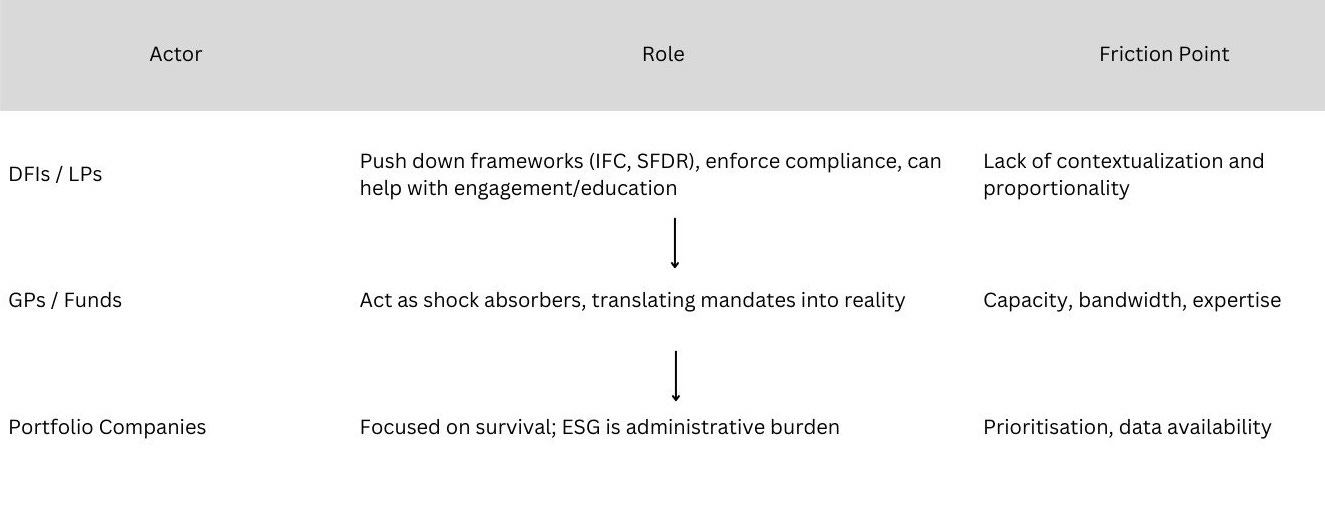
GPs, as shock absorbers, sit at the critical juncture of this chain. They are ultimately responsible for translating top-down mandates into bottom-up value creation, yet are consistently constrained by limited capacity, bandwidth, and expertise. Addressing this tension requires coordinated action across several dimensions.
The recommendations below are primarily directed at LPs and senior GPs from large institutional funds. By strengthening ESG integration at the fund level, these actors can enable better prioritisation across the chain, and, ultimately, drive greater value for their portfolio companies:
Encourage Digitalisation. Fund managers expressed a desire to move from manual, Excel-based systems to integrated digital platforms to improve consistent ESG data collection and reporting, yet existing ESG platforms have yet to be adapted to EM contexts.
Support Peer Learning and Community. GPs expressed valuing peer exchange, practitioner networks, and access to experienced professionals over generic standardised templates.
Develop Standardisation and Bridge Tools. Funds routinely face the tension of maintaining external DFI compliance across multiple frameworks while building internal ESG policies material to the startups they invest in. Better bridge tools — enabling managers to map their internal policies against relevant compliance frameworks — would considerably ease this burden.
Invest in Capacity Building. Investment in junior staff training is needed, particularly to develop technical expertise for assessing complex and fast-evolving risks such as AI. ESG and impact content, case studies, and practitioner literature should also be made available in local languages.
Ensure Framework Localisation. The most important design principles for the next generation of ESG frameworks are proportionality and more specific materiality. Requirements should reflect fund size, sector exposure, and the data infrastructure actually available on the ground.
IFC, 2025, Elevating ESG Reporting in Emerging Markets; [https://www.ifc.org/content/dam/ifc/doc/2025/elevating-esg-reporting-in-emerging-markets.pdf]
BII, April 2025, Scaling Blended Finance - Practical tools for Blended Finance Fund Design; [https://assets.bii.co.uk/wp-content/uploads/2025/04/23104557/Scaling-blended-finance.pdf]
ADBI, 2024, ESG Investment and SME Green Policies;[https://doi.org/10.56506/MCGQ8173]
Forster, William Paul, et al. (2023). “Development Finance Institutions: New directions for the future”. Paris Cedex 12 : Éditions AFD. AFD Research Papers, p.1-68, [https://shs.cairn.info/journal-afd-research-papers-2024-298-page-1?lang=en.]
Emme, Leticia, Pilar Rodriguez, Rafael Plaza, Ariana Rojas, Belissa Rojas, and Yuri Soares 2022. Sustainable Investing: A Playbook for VC Funds. [https://doi.org/10.18235/0004631]
Our emerging market fellows conducted semi-structured interviews with 21 general partners and 9 limited partners, complemented by an online survey completed by 21 respondents. The sample reflected genuine diversity in fund maturity, geography, size, and depth of ESG integration. AUM ranged from $3 million to $2 billion.
To assess ESG maturity, we developed an internal benchmarking framework, termed the Responsible Investing Maturity Matrix, in the absence of a publicly established international standard for venture capital. The Matrix was developed in consultation with DFIs and leading institutional LPs, and will be published in April 2026.
Applying this framework to the funds surveyed, three broad tiers emerged. Fourteen percent demonstrated advanced ESG integration, with deals rejected where the investment committee lacked comfort on environmental and social risks regardless of commercial viability. Fifty-seven percent showed partial ESG adoption, evidenced by a formal ESG policy, fund-level reporting, or ESG criteria embedded in due diligence frameworks. The remaining twenty-nine percent had basic ESG integration; many described themselves as “doing ESG” without the label.
While we recognize the limited extrapolations that can be drawn from this sample size, we believe these proportions broadly reflect wider industry averages.
***
If you’re interested in joining the EM community generally or participating in our research interviews, reach out to us at alexandrine@reframeventure.com
Kato, Ahmed I. 2025. "Venture Capital as a Catalyst for Innovation and Economic Growth in Emerging Economies: A Systematic Review and Future Research Agenda" Administrative Sciences 15, no. 11: 405. https://doi.org/10.3390/admsci15110405
Cárdenas Rodríguez, M. et al. (2024), “National greenhouse gas emission inventories, filling the gaps in official data”, OECD Environment Working Papers, No. 252, OECD Publishing, Paris, https://doi.org/10.1787/f19f1663-en.
Comments
Nothing yet. Say the first thing.
Sign in to join the conversation.