
Ask an AI coding agent to fix one difficult bug and watch what happens behind the screen.
It reads files. Calls a model. Searches again. Calls another tool. Runs the code. Sees an error. Sends the new state back to the model. Tries again. Compresses some context. Calls the model again. Then finally gives you the answer.
One task has quietly become many inference jobs.
NVIDIA recently published a trace of a 33-minute agent session containing 58 main-agent turns, 225 sub-agent calls and 283 separate inference requests. During the same run, the working context grew from 15,000 tokens to 156,000 before it had to be compacted.
That one example explains why I think inference engineering is becoming one of the most useful AI skills to understand now.
A better model is only one part of the improvement. The other part is deciding how often that model runs, what you send into it, what stays in memory, which requests can be cached, which model handles each step, how much GPU memory is sitting idle, and when an agent should simply stop.
This is the invisible side of AI.
And once you understand it, a lot of strange things about AI suddenly make sense: why a smaller model can make a better product, why a huge context window can become expensive, why agents burn tokens so quickly, why GPUs run out of memory even when the model itself fits, and why the same LLM can feel fast in one app and painfully slow in another.
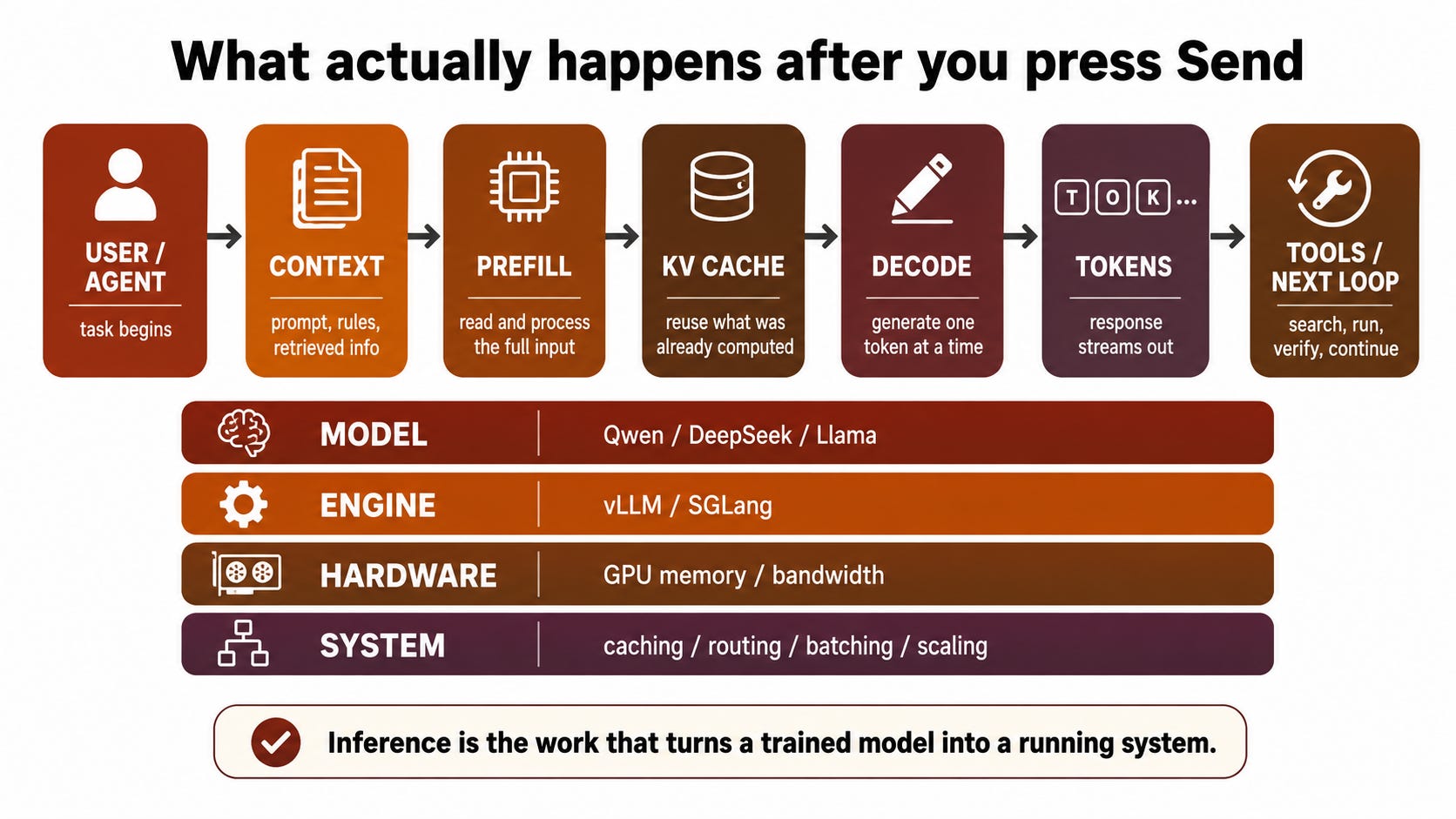
Inside the full guide: training vs inference, prefill vs decode, GPU memory and KV cache, TTFT and token speed, model routing, prefix caching, context control, batching, agent loops, graph engineering, long-term memory, token costs and multi-GPU scaling plus a hands-on vLLM setup with commands, benchmarks, prompt templates and a practical tool stack using vLLM, SGLang, TensorRT-LLM, NVIDIA Dynamo and LangGraph.
Comments
Nothing yet. Say the first thing.
Sign in to join the conversation.