
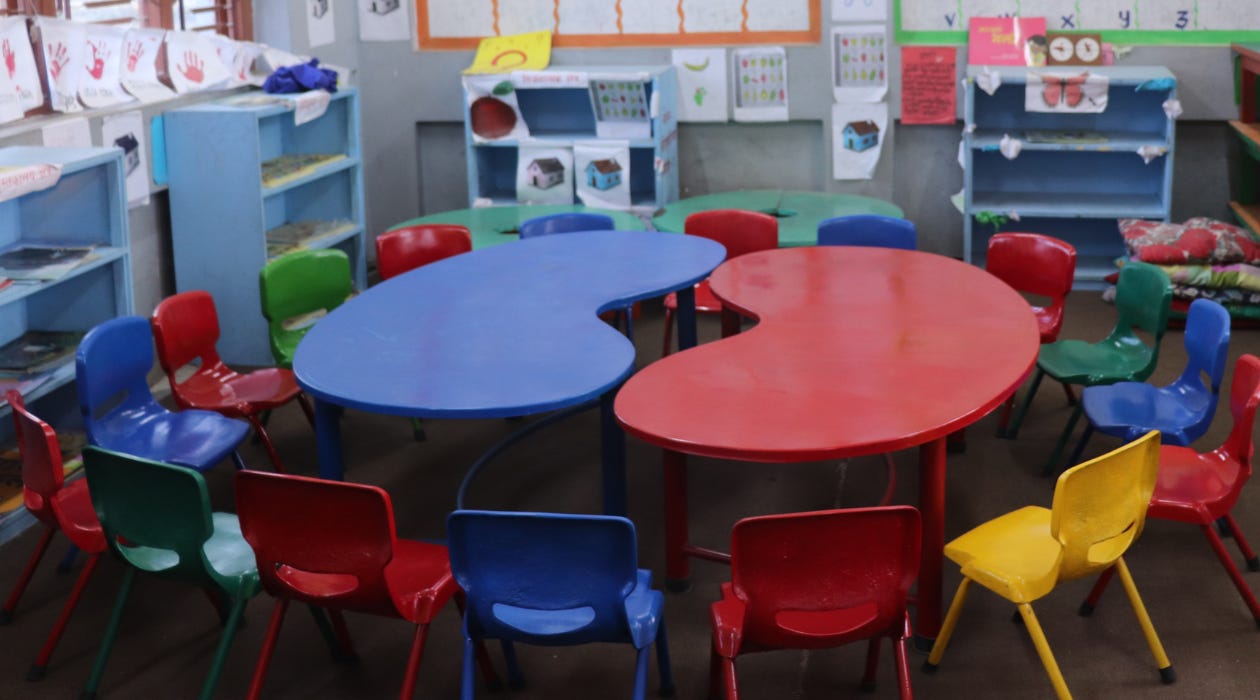
If you missed my first post on Irish vs. American schools, you can find it here. We moved to Cork in July 2025, and we were fortunate to find spots in a co-ed, public primary school in walking distance of our house. Here are some differences we’ve noticed after several months in the Irish schooling system. Some are obvious, some are not-so-obvious!
Uniforms
Most schools in Ireland require uniforms. Fortunately, this is pretty laid back with comfortable clothes. Our school technically has a more formal uniform with polo shirts and dress pants or skirts, but they loosened the policy a few years ago so students can just wear the school tracksuit (comfy sweats/athletic clothes!) to school. They can use any backpack and shoes they want.
I see quite a few Irish kids wearing shorts to school, even in the winter!
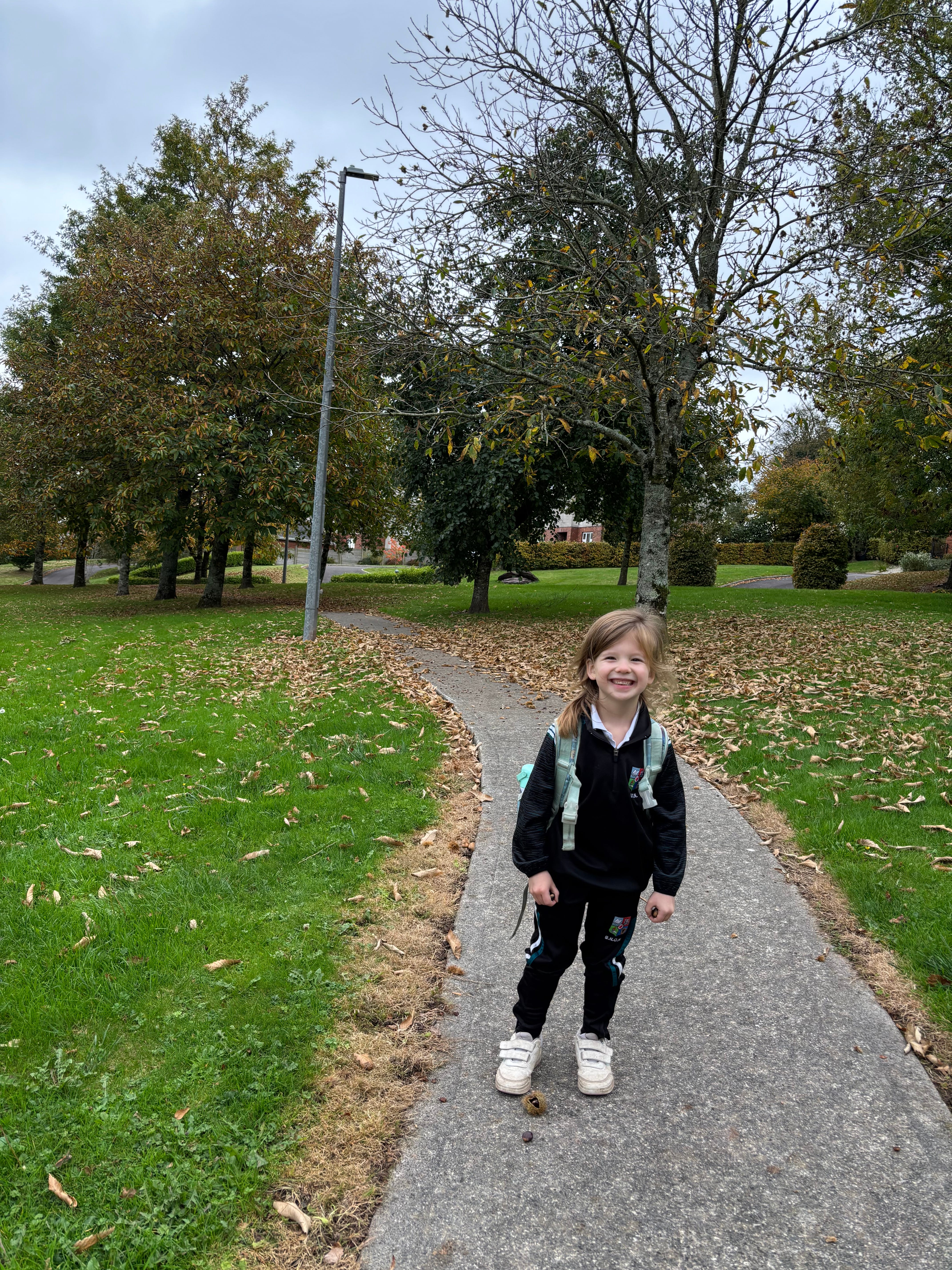
On that note, we didn’t receive a school supply list at the start of the year. The uniforms are the main school supply you’re expected to provide. All we needed to send was a backpack, a pencil case, and a tin whistle.
Getting to school
In Ireland, there are no yellow school buses. Like many of our neighbours, we walk in almost all weather conditions. However, we live in a semi-rural area, and many families drive.
It’s nice walking up to the school gates with other parents and getting to chit-chat twice a day. I can have a quick word with the teacher if I need to. Younger students need an adult to be present at the school gates at pickup, but older students can walk themselves home. My older two love this independence.
Our village doesn’t have a secondary school, and teenagers can’t drive, so teens need an alternate way to get to school. There are some government-provided buses for rural areas— One picks up right outside our house to take students to the next town over. Other secondary students carpool or take public transportation. Secondary students have Wednesday afternoons off, so I see plenty of them walking around in groups or taking the bus on those days.
Physical books
My 11-year-old came home on the first day of class saying that she needed a plastic tub to keep her classroom books in. While she’s always had worksheets, having physical books was brand new to her! Their classes recycle textbooks for several years before they’re replaced. Students write answers to the questions out in a journal and sometimes bring books home for homework.
There is a set of tablets that’s shared between several of the older classes, but it’s brought in more for special projects, not everyday learning. I know there are benefits to technology, but it also just seemed to be a distraction in the U.S., with students playing computer games and watching YouTube at school.
More memorization and handwriting emphasis
It’s true that there’s more of an emphasis on memorization and handwriting here in Ireland. In the U.S., our kids covered times tables, but here, it’s drilled. Similarly, they have new spelling words and quizzes each week.
Spelling and handwriting were not a big emphasis in the U.S. schools we attended. There was a heavier focus on phonics and reading comprehension— which are both great things! However, I was sometimes concerned by my kids’ bad handwriting and spelling habits that persisted into the upper elementary grades.
Here in Ireland, cursive is taught, and I am honestly blown away by the neat, scripted writing I’ve seen some eight-year-olds use! My older two have both worked on cursive and are improving (it’s not required by their teachers for assignments, they say to use whichever is most legible). You could debate all day about whether spelling and handwriting are important in this computerized world we live in, but I am happy they’re learning it for now.
Consistent homework
In the U.S., our kids’ homework could vary widely even by teacher within the same school. Some teachers gave no homework at all, while others gave it every day or only certains times of the year. Most years, our students didn’t have any homework, but some years we had an imbalance where one kid had daily homework and their siblings didn’t, which was not fun to manage.
In our Irish school, there is daily homework, but you always know what to expect. All teachers post the weekly homework on the school app on Mondays. Everyone has homework Monday through Thursday, then get a break over the weekend. My youngest finishes her homework in about 15 minutes, while the older two take anywhere from 30 minutes to 1.5 hours do theirs.
While it is a heavier lift here, I do appreciate that it’s consistent. We can plan our time around it and incentivize finishing homework early.
Shorter day, more movement
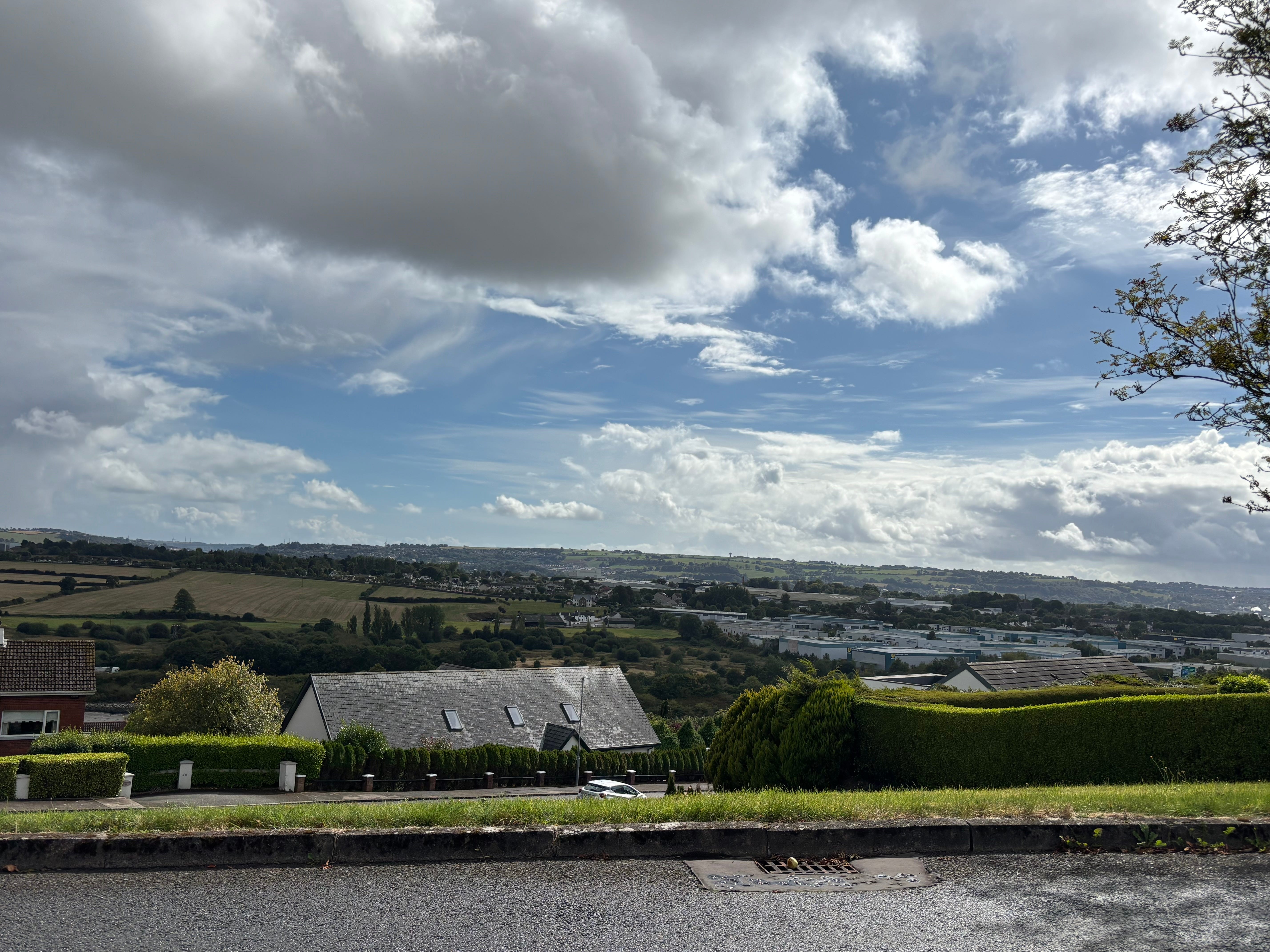
A coat every day until May! This is Ireland, lads! (teacher saying frequently quoted by my kids)
In Ireland, the school day is shorter. Instead of 7:25-2:25 in the U.S., our school day runs 9:00-2:40. I don’t think any schools start earlier than 8:30 here! The two youngest classes, junior and senior infants, release a whole hour earlier, at 1:40. There are some before-care and after-care programs and clubs to make this easier for working parents, but it’s still a challenge for parents.
Another thing I’ve noticed is more breaks. Primary students have two recesses instead of one and get outside year-round, as long as it isn’t pouring. They have gym two to three times a week and go outside if it’s nice. My son’s class is also getting bused to a local pool every week over the winter for swimming lessons— it’s part of the curriculum!
I think the cumulative effect of the shorter school day and more breaks with physical activity means that it’s easier for students to learn. One of our children has ADHD and has struggled every year with sitting still and focusing in the classroom. Those issues have been much improved this year.
No standardized testing
In the U.S., my kids spent a lot of time throughout the year preparing for or taking standardized tests. By 3rd grade, they took the NWEA 3x a year, Indiana’s I-Read and I-Learn, and Spanish proficiency tests. These were all taken on computers or tablets and took hours during testing weeks. Test prep took the majority of the class’s focus from February through April.
When we reached out to our kid’s teacher to request testing accommodations, she was a bit confused. We realized in that conversation that there is no standardized testing in primary school— just short tests each Friday on what they covered that week in class. (Secondary school is completely testing-focused, so that’s a different story!)
Different outdoor spaces
While the students spend a lot of time outside, you might not recognize the outdoor spaces. There is no playground. The outdoor spaces consist of a concrete area and a grassy field (with a pretty spectacular view over the harbor!). There’s also the “ditch”— a sloped wooded area that the classes can play in. To stay entertained, they play soccer or do hula challenges. Students bring their own jump ropes, and my older two are getting to be pros. They invent their own games, no fancy equipment needed.
This is changing this year, however! The school is fundraising for a playground and a huge astro turf pitch. These should be built by next school year, which will be a great addition.
Classroom access
In addition to the different outdoor spaces, the schools are set up a little differently. Most classrooms on the ground floor have an external classroom door that students enter and exit through. At the start of the school year, I walked my youngest right up to her door to drop her off. Let that sink in for a moment.
Lockdown drills and school shootings simply aren’t a thing here.
Learning Irish
There are two official languages in Ireland: English and Irish (Gaelic). To keep its heritage alive, Irish is required to be taught in all schools. A minority of schools are Irish immersion, but most teach in English with Irish as a daily subject. At the primary level, this might mean that 30 to 45 minutes a day focuses on Irish.
We love second-language learning. All three of our children attended a Spanish immersion school in Indianapolis, and this was one of the hardest things to give up when we moved.
Our oldest two are definitely behind in Irish. Students moving from abroad can request an exemption, which we might do at the secondary level. For now, we asked the teachers to give them easier Irish assignments so they can learn a little. I may learn a little by helping with homework!
No specials teachers
I’m amazed by the primary teachers here in Ireland. Not only do they teach in English and Irish, but they do all the specials. P.E., music (teaching tin whistle, aka. Irish recorder!), and drama— they do it all! There is also no school nurse, so they manage band-aids and loose teeth and pull in the Vice Principal or office manager for illness or lice checks.
Clubs and activities
Compared to a U.S. middle school, the 6th and 7th graders here likely don’t have as many activities to choose from. But there are still a good number of after-school clubs and teams to participate in. Art clubs, chess club, music club, and a yearly school play are offered after school. There are gaelic sports teams, soccer, and “athletics” (track and field) to be offered in the spring. Our middle child has loved the chess team, and plays weekly virtual tournaments with 60+ schools from across Ireland!
The school’s gaelic football teams made it pretty far in the local playoffs this fall. The girls made it to the local final, which was played during the school day in Cork’s biggest stadium. The school took all the older classes to watch and cheer as a field trip, what an experience!
Also, just a quick note that sports are much less intense here. I think our championship-level teams only practiced once a week! Our oldest got the opportunity to join the school’s cross-country team, which involved taking a bus an hour away for a single meet. She had only run once before, and there were no practices! She said afterwards that she didn’t ever want to do it again, but I’m glad she got the opportunity to try it out. I don’t think she ever would have gone out for a sport in a U.S. middle school with 3-4 practices a week and a multiple-month commitment.
Parent connection and involvement
Like in the U.S., our school has an active parent council that organizes events and fundraisers to fill needs at the school. It’s not too different. We also get school updates via an app and can email teachers when we need to.
However, I’ve found that parents are a little more intentional about coordinating with each other. Parents of kids with close birthdays will plan joint birthdays and invite the entire class. There’s a coordinated class gift at Christmas time. Every single class has a parent WhatsApp group, and someone made sure to invite me within a week or two of the semester starting. These threads are going multiple times a week with homework questions, reminders, or recommendations. I even get traffic tips this way!
In the U.S., I probably only had the contact information of about five or six students in my kids’ classes. And while the parent threads can sometimes be a bit much (someone asking for homework pages every single day!), it’s great to have a place to initiate play dates or ask questions of my own, especially as a newcomer.
All this to say, there are a lot of differences between the U.S. and Irish systems, but we’ve been pleased with the schooling overall so far. Our kids are learning and making friends, but they miss their school, teachers, and friends back in the States.
No posts
Comments
Nothing yet. Say the first thing.
Sign in to join the conversation.