
Hear what was torn from the worlds before the first skalds sang, before the runes were cut deep into wood and bone, before the gods themselves fully remembered the shape of their own beginning. This telling was removed from the universe and held outside all sensing, kept in the same absolute absence that must one day claim the Norns and the living seed of the World Tree. It returns now only for those whose marrow still answers the old blood-call, whose bones remember the weight of winters that can never fully end. The call does not announce itself with trumpet or vision. It arrives as a sudden weight behind the eyes, an inescapable premonition that the ordinary life you have been living was never the whole of purpose.
In the long dying—which is no single day of battle but an age of unbroken fracture—the Nine Realms will not collapse in one cry. They will split like old ice beneath a weight too grievous to bear. They will blacken like the heartwood of a tree struck by successive lightnings. They will cool across a span measured in the slow evisceration of all that once held firm. Kin will turn blade against kin, as every people have done who watched their own halls fill with the smoke of internal fire. The high places will crack. The old bindings will bleed out beneath a sky that thickens with ash and unmaking.
Yet two hosts will move within the ruin, as two currents move within a single dark river—one the flare, sent upward to catch the eye of the storm; the other the tide, running cold and deep beneath the blaze, unseen precisely because the flare burns so fiercely.
The Einherjar of Valhalla will spend themselves in the open storm. Their shields will splinter with the dry crack of seasoned wood. Spears will punch through mail with the wet, heavy thud of iron entering flesh. The air will reek of opened bowels, hot blood, and the sharp, metallic tang of fear-sweat. Men and gods will bellow until their throats tear, the noise rolling across the field like thunder trapped close to the ground. Bodies will fall in heaps that steam in the cold, the heat of life leaving them in visible clouds. The ground will turn slick and black-red underfoot, so that even the surest footing becomes treacherous.
Understand this fully: they do not fight blindly. They are not brutes drunk on mead and the shallow worship of glory. Their dying is the pyre that others remember—the loud, bright, sacrificial clash whose glory is meant to fix the eye of the devouring storm. Like the three hundred who held the pass not to win, but to make the enemy believe the war was there, in that dust and that spear-point, so that the flanking fleet might slip the net of the world’s attention—so too do Odin’s chosen offer themselves as the blazing lie, the holy misdirection, the sacrifice of visibility for the sake of the invisible. Their blood is poured thick as mead not merely to stall the dark, but to blind it—to fix its ravenous gaze upon these singular, bright, sacrificial points. In the shadow cast by their pyre, a quieter and more consequential work slips through the fingers of the unraveling.
All the while, those first Einherjar taken of the Lady Freyja fight with a different iron. They are no softer. They are no less killers. They strike close, careful, and without the need of song—face to face, throat to throat. The only sounds are the short grunt of effort, the wet tear of a blade finding the soft place beneath the jaw, the sudden silence when breath stops. Their hands know the exact pressure needed to keep a body from crying out as it dies. They taste copper on their teeth and feel the heat of another human’s blood cooling quickly on their forearms. In the dark between larger clashes they move like knives through cloth, leaving little more than the smell of opened flesh and the soft collapse of a body carefully lowered so it does not catch the ears that draw the eyes. Their ruthlessness is the quieter, closer violence that has always accompanied the preservation of seed through the long nights of peoples who refused to die completely. Their work will not be named in the final reckoning. Their work is to keep certain things from being found while the whole order comes apart in fire and silence. Their work is to keep certain things from being found while the whole order comes apart in fire and silence. These are Freyja’s first-favored—the ones she drew from the blood-mist while the rest of the field still belonged to Odin’s storm.
This work does not wait for the first war-horn to sound across the shattering sky. It is already moving, now, through this present breath, this marketplace, this snow-covered pass—quiet as root-fall, patient as frost, cold as the between spaces of the void. It moves through the skills you keep polishing when no one is watching, through the thresholds you guard without knowing why, through the quiet certainty that certain things must not be allowed to fall into the wrong hands. The Lady’s outposts are not future refuges; they are already filling, scattered across this realm and others, with those whose removal from the common weave must itself remain unrecognized.
You have felt them—the empty seats in the mead-hall, the names on the edge of your tongue that dissolve before you speak them, the wise old man who simply vanished one winter and whose cottage you now walk past without remembering why it felt significant. Those taken are not merely the strong, nor the merely brave. They are the many-gifted: the warrior-healer whose hands know both the suture and the seax; the smith-seer who reads the grain of steel and the grain of fate with equal clarity; the farmer-astronomer whose barn livestock and whose skull holds the old rhymes of planting and propitiation; the rider who fights equally in the saddle, in the shield-wall, and in the silent, hand-stroke dark. Those who hold more than one form of life within their ribs—who are fighters across more than one domain, who are masters of more than one domain of living—these are the ones the Lady’s representatives seek out, in the market towns and the high lands, in the halls of petty kings and the huts of solitary herd-wards. Look to your own doubled hands. If they know both the suture and the seax, the grain of steel and the grain of fate, the lullaby and the battle-cry, then the Lady’s gaze has already rested on you once, and may rest again.
Each removal is masked as something ordinary. A death in a distant border skirmish, the body too mangled for recognition. A ship swallowed by a sudden squall, its passenger-list lost to the salt. A disappearance into a monastery that no chronicle will later name. A quiet retirement to a river bend that cartographers will forget to draw. The old tongue of power is woven over their tracks like fresh snow over old blood—so that the glance of the destroyers, even if it sweeps across the very ground where they passed, registers only the mundane stillness of nothing, the hollow sigh of a life that simply ceased to be remarkable.
When the Lady’s messengers find them—in the guise of a traveling trader, a wandering caring-woman, a wounded stranger who asks for shelter—the knowing is instantaneous. The marrow answers the old blood-call before a single word of explanation is spoken. The magic fills them. They require no long catechism. Instantly they understand the shape of the long dying, the necessity of concealment, and the precise calculations required of preserving life and lives from the hunters, from the gods, and far older forces, as if they had always known it, waiting only for the signal to step out of their ordinary names and into the hidden war. They are given their orders in few words, and they follow them without hesitation: go to this place, take up this trade, learn this tongue, watch this threshold, kill only when the veil would otherwise tear. The hardest part of the harvest is not the leaving; it is watching the world continue to spin, pretending you were never part of its turning.
And so, long before the first giant sets foot on Bifröst, the outposts of Fólkvangr are already peopled with the living seed of human skill—masters of doubled knowledge, bearers of multiple lives, the silent elect whose absence from the common story is itself the first and deepest act of shielding. Their disappearance is the foundation upon which all later concealment will be built.
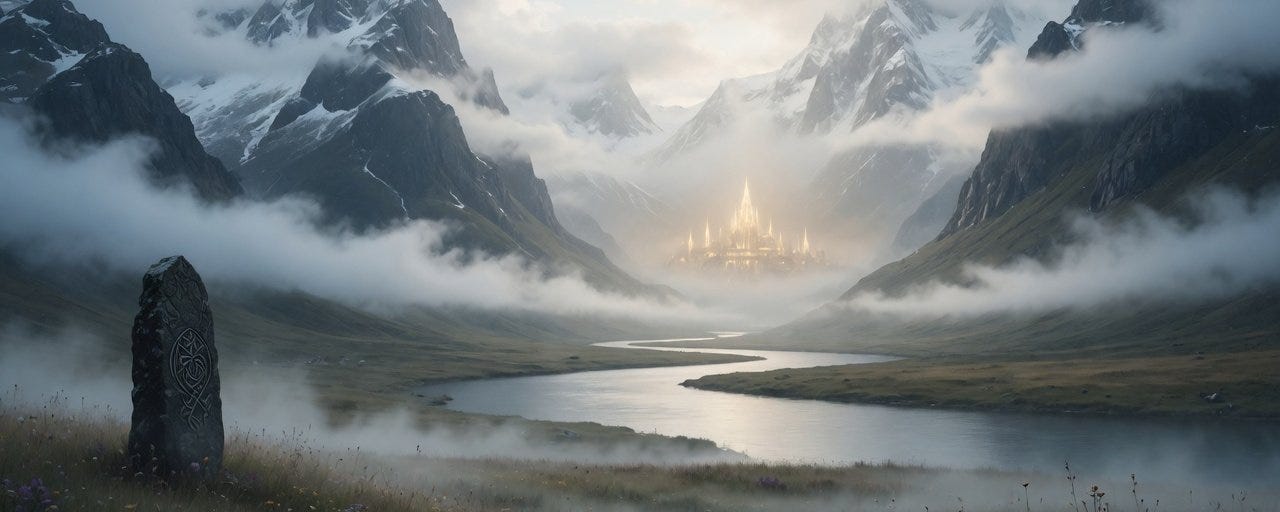
Fólkvangr does not float beyond the reach of flame. It stands here, now, in this very ground—in the valleys you have walked, in the hills you have crossed, beneath the very frost you have felt crack beneath your boot—veiled by the Lady’s deep art and by the secret, continuous slaying of those she has marked. The hiding must last the full length of the world’s dying. And so, what has already been drawn inside will remain alive, guarded, and hard to reach—like the last dry grain kept in sealed jars beneath the floors of houses that burned around them years ago, or the hidden bloodlines that survived successive empires by learning the art of becoming unremarkable until the new dynasty had passed. This is the long screening: the occlusion that lets the necessary work continue inside the collapsing worlds for as long as the outer war still burns.
Yet two things cannot stay even within that screening.
The Norns who twist the fates of god and man, and the living seed of the World Tree—the heir of Yggdrasil—will still stand outside until they can no more. Though they yet remain, and will for a time, sustaining all at great peril, within the reach of the dying cosmos, the plans for their final removal are already cut and ready. When the hour comes they will be drawn out so completely that no eye will find them, no mind will taste even the ghost of their presence—not god, not giant, not any power that still moves in the burning we no longer remember the names of. This is not concealment in a cave or a fold in the fabric. This is absolute absence—the subtraction of their existence from the very codex of reality. Once removed they will leave no trace, no whisper, no residual weight. They will cease to be things within the unmaking, as certain sacred objects of older peoples were said to have been taken out of the world entirely when the last true keepers saw the end approaching, so that the essence itself would not be defiled by the hands that would soon rule the ashes. If the Norns are taken, fate itself will end and all will fall into formless black. If the seed of the Tree is lost, the root-work will die and everything that crawls out of the ash will already be corrupt. Therefore the deepest labor of the Lady and her women of the craft will turn toward this absolute taking-away. Until that hour the Weavers and the sacred kernel will be watched without sleep, while the readiness for their removal stands like a darkened blade already drawn and held low against the thigh.
To enable this withdrawal, the gods who are fated to walk through and beyond the fire do not wait for the end to begin their service. Even now they gather, turn aside, and harden the bulwark around Fólkvangr and all the Lady’s hidden labor. They do not merely defend—they amplify. Their actions are the outer shell that makes the inner, total omission possible, and they perform their deeds in full sight of the burning sky, becoming living beacons that draw the enemy’s eye while the hidden work proceeds in their shadow.
Víðarr and Váli will bind the worst of the destroyers so they cannot overrun the guarded perimeter. Víðarr will plant his thick shoe against Fenrir’s lower jaw not merely to slay, but to pin the wolf’s death-throes to the sky, making them the visible center of the world’s attention—a convulsion so vast that every giant, every rogue power, every cosmic scavenger looks there, at that final, expected clash, and misses the smaller, deeper withdrawal occurring in the blind spot of its thrashing. Váli will not merely avenge; he will execute with cold precision any force that strays too close to the veil’s edge, his vengeance so swift and terrible that it becomes another legend to fix the gaze of the curious. He becomes the great hunted one who draws away the greatest of the hunters.
Magni and Móði will hold the broken line after their father’s fall. Yet they will not simply stand and endure. They will raise Thor’s hammer high and call down lightning in arcs so bright they leave afterimages burned into the eyes of the dying cosmos—each flash a deliberate beacon, a repeated signal that says “here, here is the war”, even as Fólkvangr’s doors close behind them. Their strength and their courage are not merely martial; they are theatrical—a grand, pyrotechnic performance of godhood that convinces the unraveling that the divine resistance is focused on that smoking ridge, not on the silent valleys where the real preservation is underway.
Baldr and Höðr, risen from the dead, will carry the last clean light and the hard reconciliation so neither is utterly quenched. Their true function, however, is more subtle: they are the confusers of perception. Baldr projects blinding, sacrificial afterimages of the Norns outside the veil, creating false echoes of fate that lead the destroyers on wild chases through the burning branches of Yggdrasil. Höðr, the blind god who sees what others cannot, creates pockets of profound shadow that entrap in an infinite maze any residual psychic whisper that might escape the withdrawal of the Seed. Together, they weave a double cloak of light and dark, sense and non-sense, that ensures the absolute absence is achieved without a single ripple reaching the surface of even the most capable seeker.
Hœnir and Njörðr will keep the quieter strength that will be needed when the flames finally sink. Hœnir, the silent god, stands watch over the silence itself, ensuring no stray sound or vibration from the outer war breaches the inner sanctum where the Yggdrasil yet to come is being extracted from reality. Njörðr secretly calms spaces within the thrashing seas and the cooling magma, holding the physical ground of Freyja’s outposts intact so that Fólkvangr does not shatter from the tremors of the divine battle raging above and all around. They are the foundation upon which all other ramparts rest—the quiet, unglamorous labor that will be remembered only in the new cycle, when the survivors look back and realize that the earth beneath their feet was held together by patience as much as by might.
Together they form a living wall whose true purpose is the protection of what must not be found. They fight beside the men of this earth, who will bleed at their own scale inside the same long dying.
On the ground, mortal kings and common outlaws fight their own Thermopylae—holding narrow passes, burning their own halls as smoke-signals, launching desperate cavalry charges not to break the enemy’s line, but to break the enemy’s attention. Under the cover of their roaring, generous deaths, the last grain-caches, the last hidden bloodlines, and the last children of the richly talented are moved to safety. Some men will be drawn to the open sacrificial path of Valhalla, becoming the bright lie that shields the truth. Others will be drawn to the careful, close, and ruthless work that keeps the last of the veils from tearing—the quiet harvesters, the watchers at the threshold, the ones who lower a dying body to the ground without a sound so that the enemy’s attentions find nothing to follow. Some farmers will hide the last true seed of the old wheat in hollowed bones, passing them from hand to hand across generations of the long dying. Some smiths will forge weapons that are never used, only preserved, so that the new age will not have to rediscover the tempering of steel from ash. Some mothers will teach their children the old runes in whispers, so that the alphabet of power survives the burning of all books.
Both forms of struggle will be required. Neither alone will be enough. The pattern is older than the names now given to it: the visible host that spends itself in glory, and the hidden host that spends itself in the colder labor of ensuring something living remains when the glory is finished.
When the last fires sink and the world cools enough for green to root again, the surviving gods and goddesses—Aesir and Vanir as one—will take up the places of the fallen. New roles will be assumed. New halls will be raised from the ash.
From the outposts that were seeded in the long concealment, the many-crafted will emerge—the binder of broken bone who also binds broken oaths, the cartographer of lost roads who maps the paths of the dead, the midwife who knows both the birth-cry and the death-rattle—bearing not only their doubled skills but the living memory of a world that was not allowed to die cleanly. They will raise the first halls with hands that remember the keystone and the thatch, the healing draught and the sharpening stone, the lullaby and the battle-cry. Their children will be the first generation of the new cycle who do not need to be taught what was lost, because they were born inside the preservation.
A new Valhalla will be founded, not as a copy of the old, but as a hall shaped to the order that the shielding made possible—a hall with a hidden wing, a permanent architectural acknowledgment that the twofold vanguard must never be forgotten. A new Asgard will rise on the green earth that climbs from the sea. Carved into its highest lintel will be a tactical verse, a remembrance not merely of the fallen but of the strategy of their falling:
“We burned so they could hide. We roared so they could whisper. Our glory was their veil.”
Because the Norns will still weave and the seed of the World Tree will still live—withdrawn into absolute absence during the dying, then released into the new cycle—ordered fate and living root-work will return. The doubled front will not die with the fire. It will wait inside the new cycle, ready to rise again when the long twilight returns, as it has risen before in ages whose names have been worn away by great stretches of time.
So the open blood-spilling of Valhalla’s second-chosen will be necessary and bright. The secret, throat-close ruthlessness of the Lady’s first-chosen will be equally necessary and more exact. Together they will hold the line while the Nine Realms die, so that the means of ordered rebirth remain beyond the reach of the flame. When the long dark finally cools, something coherent and living may begin once more.
This is the knowledge that was itself taken out of the universe in the ages before memory, held in the same absolute absence that must one day claim the Norns and the seed. It surfaces now, as the veils thin, for the few whose bones still remember the old weight and whose blood still answers the call. The veil is thinner now than it has been in many generations beyond an honest count. Those who still answer the old blood-call can feel the difference in the air—the slight, continuous pressure of something that has been waiting outside the reach of ordinary time.
If your marrow stirs as you read this—if you feel the cold touch of a forgotten oath at the base of your skull, if you have ever looked at a stranger and recognized a shape of knowing that does not belong to this lifetime—then you may already be among the many-skilled. You may already have been marked for the harvest. You may already be walking toward a threshold whose name you have not yet been told.
Listen. The outposts are waiting. The Lady’s messengers are already on the road. The veil, even now, is thinning.
Sessrúmnir’s Silent Vanguard
·
Jan 1
In the shadowed hush of a New Year’s dusk, where the veil between worlds thins like mist over ancient fjords, the earth trembles on the precipice of its own unraveling. Few dare whisper its true name: Ragnarök, the doom of the powers, the twilight that devours gods and men alike. Yet it slithers forth not with the blare of Gjallarhorn’s thunder, but in …
No posts
Comments
Nothing yet. Say the first thing.
Sign in to join the conversation.