
On the Collapse Already Past
Against the Financialist Architecture
An introduction to the essays that follow
— — —
We are looking for the wrong collapse.
The markets still open; the accounts still balance, after a fashion; the currency still circulates; the institutions yet issue their statements; and the numbers still move across screens as if they described a living order. They may do so for decades; they may do so for another century. And because these forms persist, most assume that nothing essential has yet fallen.
But this is the very opposite of the truth. The forms have outlived the thing they once expressed. What has already collapsed is trust—that rare and glacially-grown capacity of a historic people to cooperate with non-kin under impersonal rules, to keep contracts without immediate enforcement, and to transmit competence and restraint across generations. No high-trust economic, financial, or cultural regime can long exist once that capacity is exhausted. The forms may linger, but the thing itself is gone.
To understand how this came about—and why it is now beyond repair by the means that created it—we must look back to the machine that has been at work far longer than the American quarrel itself.
In 1648, the Westphalian settlement made the sovereign state a vessel that credit could enter. Then, in 1688, the Glorious Revolution seated that vessel in the English-speaking world: funded debt, a privileged bank of issue, a center answerable first to creditors. This is the Westphalian–Glorious Revolution Regime, and its working is the Financialist Kill Chain: a producing people built up, then harvested. Its requirement is the harvest. A middle class is raised up across generations; then its assets and surpluses are converted into claims held outside the producing community. That is the engine. Everything else is its motion.
The Constitution of 1787 was not that machine. It was a bounded charter. But Hamilton seated the machine inside it in 1790 and 1791. He gave the union a funded war debt paid at par, the assumption of the states’ obligations, a national bank, a creditor class bound to the center, and a doctrine that whatever served the machine was necessary and proper. Jefferson saw the seating for what it was and moved to arrest it. He failed. Ever since, the vessel and the machine have been named as one object.
Today, no fight over that seating is permitted. Those who benefit most from the regime desire no second Federalist Papers; they are resolved to prevent just such. Hamilton is sainted, and any man who disputes him is subjected to inquisition—named an enemy of the state, of the Constitution, and of all that is right and holy. What is being forced upon us is not, as they say, a return to what the charter intended. It is the completion of what was seated, named sacred so that it cannot be reopened. And yet the fight that was refused in 1791 must be taken up anyway. That is the work of the New Sovereigntists.
What the regime’s men have opened is not a war of papers—not an open contest of printed arguments. It is an inquisition in the name of a cause already won. The only permitted voice is Hamiltonian: funded debt as the sinews of the union, public credit as the proof of nationhood, implied powers as the living Constitution, and the free movement of claims as liberty itself. Those who speak for the other side—that a republic lives only while a producing heritage people keep their surplus, their land, and their mutual confidence—are named enemies of the Constitution. They are not. They are its older claim.
The Constitution of 1787 and the Hamiltonian construction placed on it by 1791 are not the same object. A Sovereigntist is not a man who waves the ratified text over a people already harvested. He holds that the limits drawn around Congress in 1787 still bind the Treasury of 1791—and that calling the later Treasury settlement the meaning of the Constitution does not make it so.
These essays take up that older claim. They do so in continuity with work already laid down: the Eternal War between Financialists and Sovereigntists; the Financialist Kill Chain as the diagnosis of the harvest; This Our English Civilisation as the naming of our specific peoples harvested; This Our Restoration as the duty once sufferance is exhausted; The Sovereign Mind as the interior work of remaining a free mind outside the enclosure that harvest requires. What follows is not a new argument. It is the same argument, brought now to the specific American seating: the point at which the 1688 financial settlement was placed inside the bounded charter of 1787, and the attempt to arrest that placement was refused. The man who saw that seating for what it was is Jefferson.
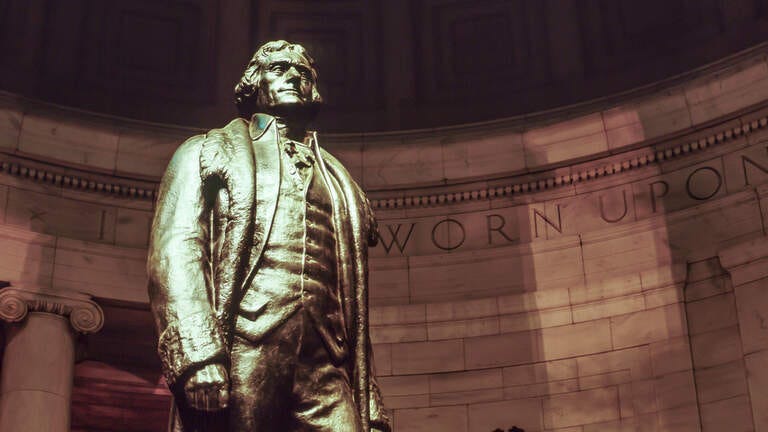
Jefferson is not a costume. He is the American posture of the loyal and reasonable man at the moment the Treasury became a regime. In 1774, he still wrote as a subject seeking redress within the ancient constitution. In 1791, in his opinion against the bank, he wrote that to take a single step beyond the boundaries specially drawn around the powers of Congress “is to take possession of a boundless field of power, no longer susceptible of any definition.” Hamilton took that step and called it energy. These essays are written against the step, and against the naming of the step as the charter itself. But the quarrel over the step rests on a deeper quarrel over what the charter is for. Jefferson measured its success in sovereign flourishing—a producing people, rooted in their land, retaining their surplus and their mutual affinity. Hamilton, and all who have followed him, measure it in numbers that can be bought and sold. The second standard has become so habitual that the first now has to be argued back into view.
Now, consider what we are taught to watch. Men are trained to watch the wrong metrics: the price of claims, the volume of transactions, the official count of employment, the ratio of debt to a product that is itself a confection of the same system that issues the debt. They are told that so long as these figures can be made to rise—or made to appear to rise—the people are thriving. This is a useful falsehood for those who live by the conversion of production into claims; it is fatal for those who must live by production, for trust among the productive requires grounding in hard reality—in truth, not in the illusion of numbers. A number that does not rest upon such ground is no reality but a mere notation, and a mere notation is itself an enclosure of thought. The old enclosures fenced the field; these fence the mind. The false metrics are not only a fraud on the ledger; they are a wall around the mind, so that the harvest cannot be seen except as prosperity.
The Founders did not declare a republic of notations. They declared a standard by which the life of a man might be measured: Life, Liberty, and the Pursuit of Happiness—a safe, secure, and prosperous people who build and pass forward their surplus across their own generations. Not GDP, nor the artifice that props it up. That older standard has not been disproved. It has been buried under arithmetic, and the burial is not innocent. To judge the republic by the metrics is to have already replaced the thing the charter was meant to secure. And the replacement has consequences: trust between productive men exists only in shared reality, and when that reality is hidden behind false numbers, trust dissolves with it. What must take its place is ever more surveillance and ever harsher punishment, increasing tyranny to force men to produce more for less—the machinery that marks the absence of trust while pretending to stand in its place.
When strangers will no longer keep faith with one another save under surveillance and penalty; when the yeoman and the artificer cannot rebuild because they must work directly together and the community trust required for that work has been spent; when there is no surplus to carry a community through the lean years together, and men are forced to compete rather than collaborate for survival; when the harvest takes the next generation before it takes the title, and the cradle stands empty—then the warm air of the activity-chart, read by a banker who mistakes movement for growth, is a record of extraction, not a register of life, liberty, and happiness.
This brings us to the nature of the harvest itself. It is never a single confiscation. It is the conversion of a people’s very lives—their land, their tools, their time, their fertility, and their deferred dreams and aspirations—into transferable claims held outside the producing community. War is not an accident in this conversion. It is the ordinary instrument, because the debts of a war do what a direct seizure cannot: they reach the unborn, and they do it under the guise of national security. The young who survive the war return to find their patrimony converted, through that war’s debts, into multigenerational obligations held in a distant counting-house. America had its first such harvest before it had a bank. The Revolutionary debt was funded at par in 1790—not to the soldiers and farmers who had been paid in certificates, but to the men who had bought those certificates from them for a fraction of their face.
But the debt is only the first movement. Once the claims are concentrated, the original producers no longer possess the capital or the time-horizon required to rebuild what was taken. The raising of a freeholding stock requires generations of self-secured surplus—the very thing the debt structure consumes faster than it can be replenished. A family is formed on surplus; take the surplus and no family forms. When that stock is shattered, it cannot recall itself. Here the divergence between the two classes becomes explicit. The extractive house can survive a century of misfortune through its retained counsel, its corporations, and its distant holdings, because its wealth is stored in claims that are mobile and indifferent to place. The productive house, the freeholder, has no such refuge. His wealth is his name, his acre, and his business, and he must stand or fall by the trust of his neighbors, his suppliers, his customers, and his partners. The extractor can wait; the producer cannot.
When that trust is gone, the freeholder does not merely lose his holding; he loses the web of mutual obligation that made the holding productive. The barn still stands, the mill still turns, the sons still know the trade—but none of it any longer coheres into a life that can be passed forward. What follows is the slow draining: the land, the forge, the hours of labor, the next generation’s inheritance—all transmuted into paper that migrates ever outward, away from the hearth that produced it. The freeholder becomes a tenant on ground his fathers worked, or a laborer in a market that sets his price without knowing his name. Multiply this by a thousand parishes, and the old field is not merely thinned; it is burned down. The extractor, holding the claims that were once the community’s surplus, now surveys the ground he has cleared. He can let it lie fallow, trusting time to restore what he himself cannot grow, until the soil is ready for another cycle of the same. Or he can import new stock—strangers to the land, without care for its old claimants—and supplement them until they come to dominate the field, bearing his brand rather than their own. The fire of extraction was never lit to improve the native stock. Clearing is what a harvest by fire does.
What the extractor does to a community, the regime does to a nation. But the extractor can wait and the regime cannot, for the claims it holds must be serviced without pause; a nation cannot be burned down and left to lie fallow while the debt runs on. The regime forever requires a productive middle to draw upon. When the native middle class can no longer be rebuilt—when its land, its trust, and its generative stock have been spent—the regime must find or fabricate a replacement. This is the bind.
The indispensable requirement of a middle-class-capable people is the capacity named at the outset: high generalized trust. It has appeared only rarely in human history. Where it appears, the regime harvests it—and a harvest is a war: the middle class fights to keep what it has, and the harvest wipes it out. The regime rebuilds from the same stock, harvests again, rebuilds again, until the day the middle class can no longer be rebuilt. Then it must be replaced, and there are only two places to look.
The first is empire: a people out there who already have it. Such peoples organize around it themselves and have no wish to join a foreign build-and-harvest cycle; they must first be conquered. Conquest is the first harvest. What follows is the cycle again, run on their stock and under the regime’s greater control—built up out there, harvested, built up again—until that stock too is spent. And there are only so many such peoples on earth, and fewer still within the regime’s reach.
The second is importation: a people who lack high trust in their own lands, brought into harvested lands to be built up as the new middle class to be harvested generations on. Those who cannot hold high trust among their own, yet want the benefit of a people who can, will come willingly and take their place in the middle class. But they do not thereby acquire the capacity. They live on trust that is not theirs, and among their own they remain forever in the low trust they came from. Some hold that trust can be grown in any population, given time. It cannot. It grows only in a stock that carries it, and it cannot be grown into one that does not—not in a cycle, not across any number of cycles, not ever. Nowhere in history has a mass of strangers, gathered from lands of endemic suspicion and tribal-fidelity, been remade into a people of impersonal contract and deferred honor. The schoolroom may teach the outward forms and the dole may pay for them; neither implants the inward habit. The habit is carried, not conferred.
That is the hard limit on the second instrument. Importation brings no trust of its own. The imported class works only so long as the historic stock still extends its trust around it—still keeps the courts honest, the contracts kept, the institutions running—and when that stock is spent, the borrowed trust is spent with it. The limit on the first instrument is not one of capacity but of count: capable peoples are few, a regime can conquer and hold only those within its reach, and each one taken is one more stock to burn through. Historical pattern suggests that a regime burns through all three—its own stock, then empire, then importation—in roughly four centuries from the seating of its debt. The American clock did not start in 1791. Hamilton seated a machine already a century into its run, and the American regime has followed the sequence on schedule: the home stock harvested through the Civil War and the world wars; the turn outward to empire in 1898, when the home stock ran short; the turn to importation in 1965, when empire did. We are at the end of the third fuel, and there is no fourth.
There is no fourth because the earth has been emptied of the stock a fourth would need. No unharvested middle-class peoples remain to be conquered as empire, nor to be imported as the early twentieth century imported them, from a Europe that still had stock to spare. Russia and China are strong once more and cannot be conquered. All the rest have been harvested so many times over, from the Second World War to today, that very little capacity for a middle class remains in them that is not faked—forced into the shape of one by surveillance, and by the force that surveillance makes possible. And even this is a losing proposition. No amount of surveillance and force can compensate for the lack of quality in what remains, or for the sheer volume of what has already been taken.
So the last fuel is burned at home, and it does not burn quietly. When the regime brings the imported stock in at scale to fill the middle its harvests have emptied, it begins to fail at that moment, because the trust it still runs on is now spent from both ends. From one end, what remains of the historic middle class fights to keep what it has, and withdraws its faith from institutions turned against it. From the other, the regime answers through those same institutions, ever more draconian and ever less effective, because they are now staffed by the imported stock, which can run them only by the same force and favor that are failing abroad; and every such use burns more of the historic trust the regime cannot replace. When it is spent the regime falls, and the civilization that hosted it follows. The historic stock that carried the trust cannot be replaced by those who do not carry it. That is the fact around which the official numbers are arranged, so that no one need look at it.
Let this be clearly understood: high-trust institutions do not create high-trust people. High-trust people, under particular historical conditions, create institutions that manage prosperity; and when the people change and the trust threshold is crossed downward, the same institutions become instruments of extraction and then of paralysis. The conversion is done from within, by two kinds of men. The operator of the regime is the first. He has no trust and is incapable of it, and so he sees an institution for what it can do for a man without it: force trust where it will not be given, or simulate it where it cannot be forced—paper, lawyer, and court standing in for the word a stranger would once have kept. His methods—abstraction, leverage, opacity, the conversion of production into claims—generate none of the trust they consume and select against the very traits that produce a harvestable middle class. He does not enter the institution himself. He sends his men into it to rise, until he holds within it a force that answers to him and depends upon him, and from that day the institution answers to him through them. But an institution run this way is being spent, not kept: the trust its people placed in it is drawn down with every use, until nothing remains in it or in them worth drawing. So he leaves it, and finds another. He incessantly moves from host to host. The imported stock is the second. It cannot run an impersonal institution at all, and so runs it the only way it knows, by kin and favor. Between the two, the institution that still bears a venerable name is no longer the institution that earned it. Continuity of letterhead is not continuity of character. Continuity of a Constitution whose construction now knows no limit is not continuity of the ancient constitution that instrument was meant to secure. The cost of every bargain rises, for no man will trust his neighbor’s word—and he trusts it less, not more, when it comes stamped by an institution that has spent the store of trust its founders imbued it with.
A civilization, like a star, lives by fusing successively heavier fuel. The hydrogen is the original high-trust yeoman and heritage middle stock—burned first and burned longest, for it is the most abundant and the most generous, and it sustains the regime for centuries. The helium follows—empire and those selected peoples of similar capacity, cultivated out there and drawn into the outer rings—and burns faster, a century or so. The heavier elements come last: mass importation of unlike stock, combined with the financialization of whatever remains of the original body; these burn in decades. Each fuel burns hotter and shorter than the one before. When no further fusible material exists, the star does not merely dim. Its core implodes first, unseen, upon the cold center that once gave it light; the explosion everyone watches for comes after, scattering what remains into the void. The Westphalian–Glorious Revolution world has reached that point. Hamilton’s seating of that world inside the American instrument has reached it too. The collapse of trust is already behind us. Currency, accounts, and institutions may continue their motions for a long while yet. What remains is the working-out of consequences: the impossibility of regenerating a middle class from the remaining native stock under current ownership and fertility conditions; the failure of imported substitution; the conversion of once-high-trust institutions by those who rose within them; and the approach of the regime’s own terminal constraint. This is not an argument for restoring the old Financialist order. It is a demonstration that the order has consumed its own necessary conditions and cannot be revived by the means that created it.
If there is to be anything at all, there must be a retrenchment: the removal of the imported low-trust population; a taking-down of the old house, once noble, now so rotted that the joists cannot bear the weight of trust; the framing of new institutions by what remains of the few high-trust original stock, in their own hands and not conferred upon them; and the patient regrowth of that stock, capable of restoring the high-trust society necessary to the rebuilding of a middle class. The rules must be more stringent than before, and their severity must fall where the harvest came from—on the extractor, on the claims, on the Treasury: a charter bounded again, and this time held to its bounds. They are not for the surveillance of the producer; that machinery is what the absence of trust builds, and it comes down with the rest. The restoration can wait out the regrowth because it will not be servicing the claims that made waiting impossible for the regime. Revolution is what follows when a people discovers too late that the numbers were a theater and the trust is gone. Restoration is the harder and the rarer act: to admit the collapse already past, to stop measuring life by the lies of claims, and to gather what remains of the historic stock under rules severe enough to let trust grow again in those who carry it. The Financialist will call this cruelty. It is the opposite of cruelty. It is the refusal to spend the last of a rare people on a cycle that has already eaten its fuel.
Hamilton treated funded debt, a privileged bank of issue, and the confidence of creditors as the proof that a nation existed. Jefferson’s insistence was older and narrower, and it did not begin with him. It is the insistence of the ancient constitution: that power is bounded, that surplus belongs first to those who produce it, that a people who must work directly together cannot be replaced by those who work through lawyers and paper, and that a charter which can be stretched without limit has already ceased to be a charter. The essays that follow will take each of these in turn—the harvest; war as the ordinary converter of surplus into unrecoverable debt; the two replacement instruments; the rarity of trust; the impossibility of imported substitution; the conversion of institutions from within; the four-century limit; the bounded charter as against boundless construction; the enclosure of the mind that makes the false metrics appear as life; the standard of sovereign flourishing that must be measured in their place; and the restoration that is still possible if it is begun as restoration and not as another harvest.
That is the ground. We shall not be argued off this ground by a rising index. We shall not surrender the intent of the Constitution to the men who have made it boundless. We shall not pretend that weariness is a discharge from duty. Strength may diminish; the will does not. The historic stock is not finished while any of it remains capable of high trust, and while any of it still knows that sovereignty is not a slogan of the Treasury but the unharvested life of a people.
— — —
The New Sovereigntists will continue.
No. 2 will take up the harvest.
No posts
Comments
Nothing yet. Say the first thing.
Sign in to join the conversation.