
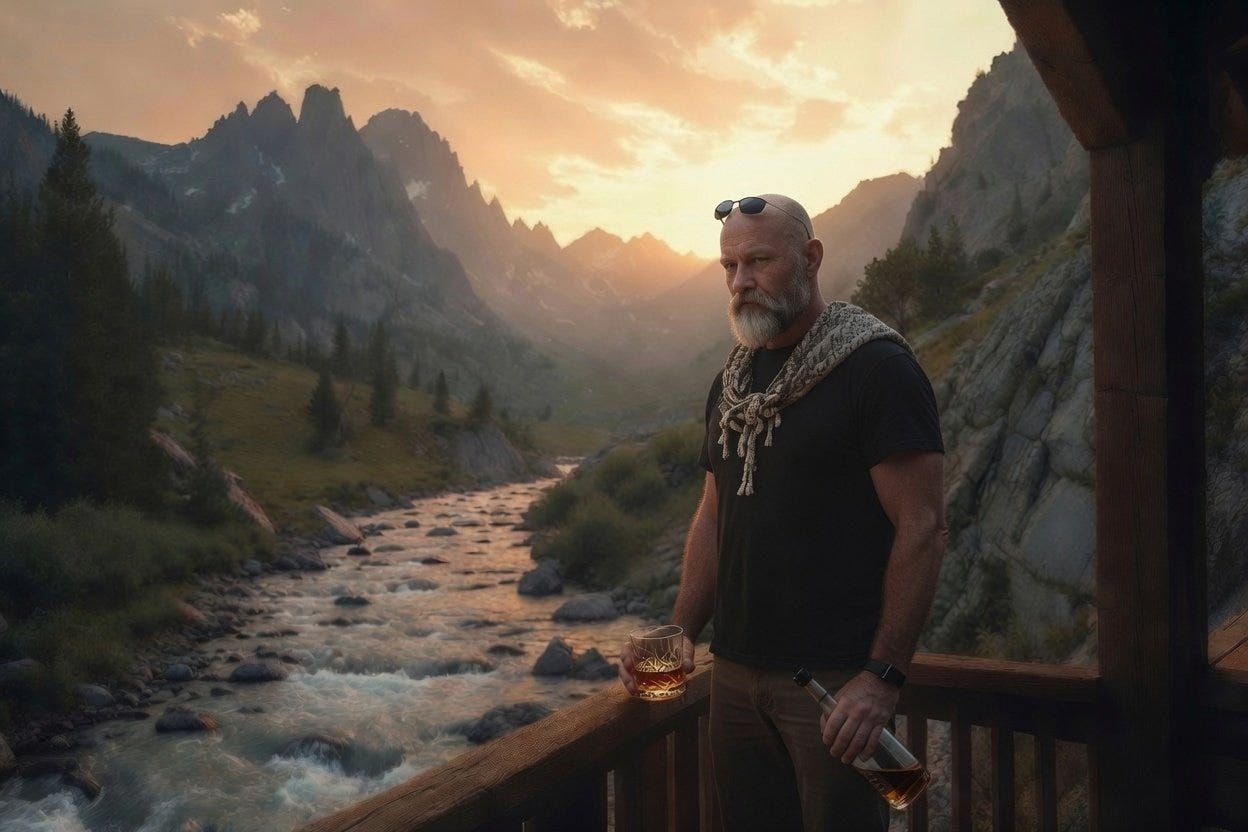
I It profits little that an aging man II For I am part of all that I have met And through it all a doubled thread was spun: III Out of that quarrel one whole people grew — IV And westward still my people pressed the line, V Now I am near to old, and on this mountain porch VI So I stand weeping: not for weakness, no,
sit warm upon a porch he did not raise,
above a stream come down out of the snow
to sing the one cold song it always sang
before my fathers climbed into these hills.
Below me runs the water; at my back
there sleeps a people, fed and free and safe,
who eat, and drink, and slumber, and forget
what hands first held this line, and at what cost,
and whose they are, and what they are the heirs of.
I cannot rest from memory. All my days
I have drunk deep — of glory and of grief,
of those that I have loved, and those long dead
a thousand years before my mother’s milk,
yet nearer to me than the living men next door.
along the long descent of island blood:
the marsh of Athelney, the hidden king
who rose at Edington and would not yield
the Saxon to the Dane — and then the Dane
made kin, made English, married to the soil;
the Norman, come by sword on Hastings field,
and in three hundred winters made as ours
as oak, as thorn, as any English hedge.
I am the meadow where they bent a king
at Runnymede, and wrote that even crowns
must answer to the lowest of the low.
I am the wet October of Agincourt;
the beacons lit from headland to the dark
when Europe’s fleet came up against the wind;
Blenheim, Quebec, and then Trafalgar’s smoke,
the squares at Waterloo that would not break,
the wire and the long mud along the Somme,
the few above the harvest fields of Kent
who held the burning summer of the sky.
the kings made great by standing for the least,
the least made sovereign, standing for the king,
till high and low were common in one creed,
and every man a kingdom in himself
that all the rest would form a line to keep.
Yet do not dream it came down clean or whole.
My fathers, on my mother’s side and his,
in the old isles, and after, on these shores, and more,
have fought each other, burned each other’s roofs,
then buried that, and married, and made sons
who fought again — sometimes against, and then,
within the season, shoulder to the same
hard line, against some common dark. Such knots,
such grief and grafting, are the thing we are;
this tangled greatness, English civilization.
not given, but hammered, forged the way a blade
is forged, by fire and by the hammer’s hate,
and folded back, and beaten, till it held.
And when the isles grew narrow, some went forth:
my blood came early to the western shore,
and came again when Culloden was lost
and the last clean hope of the old cause died,
and came once more, a greater tide of them,
when our own brothers’ war had bled and ceased.
Yet those that crossed and those that stayed behind
were never severed: letter answered letter,
and ship brought cousin back to cousin’s house,
and son wed daughter of the further branch
deep into our own century — one folk
on either ocean, parted, but not cut.
through forest, over river, to the range,
and on, until the last of all the land
broke green and cold along the further sea —
the frontier wars, the long and bitter wars
that ran from eastern wood to western fir,
before our parting from the crown, and after,
each mile paid out in blood, and grief
on every side, for war takes all alike.
And those of mine that stayed beneath the flag
stood every corner of that wide command
where the sun could not go down upon the map —
in Africa, in India, on the sea,
through two great wars, and to the second’s end.
Here in these mountains most of us laid down
our years, our treasure, and our given strength,
to widen out the world our fathers loved:
the Anglo-Saxon grown to English civilization,
one thing flung far, on every continent,
and scattered wide, and yet, in heart, but one thing.
the light goes long and golden down the pines,
and that great love is near gone out in us —
the love I bear my people and their dead,
our ways, our word, our slow-built Commons.
And here is what I fear above the rest,
above the failing of my arm and breath:
not that our strength is less — strength can be raised —
but that the love that raises it is near to lost,
the love without which no man stands to act.
For I have grieved. I have stood above the graves
of friends cut down by accident and war;
and I have known one overmastering love,
one woman worth the wreck of all the rest,
and felt the whole world greying when she went.
Yet none of those, I tell you, none was this.
This grief runs deeper. This would be the loss
not of a man, a love, a single life,
but of the very reason men have died —
twelve centuries of them, and gladly, too —
for something that their children do not name.
but that a man may weep at what he loves,
and weep again to think it could be lost,
and both are on my face at once, like rain
and sun together on the falling water.
The day is well down now. My hands are scared.
But they are whole; and there are others yet,
some few of us, the old blood, sound and game,
who have not let the long remembrance die.
While one of us remains, the keeping holds.
Come then, what’s left of us — the hour is late,
but it was always late, and still they rose:
the king out of the marsh, the line that stood
when all the rest gave way. The work is one —
to guard the love, to teach it, and to hand
the whole long fire on, unquenched and warm,
into the hands that will not know our names.
That is the last and hardest fight in us,
and it is ours, and we will not refuse it:
to hold, to keep, to love, and not to fall.
No posts
Comments
Nothing yet. Say the first thing.
Sign in to join the conversation.