
Earlier in January, I received a call from a dear friend of 23 years. He had good news to share. His son had just landed his first full-time job post-graduation. Of course, we were both very excited, and—as is typical in decades-long friendships—we talked about finances and the new world his son was about to begin experiencing on his own.
At the time, I was in the midst of a bad cold. My voice was so smoky it was getting scratchy as the minutes passed. I offered to write up some of my perspective, since I spend a lot of time thinking about and working in this space, so he could share it with his son.

A week and a half has passed since that call. I’ve been thinking about all that I wanted to share. Now that I’m feeling better, and with cold weather here in Colorado, I found myself getting up at 5:00 a.m., energized to put these thoughts to paper. There was so much to say that this letter turned into a blog post—and with still more to say, it has now become a three-part series.
This series is written for a recent college graduate stepping into a first “real” job—smart, capable, and loved well by parents who built a runway.
Frankly, the message is universal. This is a college grad’s first chance to architect a life and supporting system that stays strong even as technology and the economy continue to change.
I’m going to break this into three pillars—and three posts:
Get real business experience (systems, not just job skills)
Become an explorer (of the world, and of yourself)
Build financial flexibility (so you can embrace any future)
And yes, I’m keeping the details. This is meant to be a roadmap based on my own experiences and perspectives. I cannot do my life over again, and I would not want to. But I do wish I had learned some things earlier and had the benefit of time as my best friend. As a young twenty-something, they are wealthy beyond measure in their time.
However, as Leonard Bernstein once said about planning and urgency:
“To achieve great things, two things are needed: a plan, and not quite enough time.”
Let’s begin.
Why business experience—not just skills—is your real advantage
First—congratulations on your first corporate job.
If it felt like it took longer than you expected to land it, you’re not imagining things. Hiring is far more challenging than it used to be, especially for brand-new graduates. Companies are actively sorting out what should be done by humans, what can be done by software, and what will be done by AI.
Not surprisingly, with so much technological change underway, many organizations are pausing to see which technologies will become winning strategies before moving forward. Or worse yet, which companies may be experiencing business destruction due to AI technology. Those pauses have a direct impact on hiring.
This isn’t bad news. It’s clarity about the arena you are walking into. We all entered the workforce at different moments—some during easier times, others during recessions, a pandemic, or a technology reset.
That context tells you exactly what to focus on:
Stop thinking only about “job skills.” Start thinking about “business experience.”
Job skills matter. You’ll learn tools, methods, software, templates, and workflows. Some of that will stay relevant. Some of it will be replaced faster than you expect because many layers of job skills are teachable, repeatable, and eventually automatable.
Business experience is different. Business experience is learning how real systems work:
Businesses are systems
Industries are systems
Economies are systems
Geopolitics is a system
And every system is maintained by human values: trust, fear, pride, incentives, politics, reputation, relationships, bias, courage, and ethics
A tool can draft an email.
A tool can summarize a report.
A tool can generate a dashboard.
A tool can read, relabel and file away PDF’s.
A tool can create a complex financial model with scheduled events.
But a tool cannot fully understand why humans in a specific company are making the decisions they’re making—this week—under these pressures, with these personalities, stakeholders, and political realities.
That will be your edge: developing business experience, systems understanding, and nuanced pattern recognition—because those are much harder to automate.
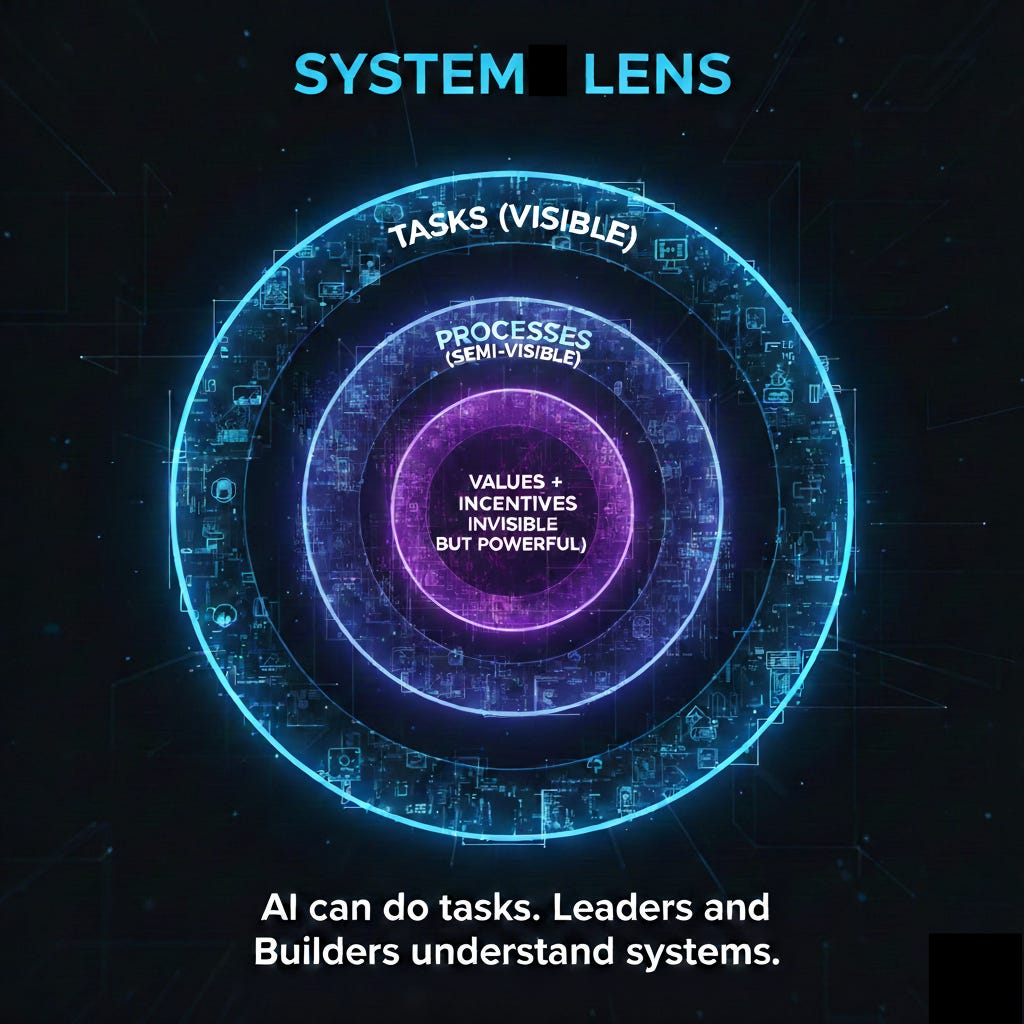
As you step into supply chain engineering, start looking for the invisible structure beneath the visible work.
Ask these questions early, often, and quietly to yourself initially.
How does this business actually make money?
Not the mission statement—the mechanism.
What gets sold?
What costs are most sensitive?
Where does profit come from?
What would break the model?
Where does value get created—and where does it leak out?
In supply chain, leaks often look like:
delays
rework
quality failures
miscommunication
poorly designed handoffs
“workarounds” that became permanent
decisions made for speed that create future cost
Who are the real stakeholders?
Yes—customers, vendors, employees, shareholders, and regulators.
But also:
internal gatekeepers
informal leaders
people who control access to data
the person everyone turns to when something breaks
the “historian” who knows why things are the way they are
How do decisions really get made here?
Data-driven?
Emotion-driven?
Power-driven?
“We’ve always done it this way”-driven?
And here’s a question most new grads never ask:
What does the company reward—actually?
Speed or precision?
Compliance or creativity?
Loyalty or results?
Risk-taking or risk-avoidance?
This isn’t what leadership claims—it’s what the system reinforces.
If you can recognize patterns early, you become useful early. You don’t need decades of experience to see systems clearly. You can build this skill in your 20s—if you decide it matters.
If you work for a publicly traded company, many of the questions listed above will be much easier to answer. You can start by reviewing quarterly and annual financial statements, listening to earnings calls and investor days, and reading analyst summary reports available through resources like Morningstar and similar platforms.
If you work for a private company, this will require more effort on your part, as the information is not readily available. That said, find whatever insight you can from your leadership and executive team regarding the health of the business. One practical step is to befriend the financial analyst who supports your organization. This relationship can be mutually beneficial, as analysts are typically focused on optimizing the business for growth. Just be mindful to ensure they are interested in growing revenue and expanding business opportunities—not simply cutting their way to short-term profits. If your analyst is well regarded and respected, and open to sharing, you can learn a great deal about how the company truly operates.
Lastly, I suggest you ask these questions quietly and initially to yourself. Over time, you will want to determine whether your department—and ultimately your company—is open to growth and innovation. Both require change, and both require builder-type employees.
Your ability to contribute real value, both economically and operationally, is directly linked to the kind of company you are operating in and the leader or leaders you work for. If you are in an open, innovative company and working for a future-forward leader, you will flourish. If not, save as much of your salary as you can so you have the flexibility to move as quickly as possible to a company that does.
Those companies will welcome you—and your desire to learn the business, contribute technical and operational capabilities, and bring a thoughtful style of leadership. In environments like that, you will be what I call—quite special.
I’ve been planning travel recently. When you are the person doing the planning—and you value your time once you arrive—you quickly realize how much research it takes to build a plan based on lived experience. You would think that in an AI world this would be a breeze. It’s not—yet.
When online booking first took off, many people assumed travel agents were finished.
And yet… travel agents still exist.
Why?
Because travel is full of one-of-one, real-world nuance, where several systems intersect:
culture
timing and seasons
what requires reservations months in advance
what’s worth it versus what’s a tourist trap
shortcuts locals know
how to avoid missing the very thing you came for
AI can list options and pull together a plan. Reviews and blogs can help. AI can research and summarize. But there is still a real risk of missing critical details—especially when your trip has a short window of opportunity. Anyone who uses AI tools to plan travel sees this firsthand.
What you’re ultimately seeking is a travel plan grounded in human, real-world experience—someone who has been to the location and can connect nuance to outcomes. Some people pay for that expertise; others invest weeks doing the online research themselves. Both approaches are deeply human, even when AI is involved.
What I discovered this time around during my travel planning is that what still makes this work hard—despite help from AI—is that I’m really looking for the system nuances of the places we’ll be visiting, and how to operate effortlessly within those systems so our time there feels smooth, immersive, and awe-inspiring.
When you start worrying about transportation timing, when the UNESCO site opens, the distance between two locations, how early you should arrive, and when to leave so you can beat the tour buses stopping at the same awe-inspiring cliff or open mountainside, you begin to see that travel is fundamentally about the physical world and the systems operating within it.
You also begin to see why travel agents—and touring companies—did not become extinct. In fact, I would argue that the prices we pay for such services have become more valuable, because what we are really paying for is ease of effort and an immersive experience that remains deeply human.
This same dynamic exists inside businesses and supply chains.
Systems and Businesses look clean on paper. Reality introduces friction.
Your supply chain processes may look clean on paper. Reality will introduce:
exceptions
supplier surprises
late shipments
quality misses
ambiguous ownership
communication failures
leadership reactions
tradeoffs under pressure
“political” decisions that never appear in the project plan
Your value isn’t just executing tasks.
Your value is learning how reality behaves—and responding in ways that improve it.
That’s why business experience compounds. It’s built through lived, one-of-one situations where multiple systems intersect, and at times clash and collide.
AI can generate output.
But businesses still must ship products, satisfy customers, manage risk, handle crises, keep promises, retain talent, and navigate human dynamics.
The more technology we use, the more valuable it becomes to understand what technology does not capture.
So don’t just learn your tasks. Learn:
how processes break
what people do when they break
who gets blamed when they break
how leaders behave under pressure
what happens when the numbers are ugly
If you learn this, you’ll be resilient anywhere.
One of the fastest ways to become valuable is to learn how to remove work.
You do this because people matter—because you cannot create space for new value and new innovation if everything is clogged with legacy work that has already served its purpose.
Foundational work matters. But once foundations exist, you don’t keep pouring concrete. You build the next level—which requires a different skill: creating and innovating.
Innovation requires letting go. New work takes time to think through, build, test, debug, and integrate. Even having an AI assistant adds work. It requires new skills—like becoming the conductor of your own agent work orchestra.
I began doing what I call consolidation and removal work when I was 28. It changed my career.
A senior leader once asked me—hypothetically—if I had inherited the organization, what changes I would make. He told me no one else would read it. That freedom allowed me to make bold recommendations based on system problems I had observed.
He already had someone more senior in mind, but he valued my work ethic and tenacity.
He said, “You’re a bulldog.”
At first, I thought that didn’t sound flattering.
Then he clarified: “No—tenacious. Dogged.”
Someone who sticks with the hard thing and builds better systems.
That’s what I did—locally, regionally, and eventually nationally.
So consider becoming the person who can:
simplify
improve
automate responsibly
redesign
protect quality while increasing speed
remove friction without breaking trust
and innovate
That’s not just employable. That’s leadership. That’s being a builder.
If you can remove friction and improve outcomes in the real/physical world, your economic value changes.
And eventually the compensation equation changes too—because companies pay more for people who create more economic value than their total compensation. Start keeping track of the real and measurable economic value you are creating for your employer.
Weeks 1–2: Learn the system language
Capture acronyms and how they’re used
Map the high-level process: supplier → internal steps → customer outcome
Identify “where problems hide” (every system has a few predictable places)
Weeks 3–6: Identify value leaks
Where do delays happen?
Where does rework happen?
Where is data unreliable?
Where do handoffs break?
Week 7–12: Pick one improvement that matters
Pick one improvement that is:
visible
measurable
useful to other people
small enough to finish
Then document it:
what was happening
what changed
what improved
what you learned
Document what changed and what improved. That documentation becomes your reputation. It also becomes your artifact of the big and small wins, challenges, and set backs as you continue to learn and grow.
Before you try to change or improve any process, you need to understand the tools already shaping how work gets done. Every company operates inside a defined technology environment—what software is approved, what data is accessible, and what automation is permitted. Learning this landscape early gives you leverage, because it shows you where improvement is possible—and where it is not.
Find out which tools your company already uses today to do its work.
Are they primarily a Microsoft or Google software organization?
What AI tools does their IT organization permit today?
What proprietary or industry-specific tools does your company already have deployed?
Who is their cloud provider, and where is data stored and accessed?
Pull together an inventory of the systems and tools already in use. You will want to study what is possible so you can advance your work.
At the beginning of 2026, there was a major breakthrough with the introduction of Claude Cowork. Agentic work is now a reality for non-technical professionals.
If you are not familiar with the solutions already available, you will want to spend time learning how to use these tools fairly quickly. In order to simplify and improve the business, you must first understand the tools. From there, you can begin looking for opportunities where work can be improved—and where work can be eliminated, with a new, simpler role taking its place.
As you do this, you will want to start building, testing, and eventually flexing your AI solution skills. This may require some after-work time to learn and experiment. You are not doing this extra effort for the specific job you are in today. You are doing it to educate yourself so your skills are transferable and become part of your personal system of support for your life and lifestyle.
Tools I’m studying and using for my own personal goals and responsibilities:
Claude Cowork — just released for Mac users on their higher-end plan. This will be quite impactful this year. I’m waiting with bated breath for their Windows release so I can start building my agents. I’ll wait but I won’t be patient. If this doesn’t get released soon, I will be working in Claude Code.
Copilot — I’m finding this tool requires more effort. I want to continue operating within our enterprise Microsoft tenant, but it feels like there are still many building blocks that need to come together. This is a heavier lift than in other tools.
ChatGPT — a thinking partner across multiple roles. I use it as an executive assistant, home contractor, technologist with 20 years of experience, IT support, and more. Once you build detailed profiles, you can ask nuanced, role-specific questions to help you think through decisions.
Gemini — for advanced and deep research. I also find it useful as a counterbalance to some of the content queried through ChatGPT.
At some point, I’ll need to consolidate my tools. Not yet, though.
As you can see, this is how you shorten the distance between where you are today and where you want to be next—by increasing your personal leverage, adaptability, and velocity as the world of work continues to change.
Job skills can be automated; systems understanding is much harder
Learn how money is made and decisions are reinforced
Pattern recognition is business experience — both compound early
Eliminating work creates space for innovation
Your first 90 days should produce visible value
Understanding the AI and technology tools already embedded in your organization
Start building your AI skills - pick one AI agentic tool to get started.
I’m sure this is not what your dad imagined I would send to you. It goes well beyond the finance part. However, I believe you have to work on the top line first—your personal revenue, your salary, your economic value in the world—before we can get to the financial part, which will come in Parts Two and Three.
Your job title will change. Your tools will change. AI will keep moving.
But if you understand systems, you’ll always have options.
Next week: Part 2 — Become an Explorer.
It’s the pillar most people neglect until their late 30s and 40s, … and then wish they hadn’t.
Until next time,
Rachel
_____
For privacy purposes, I have written this as an anonymous letter. Feel free to share it with others who could get value from it.
Disclosure: I am an investor in several of the companies that offer the AI technology tools mentioned above.
Comments
Nothing yet. Say the first thing.
Sign in to join the conversation.