
Some have asked for my thoughts, so here they are (as a theologian-pastor, a little off the neuroscience and formation topics here).
Here are the preliminaries:
1) Yes, you should go see it. It is an excellent adaptation of Homer’s “The Odyssey”, well worth your time and money.
2) We must remember that “The Odyssey” is a foundational story of Western Civilization, but it is not a *product* of Western Civilization. The first epic of Western Civilization would probably be Dante’s trilogy (but I’m not going to fight about that). Nolan’s adaptation is a product within Western Civilization, which, yes, means it is Christianized. I will get to that below.
3) Regarding the actors, Robert Pattinson was delightful as a villain. Matt Damon and Anne Hathaway probably gave the performance of a lifetime. And Tom Holland held his own among the stars.
4) The shots and setting were majestic, along with the monsters, accomplishing the “elevated style” that befits an epic (give no mind to those who think “elevated style” is primarily about the words in a dialogue making it grandiose [Yes, Telemachus can call Odysseus “dad” without it being a violation because Homer wrote using the ordinary language of the time.]) What makes an epic and epic is the sweeping, if not cosmic sense, gathering all the experiences of “humanity” together. Nolan’s “Interstellar” is also an epic in this sense.
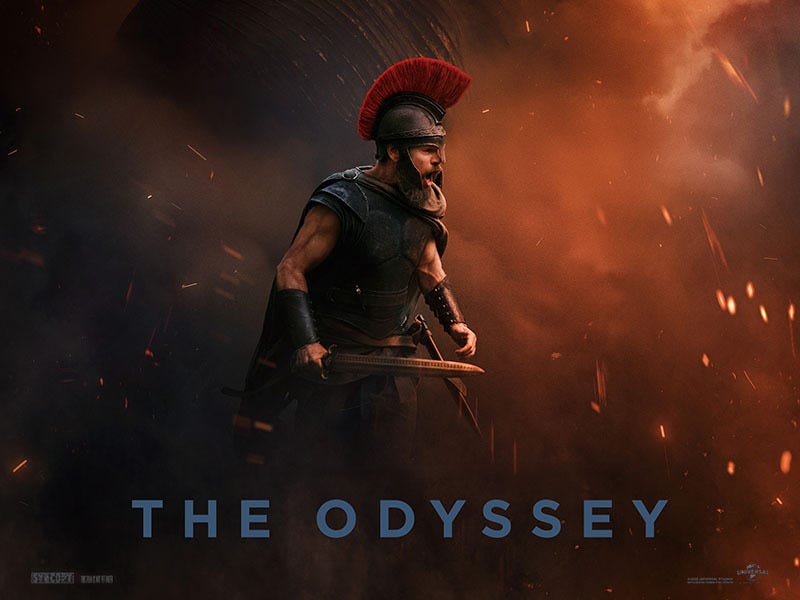
There are multiple moral tales (moralities) at play in Nolan’s The Odyssey (from here on, just “The Odyssey”, I’ll make reference to Homer’s version when comparisons are needed). There is the morality of respecting the gods and giving them the honor due them. Also connected to the gods, there is the morality of Zeus’s law of hospitality, that one should always give guests food, drink, and shelter.
The one that I’m most concerned with, because I think the movie is, is the anxiety over the end of a civilization and humans returning to beasts.
A pivotal moment for this theme is when Odysseus’s men encounter Circe, a sorceress, who turns them into pigs after they eat her meat (which means she has violated Zeus’s law). She justifies her actions as preemptive self-defense for the violence of the men (which previous and future events would seem quite justifiable).
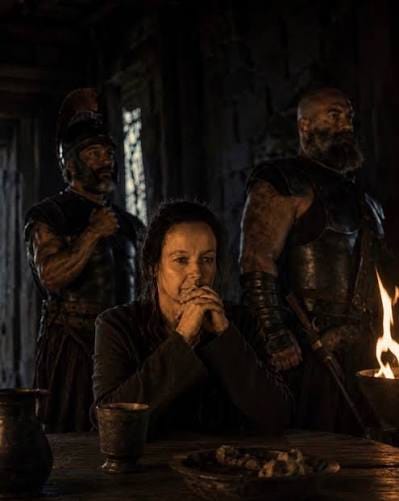
But Odysseus forces Circe to return the men to their human forms. As she does, she gently whispers, “back to your disguises, back to your disguises.” Her haunting insight is that the men as beasts were revealing their true nature, but while in their human form they are hiding their true nature. The question throughout The Odyssey is who are the real monsters, who are the real beasts? Circe has given you one answer.
Near the end of the movie, but recalling the sack of Troy, which sets in motion all his misfortunes, Odysseus says that the violence changed from a FIGHT to a HUNT.
Why is this important? Through several previous episodes, we learn that Odysseus always snaps his bow while hunting. When asked about it, he replies that he wants to give fair warning to the prey. But the Greeks did not give fair warning to their prey when they tricked them using the Trojan Horse. Odysseus confesses that it was no longer men fighting men; it was beasts hunting beasts when they were sacking Troy.
In his disguised confession to his wife, Odysseus laments the cutting of the social contract that Zeus’s law of hospitality had held together.
The tension (and repetition) of the movie is that Odysseus must again violate the law of hospitality (as he did outside of Troy) to rid his house of the suitors in his house (which he does with every bit of vengeance required by the narrative).
In both accounts, Odysseus wins by losing (wins the short-term battle but loses the cornerstones of the civilization as he knows it).
And certainly, these days, I would love if many conservative Christians would be more introspective about whether they are “losing by winning” these days when it comes to politics.
While Nolan’s “The Odyssey” is the product of Western Civilization, and in that sense, it is already Christianized, it is not yet Christian. A properly Christian view of the world, of civilization, is not an anxiety about “losing by winning” because Christians follow the crucified and risen Lord who “wins by losing.”
1) In Greek and Roman culture, the majestic predators were always venerated as the heroic ideal. But Nolan’s Odysseus sounds more in line with the prophet Daniel in contrasting the nature of beasts and the nature of humanity. But it can’t quite arrive at the Book of Revelation’s claim that hearing a lion means seeing a lamb (Rev. 5). In this sense, it is Christianized, but not yet Christian.
2) Let’s remember that the gods of Homer are not the somber oracles of insight and righteous dispensers of justice. They are as fickle and whiny as the wealthy and elite of any society, believing themselves entitled to power. They are not objective observers of human affairs, just trying to keep everyone in line. They actively meddle, often for only their own enjoyment.
So, when Calypso calls Odysseus to hand over himself, as a leap of faith/trust, to the mercy/judment of the gods as a kind of lesson in humility, it is quite Christian.
But Christians can humbly submit themselves to God because God is loving, and not just as an idea, but that “God demonstrates his own love for us in this: While we were still sinners, Christ died for us” (Rom. 5:8).
Time requires that I end here. But the question of whether we are becoming more and more like beasts and less and less like image bearers is a very Biblical question, one that Nolan’s “The Odyssey” places squarely before us.
What did you get out of watching the film? What themes did you see?
Comments
Nothing yet. Say the first thing.
Sign in to join the conversation.