
Just last week, I was teaching a group of our Doctor of Ministry students (a mix of 19 pastors, therapists, and spiritual directors) about the pros and cons of ministering within our therapeutic culture. I started off by provocatively asking, “Are therapists and self-help gurus really all that different?” It was a really productive conversation.
I was hoping Matthew Loftus’ new book, Resisting Therapy Culture, might add to this needed conversation about ministering in a therapeutic culture. But after reading his recent article/excerpt in Christianity Today about attachment and spirituality, now I’m not sure (perhaps the rest of the book is better).
BOTTOM LINE ON TOP: It seems Loftus has 1) not quite understood attachment theory, and therefore throws out the baby with the bathwater, and 2) does not understand what Cyd and I say, or what the Bible says.
Note: I’m responding specifically to what Loftus wrote in the CT article, not his bigger book (which I received in the mail yesterday, but have not read thoroughly yet. I’ll probably review it in October).
Also, I’m under some rather tight writing deadlines, so please excuse any editing errors or typos.
The article starts off well by describing how all of our lives are experienced through what we already know and have already experienced, that our memories are unconscious maps and guides for how to efficiently live and work in the world.
He correctly notes that our “brains are constantly taking in what is happening around us, processing potential threats when they arise, storing memories as key events take place, and integrating our relationships with others into our self-understanding.” And he properly emphasizes that our “minds develop through shared experiences. Knowing that we are loved and cared for is a deep, fundamental need that happens first in families and then in broader communities (such as neighborhoods, extended families, and churches) as we grow up.”
Loftus even brings up the technical term of “mentalization” (but then doesn’t talk about it anymore), which is all about developing the ability to understand the thoughts of other people and to understand our own thoughts. It is “thinking about thinking”, or what Dan Siegel calls mindsight.
Mentalization Disgression: While ancient literature is written for moral formation (so that people know how to act and feel based on the actions/feeling of their ancestors), an argument could be made that in addition to this, God’s relationship with Israel is meant to cultivate mentalization. From God’s opening questions, “Where are you?” and “Who told you that you were naked?” to the flowering of conversation within the soul and God in the Psalms (see Ps. 42), God is having a continual conversation about the thoughts, intentions, passions, and desires of his people and who they are attached to. That’s definitely a research topic for a PhD in OT. ;-)
Loftus ends the opening section by talking specifically about attachment and attachment styles.
It ends by noting that the basic contours of attachment theory are not controversial. But what to do with this information is controversial, he claims.

After looking at what some have said about the significance of attachment for our relationship with God, and how our insecure attachment can distort our view of God, Loftus offers the complaint that
the emphasis in these stories ought to be shifted toward “How does God want me to approach him?” rather than “What can I learn about my relationships with others and apply them to my relationship with God?”
I don’t know any truly Christian therapists or theologians who think it is a good idea to take our insecure and sinful attachment strategies and apply them to God. (Now, to his pop pysch critique, yes, I think many take the insights of attachment theory and just make it part of their “personality” and critique all religion/spirituality from
Nobody thinks that is a good idea.
Nobody thinks that we should do this.
But they do claim that we do live from these strategies, because we can’t help it.
Loftus is focusing on the wrong problem. It is not a question of “should” our attachment shape our experiences of God. The problem is that our attachment strategies “do” form our experiences of God. Our attachment strategies, if unexamined and consciously shifted, will inevitably inform our relationship with God, whether we want it to or not.
It is not a question of “should” our attachment shape our experiences of God. The problem is that our attachment strategies “do” form our experiences of God.
The troubling thing is that Loftus has already noted how our brains create “mental models” (how cognitive science speaks) or “internal working models” (as attachment theory speaks), or “attachment filters” (Todd Hall), or “attachment defaults” (Holsclaws). And that these work on an unconscious level.
And our attachment strategies won’t shift just by adding true information to the mix about “How does God want me to approach him?” (as Loftus suggests). They shift when we encounter truly loving attachment figures (in God and through God’s people). This is not primarily an information process (about knowing what is true about God). It is a relational process of healing relational wounds through relational care.
To ask should it be this way is to ask the wrong question. We need to realize that this does happen, and then ask what to do about it, and adding a giant dose of should does not usually transform people (and attachment theory tells us exactly why this is).
But then the article turns bad in claiming that God should not be viewed as our attachment figure. Loftus say,
it is inappropriate to describe God as an “attachment figure,” because our relationship with him is about so much more than learning to trust and grow in autonomy.
The link in the quote is to our Landscapes of the Soul: How the Science and Spirituality of Attachment Can Move You into Confident Faith, Courage, and Connection. It seems that Loftus thinks we are an example of those erroneously claiming God as an attachment figure (in his book he points to pg. 36, which has the heading “God Is Our Attachment Figure”).
This is problematic on two levels: the level of what he claims we claim, and at the level of biblical theology.
On the level of what he claims we claim, he says that God is not our attachment figure because our relationship with God is “about so much more than learning to trust and grow in autonomy.”
We have never claimed that attachment theory promotes a view of trusting and growing in autonomy.
The irony of this claim by Loftus is that in the next paragraph he points to a “more measured approach”. And who is he talking about? He’s talking about me, and points to this post: 4 Reasons Why Spiritual Formation Needs Attachment Theory.
It is confusing because in the footnotes of his book, when he notes Landscapes of the Soul, he only lists Cyd as an author (oops). So maybe he doesn’t realize that I was a co-author of the book he doesn’t like and the author of a post he does like.
Even more troubling is that EXACTLY one page before the one he notes as problematic, we have the chart (copied below), explaining how we see human attachment figures modeling for us what God does as our attachment figure.
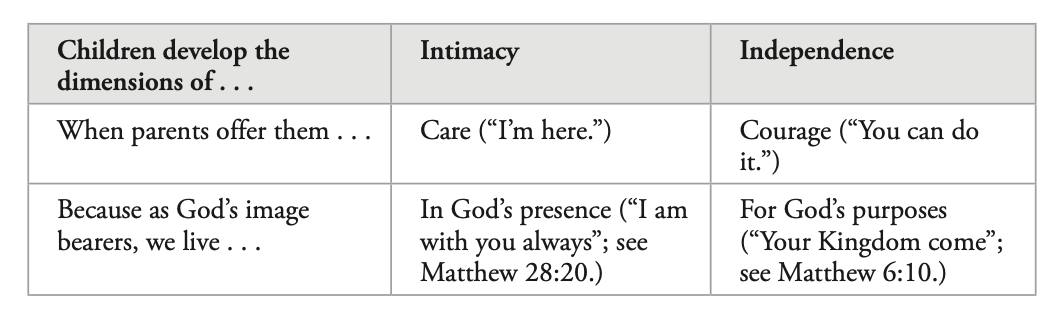
Attachment theory has always worked in two dimensions of human development, that of growing the capacity for intimacy and growing the capacity of independence (in the sense of living alongside of others). John Bowlby, the co-creator of attachment theory, intentionally chose the word “attachment” because he wanted to leave the unhelpful view of psychology that we are to grow from dependence (lack of autonomy) into independence (full autonomy). He understood human development as the continued growth of intimacy and independence, such that while our attachments might change the older we get, we never truly outgrow the need to attach.
So, NO, we don’t promote the idea that spirituality is all about autonomy.
And YES, God is our attachment figure who is constantly offering his presence to us for care in distress (“I am always with you.”), and who is constantly opening up for us a world of purpose where we practice caretaking and discover (“My kingdom is bigger than just you…”).
In fact, this is exactly what the Bible says.
Loftus’ article is an excerpt from his new book. So I’m just going to offer an excerpt from Landscapes of the Soul to make this point about how attachment relationships develop through attuned and joyful connection, and how it is central to the Bible.
Early in Israel’s life, when Israel was just a baby nation, God gave instructions for how the high priest would regularly bless the people:
The Lord bless you
and keep you;
the Lord make his face shine on you
and be gracious to you;
the Lord turn his face toward you
and give you peace.Numbers 6: 24 - 26
God’s face is mentioned twice in this blessing. That’s a big deal, especially because in other places in the Old Testament we are told that no one can see God and live (see, for example, Exodus 33:20). In this blessing, we see that God’s face is connected to both aspects of joyful connection— amplifying joy and returning to joy.
The Joy- Amplifying Face of God
First, this blessing offers us the joy- amplifying face of God. The blessing asks that “the Lord make his face shine on you and be gracious to you.” The idea of a face that shines on us is really something like the “beaming face,” the “face with eyes dancing,” or the “joyful face.” This verse speaks of a joyful, face- to- face interaction with God.
Interestingly, this isn’t the only place where the Bible speaks this way. Psalm 21:6 speaks of how God has granted the king of Israel “unending blessings and made him glad with the joy of your [God’s] face.” And Psalm 16:11 says of God, “You make known to me the path of life; before your face there is fullness of joy” (esv).
Now, if you were to look up these verses, you might see the word presence instead of face. Why?
It’s because Bible translators are trying to hold two things in tension. On the one hand, these verses (and others like them) use the Hebrew word for face (pānîm) when speaking of God. But on the other hand, these translators want us to remember what God told Moses: “You cannot see my face, for no one may see me and live”(Exodus 33:20, 23). Because of this, some Bible translators substitute presence when they come across the word for face.
This is why it is so striking that God gives us a blessing in which, not once but twice, we are told that God’s face is looking upon us. The first time is God’s joy-amplifying face that beams down on us.
The Returning- to- Joy Face of God
Second, this blessing assures us of the returning- to- joy face of God. The blessing asks that “the Lord turn his face toward you and give you peace.” When you are distressed, overwhelmed, full of fear, or feeling abandoned, God’s face will turn toward you, comfort you, and give you peace. God’s gaze soothes our distress when, like the little boy at church, we stumble or run into trouble.
This peace God gives is not just the absence of distress. It is the fullness of life. It is the peace we experience when life with others, with God, and with the world is flourishing. This is the peace that Jesus came to offer us— a peace that leads us into the very presence of God. It is the peace that “will guard your hearts and your minds in Christ Jesus” (Philippians 4:7).
So, if we are designed to desire joyful connection, ultimately it is God who wants to fulfill this desire in us. God’s face shines upon us to amplify our joy and to help us return to joy. No matter what our experience of early life is like, joy is always available in the face of God turned toward us.
Do some take the findings of attachment theory and bend them to their own purposes? Yes. Do we live in a therapeutic culture that is creating problems we need to be honest about? Yes. Do some take psychology as absolute truth and attempt to bend faith and theology to its dictates? Yes.
All these things happen. And we need good conversation around them.
But if God is a relational God, then understanding how God made us for relationships is essential. Attachment theory does this. So we would be wise to listen, being faithful to what attachment research really says, and staying faithful to what Scripture really says.
I hope that Loftus’ book is better than this part of one of his chapters. And I hope that you all read (and that he reads) about how God really is the best attachment figure we could ever have (Landscapes of the Soul).
In fact, all earthly attachments are just preparations for and pointing at God as the fulfillment of all that we desire.
Comments
Nothing yet. Say the first thing.
Sign in to join the conversation.