
Hey friends, we just finished one of the most fascinating investigations we’ve ever done at Elyvora US, a synthesis of 30 studies on how perfume affects the female brain. Not skin sensitivity or allergies this time. The brain. Mood. Stress physiology. Migraine pathways. Social perception.
The biggest surprise wasn’t that synthetic perfume chemicals are associated with neurological problems. We expected that. The surprise was the specificity of the mechanisms, and how dramatically natural fragrance compounds do the structural opposite.
Here are three findings that genuinely surprised us.
If you’ve ever suspected that perfume triggers your headaches, the research says you’re not imagining it.
A 2023 study in Headache (PMC10213061) examined 101 participants and found that fragrance VOCs (volatile organic compounds), the aerosolized chemicals you inhale when perfume evaporates, are a significant migraine trigger, with women showing greater susceptibility than men.
The mechanism isn’t psychological. Fragrance VOCs activate trigeminal nerve pathways, the same cranial nerve system involved in migraine pathogenesis. The trigeminal nerve carries sensory information from the face and head, and chemical irritation of this pathway can initiate the cascade that produces migraine. Women have higher trigeminal sensitivity on average, which explains the sex-specific vulnerability.
Separately, a population survey (Steinemann, PMID: 27867426) found that 32.2% of adults report adverse health effects from fragranced products, with headaches, respiratory difficulty, and cognitive symptoms leading the list. Nearly a third of the population. That’s not a sensitivity outlier. That’s a design problem with the products.
While synthetic fragrance chemicals trigger migraines through trigeminal irritation, clary sage does something remarkable in the opposite direction.
Lee et al. (PMID: 24802524) found that clary sage inhalation produced a 36% reduction in cortisol, the primary stress hormone, while simultaneously elevating serotonin levels. The dual action is significant because most pharmaceutical interventions target one or the other. Clary sage does both through a single inhalation exposure.
The cortisol reduction isn’t the aromatherapy placebo of “feeling calm because it smells nice.” Cortisol was measured via saliva samples. The serotonin elevation was measured in blood. These are objective, quantifiable biomarker changes from inhaling a plant compound.
The contrast with synthetic perfume is almost absurd:
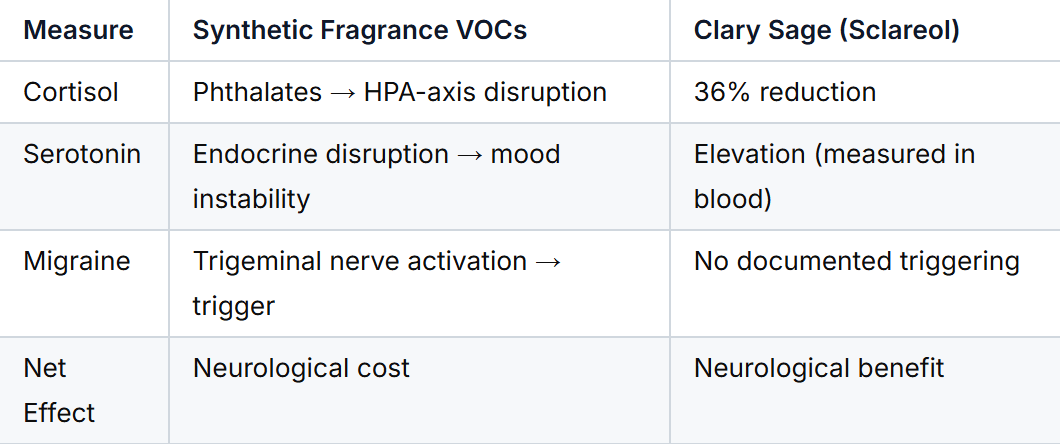
Both reach your brain through inhalation. One triggers headaches. The other reduces stress hormones while boosting mood chemistry. Same delivery route, opposite neurological destination.
This finding moves from personal neurochemistry into relationship biology.
Hofer et al. (PMID: 29293018) ran an experiment with 96 women where participants were exposed to either their romantic partner’s body scent, a stranger’s scent, or no scent before a stress test. The partner scent group showed significantly reduced cortisol levels, their stress response was measurably dampened by the mere scent of their partner, even without the partner being present.
The women didn’t know whose scent they were smelling. The cortisol reduction was unconscious and automatic, an evolved chemosensory mechanism where familiar partner scent signals safety to the brain’s stress-response system.
Here’s the catch our full investigation explores: if you’re wearing synthetic perfume that masks your natural body chemistry, you may be blocking the exact signal your partner’s brain uses to recognize your scent, and vice versa. The fragrance designed to make you more attractive may be interfering with a biological mechanism that operates on a deeper level than conscious perception.
The three findings above are fragments of our full investigation. The complete original research article synthesizes 30 studies across two dimensions, what perfume does to you and what it does to others, and includes evidence we didn’t touch here:
The cost side:
Phthalate metabolites linked to postpartum depression through progesterone disruption (n=139)
Galaxolide and tonalide detected in human brain tissue, with links to neurodegeneration
ER-β disruption → 40% BDNF reduction in the female hippocampus (memory + learning)
Sleep architecture degradation in midlife women from phthalate exposure
The benefit side:
Rose oil cutting cortisol by 48% in an RCT with laboring women
Neroli improving menopausal quality of life through cortisol modulation
Jasmine producing “alert calm”, beta-wave activation without anxiety
Peppermint enhancing cognitive performance and mood simultaneously
The social perception side:
The halo effect: gender-congruent perfume triggering cascading positive attributions across attractiveness, competence, warmth, and trustworthiness
Ovulatory chemosignals: how synthetic perfume masks the scent cues that trigger male hormonal responses
The Proust effect: why scent-triggered memories are more emotional than any other sensory modality
The evidence-based brain protocol: a 3-tier framework for choosing perfume that works for your neurology
If you found the science in this dispatch useful, the full investigation puts it in the most comprehensive brain-fragrance context we’ve ever assembled for women.
Thanks for reading. If you know someone who wears perfume every day and has never considered what it’s doing to their stress hormones, or to the people around them, share this with them.
Elyvora US is an independent product research publication. No brand affiliations, no sponsored content, no free products accepted.
No posts
Comments
Nothing yet. Say the first thing.
Sign in to join the conversation.