
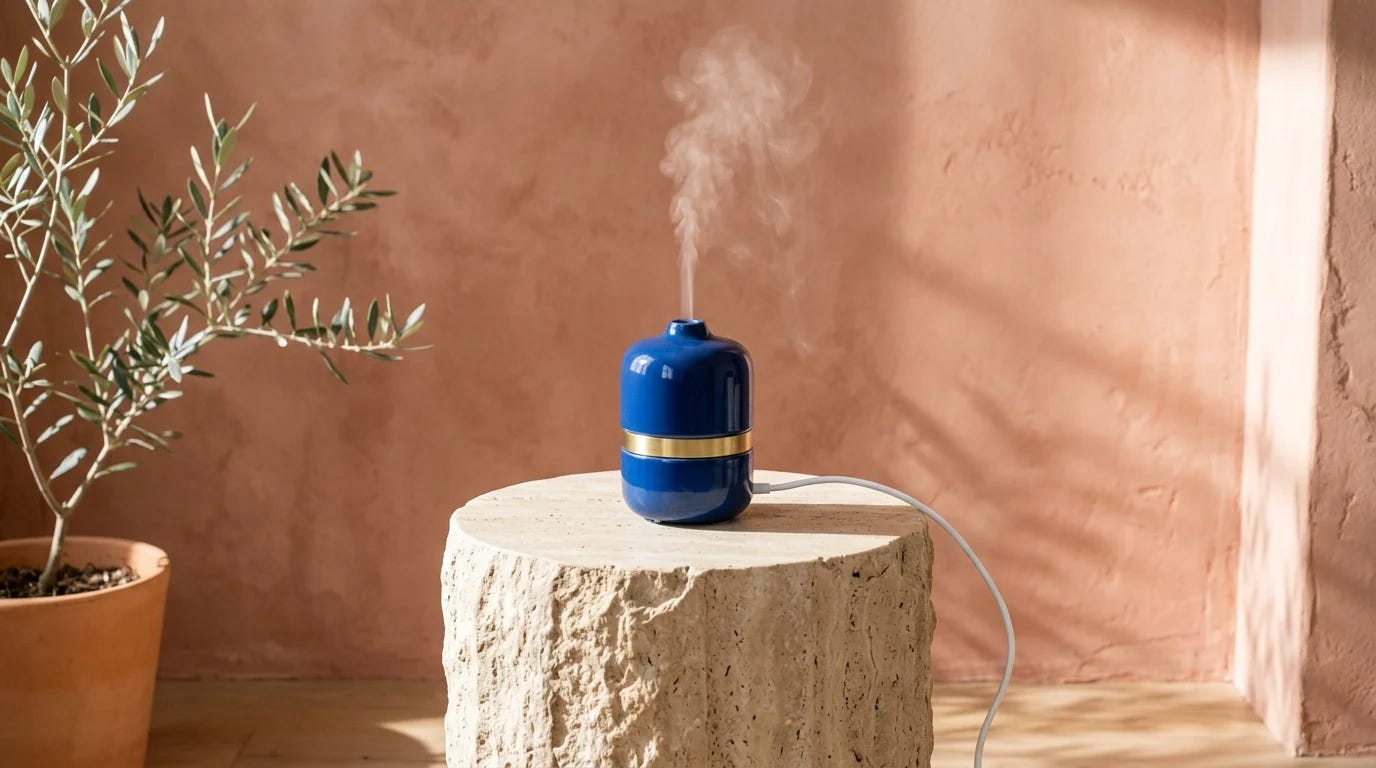
A few months ago, I had a candle burning on my desk while I worked. Millions of people do the same thing. It’s ambient. It’s pleasant. The soft light and familiar scent create a sense of comfort that’s hard to replicate.
Then I started reading the emissions research. And I haven’t burned one since.
At Elyvora US, we publish evidence-based product investigations. Our latest project pulled together 18 peer-reviewed studies on home fragrance delivery systems. The science didn’t just compare products. It mapped a fundamental divide between delivery mechanisms that add things to your air and mechanisms that don’t.
Salthammer’s 2025 review cataloged what candle flames produce: PM2.5, formaldehyde, acrolein, benzene, toluene, and naphthalene. The specific cocktail varies with wax type, wick composition, and fragrance additives.
But the finding that changed my behavior came from Salthammer’s 2014 indoor air review: the extinguishing plume. When you blow out a candle, the smoldering wick releases a concentrated particle burst that exceeds steady-state burning emissions. Derudi et al. (2014) measured the spike in a controlled chamber. The particle counts hit levels that outdoor air quality indices would flag.
I had been blowing out candles in my bedroom before sleep for years. The moment I thought of as “winding down” was the peak particulate exposure event. Right before eight hours of breathing that air.
I thought wax warmers might be the answer. No flame, no combustion, no soot.
Jung and Boor (2025) at Purdue tested that assumption. Heated wax melts released ultrafine nanoparticles below 100 nanometers. At that size, they bypass nasal filtration, penetrate deep lung tissue, and some cross into the bloodstream. No flame. Still nanoparticles.
Andersen et al. (2022) added epidemiological weight with a Danish cohort study tracking candle-burning frequency against respiratory outcomes. Denmark has among the highest per-capita candle use in the world. The associations with lung function changes were notable.
Jager et al. (1996) measured blood plasma after inhalation of 1,8-cineole, a primary eucalyptus compound. Detectable in blood within 18 minutes. Falk et al. (1990) documented a half-life exceeding 100 minutes. Moss and Oliver (2012) then correlated blood levels with improved cognitive task performance.
Aromatherapy isn’t just about what you smell. It’s about what enters your bloodstream. And the delivery system determines whether those bioactive compounds arrive alongside combustion particulates or clean.
Ferrini et al. (2016) nebulized essential oils in a hospital and measured a 90% reduction in airborne bacteria. The mechanism preserved molecular structures that heat would alter. Franco et al. (2020) conducted an RCT on passive aromatherapy with measurable outcomes, no combustion involved.
The Circadian Scent Window. Granqvist et al. (2017) found olfactory sensitivity peaks at 9:08 PM. Your evening scenting habits overlap with peak biological receptivity.
Sleep and scent. Schredl et al. (2009) showed ambient scent during REM directly influences dream emotional valence.
Sub-threshold pharmacology. Masuo et al. (2021) documented linalool producing anxiety-reducing effects below the conscious smell threshold.
Six delivery mechanisms compared. Combustion, heated wax, ultrasonic, nebulization, passive evaporation, and porous material absorption. Each mapped against clinical evidence.
18 peer-reviewed studies. Every delivery mechanism compared. Every emission pathway documented.
Read the full 18-study investigation →
Elyvora US is an independent product research publication operated by FLASH SHIP SRL, based in the EU. No brand affiliations, no sponsored content.
No posts
Comments
Nothing yet. Say the first thing.
Sign in to join the conversation.