
Let your AI brief you before your next meeting. Open ChatGPT or Claude, paste in the last few emails or notes from a client, and ask: “Brief me on this person before my call — what do they care about, what’s unresolved, what should I ask?” Thirty seconds, and you walk in sharper than 90% of people you meet.
Grab the webinar replay + The AI Blueprint. I went live last week on how AI adoption actually works inside a company (the messy operational version, not the demo). If you missed it, register here and I’ll send you the recording plus the AI Blueprint framework we hand every attendee. Get the replay →

For two years, using AI meant typing. You asked a question, you got an answer, you copied it somewhere. This week that flipped.
OpenAI quietly shipped Record & Replay for its Codex app — you do a task once while it watches, and it turns that into a reusable “skill” it can repeat on its own, forever. Microsoft pushed out Copilot Cowork and Anthropic has Claude Cowork - both built around the same idea: AI that does the work alongside you, not just chats about it.
Why you should care: This is the shift from “AI as a smarter Google” to “AI as a junior employee.” The thing you used to write step-by-step instructions for can now just watch you do it once and take it over.
What this means for you: Pull out that automation hit list from the playbook. Every item on it is now a candidate for “show the AI once, then hand it off.” This is the single biggest change in how AI gets used at work — and most business owners haven’t noticed it yet. You noticing it early is the edge.
The audited 2025 financials for OpenAI got out this week: roughly $13 billion in revenue against $34 billion in costs. Yes — the most famous AI company on earth is burning more than two dollars for every one it brings in.
Here’s my take: this is signal, not noise - but probably not in the way the doom crowd wants. The tools you’re paying $20/month for are being sold to you below what they cost to run. You are, quite literally, getting subsidized AI right now.
Why it matters for you: This pricing won’t last forever. The smart move isn’t to panic about an “AI bubble” - it’s to lock in the value while it’s cheap. Build the workflows, train your team, and bake AI into how you operate now, so that when prices normalize you’re already getting 10x the value out of it. Cheap, powerful AI is a window, not a permanent state.
A question I get constantly: “Jesus, if AI can code now, why pay a team to build my software?” I went down a rabbit hole on this and the data is not what the headlines say. Block cut 4,000 and blamed AI - reporters found it was financial pressure. Intuit cut 3,000 and the CEO admitted it had “nothing to do with AI.” The tell: when New York forced 160+ companies to legally disclose why they laid people off, exactly one checked the “AI” box. And 59% of hiring managers admit they play up AI in layoff announcements because “it plays better with stakeholders.”
The deeper reason it’s hype: writing code was never the expensive part. Building software is decide → execute → deliver, and AI is only good at the middle. One study of 100,000 developers added AI and saw 8x more code but only 30% more product actually shipped. The bottleneck moved, it didn’t vanish.
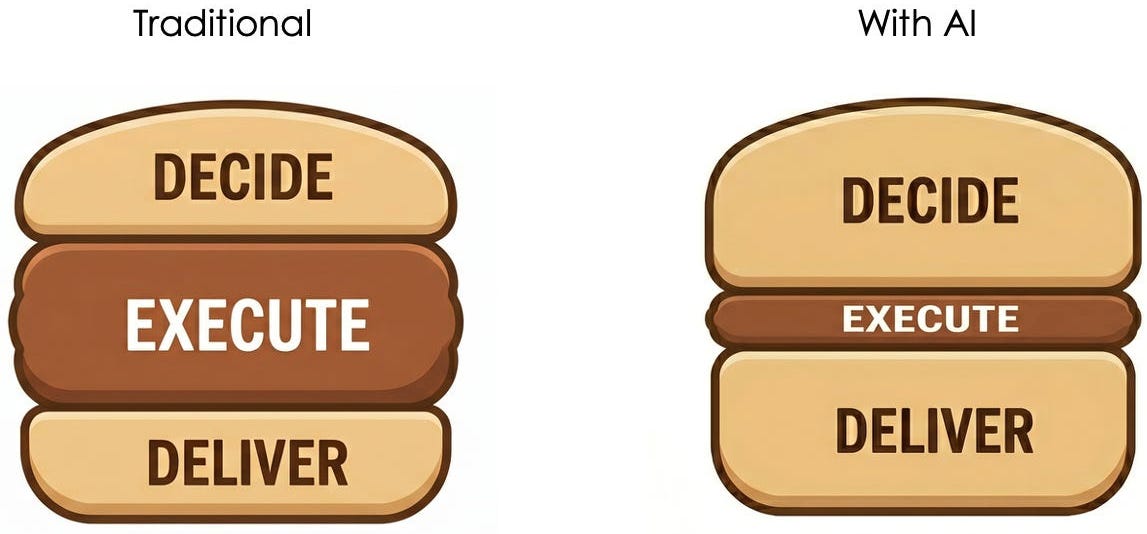
Why it matters for you: Don’t freeze building because “AI will do it” — the companies saying that are mostly covering for other problems, and you’ll fall behind the ones who keep shipping. The value was never the code, it’s the judgment about what to build and whether it works. Use AI to build five things instead of one, not to cut the builders.
Ploy — An all-in-one AI marketing platform for your website, SEO, CRM, and campaigns, built by the founding CTO of Webflow (so it’s not a weekend project). Try this: if your marketing is currently spread across five tools and a prayer, point Ploy at your site and let it tell you what’s broken. Worth a look for any owner doing their own marketing.
ZoomMate — Zoom’s new AI ($20/user/month) sits inside your live meetings and pushes the decisions you make straight into Salesforce, Jira, ServiceNow, or Slack — so “I’ll update the CRM later” finally dies. IMO, it’s WAY too expensive. There are better options out there.
Claude Design — Anthropic’s design tool now follows your brand’s design system, lets you edit the canvas directly, and syncs with the rest of the AI building tools. Try this: if you’ve been paying a designer for simple landing-page mockups, try briefing Claude Design first and bringing the human in only to polish. Genuinely impressive now.
Framer — The popular website builder now connects to outside AI agents like Codex and Claude Code, so you can describe changes and have them made for you.
The shift this week: AI is becoming something you hire and deploy, not something you use.
Look at the pattern. OpenAI just launched a formal Partner Network (and we’re going to be part of it, stay tuned!) - backed by $150 million - with plans to certify up to 300,000 consultants by year’s end. A whole profession is springing up around “help me actually put AI to work,” because the gap between having the tools and getting value from them is real and most companies are stuck in it.

Why this matters to you: the winners over the next year won’t be the businesses that “use AI.” Everyone uses AI now. The winners will be the ones who deploy it - who turn it into repeatable jobs that run without a human babysitting them.
What to do: Start treating AI like a hire, not an app. Take the top item on your automation hit list and ask: “What would it take for AI to own this end-to-end?” That’s exactly the work we do at LowCode Agency - we build the AI “employees” that quietly handle the repetitive stuff. Reply to this email and I’ll tell you which of your tasks is the best place to start.
Snap’s first consumer AR glasses, “Specs,” are up for preorder - $2,195, shipping this fall. Cool, but it’s an early-adopter toy at that price. File under “watch, don’t buy.”

Midjourney is building a body scanner - yes, the AI image company is launching “Midjourney Medical” with an ultrasonic scanner and a San Francisco spa. A reminder that the big AI players are wandering into everything.
Google’s Gemini 3.5 Pro is rolling out with a “Deep Think” mode and a 2-million-token memory (it can hold a small library of your documents in its head at once). If your work lives in Google Workspace, it’s the one to test next.

Now that the webinar’s done, I’m packaging the four-phase AI adoption framework we ran through into a self-serve version any owner can follow solo - plus cleaning up The AI Blueprint template so it actually works without me on a call. If AI is clicking for you but not your team yet, that’s the gap this fixes. Grab the replay and the template here.
That’s your week in AI. Forward this to someone who keeps asking “should I be using AI?” — the answer is yes, and this newsletter is their starting point.
No posts
Comments
Nothing yet. Say the first thing.
Sign in to join the conversation.