
The seasons of life are shifting. Uncertainty, confusion, and weariness seem to have made a home in my heart. I do not know how or what to feel. There is a yearning, a longing, and I do not know what exactly I am searching for.
Physical fatigue, emotional fatigue, a sense of wondering in my soul.
I often write and speak about living in the tension, the many nuances of being a third culture kid, an immigrant. It is good to remember and be thankful for the various facets of your life and identity. But the last few years have been harder than others. Perhaps it’s transitioning to being empty nesters; perhaps it’s watching your adult children make decisions and choices that seem out of your control and out of your comfort zone. Perhaps it is burnout. Why do the answers seem so complicated? Why can’t I just run away from it all?
I think we can all agree that life has its fair share of hills and valleys, but this season feels like a never-ending valley, and I am walking in the darkest of dark! When will this road end, and is there a light around the corner?
Loneliness and panic often grip me, and I spiral.
So, I do the thing I have been doing for the last 3 decades of my life. I keep talking to God. But this time He seems to be on mute.
Last week, for a few hours, I felt myself coming out of this funk or pit I seem to be in. Because I am one of those people who sees every glass as half empty, I couldn’t help but wonder when the dark clouds would come back. I mean, hey, sunshine cannot possibly last more than a few hours with the way my brain works!
Waiting for the proverbial shoe to drop - I spent my day half-breathing, and yes, by the end of that day the shoe did drop, and I was back in the pit.
You could almost assume I sent myself there. Maybe I did, or maybe I didn’t. Hear me when I say, I do not want to be wandering in this stupid valley. I hate it. I want to be blissfully unaware of the problems of this world and not care about anything! But I cannot seem to do that. In daily functioning, I am a machine. But on the inside, I feel dead.
So in late June, when Tish Harrison Warren’s new book, What Grows in Weary Lands: On Christian Resilience, landed on my doorstep- it seemed to have perhaps all the answers I was looking for.
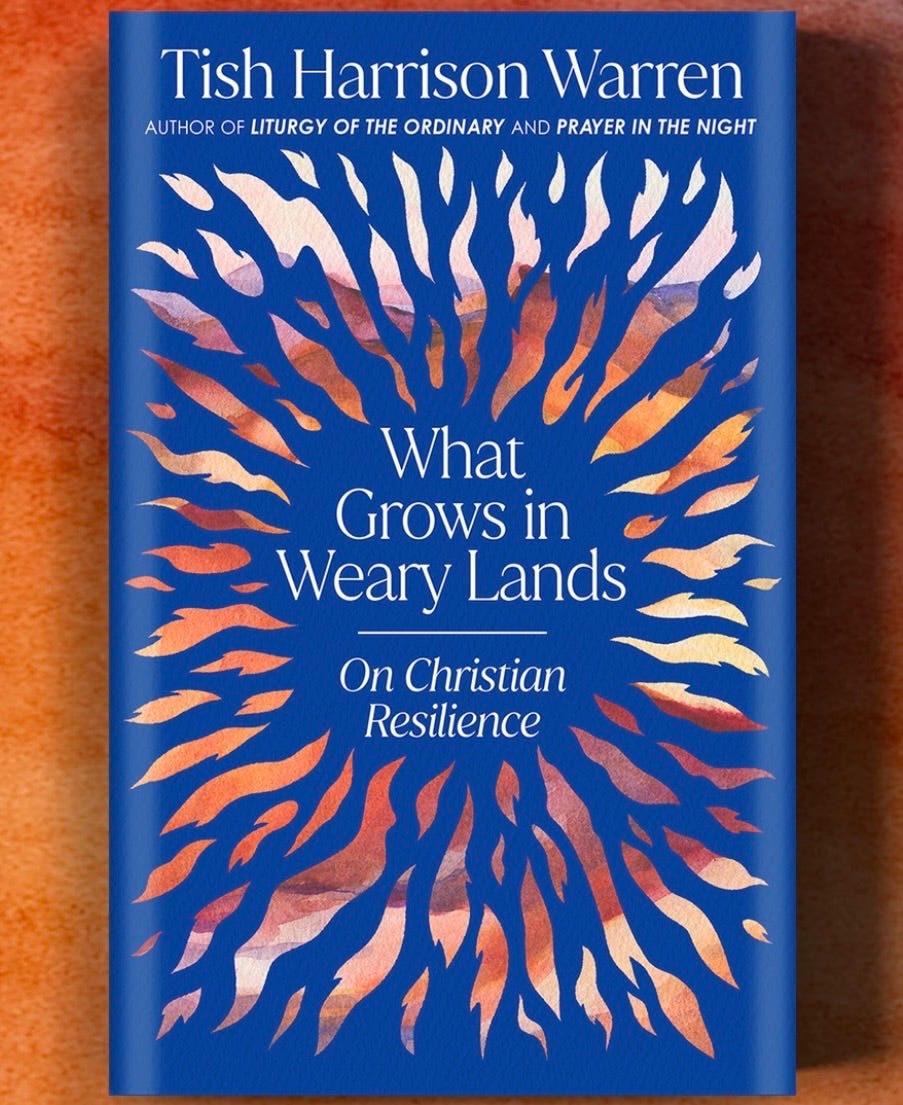
Maybe Tish had the answers, or maybe God had given her the answers to share them with me!
I am a huge fan of Warren’s writing and scholarship. I got hooked on her work when I read her first book, Liturgy of the Ordinary. Her second book, Prayer in the Night, left me sobbing over my highlighter as I scribbled into the margins.
Needless to say, this book was just as amazing and answered many of my questions in this season.
For possibly the first time in my life, I began to admit that perhaps life could be hard, that the theory of “pulling yourself up by the bootstraps” might not always be the best advice. There are seasons where one needs to compartmentalize, set aside some emotions, and keep moving. There are benefits to that. When others depend on us- young children, aging parents- you keep moving.
However, this time, I started to wonder about the concept of self-care, focusing on oneself- all of the things I usually ignore or deem insignificant ( at least for myself). Could there possibly be anything true about all this stuff? Could I just be exhausted with life?
My formation and my inner critic told me I was being a wimp. I just needed a good night’s sleep, and all would be well. Well, Julian of Norwich told me that also, “all shall be well, and all shall be well, and all manner of thing shall be well”
Fear of failure, fear of letting go, fear of letting others down were all convoluted in my head. God was on mute, and I was exhausted and alone.
My Christian upbringing and theological training reminded me that even if it felt like God was silent, He was still working. But in this season, I need to feel and see it palpably. I needed more than just a reminder.
Running away was not an answer, although I considered it! One cannot escape one’s mind!
So, accepting my season of life, I began Warren’s book. The first thing that encouraged me was that for those of us who follow Christ and have faith - we also fail, we also doubt, and we flounder and struggle. That is OK.
In her book, Warren says, “ we cannot get from newfound ardor to tried and tested wisdom without the winding middle”
She says what we today call resilience was called fortitude- we need to embrace the middle. Warren goes on to say, “resilience is indispensable if we are to become who we are made to be.”
She goes on to explain how the exhaustion and burnout we feel often come from doing the things we most love, not the things we hate. That resonated with me- I was doing all the good things I loved, and yet I was exhausted.
I live, and I suspect most of us live in a world that celebrates resilience, but we often do not understand how to navigate those seasons.
I was stuck in this desert, lonely, dry, far from God, and yet as Warren says, there are no shortcuts in the desert. I needed to go through it, not around it. I had to work my way through this aridity with God as my guide.
So as I worked my way through the book section by section, I learned the lessons she learned during her season of aridity and Acedia, accepting that for all of us as followers of Christ, the desert is essential to growth. There is Discovery in the Desert.
The word Acedia pops up often across the pages.
Simply put, it is a lack of motivation, but according to John Paul II, “it is a sadness arising from the fact that the good is difficult.”
During this season, I have grown exhausted by the rhythm of my daily life.
Decision fatigue is real and hard. Everything good and worthy seems challenging, and I wonder when this ennui of life will end.
Do I want to inhabit another world? Am I ready to leave what I have behind and start afresh elsewhere? Yes, maybe? Or am I too scared to leave? Am I scared to leave it behind because what I am looking for does not really exist and is just a figment of my dreams and longing?
Are dreams dangerous? I do not know.
But what I do know is that for this season I need to be obedient to what is in front of me and do what is needed while setting my eyes on God. I might not be able to feel Him close, but I know He is there.
Warren calls this process of focusing on what is in front of us- staying in the cell. In her book, she draws from the lives of the desert fathers and mothers, and she says that when we are in a season of Acedia, the desert fathers and mothers vow to stay in one place.
Staying true to their commitments and practices of prayer, work, and worship, they called it staying in their cell no matter the outcome; it was the practice of stability.
Hence, whether we repeat the prayers that we pray every day, confess our sins, practice the study of scriptures, practice solitude, love our neighbors, take care of the people in our lives, be it hard or easy, whether the dinner was burnt or the groceries never got bought, we practice stability.
She reminds us to enter our cell, sit down,n and turn to God. So on days when I didn’t feel hope, I didn’t feel God, and my faith seemed to vanish completely. I had to remind myself to practice my Faith like a trained muscle.
As humans, we are all bound to get exhausted by the demands made on us by the sheer existence of life. But we are not called to selfish lives,
Warren says it well in her book, “As disciples of Jesus, we must not live as if we are autonomous individuals with infinite options. We must allow others to lay claims on us to limit us. Even to go deep with God always involves going deep with others, being rooted in a place, a community, a tradition, and a Church.”
As I have longed for escape, I have also desired a change of scenery, a desire to inhabit a place of my dreams, new rhythms and new faces. But I am called to pledge my Body to these Walls where God would have me. “The witness of Christian throughout history is that we ought to be skeptical of the impulsive bolt when things become difficult and arduous in times of difficulty; we need to fight the urge to flee. To follow our bliss is to, in the end, miss everything the cell has to teach us, so not only am I called to stay in my cell. I am also called to pledge my Body to the walls. ”
Waiting to hear from God is what all of us who have professed faith in Christ are called to do in seasons. More often than not, waiting refines and sharpens our faith.
I desire control over every area of my life. To will things and behavior into existence, to manipulate and have autonomy.
In reality, I am like a piece of grass that could be blown away tomorrow. My only choice in this journey is to wait on the Lord, and so I pledge myself to these walls. I Stay in the Cell, and I Wait in the Womb. Warren calls the cell of our lives a place of encounter and transformation; what we often consider the place of death and darkness becomes the site of a miracle.
When we read the lives of the desert fathers and the mothers, we see that they were wholehearted in their commitment to God. They lived with deep levels of discipline and austerity. Unfortunately, not many of us could live like them today.
I’m not quite ready to give up the luxuries of my life. Simply put, I am spoilt. But neither did they go through life depriving themselves and sitting around with a mournful look on their face; they lived simple lives, fasted, prayed, spent time in solitude, and rested. Their resilience did not stem from self-will but from a constant reminder to turn to God and rhythms when the flesh weakened.
They didn’t leave the comfort of daily life to go live in the desert with a clenched fist, gritting teeth, willing themselves to survive with an attitude of resignation.
This is probably the hardest thing for me: living life with a clenched fist unwilling to loosen my grip. In this season it’s been frustrating to be still and know. All the Bible verses from years of sermons and sacraments bleed through my mind and saturate my soul, and yet I want more.
The fear of failure and loss overwhelms me. Panic rages inside me, and the rational part of my head reminds me God is still with me. The fear of disappointing God is also alive and well. It’s almost as if He is looking down on me, shaking His head in disappointment. I know that it is not true, but those feelings persist.
Warren reminds us in her book that God is gentle with us.
Thomas Merton quotes an unnamed desert father saying the reason why we do not get anywhere is that we do not know our limits.
Can I handle myself? Can I build resilience with an awareness of the presence of God? Will I break or can I bend?
In His presence, I allow myself to fall apart, unravel, and cry out for mercy, relief. I Relax the Bow. I beg for mercy, hoping He hears me. His silence is deafening. And through the words of encouragement in this book. I know He is there. He is near.
I have always found that in seasons of chaos, what the soul often needs is solitude. Warren reminds us of the importance of solitude. We often view solitude as a form of self-care, a place to turn off our phones, turn off social media, or take a spa day.
But there’s more to solitude than just caring for our physical self. Withdrawing from the noise of daily life to spend time with the Lord, thinking thoughts about Him, is the most important thing.
As we go through seasons of exhaustion and awareness, the only way for us to be still and know that he is God is to put our heart to the chest of our Father so that He can hold us close. We need to have moments in our lives and days in our lives where we can let the silt of our lives settle so the waters run clear.
Now here’s the thing: as I’ve been reading this book, I’ve embraced the lessons that Warren is teaching us. But that does not mean her journey and the answers she has received have immediately fixed all my problems.
My humanity has a way of sending me back to my old haunts of worry, fear, stubbornness, and wrestling. Wrestling with God is not inherently wrong, but living in doubt and giving in to fear can create patterns of behavior that are unhealthy.
My biggest question to God is, “How am I supposed to find my faith and persevere and overcome this weirdness in my soul when so much of what I’ve believed in seems to be dissipating around me?”
Warren goes on to remind us that doubt is “simply a fact of human existence, like sadness or fear. Doubt can become disordered, unhelpful, misleading or overwhelming. Still, for the most part it is a normal response to living a full life and can even be a useful motivation for seeking truth.”
Like many others before me, I have prayed, “Lord, I believe; help my unbelief.”
It’s scribbled across journals and books. The desperate Father in the New Testament had the faith I am now envious of. Can my God handle the weight of the questions I am screaming at Him? Is He real enough to handle all the mess that is me and my life? He is the only one with whom I can be honest, raw, and open. Can He carry me through this season? Where are you, God, and why are you so silent?
In the closing chapters of her book, Warren says, “We don’t simply find Faith once and for all. We find it and lose it and find it again. We believe and doubt and believe. We sort through what is essential and what is not. We sift through the ways our culture or upbringing has warped our understanding of the gospel. We learn. We repent. We rethink.
And so, like John of the Cross, who wrote that the dark night of the soul produces a particular strain of doubt which she called the “spirit of blasphemy,” which Warren says is not so much as doubting that God exists but instead doubting that God can be trusted; I find myself on this strange, long journey.
God has seemed far away from me this season, so I rail at the world and the people in it.
Mute, alone, and angry, the book of Job has helped me voice the crazy depth of my emotions. Trusting in the rhythm of scripture helps. The Word of God helps. I cannot always feel Him, but I know He is there.
If you’ve managed to be with me till the end of this ramble, then I hope you’ll go onto Warren’s website and purchase this book. It is a must-read for all seasons.
Catholic priest and theologian Tomás Halik wrote, “Christian faith-unlike natural religiosity and happy-go-lucky religiosity - is resurrected faith. It is a faith that has to die on the cross, be buried and rise again- in a new form. This is a process, and it is possible for people to find themselves at different phases of this process at different moments of their lives.”
Perhaps as Warren says, my faith too must die and by God’s immense grace be made new and born again in me. Maybe I am on this journey to learn to believe again and again.
I don’t know yet what this season is for. Maybe it’s the empty house or watching my children choose paths I cannot walk for them, or just the ordinary erosion of seasons of life. Maybe it’s all of it. What I do is that I cannot rationalize or think my way out of it, and it’s time I stopped trying.
Growing in faith takes a lifetime. It’s not a one-and-done thing. We need- I need these seasons of uncertainty and doubt to refine me on this journey. I have no idea where it is going and when it will end, but I need to trust God on every turn and speed bump.
So, I keep doing the unglamorous things. I stay in my Cell: Pledge my Body to the Walls, even on days when I want nothing more than to run, I wait in the Womb of not knowing, I relax the Bow, unclench my fist, let God hold me when I cannot hold myself. I let the silt of this life settle, so that one day, hopefully soon, the waters will run clear.
Doubting, worrying over the strength of my faith and the weariness, is not empty. It is in the work of waiting that -will grow something in me.
Thanks for reading Monday Morning Musings! This post is public, so feel free to share it.
Comments
Nothing yet. Say the first thing.
Sign in to join the conversation.