
It’s Japan, 1855. Toward the end of the Edo period.
An era in Japanese history of relative peace and stability, known for its art, culture, fashion. The woodblock prints of Hiroshige. Kabuki theatre and silk robes. The elaborate rituals of a society turned inward. And a powerful, wealth-hoarding merchant class separating itself from the poor, who are living off scraps.
Then a powerful earthquake hits Edo – modern-day Tokyo. The city’s lowland districts, where the wealthy have built their estates, are the first to go. Thousand are killed.
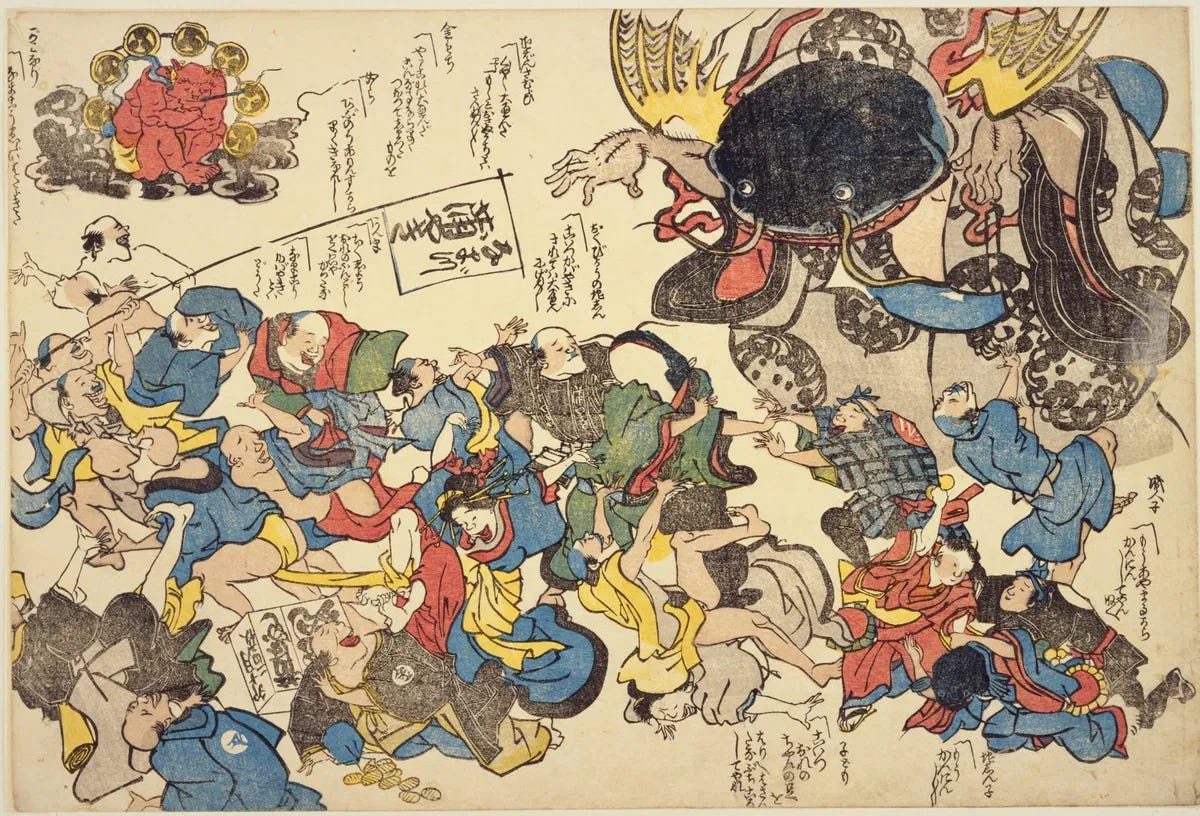
During the following days and weeks emerge woodblock prints depicting a giant catfish, grinning and thrashing, by different artists.
The artworks depict Namazu, the earthshaker. A giant catfish living under the surface of the earth. The artworks (namazu-e; 鯰絵) vary, with some intended as a ward against future calamity while others function as a social critique (McDowell 2025).
While the Namazu myth existed long before this particular quake, it was around this time that it was used in the form of woodblock paintings to critique social structures of the day. Rather than being depicted purely as a force of evil or misfortune, Namazu was at times linked to good fortune for the less wealthy, because following the quakes the merchant classes were often forced to contribute funds to help rebuild the city and aid the lower classes.
The woodblocks depict a kind of retributive justice. The quakes, the resulting fires, and the thousands killed are all horrors, but there is more than just the horror at play.
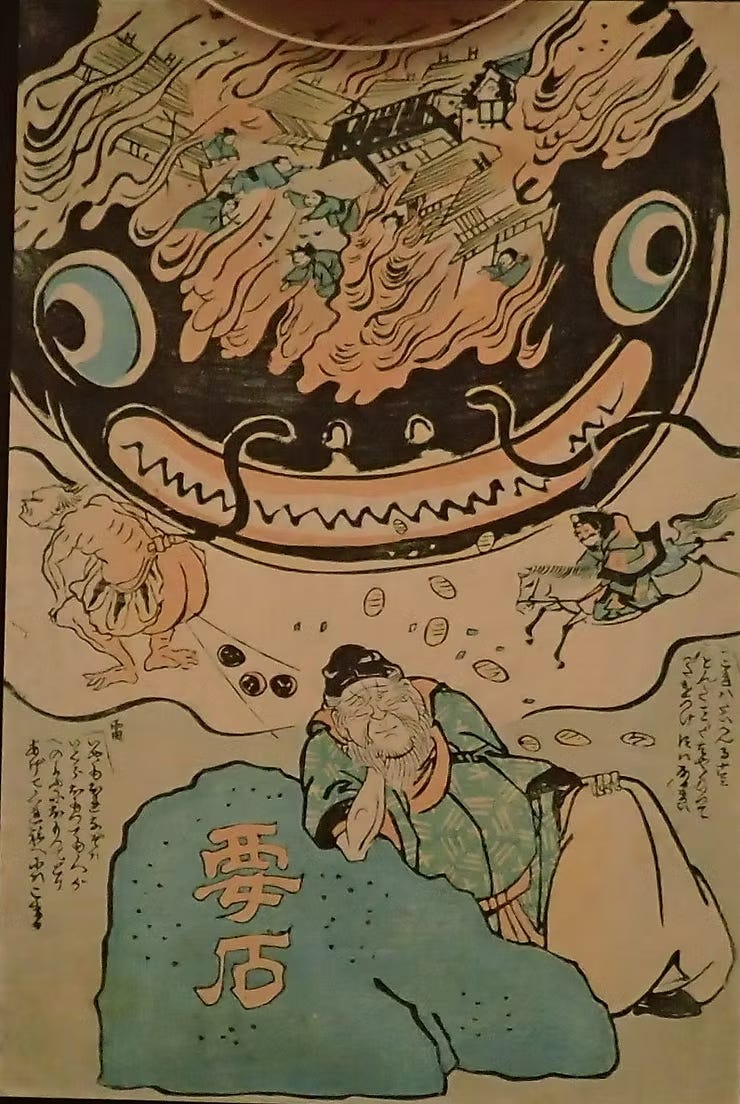
I’ve started noticing this theme a lot: the earth, or some mythic force embedded within it, punishing people for their actions. Taking revenge for exploitation. Or, more recently, for the Anthropocene, that human-induced geologic era of catastrophe we now find ourselves in.
I started thinking of this trope as something specific: anthropocide.
On the surface, anthropocide is a common enough trope in myth and stories. Vengeful killings of humans by a non-human force representing or acting in place of nature itself – this is a common enough occurrence in books and stories. A reaction to ecocide. It’s usually at scale: not the killing of a single person, but a threat to the very idea of humanity. Where does this urge come from? Why should a spate of woodblock paintings suddenly emerge after 1855 depicting the cruelty, anger, or mischief of Namazu?
In 2015, N.K. Jemisin published the excellent novel The Fifth Season, first in the Broken Earth trilogy and one of the most politically charged works speculative fiction of the past decade or so. Set in a world called the Stillness, a continent wracked by catastrophic seismic events called ‘fifth seasons’, these periodic apocalypses of ash and earthquakes end civilisations. The name “the Stillness” is ironic, since the earth moves violently and without much warning.
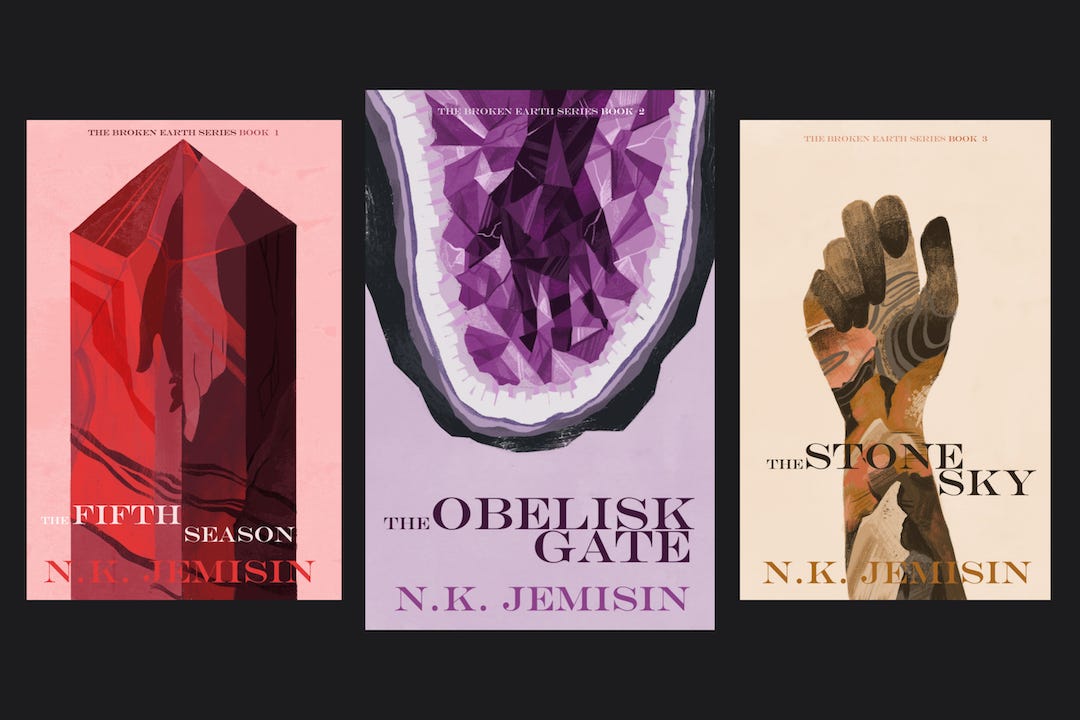
Source: cbaillustration.tumblr.com
At the centre of this world are the orogenes, people born with the ability to manipulate seismic energy to calm the earth or, when threatened, to crack it open. For this reason, they’re also feared, enslaved, and systematically dehumanised by the societies they are forced to protect.
In The Fifth Season the earth is angry. Known as Father Earth, it wants to destroy the parasites that exist on its surface. This anger is not the personification of ordinary geological processes, like volcanic eruptions caused by shifting tectonic plates. It’s a reaction to human behaviour. Humanity wounded the earth long ago, tearing its moon from orbit in an act of profound hubris. Every fifth season is an act of retribution. Like the orogenes, the earth is damaged and exploited.
What is so powerful in the Broken Earth trilogy of books is the way Jemisin makes the reader feel sympathetic towards the earth, despite its violence and rage. This is anthropocide in action. The humans in these books are guilty. Of ecological destruction, yes, but also violence enacted on each other, on orogenes, on everything they cannot control. The earth’s rage and humanity’s social violence mirror each other, becoming two sides of an impossible choice for the books’ protagonists.
What connects Namazu and Father Earth is not just the destruction they cause but the meaning we find in it. A common element in anthropocide is the projection of human moral frameworks and feelings of guilt onto natural processes. The catfish grins. The earth rages. There’s the suggestion of agency drawing from a deeply emotive reservoir, reacting against human activity. A notion of retribution, justice, or plain mischief.
There is something revealing in this compulsion. When we imagine nature taking revenge, we are not really describing the natural environment. We are describing ourselves, our guilt.
Inherent within anthropocide is our need for the damage to be purposeful or justice to balance the scales. We ascribe human morals to the world around us in an effort to make sense of the things we have alienated ourselves from.
As a trope, anthropocide is less about the natural world and more about the limits of the human moral imagination. We look at ecological collapse and reach instinctively for one of the oldest narrative structures we have: wrongdoing that begets consequence and punishment.
There is another alternative, though. And it’s perhaps more terrifying than punishment. The earth might not be angry; it might just be indifferent.
In the longue durée – the deep time of geology and evolution – “the biota itself seeks the establishment of the ideal conditions for perpetuating life that may or may not include the human” (Sawyer 2015, 12). Anthropocide need no earthshaker, no wilful act of vengeance. It is all the more unsettling when it has no face, no catfish grin.
In Jeff VanderMeer’s Southern Reach series of books, it’s the agency of a place – Area X – that reclaims human structures, warps the minds of those within, and twists their bodies into unrecognisable Others. It is an area, a place, that has this effect on people. Bound by an invisible barrier, inside Area X different rules apply.
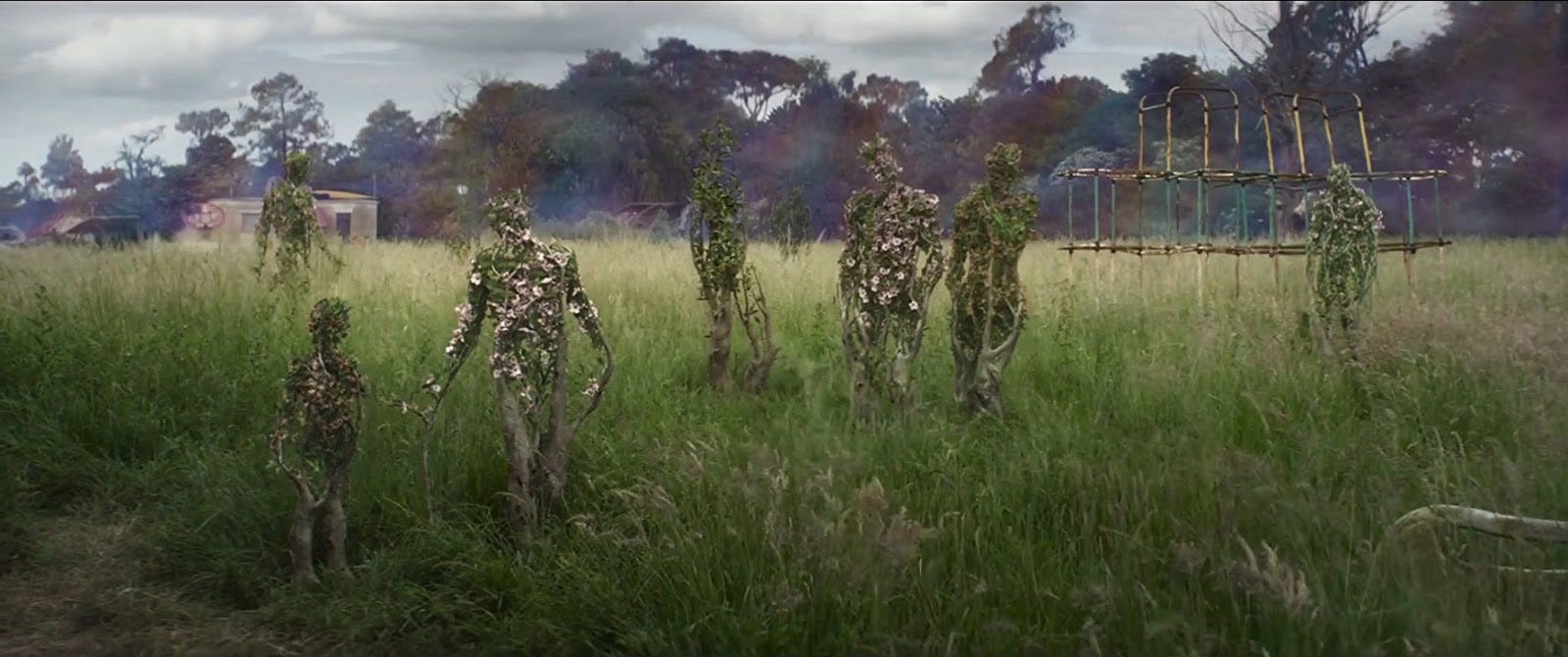
Image: from Annihilation (2018)
Area X is doing something to people. The question the trilogy keeps refusing to answer is: Why?
This is also where VanderMeer diverges from both Jemisin in a way that is important. In the Namazu prints, nature’s retribution is legible. The merchant class hoards wealth, and the earth shakes. In the Stillness, Father Earth’s rage is enormous but comprehensible: humanity wounded the planet, and the planet does not forget. But in Area X, the moral logic is less explicit. “If I don’t have real answers,” the biologist reflects in Annihilation (2014), “it is because we still don’t know what questions to ask. Our instruments are useless, our methodology broken, our motivations selfish.” Throughout the Southern Reach books, it is the expectation of finding logic and sense that is a source of horror and angst for the various characters that encounter Area X. They are engaged in an existential confrontation: a world powerful enough to destroy them, but not motivated by anything that makes sense at a human scale.
This is where anthropocide overlaps with cosmic horror.
In cosmic horror, derived most famously from H.P. Lovecraft, the terror is not that the universe wants to destroy you. It is that the universe is so vast, so alien, so indifferent to human categories of meaning, that your destruction is not even the point but merely an unfortunate (for you) byproduct of forces you cannot control. For Lovecraft (famously racist and xenophobic) the Other was the ultimate threat to self. When Western scientific rationalism fails to make sense of the world, and fails to control it, the consequence must be utterly destructive.
The horror of the Anthropocene, though, is that it is human-induced. The indifferent force bearing down on us is not alien. It is the consequence of ourselves, of our own actions and inactions.
Area X, in this reading, is not a metaphor for nature’s revenge. It is a metaphor for what we have already set in motion: a transformation so vast and so indifferent to human wishes that it seems beyond control. The climate is changing. We are witnessing species and ecological collapse and new configurations are emerging. Coastlines are shifting. The borders of the habitable world redraw themselves faster than we expected. The Anthropocene feels like a cosmic horror because we feel incapable of doing anything to stop it.
There’s a problem buried in the anthropocide trope, whether our destruction at the hands of nature is vengeful or inevitable. As a concept, it demands a separation between human and nature.
Namazu is not separate from the city he shakes – he lives beneath it, has always lived beneath it, is part of the same system of earth and water and human settlement that the merchant estates were built on. Father Earth is not the enemy of humanity, he is the ground humanity emerged from, the same geological process that produced the orogenes and their impossible, intimate power. And Area X does not invade from outside. It transforms from within. Area X is already inside the biologist that explores the region before she understands what has happened to her.
The human/nature divide is always a convenience, a story told by people who needed nature to be a resource rather than a relative. Anthropocide is what emerges when that story starts to fail, when the boundaries we draw between ourselves and the world that made us begins to dissolve, and we reach, one last time, for the comfort of an enemy, of a monster, of a horror.
Thanks for reading An Elsewhere Anthropologist! This post is public so feel free to share it.
Thanks for reading An Elsewhere Anthropologist. If you enjoyed this post, please consider subscribing. If you’re already a subscriber, consider recommending this post to someone you think might enjoy it.
You can always send me a comment or question.
For more, check out christophermarcatili.com.
No posts
Comments
Nothing yet. Say the first thing.
Sign in to join the conversation.