
Click here to listen to an audio version of this piece, read by the author.
The budget for Metro Goldwyn Mayer’s epic production of Quo Vadis, as approved in 1948 by L.B. Mayer himself, was $6 million. Even if there hadn’t been two years of pre-production to blow the number out even further, $6 million would have made Quo Vadis, by some margin, the most expensive movie ever conceived. The trade publications could barely contain themselves, let alone the agents. Mayer, that brilliant bespectacled blusterer, had really outdone himself this time.
And that wasn’t the half of it. Rumour had it that old L.B. had decided to shoot his diamond darling not on the MGM lot, but far across the country, across the Atlantic, a land six timezones away. Those in the business had heard the name floating around – Cinecittà, they called it, the cinema city – but the choice aroused some confusion. Indeed the only group more aroused than the reporters were the currency exchanges in Rome. Six million dollars, which meant something in the ballpark of two-and-a-half billion lire – yes, with a B. As it turned out, two years was plenty of time to ice the Dom Pérignon.
Two years of preparations – of scouting and amassing costumes and hiring and firing. By the time the cameras were ready to roll the budget had been revised up to $9 million, a staggering sum. Suddenly Quo Vadis was not merely a historic expense, but a historic piece of studio decadence, an outlandish task set in an outlandish place. What the hell was Cinecittà anyway? Didn’t Mussolini build it, and didn’t we swear to fight him to the death? Or was it a secret MGM asset all along?
For the months that it hosted MGM and its emissary-in-chief, director Mervyn LeRoy, Cinecittà became a kind of expropriated American territory, every inch of its 148 acres designated for occupation. And with reason: where else could you store 6250 pairs of handmade sandals, 10,000 pieces of gold-plated jewellery, 12,480 yards of toga fabric, a stable of bulls, 14 racing chariots and the horses that pulled them, and a pride of 50 ravenous lions? Where else could you rebuild Nero’s palace from scratch, or dig a channel big enough to hold, with any sort of believability, a Tiber’s-worth of brown-green water? If anything, 148 acres wasn’t acreage enough; if they could’ve upped the outlay by 50% like they’d done with the budget, they just might’ve.
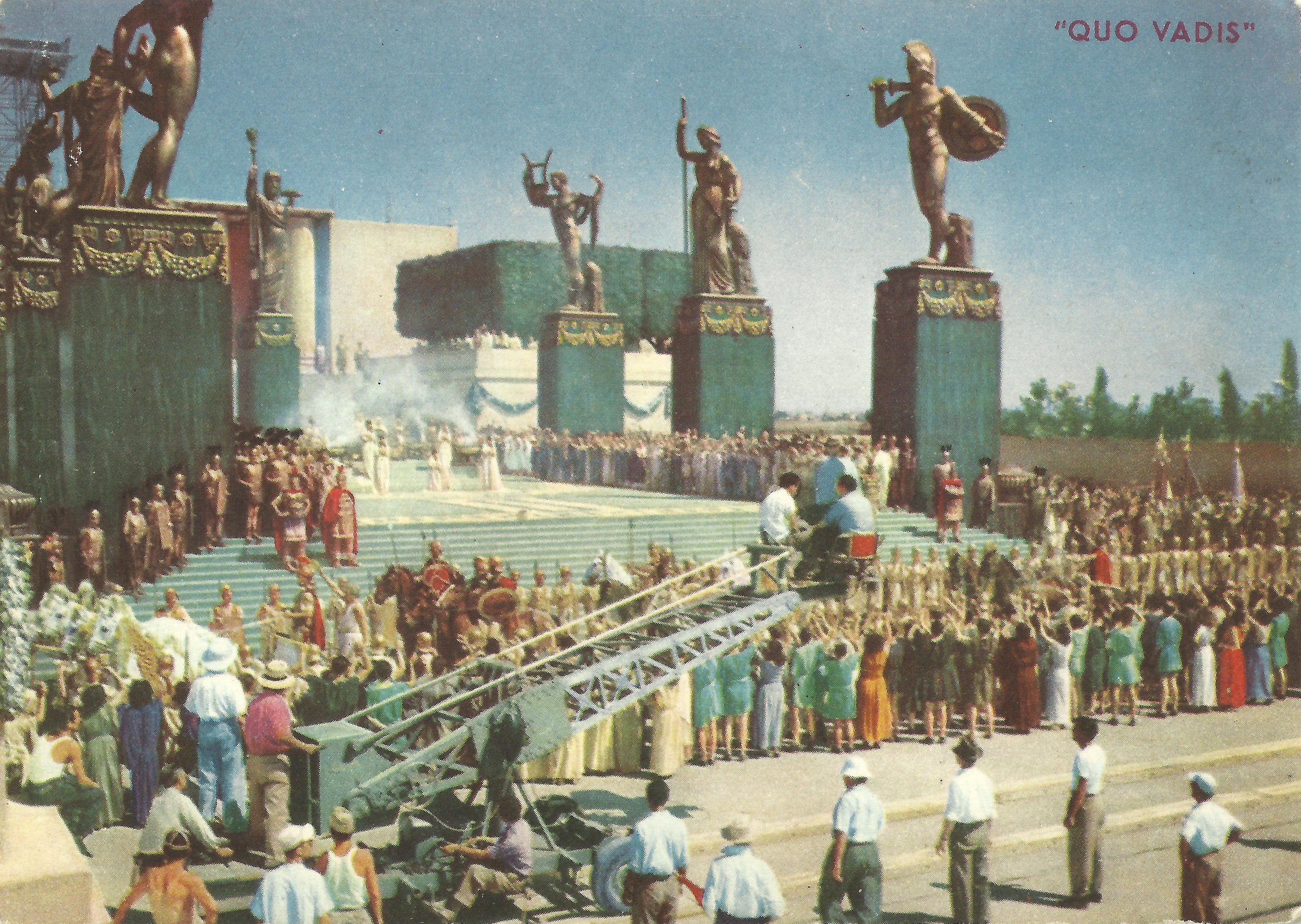
Of course, a few more extras and a few more togas hardly would’ve made much difference to the end product, but then again, any question over whether Quo Vadis ended up a great film or not was always somewhat extraneous. The production was the sell. Mayer knew it, MGM knew it, and so did the reporters, who dutifully played their part by instructing their readers to expect nothing less than “the most colossal film spectacle of all time.”
What this “colossal film spectacle” meant, in concrete terms, was a handful of Hollywood’s brightest stars, along with hundreds of imported crew, 5000 extras, and an untold quantity of anonymous labourers and hangers-on, collectively melting beneath the Italian sun for the sake of an L.B. Mayer vanity project. Quo Vadis has been passed over by the great eye of time, almost inevitably so. How could it ever have lived up to the legend?
And yet, though it was quickly forgotten in Hollywood, Quo Vadis is a lynchpin of Italian film history: without it, there would be no Cinecittà. Mayer’s film inaugurated a two-decade heyday which raised Mussolini’s monument to the movie age into the realm of cinema folklore. Fellini, Antonioni, Godard, Wertmüller, Bertolucci, Petri, Renoir, Zeffirelli, Leone – Cinecittà was their turf, the sizzling centre of the film boom in continental Europe, their answer to the Hollywood Dream Factory. With time the heralded Hollywood names joined in: Errol Flynn, Jayne Mansfield, Rex Harrison, Rock Hudson, Audrey Hepburn, Charlton Heston, Ava Gardner, Frank Sinatra, Burton and Taylor – just some of the pin-up personalities who, between 1950 and 1965, came to bask in the studio’s vaunted ether, an ether in which, today, gawking tour groups still hope they might capture some essential feeling of the great movie past. At least, that was my idea: see the old stages, wander the backlot, revivify images long dormant.
Of course, roving the ruins of Cinecittà’s empty entrails (and ruins I mean literally: the far end of Cinecittà houses the “Ancient Rome” set), one drops all delusions of grandeur. It’s a lot like the first scene of Contempt, Michel Piccoli drifting through the dry and empty Cinecittà backlot, the ground powdering his old suit, wandering through this place on the outskirts of Rome where movie history was written long ago. As I stood there, the ghosts of cinema’s past towering over me, I heard the words: “Only yesterday there were kings here. Kings and queens…”
It was true for Nick Ray’s Hollywood just as it was for Mussolini’s Cinecittà: In the beginning was the land; motion pictures came later. Kings and queens there were, but only after the long tenancy of ewes and rams. This part of the Agrio Romano was sheep terrain, home to shepherds and their ambulant flocks. Hitchcock always said directors should lead actors around like cattle; maybe shepherds and sheep were the Italian variation. It’s an image which also expresses something of the relationship between film and captive audience – not to mention propaganda and propagandee.
No matter how breathlessly Mussolini would later claim it, the real impetus for Cinecittà sprang from a man named Luigi Freddi. A professional propagandist by trade, Freddi’s youthful run-ins with the Italian Futurists and later involvement in the Fascist Party’s press office provoked an interest in what some might call the methods of dissemination, others the methods of tranquilisation. (Both were right – that’s what made the movies so useful.) In the mid-20s, Freddi authored a detailed report on the laggard Italian film industry and possible avenues of revitalisation. Naturally he saw in the cinema something of a tool to win Italian hearts and minds, but his report warned Mussolini away from taking the Soviet (and later Nazi) route. Sense-dulling depictions of nationalistic prattle wouldn’t do. Instead he advocated for a kind of sleeping with the enemy. Sure, they were the sworn nemesis, but really, who tranquillised better than Hollywood?
That Mussolini went gung-ho for Freddi’s plan might suggest just how much of the Hollywood fabulist The Duce had in him – not to mention the Hollywood narcissist. Scale and fervency were his catechism. His idea of persuasion came straight from the L.B. Mayer playbook: no matter how the image sounded or what the image said, the largeness of the projection did most of the convincing for you. In the newsreels, the cinegiornali, he was that much chestier, all huff and puff like a depraved Michelin man. At the same time, Mussolini could never quite transcend a certain peasant clownishness. He was artless and shallow, and understood movies only as entertainment – westerns, slapstick, Laurel and Hardy. Instead it was his son, Vittorio, much more naturally conversant in this new seventh art, whose personal interest in the Freddi plan may have lit the fuse on it.
If Freddi’s ideas had at first been met with some enthusiasm, before 1935 he had little to show for it. He’d launched a new national film school, he’d had his name stencilled into the door at the Ministry for Propaganda. But these were ersatz achievements, ungratifying without the realisation of the plan’s lynchpin idea – a brand-new studio. What changed things, in the end, was a rather fortuitous fire at the old Cines production facility (ah yes, that trusty Fascist pyromania), which left Mussolini’s grand national capital with a captive populace to propagandise but no functioning film studio. Suddenly it was go-time on Cinecittà. Land was chosen across the street from the film school, out in the Badlands of Quadraro. Blueprints were drawn up by a Friulian architect, Gino Peressutti. The brief was appropriately blusterous. Dispatched to Berlin, Vienna, Paris, London, Nice – the grand tour of Europe’s most illustrious studios – his job was to outdo all of them.
What Peressutti came up with indeed made the Rosenhügel studios in Vienna look like a playhouse for puppies. Unfurled onto his desk were sketches for a dozen sound stages, give or take, accompanied by a methodical arrangement of offices, dressing rooms, recreational spaces, cloakrooms, workshops, auditoriums, restaurants, bars, garages, warehouses, a canteen, a health centre, a pool, a power station, and a water tower. From the European studio he’d found most compelling – Denham in west London, designed by Walter Gropius – he cribbed a handful of Bauhausian touches which are still tangible in Cinecittà’s current form: its predominance of rectilinearity with a few comely curves thrown in, its rational layout, its fetish for symmetry. Cinecittà had, and still has, a rather immodest modesty. “Sober and practical elegance” is how Peressutti phrased it. Its excess of open spaces and towering stands of the Roman stone pine bring an airy reprieve from the city’s urban compactness, an openness which seems to recall the memory of the sheep fields it so long hosted in those placid days before the movies came along.
Upon officially opening the iron gates on April 21, 1937 – the 2690th anniversary of Romulus’s founding of Rome – Il Duce made his now-famous remark that cinema was, to him, “the greatest weapon.” For the next six years, between that inaugural speech and the bombing of Rome in July ’43, what proceeded was indeed a truly military approach to film production: 279 films shot, an average of almost one a week. Peressutti’s vision had already set the table for a massive scale of production, but then, during the studio’s 15-month construction, nine extra buildings had been drawn up and erected, taking the total from 64 to 73.
Which turned Cinecittà into something resembling a factory of soft war. Even today, the ambient buzzing of fans and A/C units, the steaming exhaust pipes, the hasty wooden scaffolds all suggest an atmosphere of industrial toil. Walking on the backside of the “ancient” Rome set, seeing the old planks holding up the plaster façades, I thought, predictably, of the phrase “Dream Factory.” But here, at Cinecittà, the phrase itself seems literalised, spoken with a different emphasis. That’s another distinction between the Italians and the Yanks. In Hollywood the stress is always on the first word. Here, it’s the latter.
For all its ’30s whimsy, Cinecittà holds its modernism with guardedness, like a tail between its legs. As with most Fascist architecture it more often recalls something vaguely belligerent, a reflection of Il Duce’s veneration of war, and after all, war, like movies, is just another industry. Certain buildings at Cinecittà feature portholes and canopies like a great naval ship, and the soundstages, broad and yawning, look like a legacy of repurposed Air Force hangars.
The biggest of the lot, the biggest in Europe even, is Theatre 5 – so big that, like some towering Gothic cathedral, it needs enormous buttresses on both flanks just to hold the thing up. For many studio visitors, Theatre 5 is the closest thing Cinecittà has to a pilgrimage destination, all thanks to its most famous tenant. If you’ve ever seen a Fellini movie you can well imagine his antics on the soundstage. Well, this was that soundstage, the Fellini soundstage, the place which made him an immortal, until, well, mortality caught up with him, and even then he couldn’t stay away. Days after his death, Fellini’s coffin was wheeled into the middle of the soundstage, put under the protection of armed guards, and deified under the glare of a single, appropriately theatrical spotlight.
It was his station, his sandbox, his site of birth and death. He liked to say he lived there, and he meant it too, in his own arch sort of way. Fellini’s life, not to mention his art, was a journey in dreams, and in Theatre 5 he could fall into the trance. He detected a kinship with what he called its “psychological atmosphere,” a place-feeling to which he was sensitised by Jungian analysis, and the depths of which he discovered after beginning to work there in the early ’50s. After a while his appointments in Theatre 5 became so frequent that he decided to plant the flag. He erected a permanent office above the theatre, which he began referring to as his “apartment.” “I live there not only when I shoot,” he said, “but when I prepare for the films, when I edit them, when I dub them, when I’m thinking about the next one…”
On the rare occasion he wasn’t “living” there, he’d loan it out to a faithful colleague. Visconti got his hands on it for White Nights and proceeded to build an entire urban neighbourhood, complete with a river running through it. That was what Theatre 5 could do – no wonder Fellini, that rampant fantasist, took to it so.
For reasons obvious to anyone who’s ever been there, Fellini also loved the EUR, Mussolini’s ghostly, surreal, monumental Fascist dream-suburb, which sits not far from Cinecittà in the southern environs of the campagna romana. But whenever it came time to put it on film, the eye of the filmmaker, and of the Jungian, made its own demands. Shooting the real EUR presented its real atmosphere in a way that was honest but shallow. Shooting a version of the EUR, rebuilt in the studio, gave a version of the real atmosphere that, while mendacious, could be extremely profound. Call it persnickety, but this, among other qualities, was Fellini’s genius. Like Godard directing Bande à part not as a gangster movie but as the remembered “reverie of a gangster movie,” Fellini didn’t reconstruct the streets and houses of Rome, he reconstructed his memory of them, which, in the end, he found more trustworthy. For La dolce vita he built a duplicate Via Veneto, and when some time later he stumbled upon the real Via Veneto, he discovered, to his surprise, that it was completely level. Didn’t it have a decline? Well, no, the real one didn’t, but the one he’d built at Cinecittà did. And he realised that, of the two, he preferred his own version. Later he’d put it all in a phrase: “For me,” he said, “Cinecittà has replaced the real world.”
Now that a museum has replaced Cinecittà – or at least feels as though it has – we can live the last melancholy chapter of Fellini’s perverted worldview. An entire building has been dedicated to his name and work, designed by the legendary Dante Ferretti. It houses the replica of the Remini theatre he frequented as a child, rebuilt for Amarcord, as well as a dimly-lit bordello set complete with tiara’d whores and a faceless male clientele and blinkering wall sconces and sleazy jazz.
And then comes the most unreal (I daren’t say Felliniesque) scene of all. Right before exiting the Fellini building you will pass a door, probably left half-open, behind which sits the museum utility room – in other words the cleaner’s closet – where, on the day we visited, six janitors were cramped into a space the size of a phonebooth, perched on top of buckets and vacuums, chatting loudly, laughing, bantering, one pulling the plastic off a fresh pack of cigarettes, another flailing her arms as she recounted a story, all contributing to a general air of wisecracking delight. After a moment one of them, perhaps sensing our presence, nudged the door closed with her foot; why I don’t know. It’s not like they had anything else to do. We were the only visitors there.
One of the first scenes ever shot at Cinecittà was a recreation of the Battle of Zama, for a film on the life of the Roman general Scipio Africanus. The scene, which called for 10,000 Carthaginian soldiers plus a few thousand horses to ride in on, was produced by none other than the Mussolini dauphin. Vittorio employed much the same philosophy as his father – cost was no obstacle for the sake of a great, swaggering image – which in part explains why, in the early days of Cinecittà, the regime threw money at the studio like crackers at a flock of gulls. Moviemaking became a tool of national braggadocio, a shot of self-conviction. The enormous scale of films like Scipione l’Africano were the pretext for the state’s decision in 1940 to ban the import and screening of Hollywood epics. What need for the Americans? We can build our own colossi. This, too, was part of Cinecittà’s hidden purpose: nothing inspired confidence like 600,000 square metres.
After the war, with Rome devastated and Cinecittà ransacked and pillaged, it was the Americans who salvaged the studio. Packing suitcases of cheques cashable to the offices of the Marshall Plan, they arrived at Cinecittà with full knowledge of the achievement of the Fascist filmmakers and a sense of the possibilities exploitable if only someone would rebuild the place. In 1949 the director Alessandro Blasetti provided yet more proof that it could still be done. Mustering whatever he could of Cinecittà’s haggard remains, he put together the historical epic Fabiola, without which, he claims, there would never have been any Quo Vadis. “Thanks to the money and the needs of Fabiola,” said Blasetti, Cinecittà became once again “the largest and most important complex in Europe[,] able to host, immediately afterwards, an American production.”
To explain why this seemed an achievement worth taking credit for, we might cast our gaze back to May 1942. “Spring in Cinecittà, Rome’s film city. Roses and jasmine are blooming on the paths that connect the sprawling area’s various buildings.” So reported a German writer assigned from the Film-Kurier in Berlin. What he didn’t mention then, and what the plaques of Cinecittà scarcely mention now, is who exactly held occupancy in those “various buildings.” A Red Cross report from October ’42 was more forthcoming: “It is a Labour Camp. The dormitories comprise 5 huts of double planking, roofed with tarred roofing felt. These huts, which are 32 metres long by 6 metres wide, stand on a foundation of well-aerated cement. The prisoners sleep on two-tier bunks.” It continues: “The general health in the camp is excellent. There have been no deaths.”
What to Allied eyes appeared a “Labour Camp” was referred to, in the cabinets of the Italian Royal Army, as “Concentration Camp number 122.” Capacity was estimated at 400 prisoners of war, but that was with production ongoing. By the time the Allies liberated the studio in June 1944, room had been found to house many, many more. Captives from the Battle of Anzio numbered at least a thousand. Crowds of Romani were dormed in the workshops once used to create plaster busts of the Caesars. Allied soldiers found 1500 refugees in Fellini’s “apartment” alone.
One rather vivid report, from August 1944, describes “the desolate spectacle of a great structure in ruins”: tanks in the parking lot, trees uprooted, broken mirrors in the “divas’ dressing rooms” where several Wehrmacht corporals had made their home. One day at around the same time, the filmmaker Francesco Rosi found himself called out to Cinecittà. When he came to the gate, he abruptly stopped, having suddenly been overcome with a fear that if he entered the studio, he might never come out.
That, for many Italians, was Cinecittà: a soiled name from a soiled past. In it was everything they would later want to forget. “Cinecittà,” wrote one Italian journalist, “was the official concubine of Fascism, the fat, bedizened whore required by any nouveau riche. […] Cinecittà was a kept, easy-living woman.” (It’s a character that just screams Italian cinema: the pudgy prostitute, cynical, past her prime and knowing it, glittering sequins failing to hide her blunted spirit.)
Now, 80 years later, the strategy of ignoring the camp stuff entirely is like something cribbed straight from the annals of Hollywood reputation management: we’d call it a canard if it was worth dignifying, but it’s not, so we’ll bury it instead. That Cinecittà’s exhibition rooms make nary a mention of the POWs, Concentration Camp 122, any of this sorry history shows how pointed was the desire to sweep it all under the rug. Then again, you can only hold back history for so long. Keen eyes scanning the museum walls will surely mark a printed still taken from a film shot at Cinecittà in early 1942. In it a crowd of extras double as Ukrainian refugees, huddling in a makeshift barracks, sleeping bodies packed tight like pressed filaments, pillows and stray suitcases scattered in all corners. One can’t help but wonder how much acting these “extras” were required to do.
That the Italians became so renowned for their “neorealist” films – their post-war movement of gritty, moral dramas shot on the crumbling streets of urban Italy – is a rather bewildering irony of culture. This, after all, was the land of Pagliacci and Scaramuccia, the land of those who tend, upon the slightest provocation or disagreement, to explode into operatic passions. If anything the neorealist period seems a reactionary exception to what has otherwise constituted an almost ancient tradition of hyperbolic unrealism. And after all, is there any better term for life on the silver screen than hyperbolic unrealism? Documentary veracity is a lie; so is historical truth. Smoke and mirrors, green screens and projection – it’s your job not to fall for it. Charlton Heston said it best: “The movies didn’t always get history straight. But they told the dream.” And that’s coming from the man who spent six months charioteering around the dusty Cinecittà soundstages, pretending to be Ben-Hur.
Italy’s almost preternatural affinity with the cinema seems more than mere fortune or free will. They are spiritual kin, a pair of fated lovers. Italians, the great dreamers of Europe, lived and spoke in flourishes of exaggerated actuality, which, as it turned out, was the language of the screen-world. The genres in which the Italian sensibility excelled required a conception of historical accuracy so tendentious you could pierce it with a Q-tip. Costume dramas, Westerns, peplum films (otherwise known as “sword-and-sandal” movies). Fantasy and self-conscious artifice was second nature to them.
And so it was only natural that they would make deadly wielders of the studio apparatus. If Fellini’s potency in the studio was matchless, many of his compatriots weren’t far behind: Leone, Zeffirelli, and Visconti, just to name a few. In a way they became emblematic of the Italian filmmaking sensibility, which sprung from an operatic worldview: swinging the camera with total freedom, constantly zooming and dollying and panning, emphasising the artifice of it all. They liked to cast bold, almost otherworldly faces; many of cinema history’s most suggestive-looking actors are Italian. And then there’s the dubbing – my God, the dubbing.
But the directors couldn’t go it alone. If the flourishing of the Italian cinema was the flourishing of the studio, it was also the flourishing of the craftsmen and technicians. Without them none of Fellini’s elaborateness would have seemed so convincing, nor Visconti’s aristocratic bluster, nor Alberto Sordi’s comical dexterity. At Cinecittà they’re called the Cinecittodini, and they have all the fascinating exoticism of people from a far-flung land. One spies them scurrying around the backlot as one spies strange birds on safari – with a kind of dumbstruck disorientation. Who are they? How did they end up here? Is there something wrong with them? What kind of malcontents would choose to reside in permanent artifice? What kind of person would choose to spend their days papier-maché-ing the heads of dead generals, or recreating, down to the scuffedness of the armrests, the theatre of some Romagnol village? Untouchable in their deluded commitment, they were also untouchable in their craft. Technically speaking, Cinecittà was the envy of the world.
But neither they, nor the directors, were anything but vertical putty compared to the women they powdered and lit. In the Italian cinema, the men might call “action”, but it’s the women who call the shots. The first thing you confront in the Cinecittà museum is the great wall of damsels: lipsticked matinee girls glaring with suspecting eyes at their rough-hewn leading men, putting on an elaborate headdress, stretching into a fishnet stocking. Eduardo de Filippo or Amedeo Nazzar can only look on in befuddlement, beaten by the too-beautiful leading ladies of the Italian screen.
And then come the big two – Sophia Loren and Anna Magnani – whose performances seem, even today, as indomitable, as dynamic, and as unutterably Italian as they ever have. From their lead, the deluge: Isa Barzizza, Claudia Cardinale, Elsa Martinelli, the Silvanas (Mangano and Pampanini), Tina Pica, Monica Vitti – all of them looking down on you gloweringly as you traverse Cinecittà’s dark halls. Mere gamines these were not – according to the movies, there were no gamines in Italy, only Women, Ladies, gale-force hurricanes to be reckoned with at one’s peril. Marcello Mastroianni finds this out the hard way in Marriage Italian Style; so too the entourage of Silvana Pampanini in La presidentessa.
Meanwhile, montages loop throughout Cinecittà’s exhibition rooms showing the men making whimpering attempts to size each other up, big boys measuring their wit in jousts of braggartry. On one screen, hot-headed bachelors ruin weddings and dinner parties by drunkenly brawling over some misplaced remark. (And who knows an Italian who hasn’t made a misplaced remark?) On another screen, corpulent drunkards make sloppy entreaties to an exasperated Roman cardinal – and judging by 2013’s The Great Beauty, the Italians clearly feel they haven’t exhausted this scenario. Even the spaghetti westerns played man against man, mind against mind, wars of elliptical speech devolving into confrontations at the corral. And in this world of dinner parties and delicate male egos, it was, of course, the women who really ran the show.
Not even an exceptional case like Fellini could escape the ardours of Hera. In fact he didn’t even try. His world is a lucid dream in which Woman knows the game by heart. She condemns to melancholy those who ignore her (I vittelloni), overpowers with her beauty (La dolce vita), orients a man’s restless obsessions (La città delle donne), is the only one who can complete him (Ginger e Fred), and becomes, in some sense, the symbol of life itself (Roma). Even if she’s a downtrodden case, a lost hope like Gelsomina in La strada, her obscure power haunts he who came to love her. Fellini’s women are truly “of the spirits,” and in the hallways of Cinecittà you can still feel their eagle glare peering down at you, batting their lashes expectantly – a reverent tribute to the eternal ladies of Cinecittà who once graced its stages.
As we strolled around the backlot my friend asked me, “Do they still make movies here?” Who exactly he meant by “they” I felt curious to know. If he was referring to a handful of steadfast cinephile auteurs, those with a fever for cinema history and just enough notches on the belt to keep their producers in obeyance – Luca Guadagnino, Jacques Audiard, the guy who won an Oscar for Conclave – if that was who he meant by “they,” then I explained rather demurely that yes, they do still make movies here.
But I immediately made the caveat that even that brief period of the grand and noteworthy nostalgics – Coppola shooting The Godfather: Part III there in 1989, Scorsese’s Gangs of New York in 2002, Wes Anderson’s The Life Aquatic in 2004 – that is a world away from what we have now. Today, places like Cinecittà are abandoned castles from an ancient epoch. Its denizens are the producers of relatively economical television, a handful of contracted crew, and a dribble of true believers coming to see the place where it was once deemed a logical and judicious expenditure of human toil to dig a replica of the Tiber River for the sake of “the movies”.
I suppose my friend had asked because, as far as we could tell, almost nothing was happening at Cinecittà and almost nobody was on site. It had the aura of an old plant with the workers on strike, only those on the picket line had died and no one had bothered replacing them. Perhaps he’d asked because it seemed improbable that this great testament to a bygone age of studio moviemaking could possibly be of any use in the era of streaming and CGI, which, as it turned out, is more or less the truth. It was announced last May that Cinecittà would get the glam up it has so long required. Five new sound stages, four completely renovated, the re-establishment of a laboratory for developing and printing film, and updated technology in the post-production facilities. Judging by the noise, the air conditioners probably need a working-over too.
In four years, they say, production capacity is expected to rise 60%. What they don’t say is where those productions are coming from. But asking those sorts of questions seems at this point almost rude. Better to go along with the fiction – it is a dream factory, after all.
The latest recovery scheme adds a new line in what now amounts to a decades-long monologue of ideas and notions forwarded to re-set the thrusters on Cinecittà. Almost none of them have done more than hold off the crash for a few years. Operationally the studio ended 2024 almost €12 million in the red, and that was with a booster shot of EU funding. With production quantities generally trending downward, it’s hard to know where to go from here. The typical sell-out moves have already been made. Cinecittà World, a themed amusement park and hotel complex, opened in Rome’s west in 2014, and the gift shop next to the museum is even more dire than one could imagine: plastic clapboards, coffee thermoses that look like camera lenses, and the same variety of leather bags you find in the shoddiest tourist-trap pelletteria, the same colours and shapes, except they’re better because they’re sold in a “museum” gift shop. There is barely a bottom left in the barrel to scrape.
At best the prognosis appears, let’s say, averse to positivity. Maybe someone who has read less than I have on the film industry’s seemingly terminal forecast would, on a quiet day at a quiet hour, walk around Cinecittà and feel almost no inclination towards melancholy. Probably they would feel nothing but genial fascination. But I couldn’t shake off what seemed like an ominous atmosphere enshrouding the place: a sense that the burden of the great past would doom it to a foreclosed future. The stages stood at attention, but nothing started, nothing stirred. The red lights remain unlit. There is almost nothing sadder in this world than an empty film set.
While Smoke Social remains free, there are several ways to support the project.
Please consider signing up to receive new posts in your inbox as soon as they’re published.
You can also share it with people who might be interested, or follow us on Instagram.
No posts
Comments
Nothing yet. Say the first thing.
Sign in to join the conversation.