
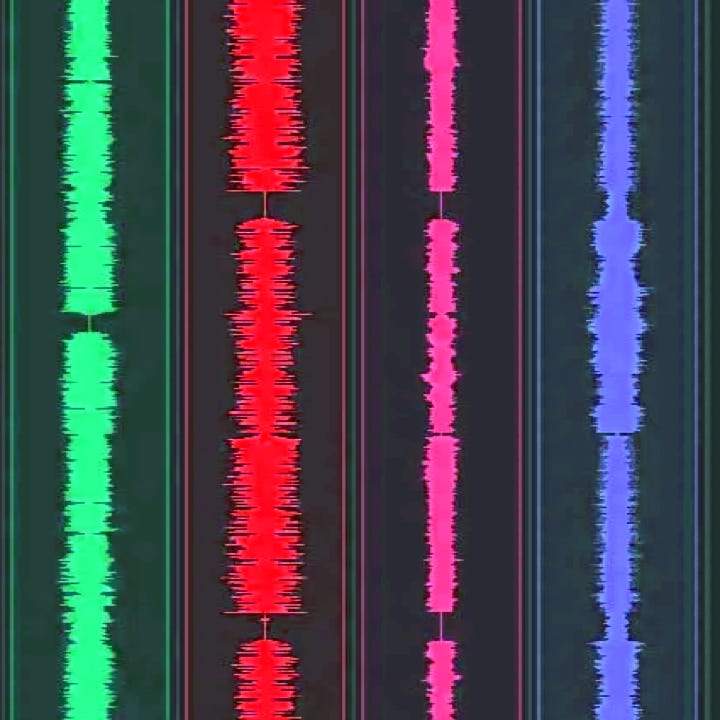
On the train now in Czechia to Prague and re-reading James Gleick’s excellent Time Travel. He describes various ways in which early filmmakers such as Méliès used the reversal of playback to comic effect to present time going backwards: the egg unscrambles, the rock pops up from the pond, the sausage becomes a living pig, et al. In the real world as we know it, these things will not happen. Certain processes are irreversible. You can’t counterclockwise stir a milky coffee to unmix it and restore its original form of black coffee and milk. The end result of such an irreversible process was maximum entropy - a form of ultimate disorder defined as the state of finality where no further processes can occur.
And so to another kind of mix, another kind of entropy, but this time in the audio realm. The Master tape. The Final. Or just The Mix.
In the days of physical tape recording, aka analog, once the mix was printed or rendered or finally outputted, that was it - the process was complete. The component sounds were now irrevocably intertwined with each other. If the mix was not to your liking, it could not be unmixed - one must make another separate mix from the individual tracks assuming you have more tape to spare as physical media had discrete limits (one could, of course, record over the previous mix). With digital recording, the dissatisfaction with a mix was easier to correct, just trash the imperfect file and redo the process.
Some years ago, noise reduction software was introduced which allowed a sample of the undesired noise to be mixed out-of-phase with a track and thereby canceling it out throughout the track. This was a first form of entropic reversal, one based on a crude algorithm: identify the noise, then negate it by adding it. With a bit of a leap, the identification of noise could be extended to the identification of non-noise: desired sounds. Machine learning allowed this technique to further develop with beta test models creating simple categories: vocals, guitar, bass, drums - each identifiable by a collection of characteristics: transient attacks, range, frequency curves. These first attempts seemed almost magical: the coffee could be unstirred. Now a song recorded 40 years previously could be separated, however imperfectly, into its audio components. The identification and separation continues to improve. A useful tool and an enhancement for the creative process, not an abdication of it.
Looppool was an album that I recorded at various NYC studios in 1986-87 using guitars, reeds, homemades, samplers, drum machines and the Atari ST computer running the software M. It was released in 1988 by Dossier Records in Berlin. I was never completely happy with the mixes and mastering so in December of 2024 I made use of stem separation software to open up the finished mixes into component parts for remixing and remastering. Entropy reversed!
No posts
Comments
Nothing yet. Say the first thing.
Sign in to join the conversation.