
Words matter. Especially in an era of drastic change, when the signposts that once helped guide American life have been rendered moot by a country suddenly careening in a different direction.
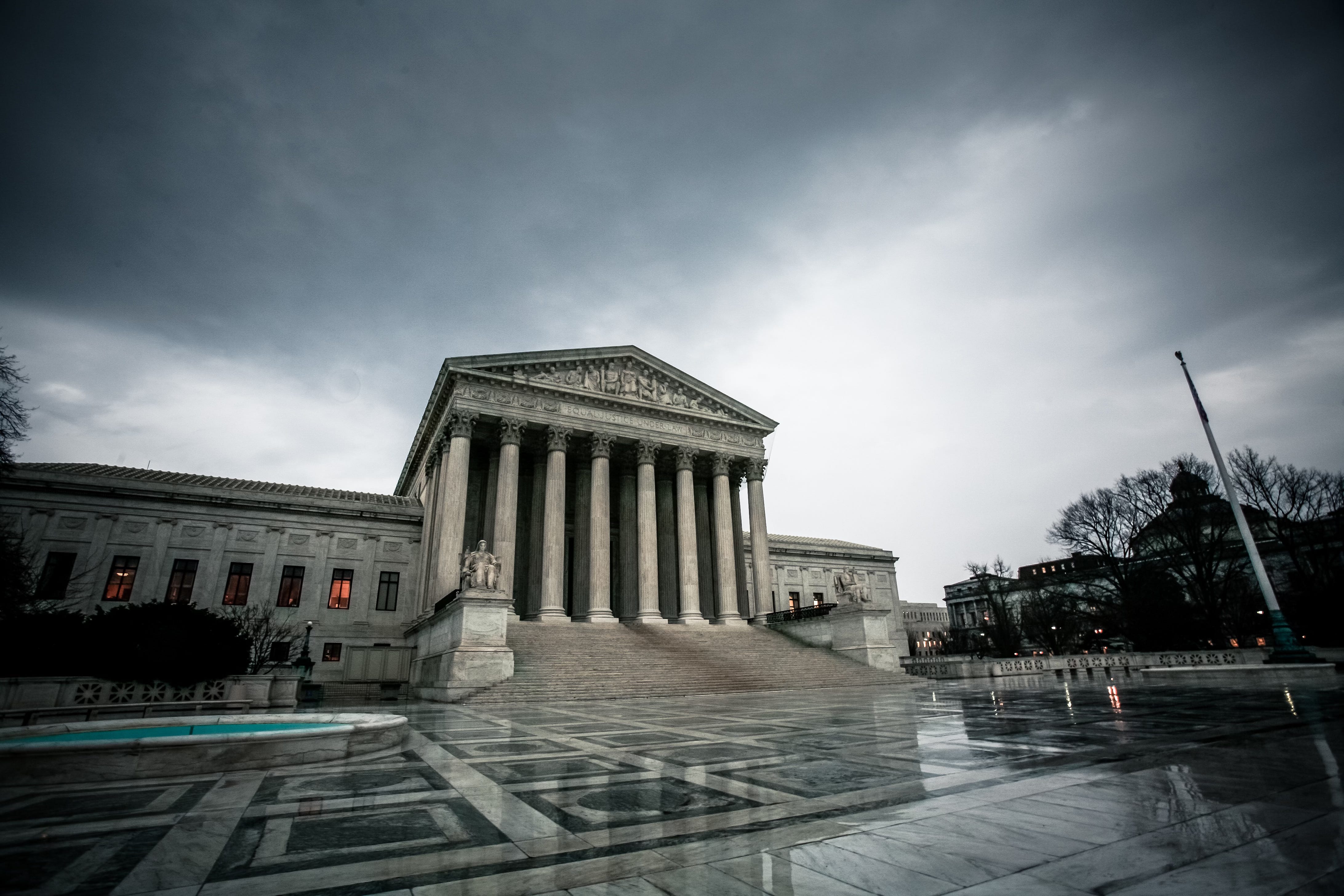
Yesterday, a radical, destructive, and unhinged Supreme Court majority finished its latest term by wrecking institutions that have long served as bulwarks of American democracy and ceding more unchecked power to a mad would-be king.
In its final flurry of rulings, the majority expanded the president’s authority to remove officials from independent agencies Congress had explicitly sought to insulate from partisan pressure. It struck down limits on coordinated campaign spending between political parties and candidates, opening another sluiceway for oligarchic and corporate money to course through our politics. And this came on top of earlier decisions that made a mockery of the Voting Rights Act as redistricting schemes strip Black communities of political representation. The majority also endorsed Trump’s harsh nativist views on immigration, from asylum seekers at the border to people living here under long-held protections from places like Haiti and Syria.
Even the few moments of relative restraint, like rejecting Trump’s attempt to rewrite birthright citizenship by executive order or allowing legally cast mail ballots to be counted, are faint horizons of hope only because they should have been easy cases. Instead, they produced divided opinions that revealed how many members of this Court see the law through a worldview soaked more in the language of Fox News and MAGA memes than in accurate history, judicial humility, or settled legal precedent.
And yet, in news reports, op-eds, pundit pontifications, and even the legal press, the word most often attached to these MAGA foot soldiers masquerading as jurists is “conservative.”
The word “conservative” has both a political meaning and a common-use meaning, but those meanings have now come into such tension that any honest accounting should expel it from descriptions of the MAGA movement, and especially from descriptions of this Court’s majority.
Merriam-Webster defines “conservative” as “tending or inclined to maintain existing views, conditions, or institutions” and “marked by moderation or caution.” Do either of these traits apply to the current members of the Court, who ostentatiously flaunt precedent, run roughshod over constitutional checks and balances, radically rewrite the terms of American life according to their whims, and seem eager to give unchecked license to the most corrupt and lawless president in American history?
They are radical, reactionary, and revanchist, unrestrained in their methods and imperious in their certainty. They do not appear to believe they are bound by precedent, Congress, history, institutional legitimacy, or any check other than their own desired outcomes, which sit far outside the American mainstream and the long struggle that has shaped our democracy, laws, customs, and constitutional jurisprudence over the last 250 years.
In short, there are many things you can call them. Conservative is not one of them.
For much of American political history, “conservative” was not the dominant label for the American right. The word came from Europe, where it was often associated with efforts to preserve or restore monarchy, aristocratic privilege, established religion, and inherited hierarchy. America was founded in rebellion against precisely those repressive systems.
In the United States, the term was adopted and adapted by those who claimed to be preserving the constitutional order. By the time of Barry Goldwater and Ronald Reagan, it had become a banner for a politics of limited government, free markets, anti-communism, traditional values, and suspicion of liberal reform. In the 1980s, as the label became ascendant, it was also wielded as a cudgel against “liberals,” who were cast as architects of disorder and chaos, a definition too many on the political left came to accept, weakening the struggle for justice and equality that had propelled the Civil Rights Movement.
But all that now feels like ancient history. Many liberals adapted by adopting the language of progressivism, while most politicians who still call themselves conservative, including the politicians in robes on the Court, have twisted the word to fit whatever shape Trump’s mercurial whims demand.
There are still those who hearken to a different era, who call themselves conservative as a way of decrying the lawlessness and chaos of the MAGA age. But that attempt to rescue the word from its present corruption is a semantic exercise far removed from the discourse of everyday citizens.
Every time a newspaper headline, cable news pundit, legal analyst, or even progressive politician refers to the “conservative” justices on the Court, they are sanewashing a group that is neither acting like justices nor behaving like conservatives by any common definition of the word. To use “conservative” now is to become complicit in the propaganda, an accomplice to the autocracy.
It is precisely because words matter that we desperately need a new vocabulary for this turbulent age. Our politics, especially the naked, reckless reach for power practiced by the majority on the Court, cannot be adequately captured by the inherited political vernacular of a bygone era.
The entire idea of a written constitution, which these supposed jurists swore an oath to uphold, is that its words have inherent meaning, definitions that cannot be overridden by the craven and lawless impulses of a president who sees himself as king.
No posts
Comments
Nothing yet. Say the first thing.
Sign in to join the conversation.