This video lecture is part of the Identity and Selfhood course on Substack. You can find the reading list here. Links to readings and access to the full lectures as video and audio are provided to subscribers, with low-income and student learner discounts available on my homepage.
Our culture is widely understood as self-obsessed. We take selfies and identify with our astrological signs. We spill our fears, hopes, and desires to patiently listening therapists. We self-brand in cover letters, optimize our bodies with the latest biohacks, and belabor our personal branding for social media profiles.
Given all this, you’d be forgiven for thinking that the antidote to our self-obsession is just to focus on the self less. It’s no surprise Girls star Jemima Kirke went viral for saying to young women, “I think you guys might be thinking about yourselves too much” (I discussed this in a recent Substack Live).
But what if the problem is not that we’re too focused on ourselves, and instead that we’re focused on the self in the wrong way? We’re focused on a particular idea of the self that existentialist philosophers such as Jean-Paul Sartre call the ego. The ego, technically speaking, is the self as an object. The ego is the source of our pride and shame, the self that others see when they encounter us as a being in the world among other beings. It’s not quite the same as the ego in psychoanalysis, which has a more technical meaning (say, in contrast with the id and superego), nor is it reducible to the colloquial sense of ego as implying being full of oneself. Rather, the ego for Sartre is roughly what William James and his contemporaries called the me as opposed to the I. (In fact, the word ego in French is le moi.)
Pretty much everything in our society inclines us to think about the self as an object. And it’s not that we can’t, or shouldn’t, think about ourselves this way. However, the ego is not the whole truth of who we are, and we alienate ourselves from ourselves when we think of it as such. In being confused about the nature of the self, we become confused about how to live well. And so we proliferate discourses about the self that will never satisfy us. Even the solutions on offer in self-help literature encourage us to treat ourselves as objects to be scrutinized, categorized, improved, or loathed. This limits self-help’s ability to, well, help. Our constant talk of self-improvement, being our most authentic selves, and finding our true selves is masking a deep lack of awareness of who we are. And the solution is not to pay less attention to ourselves. Instead, we need to relate to ourselves in a different way.
Michel Foucault thought that something similar was going on in his culture’s endless talk of sex. The obsession with talking about sex, Foucault thought, masks a fundamental ignorance about actual pleasure. We’ve developed a sophisticated science of sex, or ways of classifying sexual practices and pathologies, at the expense of an art of the erotic.
I think we can understand the proliferation of discourse about the self as comprising a science of the self, whereas we lack an art of the self. While the science of the self distances us from ourselves, the art of the self connects us. The art of the self would have to be an art of relatingto ourselves. But what would such an art look like?
We can start to see its possible contours in a story the Buddha tells about two acrobats. One tells the other that the best way for them to achieve their goal of balancing on their bamboo poles is to look after each other. But the other responds that it’s actually the opposite: the best way is actually to look after themselves. The Buddha uses this as a parable for how the practice of liberation requires looking after yourself–not as a matter of self-discovery, but as a practice of recognizing the patterns of your own mind.
Just like the assistant Medakathalika said to her master: "I will look after myself," so should you, monks, practice the establishment of mindfulness. You should (also) practice the establishment of mindfulness (by saying) "I will look after others."
Looking after oneself, one looks after others. Looking after others, one looks after oneself.
This affirmation of looking after oneself might seem strange at first, given that the Buddha also denies the existence of the self–at least, of a certain type (the type that is lying deep within, waiting to be discovered. Stay tuned for the July 29 course reading and video lecture, which are on this topic). But this is precisely the point: that, when we practice attending to ourselves carefully, we disentangle ourselves from self-obsession, because we begin to realize there is no solid self. And that makes us better able to take care of ourselves and others.
The practice of relating to ourselves liberates us from the idea of finding ourselves. There is simply no self to be found. There is plenty to discover all the same, though. One way to begin is to reframe our goal: instead of self-knowledge, we should seek self-understanding. Understanding is gained through self-interpretation, a complex process of paying attention to our surroundings, feelings, and thoughts, and reflecting on their possible causes.
Renaissance philosopher Michel de Montaigne offers a key framework here. No one took the art of the self more seriously (while also not taking himself too seriously). The inventor of the essay, which literally means ‘attempt’ in French, Montaigne was constantly attempting to understand himself in relation to his world. His essays are filled with explorations of his beliefs, relationships, and even his experience of kidney stones and erectile dysfunction. For Montaigne, the entire spectrum of human life was worthy of philosophical analysis. Most of all, what Montaigne shows is how this analysis can be an art of self-relating rather than a science of the self. He advocates self-interpretation not as a practice of reason, but as a practice of experience.
What Montaigne advocates bears an important resemblance to the mindfulness practice the Buddha advocates, which can also be understood as an art of self-relating. Mindfulness is a meditative practice of cultivating careful attention to the arising and passing away of experience at all levels.1 It fosters the precise opposite of self-obsession, because it reveals that there is no stable self underlying experience. Thus, we could perhaps equally call it an art of the no-self, as it provides an antidote to thinking of the self in the way that we usually do (that is, as an object). The art of the self is an unraveling of self-obsession. While the science of the self constrains us, this art makes us freer.
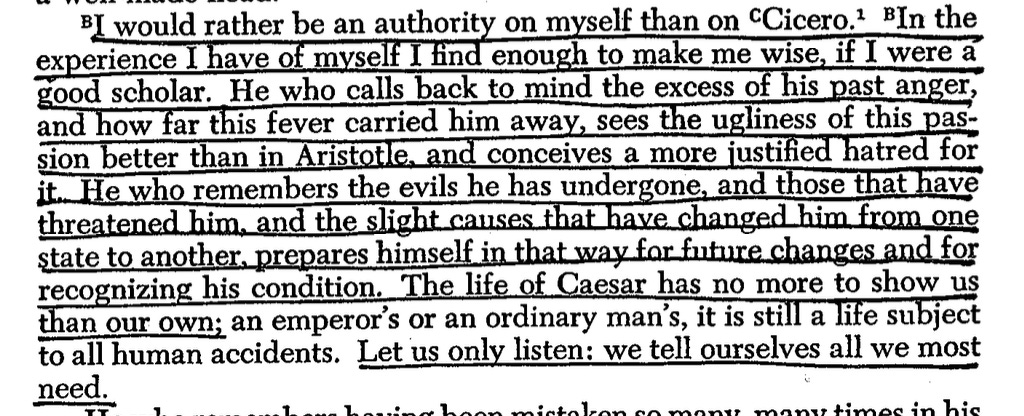
I see this insight everywhere in Montaigne’s writing, but no more so than in his classic essay, “Of Experience.” I assigned this text as part of the course and made a video lecture contrasting it with Descartes’ Meditations because I think it offers an unparalleled picture of the art of relating to ourselves. At first glance, it might seem that Montaigne is obsessed with himself. After all, he says he studies himself more than anything else.
But studying himself, it turns out, reveals the multifaceted and dynamic nature of the self. Really focusing on our own experience can give us direct insight into the ever-changing nature of reality and loosen the hold of public opinion. Too often, Montaigne thinks, we just parrot things we’ve heard from other people. And we feel the need to develop opinions on all sorts of things unrelated to us (and he’s writing this hundreds of years before X). What’s the good in that when it pulls us away from attention to our own experience, and therefore also from true insight?
From the Donald Frame translation of Montaigne’s Essays, p. 822
Reflection on our own experience is our greatest teacher.
But lest you think that Montaigne is leaning into navel-gazing, it’s worth highlighting that this and his other essays equally reveal just how our experience is interwoven with the perspectives and opinions of others. The “experience I have of myself” teaches me in large part because it is already shaped by my social relations: I might notice an inner voice is that of a teacher or parent or friend (or, more common today, that of an influencer or celebrity with whom I have a parasocial relationship). “Our opinions are grafted on one another,” Montaigne writes, and they don’t come out of a vacuum. So even what might appear to be navel-gazing is also a way of paying attention to the world.
This art of the self provides an antidote to the idea that we need to craft a singular coherent self. That idea is encouraged by capitalism: you need to have a personal brand that is the same across all contexts. Mark Zuckerberg has stated that the rise of social media has led to the end of “the days of you having a different image for your work friends or co-workers and for the other people you know.” He praised this change, saying that “having two identities for yourself is an example of a lack of integrity.”
I’ll take what Zuck says about integrity with more than a grain of salt, but one thing worth noting here is that he’s identifying different images of the self with identities. He’s treating the ego as the whole truth of who we are. (In existentialism, this is a mistake because it overlooks that we are not just objects but also subjects, as you’ll recall from the Existential Self video). This expectation that we have a single identity rooted in the image we promote on corporate social media platforms actually drives a lack of integrity, I think. It leads us to neglect the art of relating to ourselves by narrowing our focus to the image-creation of the ego.
For all lecture videos and readings associated with the Identity and Selfhood course, please consider a paid subscription! Low-income and student learner discounts are available on my homepage.
I have a lot of thoughts on the distorted and shallow approaches to mindfulness that are ubiquitous today, but at bottom, this ancient practice is I think our best shot at well-being, and I’ve been practicing it (mostly in the Insight meditation tradition, rooted in the Theravada Buddhist lineage of the Thai Forest tradition) since 2008. On the superficial uptake of mindfulness, see Ronald Purser’s book McMindfulness: How Mindfulness Became the New Capitalist Spirituality.

Comments
Nothing yet. Say the first thing.
Sign in to join the conversation.