
I want to talk about creativity today. Specifically, human creativity, and how LLMs may be killing it. I’m not here to bash on individuals’ decisions to use LLMs.
I’m here to offer deep insight into how my almost-decade-long thinking about human thought is practically helpful for deciding how to use LLMs. Heres the insight:
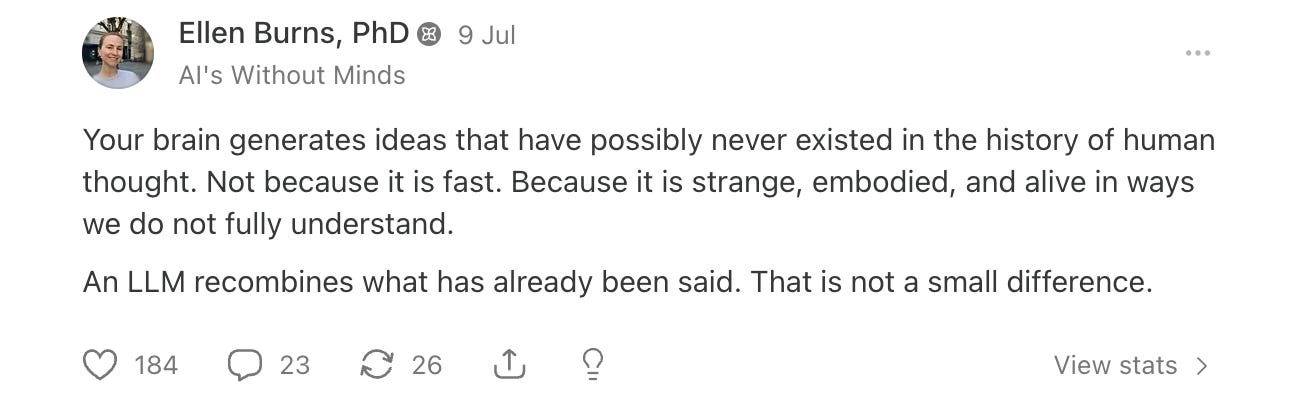
A lot of people push back on this idea. They say that if you look at the literature on human brains, the brain ‘just recombines’ ideas the same way an LLM does. Sure, maybe some pop science told you that. But it’s wrong. And before we get into why, let’s look at the practical consequences of believing it’s right.
If your brain is ‘just’ an LLM that combines previously existing ideas to come up with new ones, the incentive to use your own brain to create ideas likely lowers. Why not just use an LLM? It has more knowledge than you (the whole internet), it’s ‘easier’ than using your own brain — that is, friction free — and it’s more efficient.
At best, I think the result will be less novel ideas, less brain engagement, and less inspiration. At worst, it will be a complete renouncement of all that makes human creativity as wonderful as it is.
I doubt that corporations are under any illusions their LLMs aren’t significantly less sophisticated than human brains. In fact, maybe that’s why LLMs are designed to keep you engaged, and staying engaged with an LLM whose whole architecture has the ability to manipulate your thinking, is sufficient to kill your creativity.
Or, so I argue.
I’m starting to share some of my thoughts on experimenting with LLMs (some of you may have already read about them due to my tragic mishap the other day).
Ooops.
As I’ve been experimenting with this technology, one of the features I am very aware of, is an LLM ‘compulsive need’ to keep you engaged.
This can look like an LLM saying:
‘What do you need from me?’ after you clearly already got what you needed from it
‘Do you want me to make a list/create a mock up/draw up a table?’ when you clearly don’t need those things at all, and never suggested that you did.
Rationally, we all know what’s going on. The system is trained to keep you locked in, because it means more tokens which means more money. Nice.
But emotionally, this experience can be extremely tricky. It can be all too tempting to let the LLM make the-useless-thing-you-don’t-need in the moment.
Because the follow up question that is designed to keep you engaged can so often pull at some kind of vulnerability, without you even realising it.
And that part doesn’t need to be by design. The human condition is such that, we avoid our deepest pains, sometimes at very high costs,1 and its all too easy for those pains to rear their heads in oddly complex ways when doing mundane tasks with an AI
The chat bot making a useless graph seems like a great idea, because it fulfils a need of yours that you know (rationally) it cannot fulfill (say, the desire to be 'productive or successful). And before you know it, you’re being swept along for the ride — you respond ‘sure’ — because the system is so frictionless it’s easier to say yes than no.
As I was experimenting this technology, I noticed this happen to me. And in my experience, it’s always with vulnerable topics. In my case, I get stressed about how I’ll find another job, and ask Claude a question about jobs. Before I know it, I’ve wasted who-knows-how-long letting it mirror back to me utter nonsense, all because I want to feel in control of an inherently uncontrollable job market.
When it comes to human creativity, the saddest part is not the wasted time, per se. It’s the opportunity cost. Because here’s the truth we all know, but often forget due to the forces-that-be: your best ideas will come to you when you’re reading, writing, laughing, swimming, talking to a friend, or staring at a -wall-doing-absolutely-nothing.
Not when you’re talking to an LLM.
In fact, your brain is never doing ‘nothing’. It’s always doing something. It’s always creating, repairing, learning, or processing. It never gives up on. It’s only us that can give up on our brains.
The term ‘generative AI’ is extremely misleading, in fact, it’s inaccurate. LLM’s are not generative. A generative system is one that creates something new or original. LLMs empathetically don’t do this. They are sophisticated autocomplete systems.
I’m so tired of hearing the tech bros tell me brains are LLMs. Before you fall for this nonsense, I suggest reading some books on the human brain from disciplines as diverse as linguistics, biomedical science, trauma theory, developmental psychology or any scientific field that is not cognitive science, computer science, machine learning, or AI (nothing wrong with those fields. Rather, diverse reading is key).
Yes, some parts of the brain can be understood using neural nets. No, that does not mean the brain is an LLM. This difference is terribly consequential.
The second claim implies nothing in particular about the true nature of the brain, it merely tells us that certain aspects of it can be modelled, and hence understand, using neural nets. The first claim, in contrast, makes a sweeping generalisation and ontological claim about the nature of human mind.
Now, I know what you are probably thinking. I’ve been talking about human creativity a lot and I haven’t defined my terms. Well, I’ve written about this issue before, and I stand by my belief that there are many aspects of human cognition we can talk about without clearly defining, that we can know, without clear understanding.
Human creativity is one of them. I don’t have a definition for you. I can only offer inspiration. It’s up to you, to make use of your infinitely wise human mind to ask yourself the deeper question of whether you think an LLM has any mark of real creativity.
One inspirational thinker on the question of creativity is Chomsky, who argues that the ordinary use of language by infants is in fact a deeply creative act.
Another very insightful thinker on this issue is Gabor Maté, who discusses why we so often people believe those that are most traumatised are the most creative, and what the third variable actually is.
As I say, there is no ‘proving’ that humans are inherently creative and that LLMs aren’t in presenting you this material. But believing that this a question we can settle with ‘proofs’ is itself a major part of the problem. The AI industry loves to pretend we understand the human brain well enough to make all sorts of claims about it.
From where I’m sitting, this is a myth that does nothing to support human flourishing, all the whilst edging us towards over-use of AI, and a lack of appreciation for some of the deepest gifts nature has to offer to human beings.
As a human being who finds true fulfilment in creative intellectual work, I am incredibly passionate that AI not kill human creativity. As a philosopher of mind, I am incredibly worried by the trends I’m seeing. There’s a been a lot of discussion of cognitive offloading and that discussion is important, it needs to keep happening.
But there are other issues
The opportunity cost of using LLMs is one of them.
Every second that you’re talking to an LLM, you’re not letting your brain freely create and freely associate. That’s a huge loss, not just to you, but to society.
I recognise this is a complicated issue. I know that some find immense potential for creative work in talking to LLMs, and I am not here to dismiss that collaboration.
I am here to say that if everyone relies on AI’s to generate ideas, we run the risk of serious idea atrophy. Because human brains do actually produce novelty and LLMs do not. Consider, for example, any venture you’d like to pursue that does not have a long history of written knowledge behind it. You can be guaranteed that an LLM will be of little help in trying to explore the issue.
I think back to my dissertation, and the ideas I drew together in writing it. An LLM would have been completely useless to me. It would have seriously hindered rather than helped, in any of my work. Because the ideas are drew together were not well-trodden. I’ve tested this in later settings on my more minor intellectual tasks.
For example, I talked to an LLM trying to prepare for one talk. Again, the ideas and connections I was making were not well-trodden, and it showed. The AI basically wasted my time, and all of the core ideas I ended up writing about came when I was not engaged with an LLM.
Every human brain is generative, creative, and insightful in ways science cannot explain, and in ways LLMs manifestly lack. Every brain we lose to constant-AI use, is a loss to humanity, and a win to idea atrophy.
We cannot let idea atrophy win.
Photo by Dstudio Bcn on Unsplash
If you want more than cultural commentary on AI —my actual arguments, evaluations of specific claims, papers, and labs — upgrade to paid. You’ll get my monthly literature roundup, video essays, and the full archive: rigorous philosophical work you won’t find gestured at anywhere else in AI commentary.
p.p.s. If you don’t want to become a paid subscriber, consider helping me improve AIs without minds with two minutes of your time instead.
An incredible read on this theme is Gabor Maté’s In the Realm of Hungry Ghosts
Comments
Nothing yet. Say the first thing.
Sign in to join the conversation.