
If you’re new around here, these polaroids are a place where I journal through small windows. They’re more personal than my longer form essays and (usually) more regular. They might be a little confusing if you live in the Northern Hemisphere with opposite seasons. But, out of all the places you could be, thanks for being right here.

I’m convinced that a layer of frost covers the grass one morning in late July. My husband says it’s just the grass clippings from mowing the lawn the day before. I kneel so close to the lawn in dawn light to take a closer look that I wonder what the neighbours must think. Mild winters are common here in the metro area of West Australia; frost is rare. “Yeah, Mumma! It’s silver!” shouts our oldest son with exuberant certainty across the still crisp morning air, also sticking his nose to the grass.
For me, frost’s presence, or dew (we’ll take either at this point) where the warmth of the day and the cold of the night collide is a shimmer of beauty and intricate design, a vital dose of hope to my wintering body.
I love collecting the phrases that writers use to describe these transient glimpses of beauty. Lamott describes them as ‘a sigh’ of God’s presence, ‘a visible sign of an invisible grace’ and poet John Donahue calls them ‘little contours’ you can glance sideways at in bleakness. Greig in his book ‘Engaging the Silence of Unanswered Prayer’ calls them ‘a wealth of little epiphanies glimmering in the puddles at our feet,’ that are much harder to see if we ‘rage against the heavens, remain[ing] impoverished in our pain.’ Signposts, presence, design – I need them now – and yet don’t we always need them?
They can’t be marred by bad news. Our eyes cannot see them all; they exist without always being seen. Our hands cannot hold them all; perhaps too far to be touchable or too near to be holdable. They exist without demands or agendas or fanfare. Their patterns tell stories that we don’t always understand.
Late to the party, I’m reading Katherine May’s Wintering. I laughed my way through her chapter on visiting Stonehenge during Winter Solstice, knowing only too well the rhythms of the year around these stones and all the quirky, unapologetic rituals associated with them, having attended primary school on the edge of a Neolithic stone circle. I keep thinking about her words, during my own wintering of my fourth trimester,
“We have seasons when we flourish and seasons when the leaves fall from us, revealing our bare bones. Given time, they grow again.”
In these post-partum months, my bones feel bare, like a delicate skeleton of frost branching across a blade of grass, slowly thawing. In time, the morning light brings gentle relief and beauty.
I was feeding our six-week-old in the lobby of a church building which has a neighbouring café in the throes of sleep deprivation and six women were sitting close by in pink and grey hijabs. I come to this café almost weekly and have never seen this group of women before. I laid my baby across my lap as I held the nursing cloth over my shoulder and tied it around my neck and prepared to feed him. I was sharing the only sofa with two of the ladies and couldn’t avoid over-hearing their conversation. They swapped stories about their husbands, laughing heartily “I can see him sitting in his driveway on his phone. Then he comes inside the house and needs to use the toilet and spends another twenty minutes there!” The women chat about their weekly grocery budget and what time of day they pack their kid’s lunchboxes and whether they let the watch TV before or after school or before or after homework and I recognise the delight found in these little moments of motherhood.
A lady who isn’t a Muslim sits with them and one of the ladies quietly shares with her “Did you know that in the Quran we have a verse that says that motherhood is ‘hardship upon hardship? It also translates as motherhood is weakness upon weakness. Much like how Allah is described as ‘Noorun ala Noor’ (light upon light), we say things twice to emphasise them, she says. The depth and breadth of motherhood, of God, can’t be underestimated.
I know a scripture which says that there is a power for this weakness that is not my own, a power that perfects itself in vulnerability and I rest here, inside the freedom and acceptance of these words. I can lean on others and I don’t have to think I can do it all. I’m given grace for each day.
I turn a little away from them on the sofa, wipe my tears with the cotton nursing cloth and let out a little sigh, grateful for another little miracle, grateful to be understood.
In an afternoon haze, my newborn eyes seem to hold rainbows. I don’t understand what I’m seeing and wonder if my post-partum hormones are making me a little delusional, so I turn my head and look from different angles and turn his head gently to get a better look. In light, I can’t see the colours. In shadows and darker rooms, I can see them more clearly.
I read that this film of colour across the eye, like when fuel and water mix, is a layer of lipid oil on the surface of the eye, preventing the watery, thin part of the tears from evaporating too quickly. This layer of thin oil keeps the baby healthy and stabilizes the surface of the eye.
There is an impossibility to documenting these tiny rainbows with my camera; I’ve tried. I don’t that it’s a coincidence that I can’t freeze this moment in time. I can’t hold the fluidity of the colours within a still frame, much like motherhood, much like these post-partum days.
I tell my sister on the phone ‘I can see rainbows in his eyes’, and she thinks I’ve lost it this time. ‘Are you okay?’ she asks, and we laugh without drawing much breath for a few minutes.
Later, I research newborn tears. I watch a video of a father looking at his child’s tears under a microscope.and learn that tears under a microscope reveal delicate crystals that are formed by salts, antibodies, and other proteins as the water evaporates.
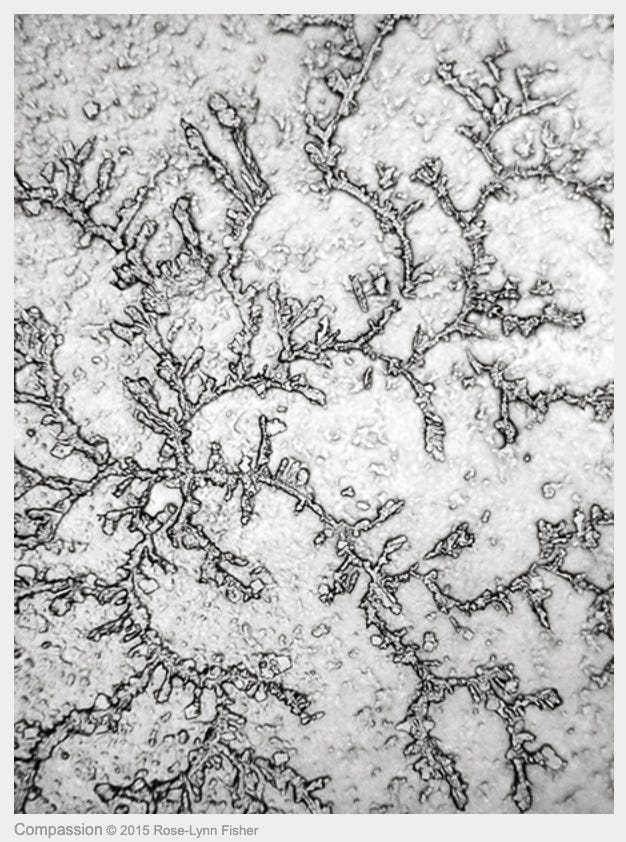
I look at the work of photographer Rose Lynn Fisher and her project ‘The Topography of Tears’ which she began during a period of personal grief. Over eight years and using a 1960s Zeiss camera, she photographed the range of her emotional tears by shedding them onto glass slides and putting them under the microscope. She found that the visual appearance of each tear was unique, like a fingerprint. Tears from the same emotion, or even the same moment, looked different from one another and couldn't be sorted into categories, “my tears revealed to me momentary landscapes…an ephemeral atlas,” Fisher said.

For babies, these completely one-off patterns are much more fragile and sensitive to humidity than the cell structure of adult tears and their formation is a sign that the tears can protect the baby's eyes from infection.
Their power is in their fragility.
Another contour, another sigh, another atlas, another reason to keep believing: the crystals inside baby tears look like the frosted miracle of another new day.
No posts
Comments
Nothing yet. Say the first thing.
Sign in to join the conversation.