
I put my heart and soul into every piece I write—sometimes I look for humor in life’s moments and other times I wrestle with memory, fear, and the search for meaning in a world that keeps shifting beneath our feet.
If this essay spoke to you, please consider giving it a like, sharing it with someone who might need it, or reposting it. You can also support my work directly through Ko-fi—or simply by subscribing, reposting, commenting, or spreading the word. Every gesture, big or small, helps me keep writing, reflecting, and connecting through words.
My grandparents have both been dead for some time. My recollections of my grandmother are the strongest. Grandma Lotka was an elegant woman with pencilled eyebrows, elegant gold jewelry, a generous heart and forever sporting a fresh coat of lipstick. She was 73 and she and grandpa were on yet another vacation to the US when she realized something wasn’t right. The doctors hastily operated, only to discover they could do nothing for her. It had ravaged her from the inside, doing in months what decades of persecution never managed. Now there was little left to do but get her affairs in order. I was a new mother living in Israel at the time. I flew back to London as soon as I could, and she thankfully got to hold her first great grandson,in her bony arms. That great grandson now has a child of his own. Of course, he remembers nothing of her.
And time is eroding my memories. I recall the distinct smell of their modest house in Wembley, London, their opaque glass entranceway, and how the sprawling willow tree at the back of their garden tore up the adjacent parking lot with its massive, invasive roots and was thus condemned by the local council to an untimely end. I remember sleeping on their lumpy guestroom bed, sipping cups of strong tea served on blue zwiebelmuster china cups. Whenever we visit Prague, I seriously consider buying a set. Both my grandparents spoke excellent English (and French, and German) but were never able to rid themselves of their strong Czech accents. “Ella daahlink! Hew are you?” my grandma would croon on the phone as if I was the only person in the world who mattered to her.
I remember how they returned from vacations with gifts for everyone. I remember her serving steaming sweet and sour red cabbage (which I always make on Passover), and the gold tube of lipstick discreetly produced from her stylish handbag after each family meal.
But it’s what I don’t remember that could fill volumes. I beat my head about, but the memories are dried up wisps somewhere. Did Grandpa Yoshka and Grandma Lotka ever reminisce about their lives before they came to the UK? How did their past not cast a giant shadow on them, like a clock tower at the end of a summer’s day?
I must be gentle on myself. I was young. It wasn’t my fault that what lay inside their shopping bags from recent trips to the Swiss Alps or the Canary Islands, carefully wrapped in tissue paper, was more important to me than what was embedded into their souls.
And furthermore, I had quietly and conveniently framed my grandparents as the ones who had escaped. They weren’t victims. I didn’t know my great uncles, or my great grandparents on my grandpa’s side. We had other things to talk about. Like my grades, or summer plans.
They lived their lives, went on numerous vacations, watched movies and plays at the West End, ate in their favourite restaurants and played bridge with their emigree friends. My grandpa ‘did a bit of business’ long after he had officially retired. Every now and then, they murmured together in their secret language about things they didn’t want anyone to understand. So what difference did it make that I didn’t know?
I did know that they had first met in Nice, France at the outbreak of the war. I knew that my grandpa was a good deal older than my grandma when they met- she was a teen, and he was a dashing officer, already 27. She had my father at 18. As a teen, I loved telling my friends this fact and watching their eyes open wide in amazement.
But I was missing the pieces. Lotka was a refugee. He was fighting the Nazis, first for the Czechs, then for the British. She’d lost everything and everyone and so had he, although they weren’t entire aware of the scope of their losses until many years later. He’d repeatedly begged his parents to leave his home town of Český Těšín, one of the first Czech areas to be overrun by the Nazis after they invaded Poland. To this day, he has no record of what happened to them. I’m still searching.
Her father had reluctantly left his extended family behind in Pilsen in 1938. These are the pieces that I’m slowly putting together now.
By the time she was 15, the taste of fear was all too familiar to my grandma. Her uncles had been arrested in the middle of the night. She’d been violently ripped from the bosom of home and extended family. She’d left with her parents, clutching a few suitcases and some hidden cash (I’m sure) with vague plans and destination unknown. Never again would she set foot in the stuccoed apartment with high ceilings in the center of Pilsen where she had lived a pampered life, with her aunts and cousins lived next door and servants caring for her needs. She had left school, friends and community—a world that was subsequently extinguished.
And thus, her formative years were marked by one thing—escape. First as a teen from the Nazis, and ten years later as a young mother. They returned to Czechoslovakia in 1946, only to find themselves on the run again two years later - this time from the Soviets. So the beautiful young woman who fell in love with my grandpa in 1938 had witnessed more than most of us see in a lifetime. She was no teen.
I do not take great interest in genealogy as a rule. I do not wish to be seen as the branch of a tree- daughter of, née etc. No, I am from an endless patchwork of stories—some myths, some with details hotly disputed— and many erased by time. But the narrative of my grandparents, snaking its bold path through a century of turmoil and destruction intrigues me. To be precise, I have become obsessed.
How did they survive? Was it pure luck? Was it instinct? Was it thanks to that stubborn trait that I have passed on to my children? Was it a Guiding Invisible Hand? I would like to think so. But somehow, they survived whilst so many others didn’t. And I got to be born. And who would have believed that?
The internet was in its nascence as my grandmother laid dying in hospital, her skin hanging on to her bones and face void of lipstick. And now I have access to this thing. It is a giant metal key to endless vaults of information, names and dates. It accesses records. It details the destruction. It puts the timeline straight. It weaves a cautious narrative. All I have is names and places. Like magic, it conjurs up carefully handwritten documents, names, dates, stamps and postmarks.
As I click and scroll, I catch my breath. I have found them. I feel an urgent need to say them aloud. The names of my great uncles are before me- the ones who my great grandfather didn’t get to say goodbye to. I see an application for a driving license, dated 1938. A photograph of my great uncle appears on the screen—stiff collar, eyebrows and nose shaped so much like my father’s.
The dates of their deaths in Mauthausen are black on white. The whispy memories take form and start to come alive. Cold air blows on the back of my neck. It is the shadow of the past, and it demands to be honored.
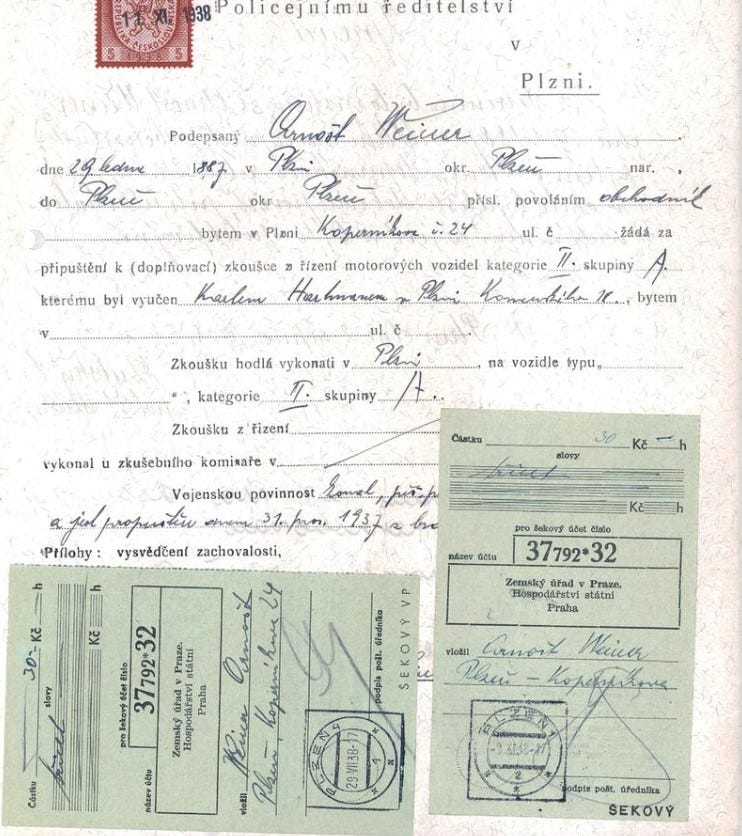
my great uncle applied for a driver’s license in 1938- the year he was arrested by the Nazis
But what do I do with these stories? My dear aunt, who recalls names dates and facts in terrifying detail, has carefully put together a file. She even organized memorial stones to be laid outside my grandmother’s family home in Pilsen, that still stands today. The timing of the memorial ceremony couldn’t have been worse -October 7th, 2023. My aunt is reluctant to share the stories of I thirst for. She strongly asserts that the details of my grandparents’ lives are a private matter, and should thus belong to only them.
But if the memories, the names, the dates, the story become lost in the sea of time, what will be? Who will honor the bravery of my grandparents who are survivors of something that refuses to be grasped in one sitting? Whose eyes and imagination will trace the rich lives of a community before and the race against time of after?
And the tiny details—the lost fur coat; the rat in Nice, in the middle of the night, that saved their lives; a counterfeit visa to Ecuador; a boat laden with wheat where my grandmother and her family stowed away as the Nazis moved into Nice, watching from the deck as a towering rock loomed in the distance, correctly identified by my great-grandfather as Gibraltar; a sleeping draught administered to my baby aunt as her parents made their perilous escape from the Soviets to the German border in 1948; the shreds of survivors who wandered about in the Mittenwald DP camp, waiting for repatriation to the UK, where my four-year-old father waited for them. These details are woven into the cracks and crevices of my DNA, whether I’m aware of them or not.
The book, or at least the chapter outlines of the lives of ordinary individuals who made extraordinary decisions must be written. Even if it sits around and gathers dust for 50 years. Does history teach us anything at all? Probably less than we’d like to think. The stories, however, must be told nonetheless. If we do not honor them, then we do not honor ourselves. If not, then my grandparents will forever remain two emigrees with strange accents and loving hearts, and that is all. And they deserve so much more than that.
I wonder how many of us are sitting on stories like this — fragments, names, half-remembered details we never thought to ask about until it was too late. If that's you, I'd love to hear what you're carrying. What do you know? What do you wish you'd asked?
No posts
Comments
Nothing yet. Say the first thing.
Sign in to join the conversation.