
I put my heart and soul into every piece I write—sometimes I look for humor in life’s moments and other times I wrestle with memory, fear, and the search for meaning in a world that keeps shifting beneath our feet.
If this essay spoke to you, please consider giving it a like, sharing it with someone who might need it, or reposting it. You can also support my work directly through Ko-fi—or simply by subscribing, reposting, commenting, or spreading the word. Every gesture, big or small, helps me keep writing, reflecting, and connecting through words.
I am not a biker. I own a decent bike that can deal with different types of terrain. I even have a couple of pairs of padded Lycra shorts and colorful biking shirts with triple back pockets; it would be easy for you to be fooled. But my helmet and mirrored glasses are a scam. The only time I might define myself as such is on Saturday mornings, when the quiet Jerusalem roads beckon. It is then that Avi and I take our Saturday Morning Ride. Our shirts match, but our pace doesn’t—he’s much better than me. He is a biker, well and truly. Proof of the fact: he owns another road bike that has only one gear. I think this piece of equipment was invented with only one thing in mind: utter torture. And he thinks it’s fun.
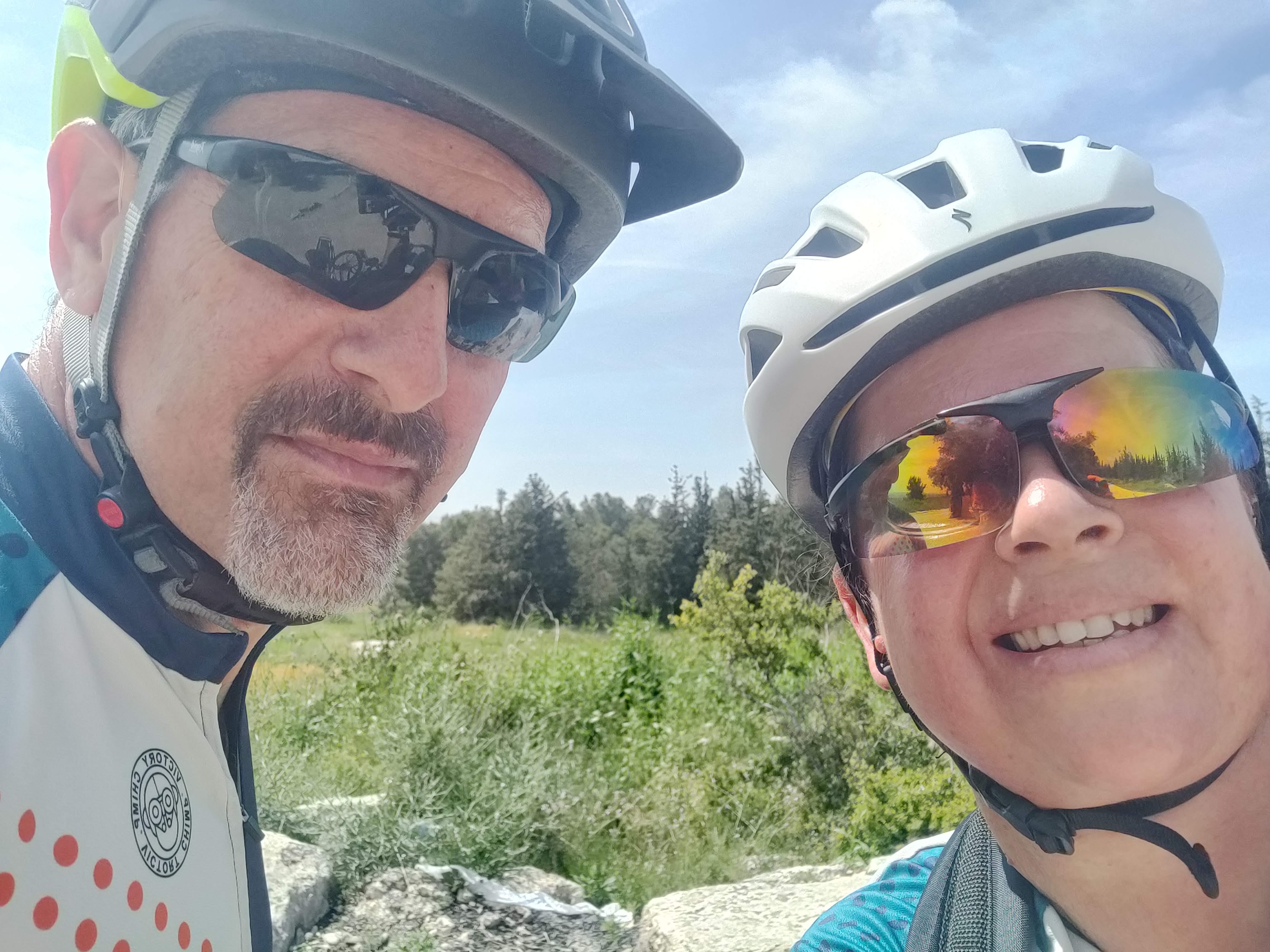
We pack coffee and cheesecake in a cute little thermal bag that attaches to my handlebar. We have a number of options, but there is one giant loop that we do most of the time. Get ready for a hilly ride.
The city is forever growing, and the bike lanes are too. The former mayor of our city, the marathon-running, beloved Nir Barkat, pushed for biking paths and outdoor gyms throughout the city. For the most part, the paths work—we occasionally have to compete with joggers, drunken toddlers, and dreaded electric bikes, but this is nothing compared to the mayhem on the Tel Aviv bike lanes.
Sadly, however, we have to start our route on a busy road. Once the tramway is finished, we’ll be able to ride the tracks—but that won’t be for another five years.
We are riding through our neighborhood, which is predominantly religious. Morning prayers are starting, and men rush toward us wearing prayer shawls. We cut through Chanoch Albeck and pass the huge stone walls of the Saint Claire Catholic monastery. I have no idea what the place, home to 20 or so cloistered nuns, looks like. I occasionally spot them exiting the giant iron gate in a service van—on their way to buy supplies, I guess.
An unlikely neighbor to the monastery is the Yes Planet cinema complex. Its opening a few years back induced a lot of hype. The secular population rejoiced, but the Chareidim protested; a movie theater open on Shabbat was taken as a direct affront to the holy nature of the city. In the meantime, the place, like many non-kosher and/or non-Shabbat-observant establishments in the area, has suffered a lot. Restaurants have opened and closed. As for me, if there were anything worth seeing on a Saturday, I guess I’d go there. But Hollywood is disappointing right now.
And then we pass the entrance to the First Station on the right. The First Station, now once again under massive reconstruction, is also symbolic of the city’s identity crisis. It was once Jerusalem’s first railway station, with tracks intact. It was originally built during the Ottoman period, connecting Jerusalem to Jaffa. Apparently, it took four hours. But nowadays, an upturned truck on Highway 1 is all it takes to subject drivers to hours of misery. Better off spending four hours on a slow train.
It closed in 1998 and was repurposed as a secular social entertainment center. They did try. The dream was that religious people would be welcome, too. Restaurants and bars, some kosher and some not, opened up. On Fridays, it held an arts and crafts fair. During the week, there are some cute events, like Israeli folk dancing and yoga. But there have been too many closures. COVID-19, October 7th, and the wars with Iran have put immense strain on a place that was fragile to begin with. What was once a treat to visit feels like a mess.
We are now heading downhill, and some drivers are honking impatiently behind us. The walls of the Old City come into view, but I’m trying to get some speed so the next hill isn’t such bloody hard work.
The ancient walls loom ahead of us as we hobble uphill. Cars are overtaking us freely, but there isn’t anywhere else to ride. Then we veer right and cycle on the stony path to Jaffa Gate. A strange combination of religious worshippers on their way to the Kotel, Arab Old City locals, and day tourists pass by, leaving us a respectful amount of space to cycle past.
Before October 7th, the Jaffa Gate area swarmed with Christian pilgrimage groups. An Arab with an ancient wooden pushcart would be selling yeasty ka’ak al-quds (sesame-covered giant pretzels), freshly baked pittot, and yellow ka’ak asfar (donut-shaped cakes). The aroma would almost knock me off my bike. I haven’t seen the guy recently. I hope he’ll come back.
Chareidim of various ages, shapes, and sizes head towards us, heading toward the Wailing Wall. Portly women covered from head to toe, wigs blowing in the wind; small babies; bearded Chassidim with shtreimels and long coats. We also see young men in knitted kippot and tourists with their hiking gear and expensive cameras. A thickly bearded Greek Orthodox priest in full black garb comes into view, his thick grey hair tied in a neat ponytail, a giant gold cross dangling.
And we are none of the above.
From one side of Highway 1, otherwise known as the Seam Line, it’s easy to forget that we are indeed cycling past predominantly Arab East Jerusalem. Never have two populations had less to do with each other. We are cycling on the side that was under Jordanian control between 1949 and 1967. The four-lane highway was once a no-man’s land of barbed wire and snipers. Now it is the border between two entirely separate neighborhoods. The division line is invisible but impossible to miss.
Even though the Damascus Gate tram stop is closed on Shabbat (Jewish state, Jewish rules), the bus station and adjacent giant car park are full of the hustle and bustle of a regular day for East Jerusalemites. People wander past with bags of fresh produce. The neon lights of stores flash; birds in cages hanging outside hummus joints chirp loudly.
The Damascus Gate area is also heavily populated with policemen and women in armor-plated jeeps, riding their jet-black anti-riot horses, or just drinking Turkish coffee and noshing on pittot. Geopolitical realities are impossible to ignore, even while you are huffing and puffing.
Four lanes across, the Chareidim are heading to and from their little shteiblech (small prayer houses) in their Shabbat finery. Both neighborhoods are overwhelmingly poor and overcrowded; both populations have high birthrates and do not speak the language of mainstream secular Israeli society. Both have their own separate education systems. Neither serves in the army. Neither thinks the other should be living in the city. They have so much in common, they should start a support group.
And then we head downhill. What bliss. No more pushing pedals for a while—just steering carefully along the twists and turns of the path. We are now on the northern ring section of the Jerusalem bike path and will remain on paths until we start looping back into town again.
We pass the Ramot Arazim Valley, a miniature forest with wildlife and deer. The odd family from the predominantly Chareidi areas of Ramot, Sanhedria, and Maalot Dafna might be out for a walk, but the path is otherwise clear for us to bomb down. In the winter, the chill of the winds slices through us on our descent. The layer that was removed on the uphill is quickly donned again. In the summer, it’s a blissful respite. Yes, I’ve swallowed a few flies here and there, but have lived to tell the tale.
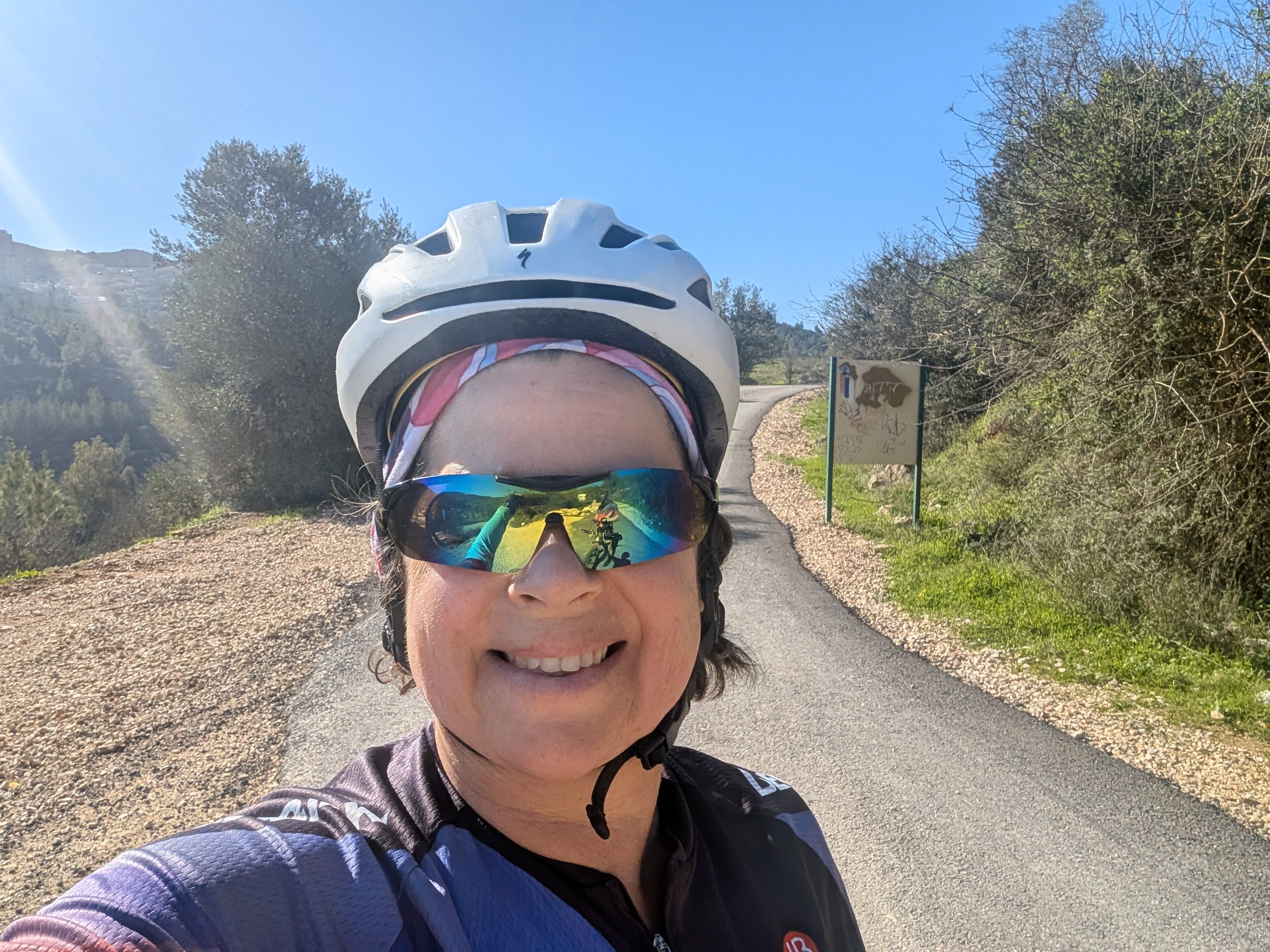
We cut past the entrance to Ramot, Jerusalem’s largest neighborhood. The highway is empty—most of the secular residents of the neighborhood have moved out by now.
It’s at this point that I’ve waved farewell to most of the signs of big city life. I’m immersed in fig trees, olive trees, picnic areas, and shaded parks. It’s May, but come September, Avi and I will be stopping off here for a fig break—the purple figs are the most delicious. We sometimes stuff extra ones into one of our three back pockets—or perhaps two.
As we pass vineyards and forested hillsides, it’s hard to imagine that we are technically still within the confines of the city. We are now in the land of sweat-wicking sports gear, overpriced sneakers, and noise-canceling earbuds. Jews and Arabs alike come here to break into a Saturday morning sweat or take their eager dogs out for a brisk walk. We dodge toddlers on miniature bikes. Our shouted warnings to the joggers we pass are often useless. No noise-canceling earbuds can protect you from the shock of an unexpected cyclist whizzing past. And we are on an official bike path, after all.
The dogs are the most unpredictable, but mostly they just ignore us. The toddlers are dragged out of the way by their anxious mothers.
We enter a gravelly parking lot. Abundant picnic areas are in full occupancy—runners, walkers, families, you name it. They’ve driven here from everywhere and are opening plastic containers filled with freshly cut vegetables, cans of olives, cookies, and chocolate milk. Some expertly prepare outdoor coffee (otherwise known here as “pakal”) in a finjan on a small camping gas stove.
My stomach is starting to rumble, too. We, however, are pretty religious about when we eat breakfast. We still have some more climbing to do.
Then we pass what we call the Winter Lake. In truth, it’s not much bigger than a giant pond. Signs warn people not to swim in it—but how deep can it be? It fills up with the winter rains. Now it’s May, and the riverbed has dried up once again until the next rainy season.
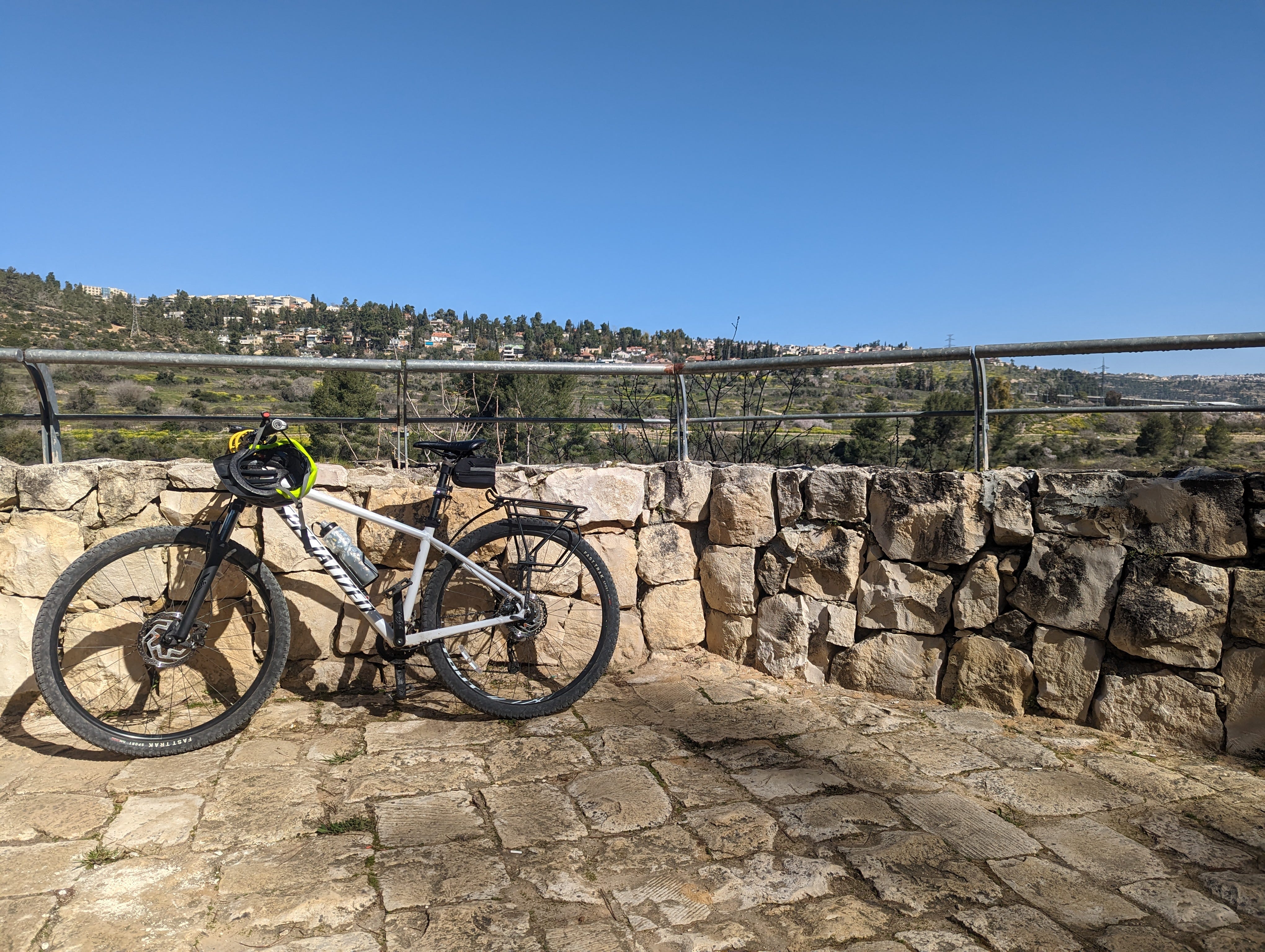
Up ahead, the gold crowns of the Russian Orthodox Gornensky Convent of Ein Kerem glitter in the distance. We’ve climbed into the lovely neighborhood of Ein Kerem on countless occasions, but today we are going to cut left and pass the entrance to the old pastoral moshav of Beit Zayit.
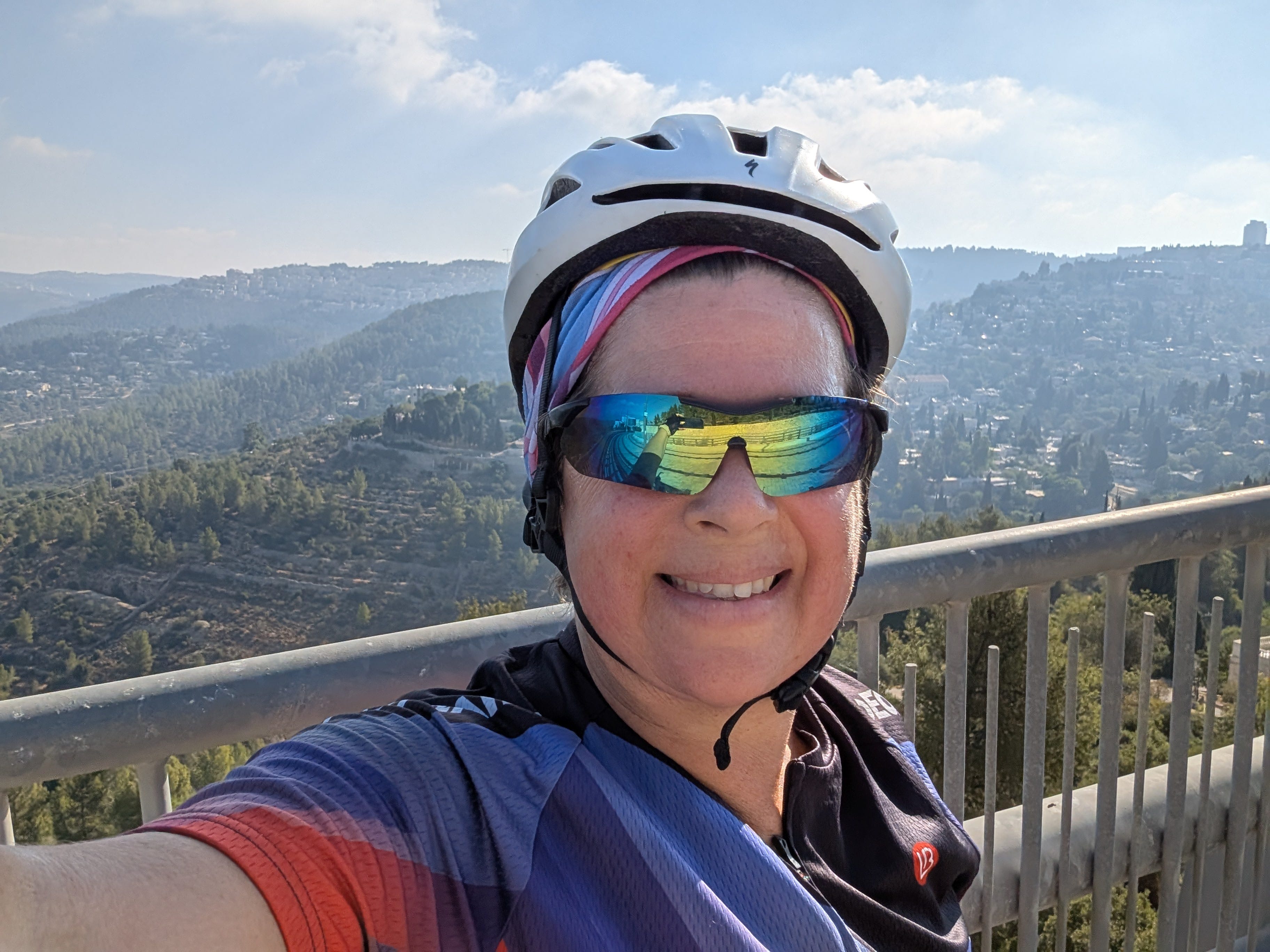
This is where the climb gets a bit grueling. I’m in better shape than I used to be, but trust me—this is the part of our route when I’m sorely tempted to get off my bike and wheel it. Now I just drop into the “granny gear” and make my way up in zigzags.
Today the weather is mild, but once it gets hot I’ll probably give this route a miss. Ten years ago, my personal thermostat handed in its final notice without warning. Since then, no matter how fit I am, I cannot exert myself when it’s over 28 degrees, or I will most likely turn a stunning shade of beetroot red and keel over. And it’s not all in my head. Ask Avi, who has had to deal with me lying prone, knees raised, semi-conscious more than once. That’s why I’m not a biker. That’s why I like cool sports, like swimming, for example.
We are actually on the road now, but nobody drives through the Jerusalem Forest on a Saturday, and if they do, we can hear them from a mile off. By now, the only thing keeping me going is the thought of the coffee and cheesecake nestled in our thermal pannier.
Twenty minutes later—hurrah—a well-deserved break. In terms of seating, we are spoilt for choice. The forest is full of empty picnic areas dedicated to so-and-so and so-and-so. We pick the table with the nicest view. All we can hear are muted city noises and the overwhelming twitter of birdlife.
Yes, this is the first official stop we actually make after two hours of riding. We are a little crazy.
Once we are refreshed and renewed with our takeaway espresso and the best cheesecake the city has to offer (made by me), we are ready—sort of—to resume the steady climb upwards.
The Jerusalem Forest borders on the Har Nof neighborhood. Look up: endless white stone apartment blocks. Look down: the Jerusalem hills and valleys. And look to the left: the Har Menuchot cemetery. The hillside is white with plain gravestones that sprawl across it. From this distance, they look identical. Jewish graves are not fancy things. Avi’s parents are buried there, and so is my son, Yitzchak Meir. (Another story for another time.)
Sometimes I look over at it pensively, musing on life as a fleeting dream. Today, no such thoughts cross my mind. With wars and terror, I want to escape death for a minute, if I can.
The hillside below us is steep. Once we reported a fire in an abandoned area below the cemetery, and once we even saw a car that had plunged to the depths—we never got the full story. Not so long ago, along the same path, we spotted a rather brazen porcupine. He wasn’t in the least bit bothered by us.
The trees are more sparse now, and the area is more of a no-man’s land of junk, broken stones, and vague plans. We pass a caravan, and then we are almost back into civilization—whatever you wish to call it. We pass the gas station—closed on the Sabbath—and move into the traffic junction of Givat Shaul. This is Jerusalem’s first industrial zone, forever under construction, where finding a reasonably priced parking spot is mission impossible.
We pass what once was Angel’s Bakery, an old and historic Jerusalem landmark. Many moons ago, I lived in Har Nof, and I will never forget the tantalizing smell that would descend on the neighborhood as the giant ovens fired up on Saturday night. Buying a freshly baked roll from the bakery was a treat beyond description. How times have changed.
A large sign advertises the place for rent. Giant, ugly industrial bakery, anyone? Given the number of boutique places mushrooming in the city, I’d say: not a chance.
We are now following yet more tram tracks under construction past the Givat Mordechai religious neighborhood, past more men, women, and families heading home from shul, past the famous Mercaz HaRav Zionist Yeshiva. We keep an eye out for the odd car and swing left onto the wide and open Shazar Boulevard, where we stick to the tram tracks. We’ll need to push our pedals a bit to ascend the Meitarim Bridge. Meitarim means “strings,” and the bridge, a relatively new and modern Jerusalem landmark, does indeed look like a giant white harp stretching over the central station area.
Relief once again—we are going downhill. Past the central bus station and its giant clock face. We are heading toward the Shuk Machaneh Yehuda, now silent and shuttered.
We are almost home. We are entering Talpiot, cranes everywhere. The city is building upward, transforming before our eyes.
As I puff and push, I’m reminded of past, present, and future. There are a lot of unknowns in this city. It’s preparing itself for a population boom, but real estate prices are the highest in the country. It still fails to provide the same opportunities as the Center.
But one thing is certain: I’m done. I couldn’t bike another kilometer. Even the gentle uphill to our apartment is a chore.
As we park our bikes on minus five of our underground parking lot, Avi thanks me for biking with him. He is entirely sincere. He understands that this is not a given.
But I’ve been doing it for so long—my Saturday mornings wouldn’t be the same without 40 kilometers of black hats (and other types of headgear) and, of course, the hills.
Were it any other day of the week, I wouldn’t saddle up—even if you paid me.
As I said, I’m not a biker.
How do you unwind on the weekends? Would love to hear about your hills (metaphoric or otherwise)
No posts
Comments
Nothing yet. Say the first thing.
Sign in to join the conversation.