
I work predominantly with code and emerging technologies so I have a lot of feelings about AI. Many questions too. Specifically, how it fits into creative and artistic practices, but more broadly I also find myself wondering, will using AI turn my brain to mush? Is it eating up the world as we know it? And if so, what will it spit back out? Am I the only one who worries about AI replacing me while being simultaneously kind of thrilled by the possibilities it opens up?
I thought It might be an interesting exercise to gather a few opinions together and see if any common threads emerge, so I’ve been asking a handful of my Internet cousins and IRL friends what they think.
Ines Alpha1, a 3D makeup artist who’s been working with filters since before they ever existed on social media, challenging the traditional expectations of the beauty industry.
Anna Lucia2, an interdisciplinary artist who uses code and generative systems in her work with textiles, and browser based animations.
Joan Sandoval, a creative technologist and digital artist specialized in real-time AI and large-scale audiovisual systems.
Vienna Kim3, a writer, researcher and curator focused on digital works, and how technology influences and transforms contemporary art.
Valentin Ducros, a producer and curator across new media, AR/VR and contemporary digital art, focused on the body, identity and the more-than-human.
My questions to them were threefold and kept purposefully broad in order to leave space for as open an interpretation as possible, so that any through-lines could emerge naturally.
Specifically, I asked them:
What are people misunderstanding about using generative AI in creative work?
Is there a right and wrong way to use AI?
How does generative AI show up in your work, process or practice these days?
Before we dive in, a note on terminology
→ Often when people hear the term generative AI they immediately think of image generation. In fact, generative AI isn’t just about visual output. The term describes a whole category of models that generate new content. That includes text, images, video, audio, code, 3D... If the model is generating new output based on patterns learned from training data, it falls under the umbrella of generative AI.
Vienna Kim
I think the main gripe that I have with people’s thoughts on the Internet towards AI is that they flatten the whole of the AI industry into something that is evil a lot of the time, or something that is going to completely change the world and make humans even more powerful. And it often feels like they are two extremities of a camp and there’s no middle ground and there’s no nuance. And I personally would encourage people to investigate the kind of shades of grey and the nuances within this technology in order to better understand it and in order to develop a better critique and practice of generative AI, which I think some artists are absolutely doing. But I think the general public often falls into one of these two extreme camps and don’t venture to realm on the kind of grey zone middle ground of the discussion around AI.
Valentin Ducros
If you compare to any other medium, be it painting, sculpting, watercolor, photography, etc., as a creative, as an artist or as a producer, you have to be emotionally involved with the tool that you’re using, you know, because you picked it for a specific reason. You picked it because you enjoy the creative process that involves, you know, watercolor, wetting the paper or being very slow about it, right. Or you chose photography because like the instantaneity of it when you take a photo, but then you’re, you know, sitting by yourself with it doing the editing and the post-production etc., right. And so I think that with a bunch of tech-based tools or creative mediums, what is usually put forward is like the productive side of it, the optimization, the quickness, the speed. And I think they can sometimes take over the more emotional side of using creative mediums. And I think that might be like my first part of the answer to that question.
InesAlpha
So that was a kind of hard question for me because I think there are plenty of things that even myself I don’t understand. I’ll try to start by being a bit positive. If you don’t direct AI correctly, it’s going to do a very mediocre job. So in order to do something great, you need some skills and a vision. So that’s a positive thing, I guess. Less positive is if you don’t train your own model from scratch locally and use a generalist platform like mid journey. The AI models there are kind of built on theft, if you look at in a certain way. And I don’t love saying that because it’s more complicated and nuanced. But generative AI is trained on the work of millions of people who never consented to it in the name of some vague greater good. So used thoughtfully, AI can be a tool like any other and you can create original, unique work. But used carelessly, it can just remix existing work with no deliberate choice, and take a lot of power away from the people whose work built it in the first place.
Joan Sandoval
So when working along other people or teams, something I commonly see is that people are being generic rather than specific. So if you are too generic when you’re asking AI something, the AI also will give you a generic result. And this probably will be very similar, this output, from other outputs that it has given to other people, right? And this can you know can be in the form of like text code and image. I work with with code. I also work with images and for instance with images sometimes you use an input image to get an output image. And so when inputting an image, I really take care of the different details and things that I want the AI to change or to you know, focus on. Then, the AI can understand more and as an output it one it will be less prone to give you a more generic output.
Context and intention seem to be just as important to everyone as I’ve found them to be in my own work with AI. When I don’t have a clear idea of what I actually want, using AI hurts much more than it helps. But if I’m specific about what information I’m giving it, and what I’m expecting it to do and more importantly what I’m not expecting it to do, or change or influence, then AI feels like a great addition to my tool set.
Valentin’s comment on how the emotional side of the work can be easily lost in all the optimization and speed granted to us by AI, reminded me how cerebral programing is. Lately I’ve been thinking a lot about how I can use the craft to get out of my head and back into my body. Prompting can often feel the same way. It’s a lot of thinking about what you want say, and then communicating that clearly. Anna Lucia shared an analogy that beautifully frames how and when we might choose or not choose to use AI really beautifully.
Anna Lucia
Either AI is going to change and revolutionize our world in an extremely positive way, or it’s the end of society as we know it today. I think using generative AI in your creative process doesn’t have to be an either or story, and there is a place to use it and places where you won’t use it. I also have been thinking a lot about AI as a new technology and comparing it to the car. In this scenario, is AI replacing the horse and carriage?
You know, where the horse and carriage is for example, writing computer code by ourselves. The horse and carriage has disappeared from our cities and it has been completely replaced by the car. Or is using generative AI technology like a car, but writing computer code ourselves is more comparable to using a bicycle or even walking.
And if we make that comparison, we still live in a world, although we now have cars, where walking and using our bicycle still have a very important place. I still love riding my bicycle and I love hiking, even though cars exist.
And also sometimes we actually need to walk somewhere to get to the top of a mountain, and the car can only bring us to the foot of the path. After that, we still have to walk ourselves to get to the beautiful views and get the most interesting experiences. So yeah, that’s been a comparison that has been on my mind.
Ines’ point about AI’s energetic footprint is also pretty important to flag. There has been much debate about this over the years, along with lots of confusing and contradictory statistics making the rounds. There’s no doubt that AI consumes an insane amount of energy and resources, but - and this caveat will probably not make anyone feel better - most of the other tools and tech we rely on throughout our days use as much if not more energy than anyone’s personal use of AI.
InesAlpha
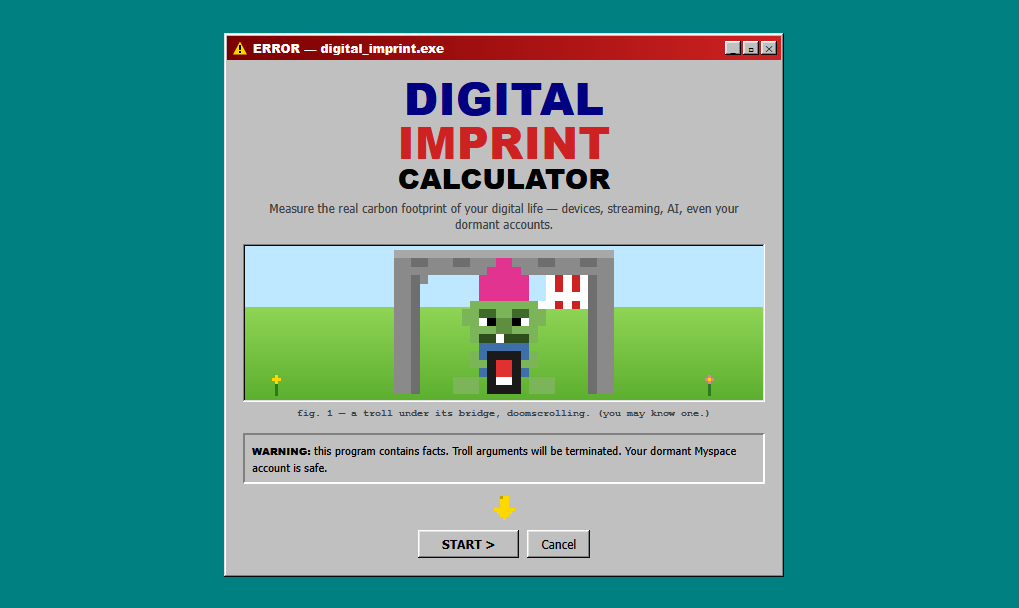
I think people misjudge or just don’t really know where the real cost sits. On the individual level, is the handful of images I generate in a day actually worse than my laptop, my phone, my gaming habits, and all the other things I run daily. The real damage comes from the scale of the big data centers and the companies racing to build them, not from one person’s prompts. We end up blaming individual habits the way we did with plastic straws or personal carbon footprints, when the people getting rich of this are the ones making the real decisions. And I don’t know if you saw it, but Anne Horel actually built a tool to calculate your AI footprint which helps put some numbers behind the conversation instead of just vibes.
Anne Horel is an artist who creates a lot of digital collages and animated films using AI. She also built the Digital Imprint Calculator which allows you to input everything from the number of devices you use to the number of socials you have, to every single email you’ve ever sent or have left unread in your inbox. While the energetic footprint of each of these can only be a general guesstimation, it’s a reality check nonetheless. Everything is tallied up and cross referenced with the amount of prompts you send daily to your AI of choice as well as it’s outputs revealing a set of final numbers that offer a solid dose of perspective.
InesAlpha
I love how she points out the irony that all the outrage comments about AI’s environmental cost are themselves burning energy. I don’t know how precise it is. I tried it and I was like, ‘oh, OK, all my hardware are way worse than my AI consumption...’ So maybe we should, I mean, people should, ease up on the rage a little bit.
The second question I asked everyone was about whether or not there is a right or wrong way to use AI in one’s creative practice.
Anna Lucia
I think that if we view AI from the point of view of a tool, in order to use that tool creatively you should really use it in the wrong-est way possible.
Valentin Ducros
I feel like with most tech tools, you know, they always come with a bible, a text sheet, instructions, a how-to. And with expected results and processes, right? And I think that following this completely 100% by the book leads to sort of expected or maybe not that interesting results. And so I think that breaking the tech, playing with it, bending it to your will, finding the glitches in it is a bit more exciting for me to see. So that would be my answer. As well as, you know, tinkering, playing with, finding unexpected and undesigned outcomes.
Anna Lucia and Valentin’s answers reminded me of all the amazing “mistakes” and glitches we saw coming out of AI generated videos early on. My favorites have included anything to do with sports, especially figure skating, yoga and gymnastics related outputs that showed athletes with arms morphing into legs during spins, or vault jumps inverting torsos where the head was suddenly flipped. Technically these were faulty estimations on the part of the model but visually the results were really captivating. I wonder if there will be room for these types of surprises as AI continues to progress. Will we be able to prompt and plan our way to such happy accidents moving forward? My fear is that with time AI will become less bendable, and more rigid and set in place.
Joan Sandoval
If you want to try to express and and communicate ideas creatively, what’s the point if an AI does it for you? For example, the phases of thinking and designing, concept executing, developing the projects. For me that doesn’t make sense. I think there are, for example other contexts where the AI can replace entire like chain of processes. But if we are talking about the arts and creativity, it’s something that just doesn’t makes sense for me.
InesAlpha
If I had to draw a line, the right way for me is integrating AI into a workflow as one tool among others, ideally trained on your own work. And the “wrong way”, is generating something in another artist style, often without even realizing it, and calling it yours because a machine made it and it’s now part of some “collective knowledge”. That’s not so different from copying another artist style by by hand. But when you copy by hand, you’re at least building a skill on the way. And while you’re building that skill, you might stumble, and realize where you’re actually where you actually want to grow, and end up somewhere unexpected. I worry that people in the future won’t bother learning anything, because why would they? AI will just do it. And I catch myself doing this too, of course. I’ll go to learn a new tool in my software and think, why bother? Shouldn’t I just let AI handle this now? It’s just so confusing and exhausting. As Ugo Bienvenue put it
AI being integrated into a larger set of tools is something that I agree with a lot. To create interesting work, I don’t believe that AI alone is enough. As Ines mentioned early on, without your own set of developed skills and practical experience, prompting can only get you to so far. Automating your whole workflow with AI will only exacerbate that and as noted by Joan, in the context of creative artistic expression, outsourcing every step of the process seems like a confusing direction to take.
I have to admit that until I listened to Vienna think through her own resistance to the initial response she had to my question, I hadn’t really stopped to consider choosing a specific material or in the case of AI, a tool, because it’s sensitive in current discourse. Listening to her reasoning helped me see how so much of the conversation artists are having, at least in the circles I’m in, still centers around the technical, the ethics of the if and how of AI and whether it can comfortably integrate into our pre-existing approaches and workflows.
Vienna Kim
Instinctively I wanted to say yes, I wanted to say, you know, don’t use the big generative models created by these massive corporations that have been heavily funded, that are destroying the planet, etc. You know, opt for smaller models or models that you train by yourself. That was my instinct. But at the same time, you know, when you’re talking about an artist picking up a medium and a tool for their work, how can you tell them to use it in a particular way and not the other?
To use an analogy, the journalist Karen Howe often uses transportation as a metaphor for how AI currently operates. She says there are the Rockets of AI, which is your open AIs, your Anthropics, etc. And using these models are like taking a rocket to work. Whereas there are also models that are like bicycles, which are a lot more kind of sustainable options and more logical options for AI usage.
I really like this analogy, but I also want to create another analogy which is with using another medium in an artwork. And as an artist, when you’re using certain media that feel socially, environmentally sensitive, is there a purpose behind why you’re using this medium? For example, ivory is a material that is widely looked down upon to use in paintings and sculptures due to its colonial history, but also how cruel it is for animals. So a lot of artists don’t use these material today.
If you do use ivory in your artwork, you’re probably doing it
a) because you just don’t care, or
b) because you’re making a very intentional choice and a statement about using ivory in your artwork and it has sense and meaning within the context of the work you’re creating.
I feel like with something that is so sensitive as generative AI right now, I think it’d be interesting for artists to kind of take a similar mentality of, I’m using this material, this tool that is currently highly criticized and kind of very sensitive in cultural discourse.
When I use it, am I doing it because I just don’t care? Or am I using it because it’s necessary to the meaning of my work and I’m trying to make a point with it?
Given the array of backgrounds assembled here, (and my own personal love of process breakdowns,) I was curious to know more about how everyone’s been experimenting with AI in their own creative endeavors.
Anna Lucia
I would say that generative AI doesn’t show up in my work, but it does show up in my process. In short, I write computer code that generates art for me, and the computer code that generates that art is still written by me. However I’ve used generative AI a lot to create functions around that process that make my work a lot easier.
A simple example is writing functions that let me export images on high resolutions or lower resolutions and automating processes that I would do every time I would start a new project or a new sketch. I’ve started adding a user interface to my sketches with sliders and I have used a lot of generative AI coding tools to create those additional helper functions for me.
However, the part where I am working creatively with computer code is still a very hands on process and that is not a right or wrong or a judgement of ‘this is how you should be doing it or other people should be doing it.’
But I think I enjoy that process, and also that it’s not only enjoyment, there’s also a lot of discovery in the process of writing those algorithms and those rules myself, and they’re an important part of developing the work that I do. At the moment I do not see a way or need to automate that.
Anna Lucia recently shared about this on instagram where she shows how she’s using the GUI she mentioned adding to her starter template. She also explains that she has begun exporting each sketch’s seed and unique parameters when she saves an output. As someone who has coded this by hand in the past, I can attest to how useful it is to have while not at all being the most exciting thing to code by hand.
Ines Alpha
So I’d be far more comfortable using AI for the repetitive, tedious parts of the pipeline like rigging, retopology or face tracking than for the parts I actually enjoy, like modelling or texturing. Unfortunately AI doesn’t do that. Still now, it still doesn’t do the rigging. I mean, there are plenty of tools that helps a bit but it’s not like implemented in blender or C4D. Maybe there are some pluggins, but just yesterday I looked for one for insutance to help with retopology in Blender, and I found one but it doesn’t use AI. I haven’t done the Claude-to-Blender connection yet. I should try it, but I’m not sure it helps with what retopology because otherwise I would have surely found a tutorial about this on on YouTube.
I’ve been so excited as a coder, to able to outsource things like tooling and scaffolding to AI as they have never been parts of the process that personally interest me very much. It’s easy to forget that this might not be as established a super power when you’re relying on other kinds of digital tools. Rigging is actually one of the things about 3D that initially scared me off and oriented me into the world of code. I loved the idea of writing an algorithm and watching it generate my ideas.
Does that make coding the original prompting?
Ines Alpha
So when I use AI in my work, it’s only with models trained on my own pieces. That said, I use platforms like Krea that let you train your own model on top of their base model, so the data set technically includes my images, but also whatever trained their underlying model. Even when I think I’m using I’m only using my own model, there’s probably still a trace of other people’s work baked in somewhere. So I try to stick to images close to my own aesthetic. And I only use my own face, never the faces of people who don’t exist but look real. That generally makes me very uncomfortable. I feel sometimes that I’m almost stealing someone’s soul, so that’s like the personal line for me.
Joan Sandoval
I definitely like to use AI to optimize my whole workflow pipeline. For instance, my recent works have been more related to live AI generation with images, and tracking. Something that you couldn’t do before is to have the body segmented or masked from the background live, at a very fast speed. And then from this, overlay different effects on top of the of the people or of the person. So I use AI in a technical way to help first to develop these algorithms of tracking and and then there are like two kind of branches. One branch is as I said putting these AR effects on top right, and another branch is the live AI generation of images. It allows me to create this level of infinite ideas and results and something that you really have to kind of be constantly checking and iterating to get your desired effect. But like I said before, I don’t see myself replacing everything that I do with AI. I enjoy the process of programming and coding and being with the computer trying to find solutions to problems. So I don’t think that this is something that I would like to be fully automated and be removed from my workflow.
Joan was actually one of the first to implement real-time generative AI animations at a decent FPS and he did it in 2021, before anyone had AI crawling through their code. What I’ve always found extra impressive was that he did it with Pix2Pix, which if you are unfamiliar with generative AI lore, is a pretty old model. It’s the one that Memo Akten made famous in 20175. Joan is actually still using Pix2Pix in some parts of his workflow today. When I asked him how this could possibly be true given how fast everything seems to be advancing, he explained that historically the focus has been on improving the quality of the model’s output and less emphasis has been given to making the models run fast enough for live contexts.
While Joan, Ines and Anna Lucia each let AI live somewhere inside their practice, for Valentin and Vienna, whose work is curation, production and research, it appears as more of a visitor. The technology is something to test, to learn from, but eventually gets set back down. This might feel obvious given that neither Vienna or Valentin define themselves as digital artists, but since both have their own personal creative practices, I was a bit surprised by their answers. Vienna writes and creates nostalgic websites and Valentin is a talented illustrator in his down time. What stood out to me was that both of them clearly enjoy using AI, but somehow it seems to get in the way. The technology has failed to carve out a lasting place in their creative process.
Valentin Ducros
I’m not really a fan of - but this definitely a personal thing - of the latency between like an order to prompt a request and a bit with the generated results. Especially when it comes to video. I feel like that breaks my idea and concept of flow that I get a lot more easily with drawing, painting or photography, for example. All in all, I think it’s such a fantastic, promising technology and I will keep using it for like, you know, any given step of the precise, including for research or to generate blueprints, drafts, stuff like that. And it’s very very useful, very fun but personally I don’t use it for like finding results. Then again I’m not an artist, so...
Vienna Kim
I’ve absolutely used it. I tested my journey very early on when it kind of was first coming out and became the huge crazy. I’m like what is it 2022-2023? I use ChatGPT sometimes still from time to time, but not as much these days, and I’ve also tested some coding with Claude that was more recent. With all of these tools, I often go through a period of intensive testing and seeing how these things work and often being quite impressed by the results and honestly just having a lot of fun with them. I think that’s something we don’t talk about enough with generative AI, but it’s really, really fun to use. But I’m very, very conscious of how much I do use AI, and I avoid it for really unnecessary things. I usually just test as much as possible and then I realize that I can learn and do a lot of these things on my own and then I kind of wane off of them once I’m kind of satisfied with the testing.
In my own attempt to use AI responsibly and preserve my brain cells as best I can, I have instructed it very specifically to allow me the time and space to reason my way to the answers I seek. It’s only ever allowed to help me think, give me hints and helpful nudges, never solutions. However naive this approach may be, having access to AI has at times felt like having a thinking partner. I don’t see myself giving that up right now.
Talking to Ines, Joan, Anna Lucia, Vienna and Valentin has allowed me to answer at least one of my opening questions: I’m not crazy for being swept up in both the thrill and the anxiety of AI.
What stands out to me as interesting here, and has some real potential as a silver lining, is that since AI is so good at executing so many things it’s allowing people to really take stock of their work and assess what they truly enjoy engaging with within what they do.
Everyone is protecting something different, whatever matters most in their own process, and drawing a line around that.
Comments
Nothing yet. Say the first thing.
Sign in to join the conversation.