
When I meet Steve at Woodhouse Farm, he is sitting on a chair in a barn surrounded by junk, or resource, depending on your perspective. He is eating a sandwich and boiling water on a meths-fuelled stove; its flame licking up and creating a bright point of light in the dim barn. He is a hedgelayer; his clothes the colour of plants, his hands engrained with soil. He has two others with him — Adrian and Max — and they are all on a break from hedgelaying.
Adrian, the oldest of the three men, walks off into the barn and comes back with a chair that is missing half its back and is covered in bird poo.
“Here you go”, he says. “Best I could do.”
“Thanks!”
I perch on the chair, half braced in case it collapses. There is a large wooden owl box in the corner of the barn, and a single white dove perched on a rafter above us.
According to Steve, traditional Devon hedgelaying is the best in the world. It is tough, but done right, it is a craft, a link to the past, and a habitat for abundant life.
**
When I am seeking my own feeling of abundant life, I am usually drawn to expanse. I turn left up the lane from our house; up the hill, away from the village, on my own towards light and views. The dense hedgerows and the tightly packed old cottages and the close relationships in the village often make me feel contained and constrained, and so I walk away from it towards the brightness at the top of the hill.
There, my eyes are not hemmed in by boundaries and walls. They are free to look to the horizon — to the distant roll of Dartmoor’s ancient hills, or to the horizons of my inner world.
**
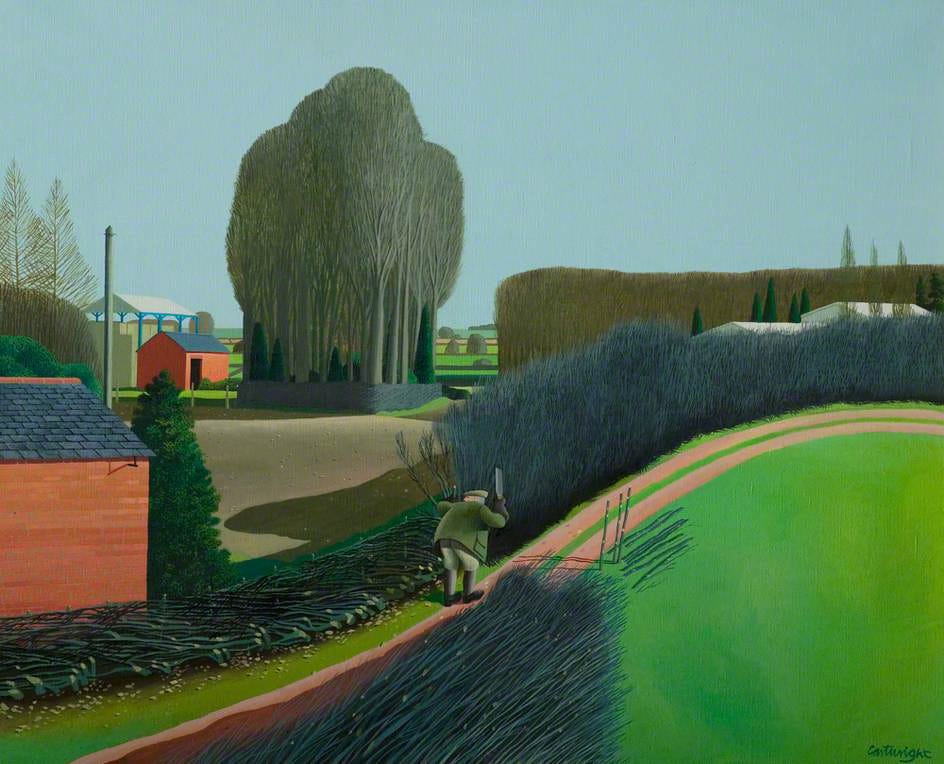
After their morning break, it is back to the hedge. Steve is working on a scruffy section of hedge which has not been maintained in a long time. It is made of blackthorn, a bit of hazel, and some hawthorn. There are occasional ash trees too, and it sits on top of an old earth bank; a common feature of Devon hedgerows. Adrian and Max are working on a section lower down the hill.
“It’s a tough hedge” Steve tells me. “There’s a lot of old growth, we’ve had to get through loads of scrub to get to the hedge. Hedges were better maintained in the past. Many have been neglected for a long time because they’re seen as a cost more than a benefit now. I feel for the farmers — they’ve been pushed to neglect them. But things are shifting, perhaps. Regenerative farming is pointing us back to older ways of doing things. Though, one old boy reminded me it just used to be called ‘mixed farming’. It’s become sexier now.”
Steve points at the scrub that has come off the hedge; neatly laid piles of twigs and branches running in parallel with the hedge. “In the past, this would have been collected by the baker and used to fire bread ovens. Things are less joined up now though.”
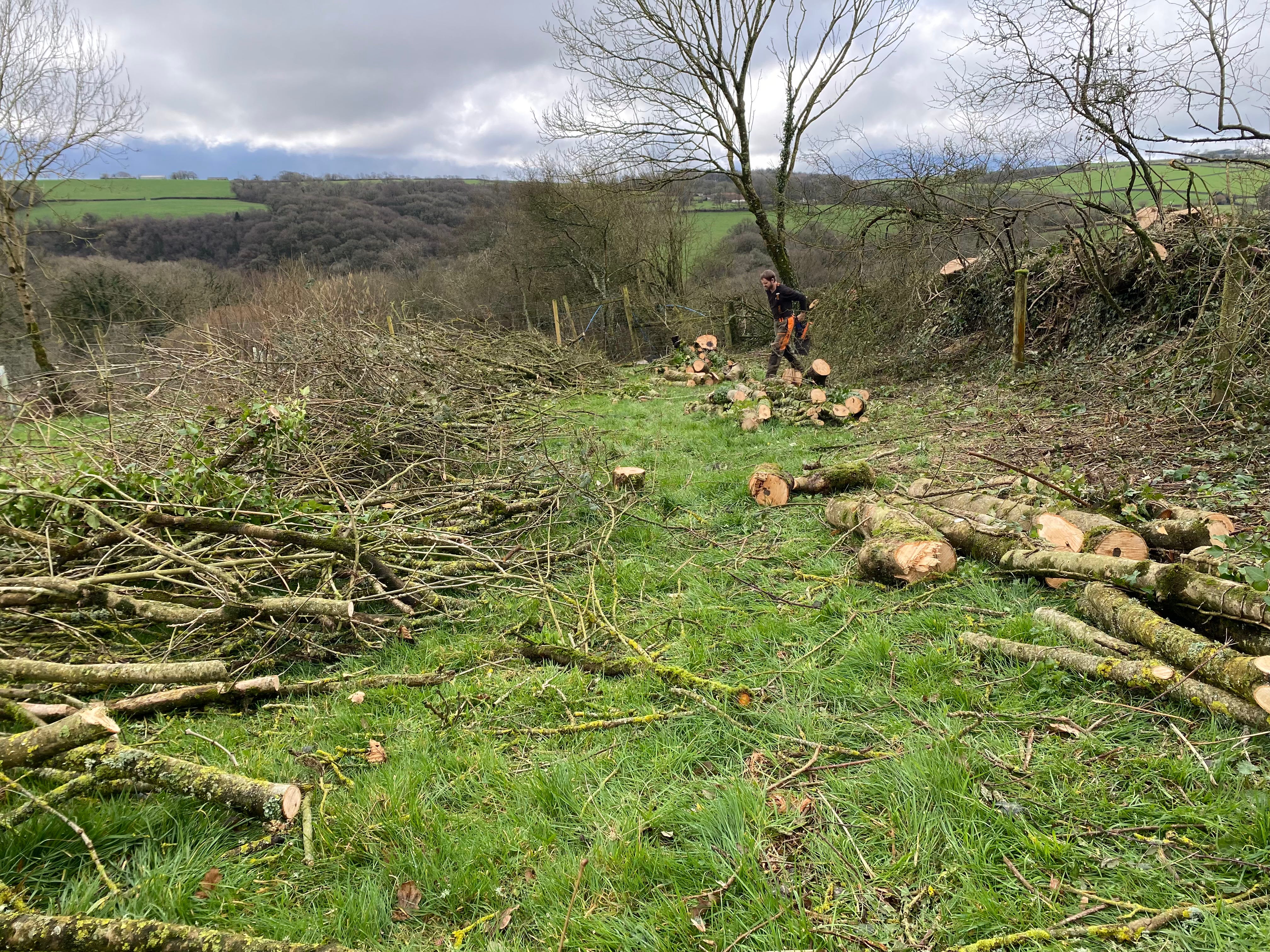
Steve faces back to the hedge, starts bending and muscling a long blackthorn stem into a horizontal position.
“You have to let the light in”, he tells me. “Make sure all the old and dying branches are cleared out, make room for new life.”
He works for a while. I watch, take notes.
He steps back, studying what he’s done.
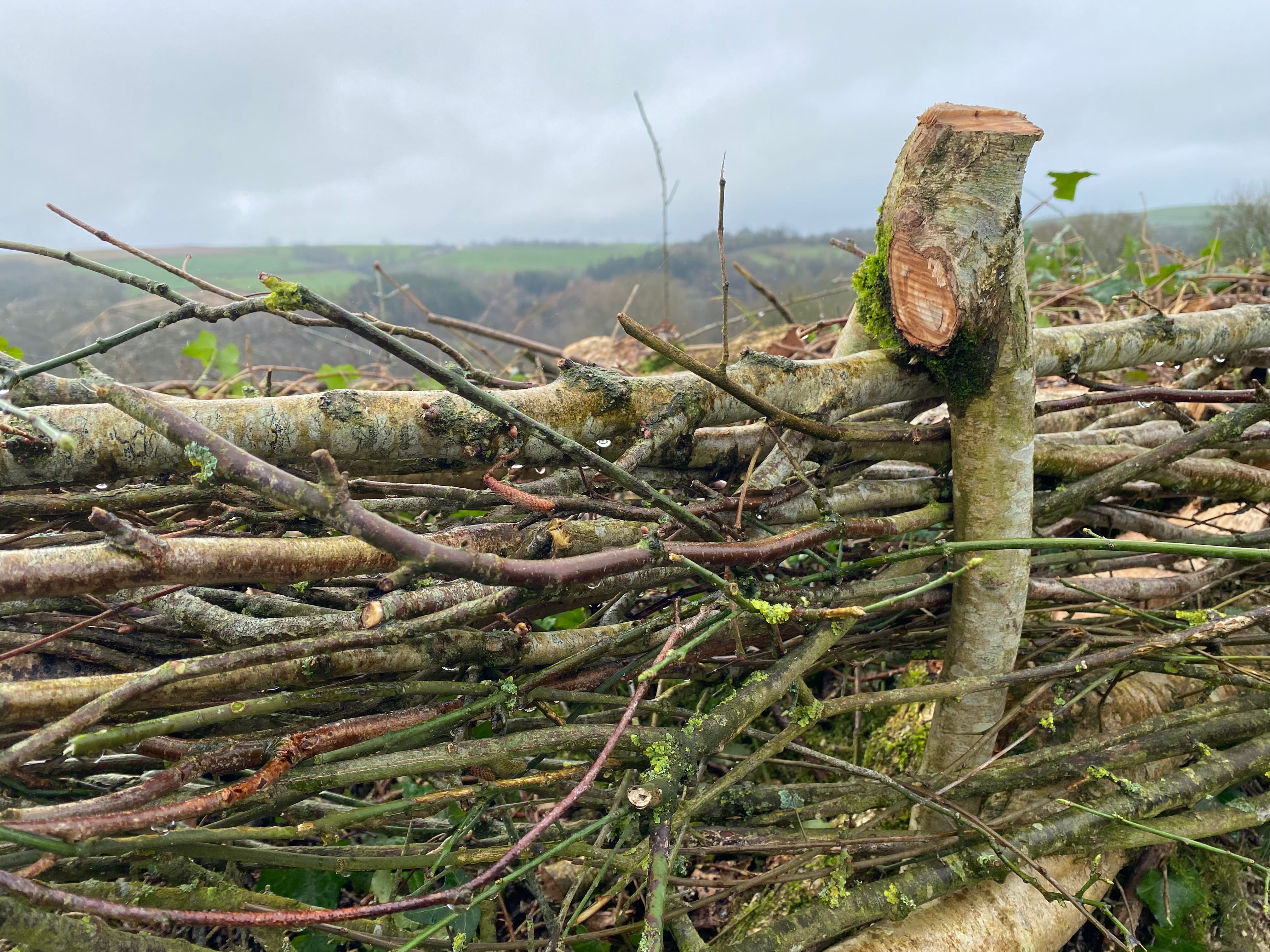
In Devon hedgelaying, ‘steepers’ — partially cut branches — are bent and laid almost horizontally along the earth hedgebank, and held in place with crooks and stakes. It can look quite bare in the short term. But its opening up means that dormant seeds in the earth germinate; foxgloves and primroses and stitchworts and other things come to life. It is a time of flowers, and of the life they feed. And then there is growth at other layers; the flowers are shaded out, leaves cloud around the branches, there are new corridors and habitats for other creatures. And on it goes: life in abundance, in green waves that swell and break and forever make room for new life — even as they are rooted to their place and tended by old ways. The hedgerow has life flowing through it again.
I look at the section of hedgerow Steve is working on. It is all bent branches and exposed earth; nothing like the dense green tunnels of hedge I am used to walking past, but it looks cared for, crafted, beautiful. And it will teem with life over the years. You can't have the abundance and the interdependence without the hedge first being tended, opened up, exposed to light.
Steve tells me the layered diversity of Devon hedgerows will become vital as the climate becomes more volatile, too.
For the 13th century abbess and mystic Hildegard of Bingen, ‘viriditas’ meant the ‘greening power of God’ and was present in everything, including humans — it was an expression of heaven and the creative power of life present in gardens, forest, and farmland.
Hildegard saw viriditas existing in duality with ariditas — the “dryness,” “drought,” and “infection” that arises when the flow of life is blocked. She taught that the only sin in life is our drying up. She would write to bishops and abbots to tell them that they were drying up and should do whatever it takes to stay “wet and green and moist and juicy”— in other words, to stay creative and keep growing; to make sure their lives were woven into the life-giving web of the world. She saw the tragedy of a dried-up person or culture, the way they lost the ability to create and bring forth new life. She spoke about the Holy Spirit as a green “sap” inside all of us; the capacity for life within us and so without.
In her Book of Divine Works — written after a series of visions 800 years ago — she conceptualises something that sounds a lot like ecology, with her ideas of viriditas uniting all of creation.
Seven centuries before anyone understood climate change, Hildegard prophesied: “Then the greening power of the virtues faded away, and all justice entered upon a period of decline. As a result, the greening power of life on Earth was reduced in every seed because the upper region of the air was altered in a way contrary to its first destiny. Summer now became subject to a contradictory chill while winter often experienced a paradoxical warmth. There occurred on Earth times of drought and dampness…As a result, many people asserted that the Last Day was near at hand.”
Her writing paints a picture in which the greening power of the world is diminished, but also a picture of humans disconnected from the greening power of their own souls.
Hildegard believed that “the soul knows what is good and what is harmful.” Stewarding the greening life force of the world and also of our lives is work that Hildegard saw as essential then. Perhaps it is even more essential now; making sure we are awake to what each choice means personally and collectively — whether it is a move towards towards viriditas or ariditas; towards or away from what brings life.
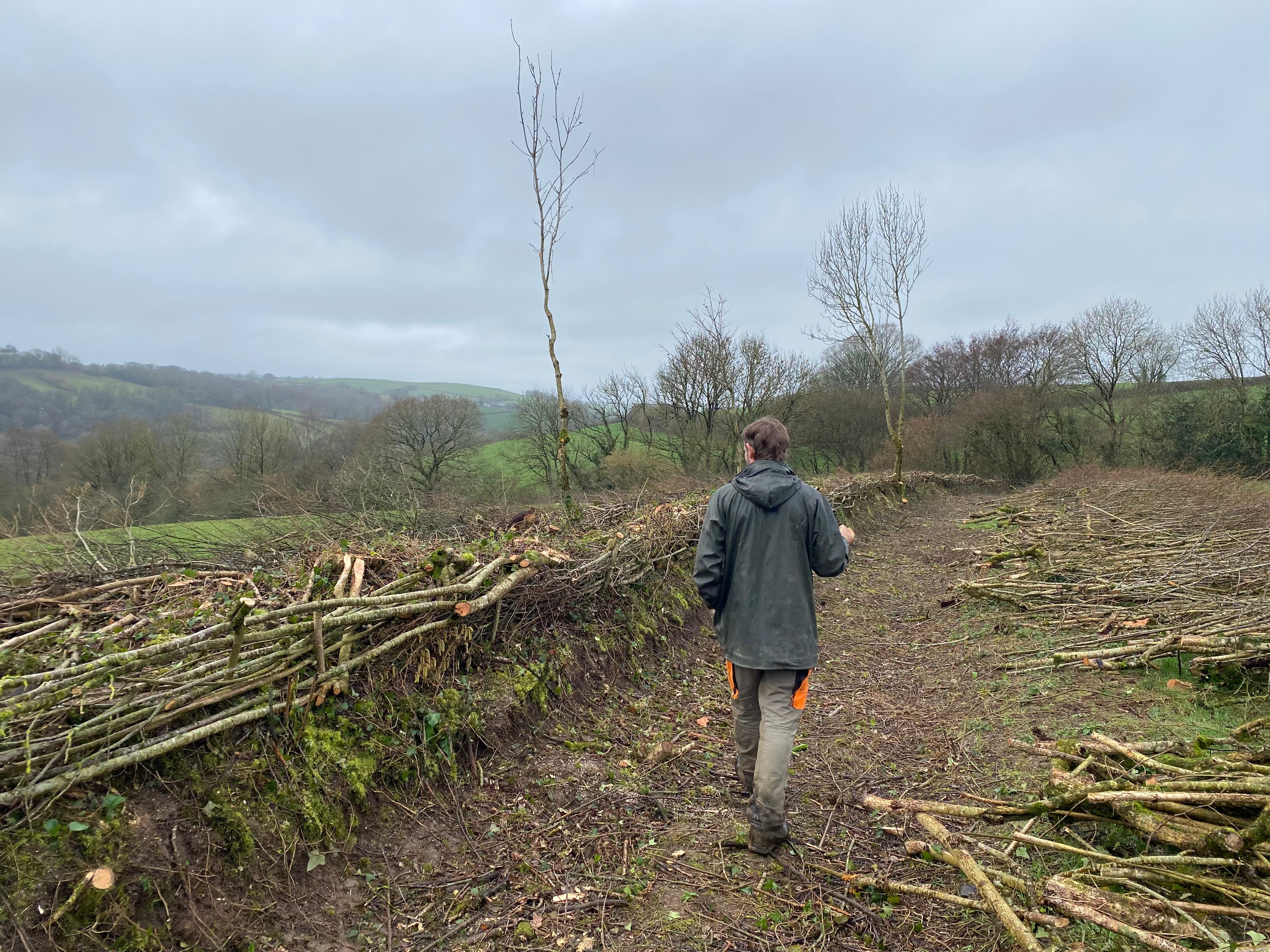
Here, amongst these old hedges, on this farm that feels off the map and outside of time, what appears as intentional damage is leading to growth and abundance. The dense dark interior is important for a time in a hedgerow’s life, but it must eventually face outward to the world so that new life appears and dormant species awaken.
Across the valley there is a farm that looks well-kept, green, its hedges shorter and neater than most of the others I can see. I am told it has its hedges cut right back to the bank, and glyphosate doused liberally to control unwanted life. It is a green desert, and the life from that farm found its way here. Steve mentions flycatchers, yellowhammers, peregrine falcons, brown hairstreak butterfly, bramblings, fieldfares, linnets, amphibians, dormice… “It’s an oasis here.”
Steve is encouraging the hedgerow’s and the landscape’s viriditas. Watching him at work makes me wonder about my own.
“The work we’re doing is for the next generation”, Steve tells me, with joy in his voice. “I’m involved in the hedge’s lifecycle. I can see what people did here a long time ago, and in the future they’ll see what I’ve done. The steepers we’ve put down touch the earth and create new plants — we’re extending the lifespan of the hedgerow. We’re just a blip in that cycle.”
Steve cuts back old growth to let light reach the base. I watch, and wonder what it would mean for me to do the same. Here, in front of a hedgerow that joins up ages as well as landscapes, I see there are old ways all around us that can point to life in abundance.
I am still drawn to big skies and big landscapes. I revert to independence and thinking I have to figure things out alone. But the hedgerows show me that containment, proximity, being tended, and intertwining might bring life in abundance too; opening up my inner world, awakening what is dormant, letting my branches weave into the great web of the earth. Reconnecting with the greening power of soul and world. Inviting viriditas to flow through it all.
Thanks for reading this Village View instalment of Field Notes. If you find any value here, please consider liking, sharing, commenting, or becoming a paid subscriber. It all helps to support my work — especially in this season of early motherhood, where balancing care, work, and writing is especially tricky! Thank you to those of you who do support my work — I appreciate it deeply.
Elizabeth x
Recent posts:
No posts
Comments
Nothing yet. Say the first thing.
Sign in to join the conversation.