
I’m a strong believer in finding the books that speak to us even when we are not looking for them. Many of us have experienced this bit of magic that can happen to readers. Welcome to our new regular feature where bookish folks from all over weigh in on a special book that found them at exactly the right moment. You never know, this may be how you find what you or someone you know most need to read right now.

Today we hear from Terrell Johnson , publisher of The Half-Marathoner, one of the first Substacks I started reading when I joined the platform six years ago - and I don’t even run. I went to his newsletter because I am fascinated by humans who push themselves to do things that are hard and yet, take time to look inward to examine the why of it all and where the journey they’ve chosen is really taking them. Early on, Terrell took the time to talk me through some of the questions I had about doing a newsletter and then, later, we talked about the parallels between writing and running.
These days I stop by The Half-Marthoner for the interviews like this one with runner Thu Nguyen in which she says, “choosing to run slower for me has meant choosing joy.” I check the essays to see how Terrell has gleaned inspiration for his life and for running from sources as varied as Jerry Seinfeld to E.B. White.
Here’s Terrell and the book he found at exactly the right time.
What book found you when you needed it most?
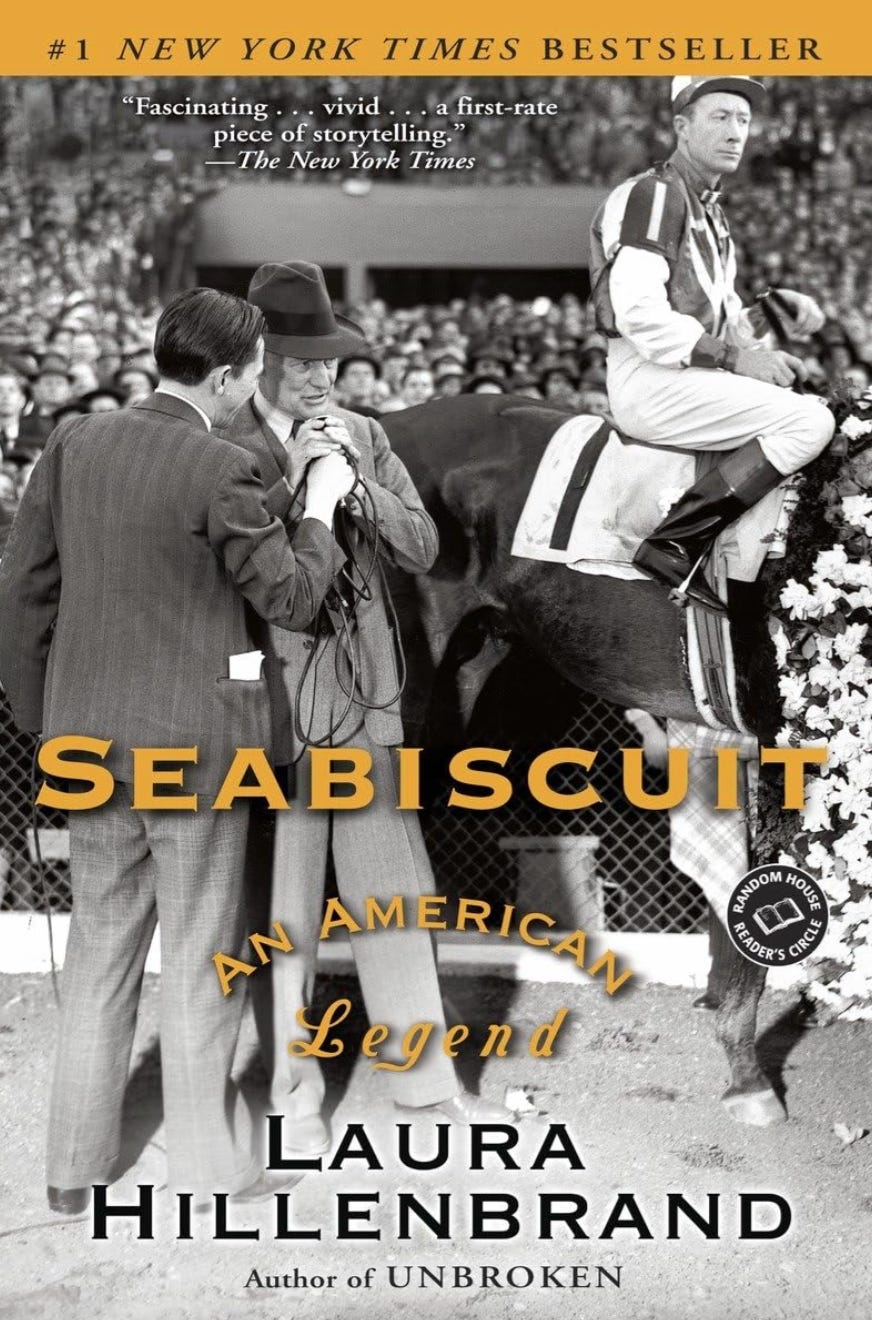
Seabiscuit: An American Legend, by Laura Hillenbrand.
When and how did it find you (or how did you find it)?
I remember seeing it for the first time when the paperback edition of the book came out, sometime in the early 2000s here in a bookstore where I live in Atlanta. There were stacks and stacks of copies on a table in the middle of the store, right as you walked in.
I didn’t think about it at the time, but a small detail that’s fascinating about the cover is that the book is about the legendary racehorse Seabiscuit, who became a hero to the nation in the late 1930s, during the depths of the Great Depression. When you look at the cover, though, Seabiscuit’s face isn’t even shown; instead, we see the faces of his rider, Red Pollard, and owner Charles Howard, standing next to Seabiscuit in the winner’s circle after a race – and only the horse’s hind quarters are shown.
There’s something perfect about that, because Seabiscuit brought together those two men (along with his trainer, Tom Smith), three people who’d all been broken down by life and discarded in various ways. And of course, Seabiscuit rose to prominence and accomplished the feats we know about today in the middle of the Depression, when the whole country felt broken down and discarded.
The story is about Seabiscuit, and horse racing, and Depression-era America, for sure. But it’s also about how a group of people who’d been broken by life found something new in themselves, strengths they didn’t know they had.
The first time I read it was around the time I was 30 or 31; I’d been recently laid off from my job, and definitely felt like I’d been discarded too. The richness of the detail that Hillenbrand gives us in the book blew my mind – how she was able to find stories of the lengths jockeys would go to in order to keep their weight down, which you won’t believe (but was absolutely true) – impressed me as a writer first.
I reached for it again almost a decade later when I was going through a divorce and got laid off from another job.
Why it mattered
As you might imagine, that year was a pretty rough one. I felt like I’d failed at my relationships and my work; really nothing in my life was going right. That feeling nagged at an insecurity deep down I’d always carried with me, a feeling of never being quite good enough, from the time I was very young.
What drew me to this story, and this horse, is no one thought Seabiscuit would amount to much either. There’s a great bit of detail Hillenbrand shares with us that I love: in contrast to most other young racehorses, which can’t wait to bolt out of the barn first thing in the morning, Seabiscuit loved sleeping:
“He could keel over and snooze for hours on end... While every other horse at the track raised hell demanding breakfast, he slept long and late, stretching out over the floor of his stall in such deep sedation that the grooms had to use every means in their power just to get him to stand up. He was so quiet that [his] trainers once forgot all about him and left him in a van for an entire afternoon in brutal heat while they went for a beer. They found him there hours later, pitched over on his side, blissfully asleep. No one had ever seen a horse so relaxed. The only thing Seabiscuit took seriously, aside from his beauty rest, was eating, while he did constantly, with great vigor.”
When you read that, maybe it’s not a huge mystery why everyone underestimated Seabiscuit :)
What was meaningful to me about this story, though, is that everyone around Seabiscuit thought they had him figured out. Not until new people came into his life, people who actually bothered to take a closer look – especially his trainer Tom Smith, who saw that Seabiscuit had “real stuff” in him – was he able to realize his gifts. He just needed to be encouraged, not written off.
That story meant so much to me because I felt the same way; I was almost 40 and I felt like the world had written me off, had told me I didn’t have much to offer. And the world had to be correct, right? At least that’s what I thought at the time.
I thought I was probably never going to meet anyone again, and wondered whether I’d ever find another job again. I was pretty low. But, like Hillenbrand – who also faced immense challenges due to illness – said in an interview once, “I was wrong. I was so wrong.”
Would you read it again?
Oh, yes, completely. I love the book on one level, the way it transports us back to the America of the 1930s. The detail, the scenes Hillenbrand gives us just make you feel as if you’re sitting in the stands in the racetrack at Santa Anita and Pimlico. You can smell the grass, the dirt, see the clumps of mud flying as the horses round the bend. It’s totally engrossing.
And then, of course, there’s this whole other level, the story of how this horse brought three down-on-their-luck people together in his own time, brought Laura Hillenbrand to life twenty years ago, and still can bring us back to life today. Seabiscuit’s story is my story, and really all of our stories, I think. It’s just the best. Here’s an essay I wrote about Seabiscuit for my newsletter. And here’s one I wrote about Lauren Hillenbrand.
What about you?
What stories — movies, novels, memoirs, nonfiction books — have inspired you or given you a lift when you needed one?
A bit more about Terrell Johnson
A longtime writer and a runner, Terrell founded one of the leading websites for half-marathon runners, The Half-Marathon Guide. He began to publish his newsletter, The Half-Marathoner a few years later and details his journey here. You can find him here on Substack at The Half-Marathoner.
Comments
Nothing yet. Say the first thing.
Sign in to join the conversation.