
Dear Reader,
This week, I was researching whether the main character in the book I’m working on, Lady Miranda Harwood (a widow), could have her own bank account, or whether it would need a trustee or some other man to ‘guide’ it. Spoiler: she can!
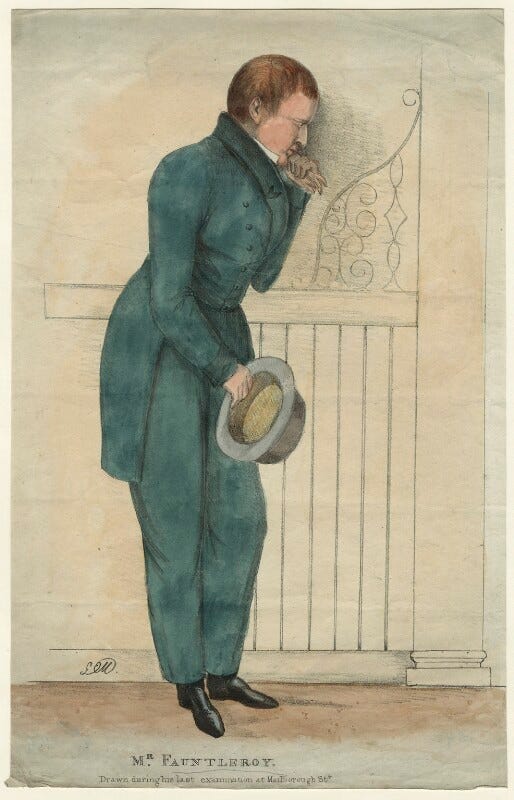
In the process, I came across the case of Henry Fauntleroy, a partner in a banking-house, who forged powers of attorney from his clients and stole their money to the tune of £170 000 pounds (the equivalent of MILLIONS today). I’ve discussed that case in detail in a video.
This is him, drawn on his way to his ‘examination’ (aka committal hearing).
This case, as you can imagine, attracted a huge amount of public interest, especially since it ended in Fauntleroy being hanged. I read a lot of articles about it and about Henry Fauntleroy’s private life. The thing I found most interesting was the treatment by the press of a young woman associated with him.
I don’t know her name, which is interesting in itself. She was a young English girl studying at a convent in France (where Catholic girls were often sent for education because there were so few Catholic schools in the UK - they had been banned until only a few decades ago at this time.) She couldn’t have been more than 16, at the oldest.
Henry seduced her away from the convent, brought her to England, and set her up in a house in Surrey, where they proceeded to live as husband and wife under an assumed name. He would come home on the weekends and, as far as the neighbours knew, he was just an ordinary businessman with a wife and, at the time of his arrest, two children. She had only recently had the second baby, when he was arrested.
The only personal comments made by the press about her, were that she was 20 years of age, ‘exceedingly beautiful’ and that she was distraught at the news of her ‘husband’s’ arrest.
They don’t publish the assumed name, they don’t tell us her name, they don’t even tell us the name of the village in which she lived. In fact, they go to an enormous amount of trouble to protect her privacy and shield her from the censure of her neighbours.
Fifty years later, in the Victorian period, I’m pretty sure she would have been condemned as a scarlet woman, particularly since Fauntleroy was technically married, although he’d never lived with his wife (he married her because both her and his family ganged up on him when they found out she was pregnant, but she went straight from the church to her mother’s house, and continued to live there with her son.')
But not in 1824, which was when his crimes were discovered (he counts for me as a Regency figure because his crimes were committed then). In 1824, the feelings and security of this young woman were tenderly acknowledged and protected by the entire press corps.
I can’t help feeling that such a thing would not happen now!
We assume that the Regency world was more censorious than our own, but that’s because we see it through the veil of the Victorian era, which was indeed more censorious and judgemental. The Regency? Not so much.
The Georgian period was far more robust in its acceptance of extra-marital, non-heterosexual and ‘irregular’ (aka kinky) sexual liaisons, and of bodily functions generally. One example: ‘pregnant’ was considered indelicate by the end of the century, but it was freely used during the Regency.
The rise in ‘morality policing’ coincided with the rise in Methodism and Protestantism generally in the UK during the 19th century, including the rise in literacy rates which gave rise to the gutter press (you can’t be a good Protestant if you can’t read the Bible, so many churches held ‘Sunday Schools’ to teach both adults and children how to read). But during the Regency, this shift had not yet gathered pace.
I have to remember this as I write, and also figure out how to hint to the reader that we are not in the Victorian period and shouldn’t expect Victorian moralising. Which is harder than you might think!
I love doing research which shows me another element of Regency society, and this one has been great fun!
I remain,
your humble servant,
Elizabeth
Comments
Nothing yet. Say the first thing.
Sign in to join the conversation.