
Dear Reader,
Because my current book (A Deadly Dowry - the publisher liked the title, yay!) is set in 1814, I’ve been paying special attention to the fashions from that year, as seen in La Belle Assemblée and Ackermann’s Repository.
The ‘Fashions for February’ in Ackermann’s in 1814 showed a remarkable image:
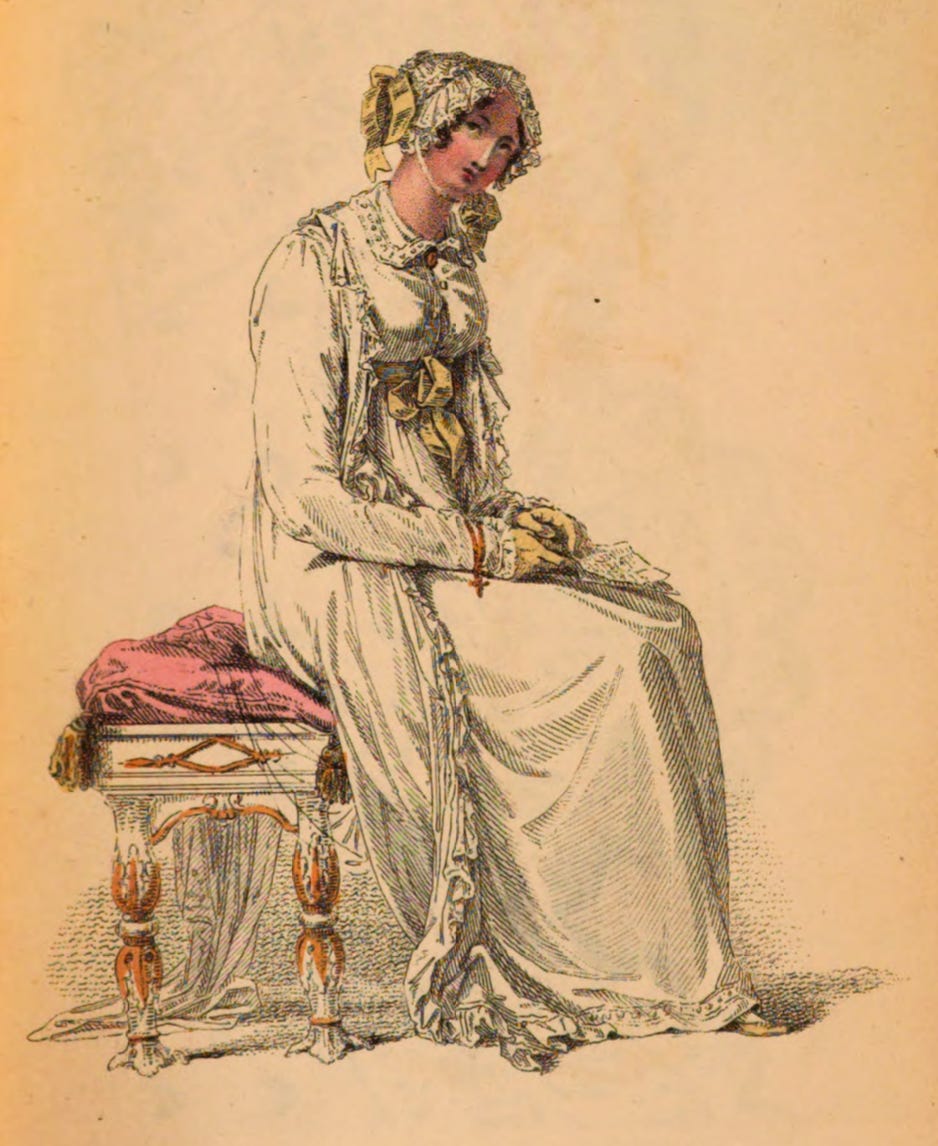
It’s described as a ‘Morning Dress’ - that is, something you would wear when making morning calls, or receiving morning calls from others.
What struck me with this image is how sad it is. And how much symbolism is present. Let’s unpack it.
First of all, this is not a dress to go out in. How do we know? Because the pelisse (the long overdress which is open at the front) is made of muslin, and this image was published in the middle of winter. So this is a staying-at-home morning dress, and it’s intended for an older woman—we know that because she’s wearing a cap, which young unmarried women didn’t do.
And then there’s the rosary. Remember that Britain at this point was legally and emphatically Protestant. For example, the only place you could legally marry was an Anglican church (exceptions were made for Jews and Quakers, but not for Catholics or Methodists). So seeing such a Catholic symbol was jarring. I did some digging, and there is apparently a High Church Anglican tradition of using the rosary.
More importantly, the rosary represents prayers.
This image is of a sad older woman who prays so much that she carries her rosary around with her on her wrist.
And what else was happening in January/February 1814? The British were, with many other European powers, fighting Napoleon in France. There had been a big battle at Bayonne in December1, so this woman may well be praying for either the safety or the soul of her husband or son. Ackermann’s editors evidently decided it wasn’t the time to publish a light-hearted fashion plate.
As always, I’m fascinated by the intersection of fashion and the political and social environment!
I hope you are too, Dear Reader, and I remain,
your humble servant,
Elizabeth
There was another battle there in April 1814, which ‘the Battle of Bayonne’ usually refers to, but the December battle had significant losses.
Comments
Nothing yet. Say the first thing.
Sign in to join the conversation.