
Everyone’s talking about the blockbuster merger between energy giant NextEra—a holding company that owns a merchant generation arm, a competitive transmission company, and a regulated utility in Florida—and Dominion Energy, the large regional utility serving Virginia and parts of North and South Carolina. What does it mean? Will it go through? What are the implications for ratepayers? Is this about AI?
Some of these questions are easier to answer than others. Most (but not all) experts concur the merger will face intense scrutiny by multiple state and federal regulators, with Virginia’s State Corporation Commission (SCC) likely the highest hurdle for a company that has often walked away from tough acquisitions. And yeah, this is about AI.
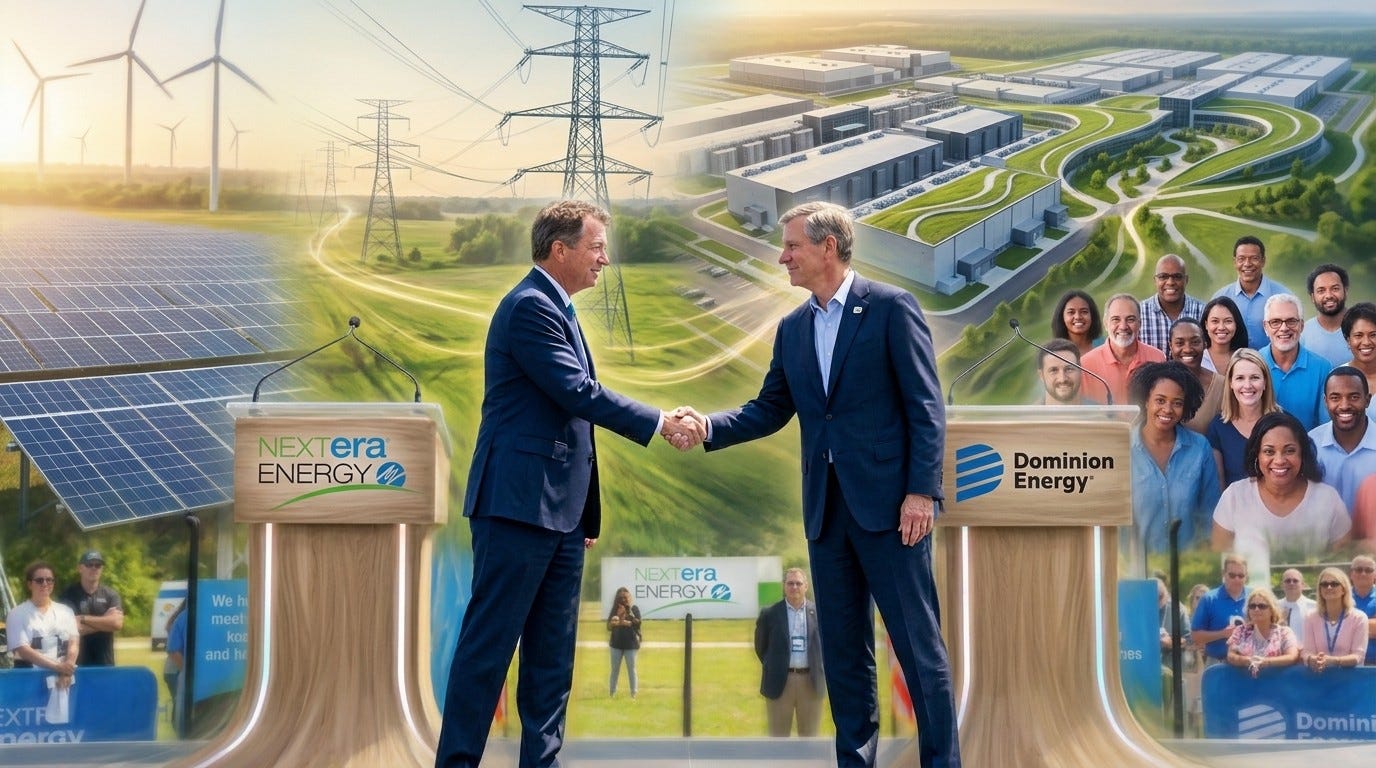
The subtext of the deal is that NextEra’s resource portfolio and ability to build will make it easier for Dominion to serve its intense concentration of data centers (with mostly clean energy, which deserves more than a nod). And the companies’ press release, while it doesn’t mention the data center angle, focuses on the benefits of the economy of scale that will allow the merged conglomerate to eventually pass the efficiencies and savings down to ratepayers (along with $2.25 billion in rate credits, as an extra sweetener).
But we’re not really talking about the economy of scale. We’re talking about the Economy of Hyperscale. A market rapidly consolidating, realigning, and orienting toward serving a preferred class of customer. A re-defining moment for what we fundamentally understood about “competition” in the energy space.
And the news crowded out by the merger headlines shows the flip side of that trend. Out in Lake Tahoe, California, NV Energy quietly allowed a wholesale power contract with a small distribution utility to lapse, leaving the community of 49,000 people desperately seeking a new energy provider in the most competitive environment for generation in modern history.
It was a simple commercial decision—at the conclusion of a term-limited contract, the provider simply opted not to renew. Instead, NV Energy will use the power once earmarked for Tahoe and use it to power its own customers. Its own data center customers. That’s totally legal, and it should make any distribution utility holding a contract for power, rather than a deed to a power plant, incredibly nervous. It should also make regulators look closely at who might lose in a deal that otherwise appears to be a win-win for two giant companies.
The NextEra-Dominion merger didn’t cause folks in Tahoe to lose their power provider. And there’s no evidence that NextEra will decline to extend wholesale power contracts or PPAs with the distribution utilities it serves in Louisiana, Colorado, and Florida when they reach their natural conclusion, simply to serve its new “native” load in Data Center Alley.
But not all cost shifting appears in the four corners of a rate case. It’s happening in commercial decisions and economic realities of a changing marketplace, in the hand-wringing inability of policymakers to intercede in financial matters that feel like the competition we’ve so long desired in the energy sector. Unfortunately, the new competitive landscape pits the preferred rate class of well-heeled tech “consumers” against native load that no longer holds any bargaining power.
And this week, the sonic boom of the merger made it impossible to notice the silence of the canary in the coal mine.
Both lawmakers and MAGA activists are asking President Trump to assert controls over AI, particularly in the realm of cybersecurity. (Politico Pro, Axios)
The knock-down-drag-out legal battle between Elon Musk and Sam Altman concluded on an unsatisfying technicality: the case was not brought within the statute of limitations. (*boos, throws tomatoes*). (Wired)
But in better legal news for Elon, the Department of Justice is considering intervening in the NAACP case against xAI to assert the “policy of the United States to sustain and enhance America’s global AI dominance.” (Utility Dive)
FERC Chair Laura Swett told PJM it might be “too big to function” and urged reform of its governance model at the grid operator’s annual meeting. Yikes. (Utility Dive)
Dueling analyses: PJM’s market monitor pins a 76% cost increase on data centers, while the Data Center Coalition’s research from E3 says the facilities aren’t to blame for high prices nationwide. (Politico Pro)
A new research group is betting the companies adopting AI can convince hyperscalers to seek more sustainable practices. (Latitude Media)
Here’s a peek inside the case challenging the Trump administration’s emergency reliability orders. (Inside Climate News)
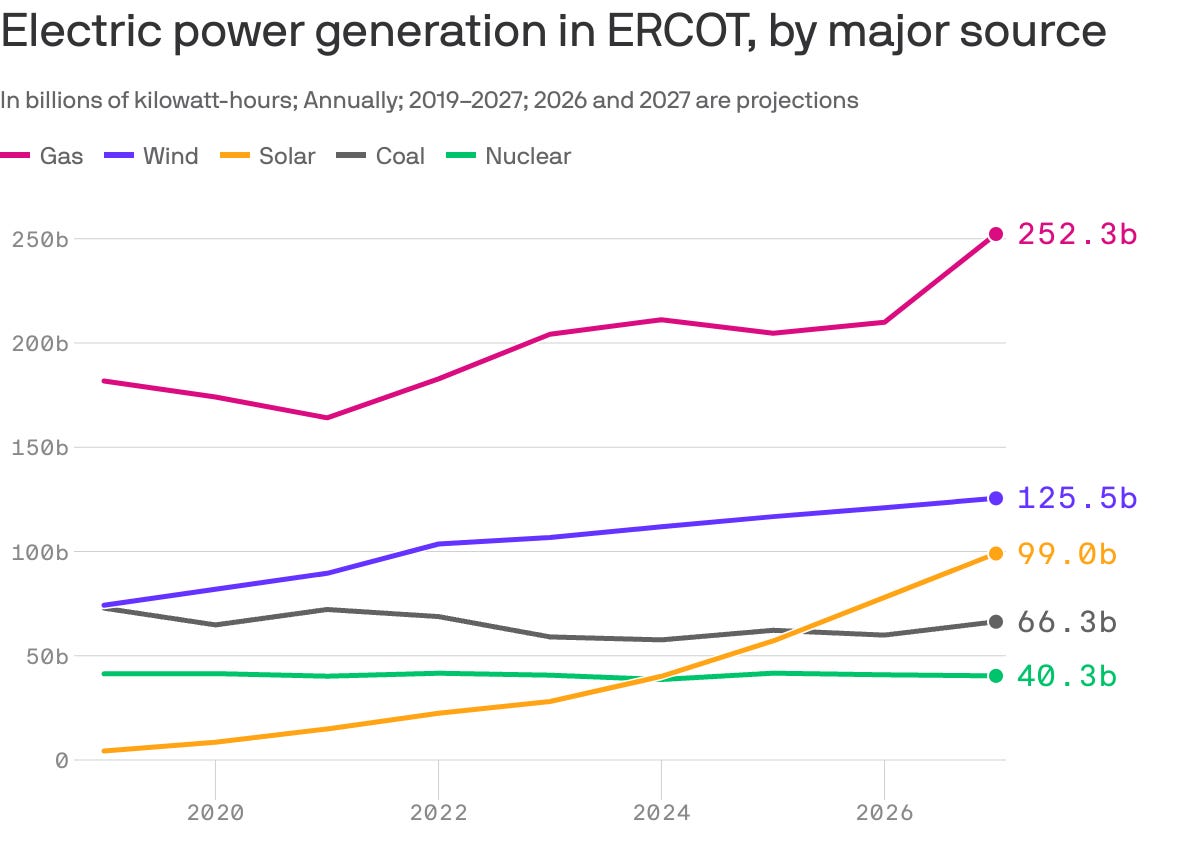
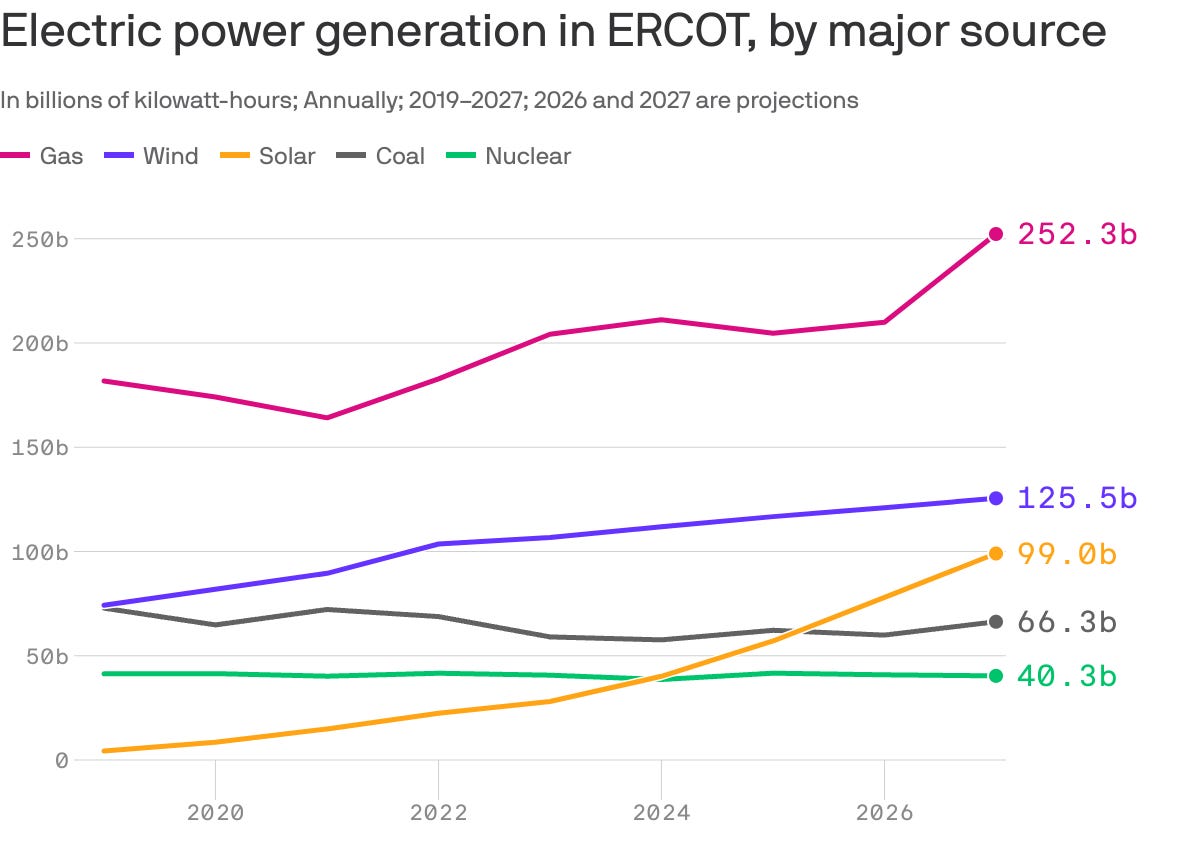
Hey, Check out Texas: (EIA via Axios)
As the SunZia transmission line enters operation, the state transmission authority that helped usher it to completion is having a moment. Could other states replicate its success? (Latitude Media)
The House Energy and Water spending bill for FY27 reroutes dollars from clean energy demonstrations and renewables support to AI programs at the Department of Energy. (E&E Daily)
Investor-owned utilities have AI tools to improve services, but questions over whether their cost should be recovered from their ratepayers or shareholders is slowing deployment. (Politico Pro)
That’s all for this week! Keep sending me cool stories and thoughts on the AI transition, and please share this with others who might be interested. Thanks for reading!
Comments
Nothing yet. Say the first thing.
Sign in to join the conversation.