
“All that data center opposition is coming from China.”
“China is ginning up opposition to data centers so they can win the AI race.”
“That’s exactly what the Chinese want you to think.”
It’s a narrative I’ve heard more than a few times on Capitol Hill that has me wondering—do Members of Congress, with their insider information and classified briefings, know something we don’t about Chinese influence over cratering public opinion on data centers?
The logic is there: Beijing knows that the data centers supporting American AI require staggering amounts of generation capacity. And while China’s grid is well-prepared for that surge, the U.S. needs massive electric infrastructure investment to keep up. So it follows that hobbling the buildout of U.S. infrastructure can provide China with a strategic advantage in the global AI race.
Getting people to oppose local siting would be a low-cost, low-effort way to do that. According to Heatmap, over 500 localities have already banned data centers and hundreds of projects have been cancelled due to local opposition. China could simply execute a misinformation campaign and damage U.S. capabilities without firing a single shot.
If true, the implications are profound. But what exactly is the evidence that China is fomenting public outrage against local data center campuses?
Just when I was beginning to think there must be some secret government intelligence supporting this claim, I spied this Washington Examiner on the coffee table in a Republican office:
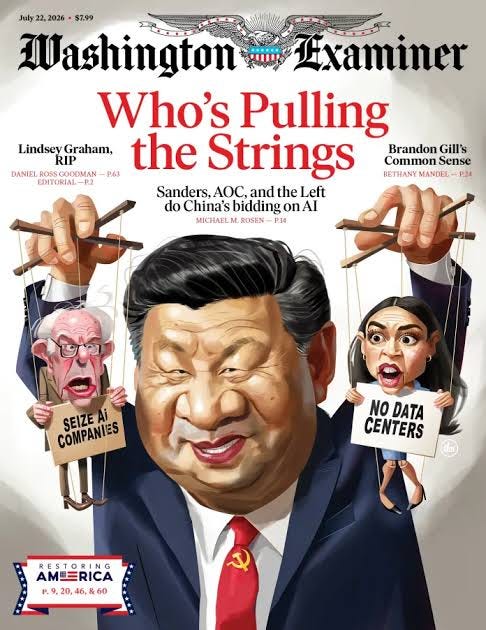
In an opinion piece that seeks to lay blame at the feet of liberal data center hawks Sen. Bernie Sanders (I-VT) and Rep. Alexandria Ocasio-Cortez (D-NY), author Michael Rosen offers only an OpenAI blog report as support for his contentions.
The report, which OpenAI released in June, discloses the company’s discovery of a group of linked ChatGPT accounts of likely Chinese origin that used the platform to create social media posts claiming data centers drive up electricity costs. The users exhibited a sophisticated understanding of social media influence, including creating multiple fake accounts and “using cross-account interactions to amplify narratives while preserving the appearance of organic engagement.”

A report from the Bitcoin Policy Institute (a group linked to Treasury Secretary Scott Bessent) goes further, alleging that China is using traditional media, non-profits, and advocacy groups to boost anti-data center messaging.
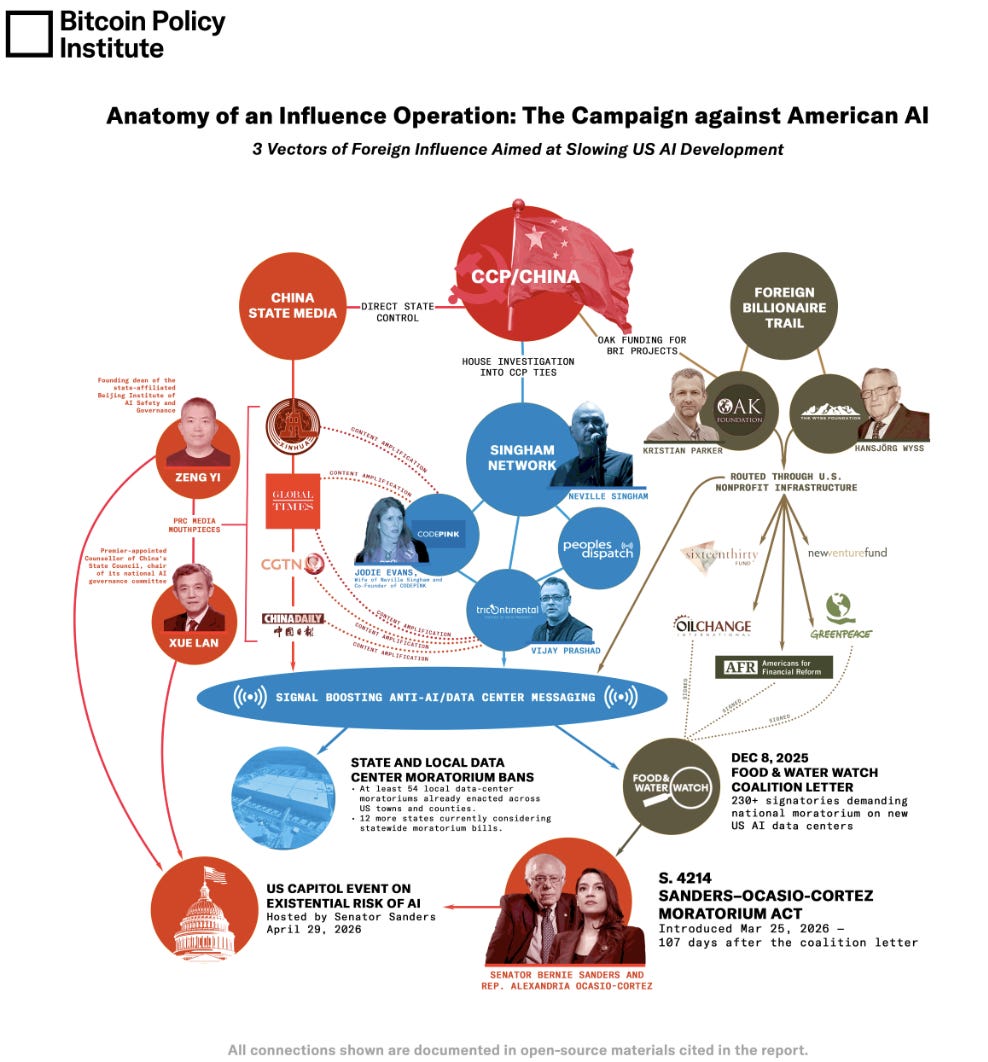
But while the reports try to spin a kernel of truth into a partisan attack, they don’t ask the question of whether the Chinese influence campaigns were successful in any way. In other words, the efforts of Sanders and Ocasio Cortez may be correlated with the Chinese influence campaign, but even OpenAI conceded there’s no evidence that the Chinese propaganda caused these policymakers to act. Rather, the Chinese strategy is to amplify the debate already taking place.
The apparent interference of foreign actors in domestic policy debates is concerning on its own. But it’s not helpful to filter it through a partisan lens that effectively accuses U.S. policymakers and protesters of collusion. When people see energy prices skyrocket, neighborhoods transform, and water rights collide, their opposition is a function of ground reality, not social media influence. And it raises the stakes for negotiating better outcomes from developers—like hyperscaler-financed generation, air and water pollution limits, and robust community benefits plans—so that moratoria don’t become the default response.
For all its attempts to align the left with the Chinese influence campaign, the Examiner article can’t help but contend with the growing concerns of Republican Governor Greg Abbott of Texas. In a lengthy discussion of his about-face on data centers, the article laments how “even some conservatives” have bought into the data center backlash. Abbott made Texas the second state to ban data center interconnections this week.
So no, China isn’t astro-turfing zoning fights across the country and Sen. Sanders didn’t need a nudge from Beijing to be skeptical of the environmental impacts of data centers. But make no mistake, even if China isn’t directing this show, it is certainly enjoying it.
The White House hosted top AI companies Aug. 4 to review the recently completed framework for voluntary government review of frontier models, but it’s not certain whether it will be made public. (CNBC)
The top Democrat on the Senate Energy and Natural Resources Committee released a new proposal titled “the GRID Savings Act” to address rising energy costs from data centers by directing the Federal Energy Regulatory Commission (FERC) to propose a rule requiring large loads to pay for upgrades and incentivize other investments. (E&E News)
The top Democrat on the House Energy and Commerce Committee is also developing legislation on data centers and the grid, walking back his prior endorsement of a national moratorium but maintaining it remains “a possibility” if necessary. First up: taking xAI to task for its troubled Colossus campuses. (E&E Daily)
The Federal Communications Commission (FCC) has added advanced robotics and power inverters to a list of high-risk components ineligible for importation. The move will not impact devices already in use in the U.S. (Politico)
PJM proposed a data center registry, a connect-and-manage proposal, and a reliability backstop auction framework shortly after FERC’s technical conference on governance reform. Let’s get into it. (Heatmap)
Meanwhile, the New England ISO is preemptively requiring new large loads to bring their own new generation and shuttling them to a separate auction for capacity, despite relatively little data center siting in the region. (RTO Insider)
A new startup is looking to put inference data centers in spare office building space, capitalizing on existing capacity and proximity to urban centers. (Latitude Media)
…And a new study shows that data centers are increasingly locating in urban or suburban areas, as opposed to rural areas. (NYU Tandon School of Engineering)
Is the potential for measuring and unlocking “grid utilization” all it’s hyped up to be? Oliver Kerr of Aurora Energy Research suggests a focus on realigning utility incentives may be more valuable than trying to measure utilization across multiple variables. (Latitude Media)
That’s all for this week! Thanks for reading, and please subscribe and share with others who might find this human-generated content interesting.
Comments
Nothing yet. Say the first thing.
Sign in to join the conversation.