
8/10/99
Into the Orchard of the Aunts
By Elizabeth Hunter
My mother, in a powder blue dress, sat in the rocking chair by the pantry door in our big Vermont kitchen. “When do you think we should go up to the church?” I asked. She looked me right in the eye. “I don’t know,” she said. “I’ve never done this before.”
Nor had I.
This is not the column I intended to write for the last pre-Y2K issue of Blue Ridge Country. But in the wake of a 4 a.m. phone call from my brother Graham on July 15, 1999, I can hardly do other. Actually, Graham called twice. The first time the answering machine kicked in before I could get to it; when the message ended, no one was on the line. I went back to bed, but not to sleep. Three rings into the second call, I picked the receiver up.
“I didn’t want to leave this on the machine,” he began, “but about 45 minutes ago, Dub...” (Dub is the name Graham’s family has used for my father since his elder son Matthew began talking.) I didn’t listen to so much as monitor the rest, the way you survey the hot bar in a restaurant before deciding whether to order from the menu. I wanted to see if there was anything in this flow of words that would arrest me.
There was. The last word, “died.”
Then my mother got on the line and told a story that I would recount, in long or short versions, many times in succeeding days: how my father had worked in his print shop with my brother Will, his namesake, until 10:30 p.m. How he’d climbed the steep back stairs of the house, bathed, and gotten into bed beside her. How he’d later awakened, feeling sick, headed for the bathroom for an AlkaSeltzer (my parents pharmacopoeia consists of two remedies: AlkaSeltzer and aspirin), fallen, and called out. How she helped him back to bed, where he told her not to call an ambulance. He didn’t want to explain to a hospital clerk that his mother had had no middle name, that her maiden name “Peirce” was spelled “-ei” rather than the more common “-ie.”
“He was very funny,” Mum said. “Our new dog was there, and he joked with it. “You better get used to this up-in-the-middle-of-the-night kind of thing. We do it all the time.’” This between chest pains, when he gripped my mother’s hand tighter (“That hurt!”). This, until the last massive jolt, about 20 minutes after the first. “It was wonderful, just wonderful,” my mother said, in a voice that wasn’t absolutely steady. I let it pass, that word “wonderful” to describe the final 20 minutes of 56 years of shared life. Maybe it was wonderful. I wasn’t there.
My brothers and I agree that, had Dad been permitted to write the script, he would have written this one. We are grateful he (and we) were spared infinitely worse scenarios. We are proud of what he chose, and that my mother chose to honor and obey. Infinitely proud.
“It takes a certain grace to joke with the dog while you’re waiting to die,” my brother Charlie said.
“Do you think he knew he was dying?”
“I think he did.”
I write this a few days after my return to North Carolina from Vermont, where, for a fortnight, I rose at first light to take the dog outside, get the newspaper from the mailbox, and let the chickens out on my way to the garden. There I did whatever needed doing — hoed corn, weeded beets, pulled up spent pea vines, picked cukes — and was privileged to witness each new day come to the land of my roots. Every morning was different, though there were connecting themes: the monotonous song of a robin from one of the big maples, mist rising from hayfield and pond as the sun flooded field and garden with slanting light, golden garden spiders manning dew-laden webs, barn and tree swallows in swooping flight.
The garden is behind the house, a big old white frame colonial whose low back rooms were built in the late 1700s. The two-story front portion, added in 1812, housed the large family of my great-great-great grandfather, the Rev. James Converse, the first pastor of the meetinghouse whose bell tower you can see poking above the treetops on the horizon when you stand in our front yard. The house went out of the family for 90 years before my maiden aunts Mary and Margaret Peirce reacquired it in the early 1940s. My parents inherited it from them. At the time of his death, my father had been living in our ancestral home for 30 years.
The garden was Aunt Mary’s before it was my mother’s. Fenced against deer and groundhogs, its land is flat, its soil loam, deep chocolate brown after rain, pale and dusty from drought when I was working it. Hilling the potatoes, which my mother plants late to avoid the worst of the potato beetles, my hoe clinked against shards of silvery slate. That sound reverberates in my mind the way the sound of the church bell did through the clear, light air, one of the mornings I was in Vermont, pealing me down the years to childhood, when I pulled the bell rope with my father’s father, when he served as summer pastor.
Between the garden and the house is a stone wall, a bit of lawn, three apple trees, a peach tree, and several fruit tree saplings. The largest tree is a St. Lawrence, already dropping its striped fruit in late July. I don’t know how long it has been there, though I do know the approximate ages of the others. The smaller of the two apple trees is an Early Transparent; the larger, whose spreading limbs I ducked under to reach the garden, is a Northern Spy. The former is Aunt Margaret, who died in 1969; the latter Aunt Mary, who followed several years later. The peach is Grandmother, last of the sisters to be laid to rest. In the years since their deaths, the trees have drawn sustenance from their ashes. I call this place the Orchard of the Aunts.
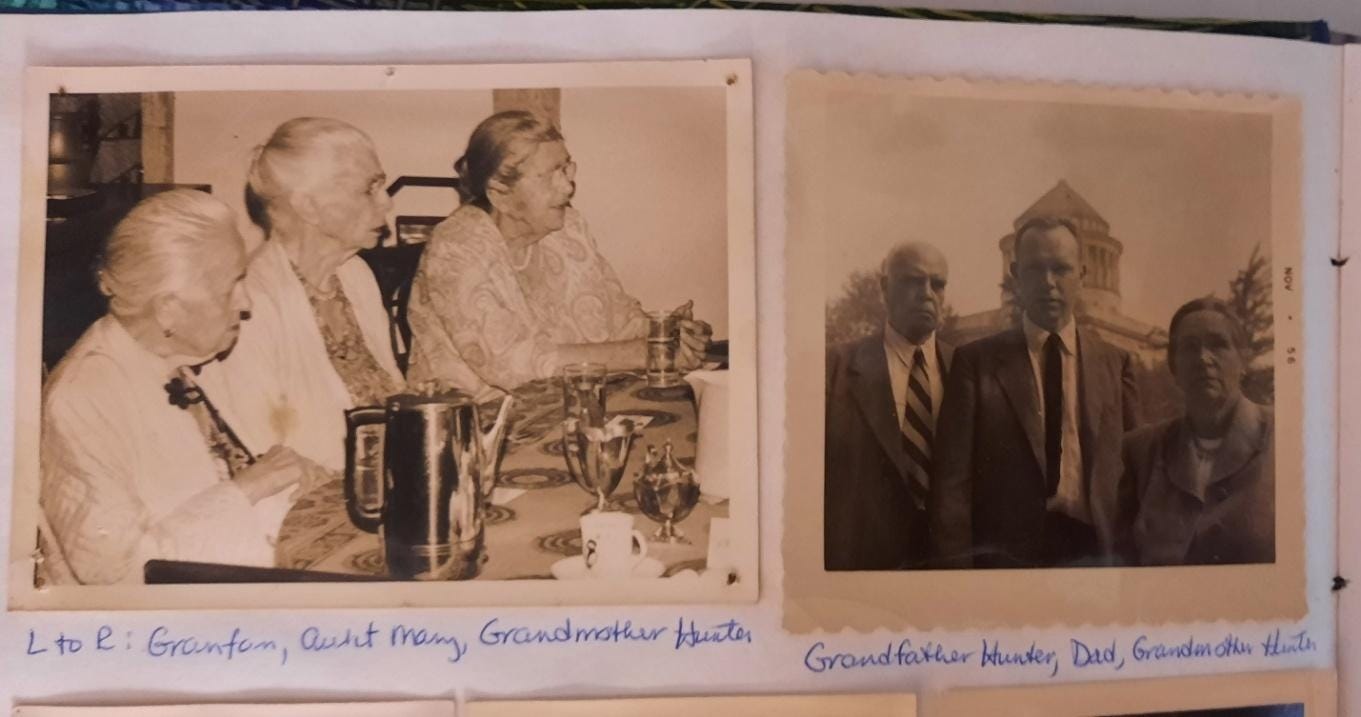
One day, perhaps next spring when the ground is again moist and rich, when the days are becoming longer rather than shorter, my mother, my brothers, and I will plant my father in this orchard. It is a thought I can’t yet entertain, a door I can’t yet open.
Right now, it is all I can bear to think of the bed my mother climbs the stairs to each night, or the print shop — my father’s small and intimate world, where he dreamed his dreams, and smoked his cigars, and hung up pictures and clippings and pairs of welder’s gloves, which he wore to feed the fires in his woodstoves. His print shop, where my brothers and I planned his memorial service, where we listened to the recording of “Just a Closer Walk with Thee” that he’d told Graham he wanted played at his funeral. His shop, that was, when I was a little girl, Aunt Margaret’s Handicraft Shop, now submerged, except in memory and old photographs, beneath a sea of computers, copiers, filing cabinets, and cartons of Hammermill bond.
Graham has had a workspace in one corner of the shop for years. It’s where he worked, night after night, writing the service, steeling himself to deliver it. William is there regularly to print his publications, as he was during those last (treasured, shared) waking hours of my father’s life. Charlie is already clearing out files, organizing those we need to keep, as he has been clearing brush from the stone walls that border our fields. I know that next time I see my father’s shop, it will look a lot less like him. As year succeeds year, his imprint upon it will blur, his tracery grow more faint, his grip relax, as it relaxed in my mother’s hand.
The windows of the shop look out on the garden and the Orchard of the Aunts. Desolate as I now feel, thinking of the shop’s transfiguration, I am consoled by another shape of things to come: a new tree, nourished by him who nourished me, unfurling its fine-toothed, shining leaves as mists rise, swallows swoop, and robin bids it morning.
No posts
Comments
Nothing yet. Say the first thing.
Sign in to join the conversation.