
I can count on one hand the number of times I have been to Target since we moved to Connecticut six years ago. It’s just not a part of my regular routine. But I did find myself there last week. And they’re stocking school supplies! I love school supplies. Except for that time I was in Target with a kid who was unexpectedly leaving home for boarding school at 15 (soccer; it’s a long story), I love to go to Target for school supplies. I’m the type of person who sees the start of the school year as “the new year.”
Those freshly sharpened pencil bouquets call my name. Even though it’s still July and I don’t want to rush summer’s end, I look forward to the arrival of new planners in the mail, smelling of fresh paper and possibility. With so many other women, I resolve that this will be the year we finally become disciplined, organized, patient, healthy, prayerful, or productive. Anticipating the fresh start ahead, we identify the habits we want to break and the virtues we hope to acquire, and then we get to work on ourselves with the quiet determination of a contractor beginning a renovation.
For a little while, it often works. September can make us feel like we can do anything! Then life happens. October hits, and everyone gets sick. Finances become tight. A child begins to struggle. A marriage grows strained. The job is lost. The disappointment settles in. We find ourselves reacting in familiar ways despite our best intentions. The impatience returns. The resentment resurfaces. The anxiety finds us before our feet have even touched the floor in the morning. We wonder, often with genuine discouragement, why change never seems to last.
By Christmas–decimated by the busyness of December–we wonder if the problem is that we haven’t tried hard enough. Were we not disciplined enough? Determined enough? Dedicated enough? I think maybe it’s that we have misunderstood what it means to change.
John the Baptist appears in Matthew’s Gospel with remarkable suddenness. The accounts of his conception, his birth, and his relation to Jesus are all in Luke’s gospel. Matthew simply tells us that “in those days John the Baptist came preaching in the wilderness of Judea.” His first recorded words are not words of comfort or encouragement. He doesn’t offer a list of practical strategies for living a better life. Instead, he calls for change with one word.
“Repent.”
For Christians, that word can feel hard and heavy and formidable. It often conjures images of shame, guilt, or angry street-corner preachers warning of judgment. Many of us hear “repent” as though God were saying, “You should feel really, really badly about yourself.”
But that’s not really John’s clarion call. Nor is his message “Do better.” And it’s not even my favorite mistranslation: “Try harder.”
The Greek word Matthew records is metanoeite, the verb form of metanoia. It is often translated “repent,” but a beautiful nuance is lost when we hear only the English word. Metanoia certainly includes sorrow for sin, but it encompasses so much more than remorse. Metanoia is a profound turning, a complete reorientation of one’s life. Literally, it speaks of a changed mind, but not in the shallow sense of changing an opinion. It is the renewal of the way we perceive reality itself. We begin to see God differently. We begin to see ourselves differently. We begin to see other people, our suffering, our vocation, and our future through new eyes.
The Catechism speaks about conversion in language that is at once gentle and demanding. It is replete with so much hope! It reminds us that Christ’s call to conversion “continues to resound in the lives of Christians” and that this conversion is “not just a human work. It is the movement of a contrite heart, drawn and moved by grace to respond to the merciful love of God who loved us first.” (CCC 1428)
Grace—the beautiful place to begin. Such a gift. God loves us first, and he moves towards us first. John’s call to repentance is not an invitation to climb our way toward God. It is a response to the astonishing reality that God has already begun the movement of repentance in our hearts.
This is a critical distinction between so much contemporary self-improvement and the Christian understanding of transformation. The world often tells us to become someone new by trying harder, thinking differently, or developing better habits. Those things have their place, but Christianity begins somewhere else entirely. It begins with grace.
Grace is God stirring in us, awakening, unsettling, exposing the lies we have told ourselves are truth. Grace gives us the courage to believe there can be something better.
First, there is grace, and then we respond. Over the past several years, after certifying as a life coach through Metanoia Catholic, I’ve returned to this passage to remind myself of the why and the how. The name itself is the mission statement. Metanoia is not simply a clever title. It is the very heart of the Christian life.
One of the most practical things I learned through that training was something the Church has understood for centuries: our thoughts determine our lives. Thoughts matter because what we believe eventually shapes what we love, what we fear, and ultimately how we live. And many of us are living from stories that are simply not true.
I am too much.
I am not enough.
If I fail, I have failed God.
My past determines my future.
If people really knew me, they would leave.
God must be disappointed in me.
Everyone is disappointed in me.
These thoughts often become so familiar that we stop recognizing them as thoughts at all. They simply become the atmosphere in which we live. They color our relationships, our parenting, our marriages, our prayer, our work, and even our understanding of God. The reality of the importance of our thoughts is why metanoia is so much more than behavior modification.
Catholic coaching might begin by asking, “What habit would you like to change?” But the answer is revealed with a different question: “What have you come to believe?” Because beneath nearly every persistent pattern of behavior lies a story. Some stories are true. Others were born from fear, shame, disappointment, wounds, or misunderstandings that have taken root and grown over many years.
The goal is not positive thinking or repeated affirmations. The goal is truth. The goal is to fully understand the true story and then to live it.
When Christ renews the mind, he is not asking us to manufacture optimism. He is teaching us to see reality as it actually is. We begin to recognize that we are beloved sons and daughters rather than employees or servants trying to earn our father’s approval. We discover that our worth is received, not achieved.
Read that again: you do not need to prove your worth. You already have value.
We learn that failure need not become identity. We begin to notice where fear has been making decisions that belong to love. This is where the Catholic blueprint for life transformation and Catholic theology naturally come together.
Grace illuminates the mind with truth. Truth reshapes our thoughts. Renewed thoughts begin to heal our emotions. A healed heart strengthens the will. The will begins to choose differently. Those choices, repeated over time, become virtue.
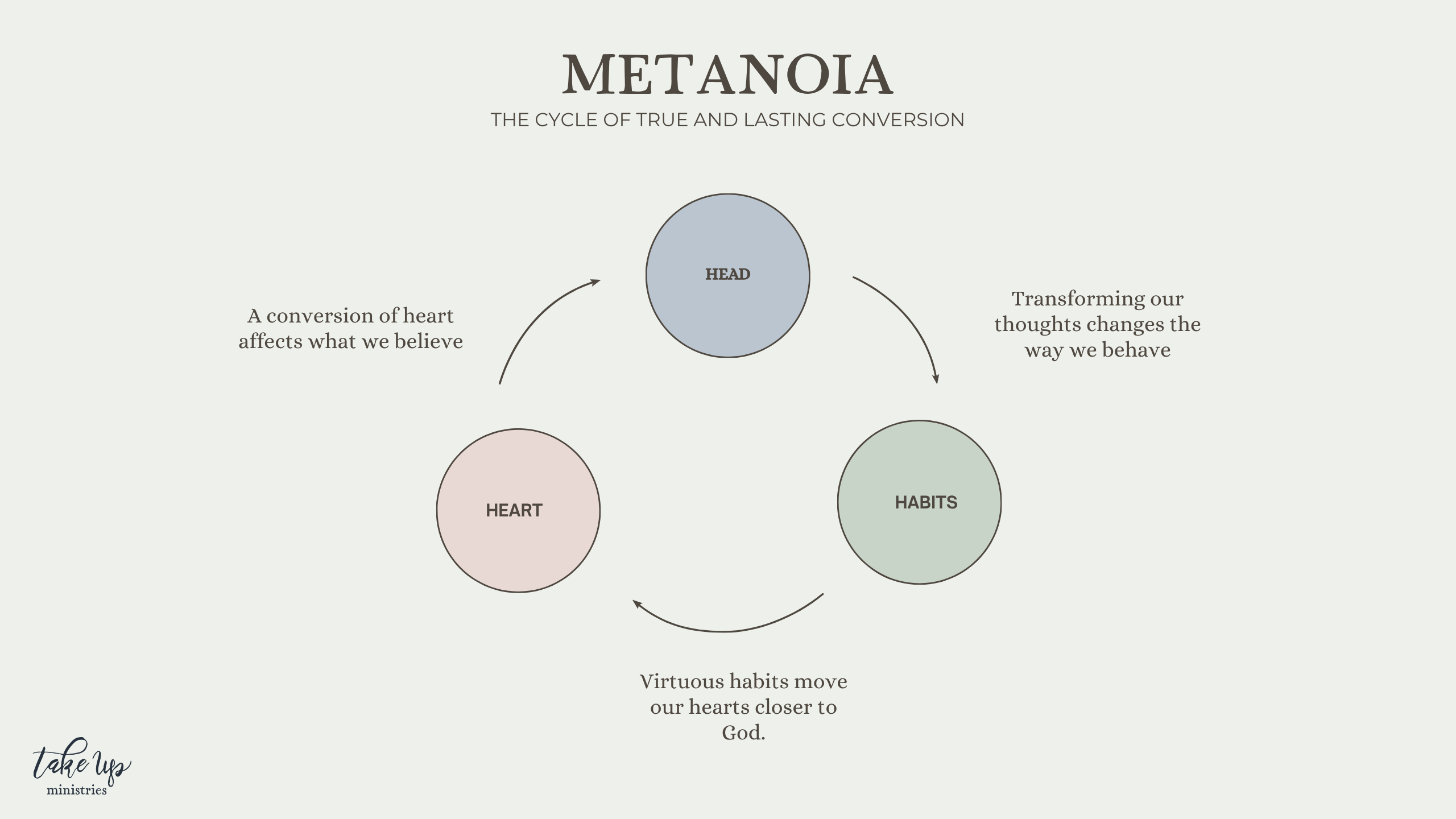
That is not merely good psychology.
It is metanoia.
Comments
Nothing yet. Say the first thing.
Sign in to join the conversation.