
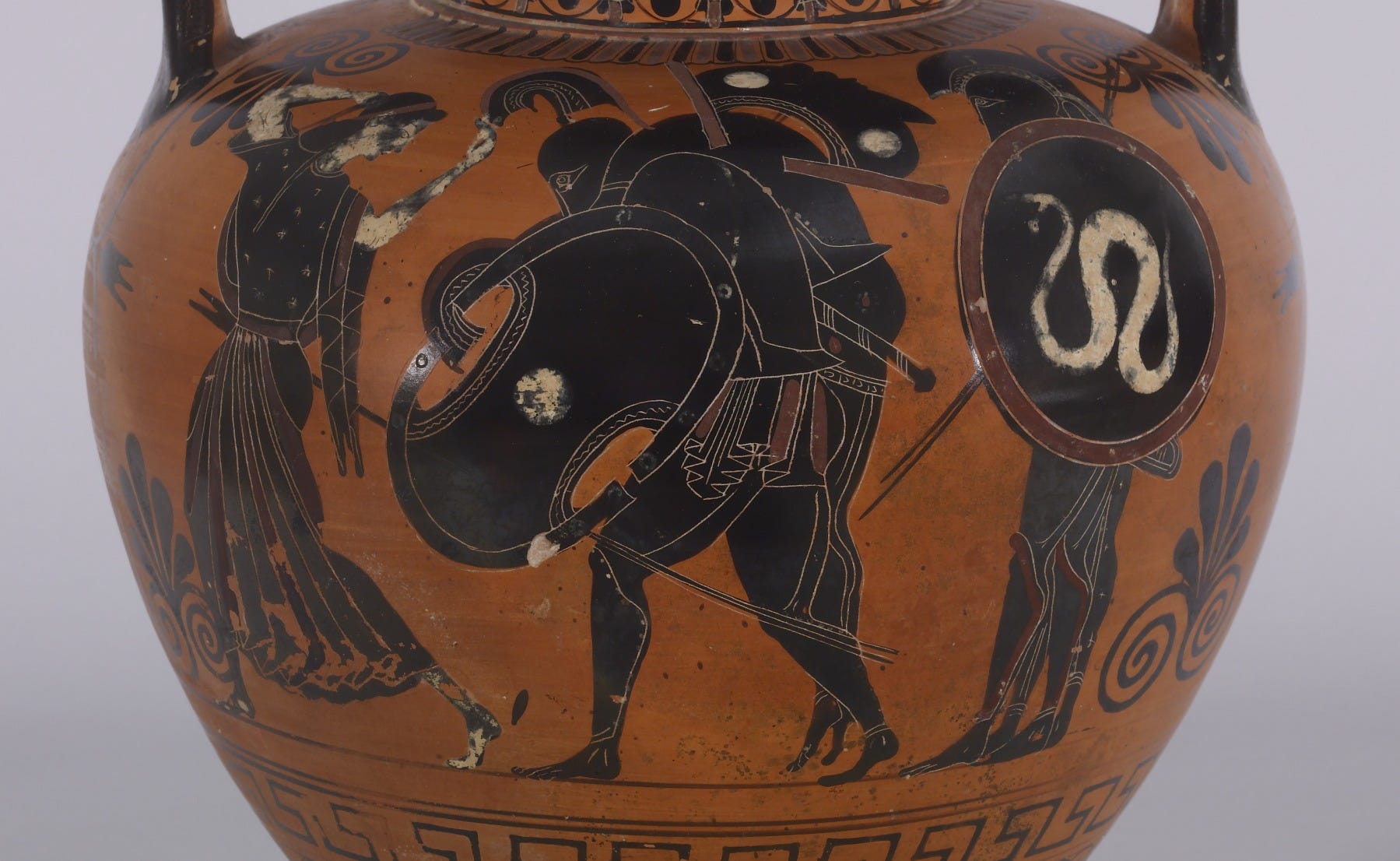
To read Part One of A Soldier’s Play:
A Soldier's Play
·
Jun 8
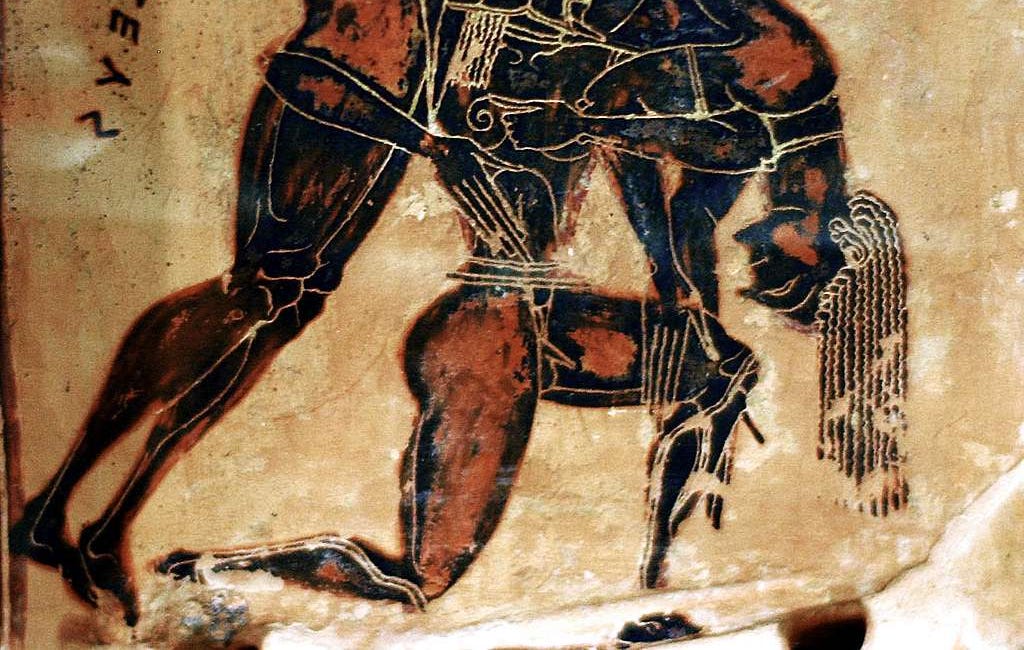
Ajax carries the body of Achilles off the field of battle. Note the hero’s strong, upright stance in contrast to the limp, dangling feet and hair of his dead comrade.
In the throes of his god-given madness, Ajax has tormented and killed defenseless livestock, thinking that they were his human enemies. Now that Athena has lifted his delusion, he sees what he has done. The bloody carcasses around him were the mildest of animals: sheep, cows, and goats penned up in the Greek camp to keep the troops fed. Heroes may kill lions, serpents, and raging boars, but to kill an animal that can’t hurt you is at best despicable vandalism.
In the Iliad, Achilles’ mother, the sea goddess Thetis, tells him that he has a choice: death at Troy, and unending glory, or a return home to Phthia, and living a peaceful but unsung, almost ordinary life. He chooses a death with eternal fame. Thanks to Homer, his wish was fulfilled: in our minds, Achilles is forever young and strong, the closest a mortal can get to immortality.
Like Achilles, Ajax holds his honor and reputation dear. He is truly nothing without them, at least in his own mind. Now his murderous rage has erased his glory. Ajax will be known for the valor and steadiness we know from the Iliad, yes, but his story will always have this coda: and then he tried to kill his fellow warriors and wound up butchering livestock. He can’t live with that.
Now, to take up the story where we left off in Part One:
Ajax is once again off-stage. We’re told that he’s in his tent, surrounded by the animals he’s killed, and now conscious of what he’s done. As we will see, Tecmessa, the mother of his son, is in there with him. We don’t know what he will do. Gather his men and fight what’s sure to be a losing battle against his former comrades? Pack up his ships and go home? Will he plead insanity sent by the gods, as Agamemnon did in the Iliad, as an excuse for the wrong he did to Achilles?
The chorus enters to an empty stage. These are Ajax’s crew of sailors he brought to Troy from his island home, Salamis. Here, the play shifts focus from Ajax to those who depend on him for protection.
The chorus’ entrance (the parodos) is always a big moment in Greek tragedy, and comedy as well. Imagine what the audience saw: at least a dozen of their fellow citizens, costumed and masked (like everyone on stage), singing and dancing in formation as they fill the semi-circular floor at the base of the amphitheatre. (‘Chorus’ comes from the Greek word for ‘dance.’) We no longer have the music, but the meter of the song they sing (the choral ode) provides some clue as to their movements. [I couldn’t tell you how the songs sounded, but Prof. Anna Conser has reconstructed the music for a production of Antigone. Link below.]
They begin with news from the outside encampment: everyone is talking about what Ajax has done. Their song is a cry for help; they must talk to their leader. They call him by his patronymic, ‘son of Telamon.’
When things are going well for you, I rejoice
but when Zeus strikes, or the Danaans attack you
with their slanderous words, I shrink back,
frightened, like a dove startled into flight.
{Danaans is a general term for the Greeks in Homer]
Their comparison of themselves to doves is out of character for warriors, to say the least. They feel utterly helpless. The Greek is ambiguous: are they afraid of the angry troops, of him, or what he will do next, or all of the above? What’s clear, in any case, is that they depend on him not just for physical safety but for order. In other words, they need their commanding officer to do his job.
It’s all Odysseus’ fault, they say. He is whispering lies into everyone’s ears, and he is so persuasive. Every man who hears the lies is enjoying repeating them. Small men are trying to bring down Ajax. But they themselves are small men, and without their leader, they can’t defend his reputation.
The chorus’ agitation is clear in the next stanza. Abandoning their claim that Odysseus is lying, they search for a reason that will absolve Ajax from his crime. They continue speaking directly to him without being able to see him — an echo of Odysseus talking to the invisible Athena in the opening scene.
Did you neglect proper sacrifices, they ask, or offend the gods in some other way? You couldn’t have been in your right mind; a theia nosos, a divine sickness, must have come over you. (Without knowing so, they’re right.) Again they plead with him to come out and talk with them. As a last resort, they tell him that everyone is laughing at him, mocking him. There is little worse for a Homeric hero than being laughed at. But even that doesn’t rouse him.
Instead, Tecmessa comes on stage.
There’s no one English word that conveys Tecmessa’s status with any grace. She’s described as Ajax’s ‘spear-won marriage bed,’ often translated as ‘spear-bride.’ What this means is that she’s a prize of war. Ajax killed her father, the king of Phrygia. Conquering armies routinely killed the defeated men of fighting age and enslaved everyone else, in Homer as well as in Sophocles’ own time.
In the Iliad, as here, women were claimed as property by the warriors who killed their male relatives. Some became their wives, or protected concubines whose children were considered rightful heirs. Tecmessa was one such. Ajax’s men address her as they would a highborn lady, using her patronymic, ‘daughter of Phrygian Teleutas,’ asking her to explain his behavior. She must know, because “brave Ajax loves you as his spear-won wife.”
We only now find out that Tecmessa was in the tent with Ajax for the whole night, witnessing his slaughter of the animals, Ajax’s raving and the beasts’ pitiful cries. She tells the story in painful detail. I won’t go into it here, for it’s truly disturbing, but it’s not gratuitous. We are meant to understand how deranged Ajax was. “He lies sickened in a storm of disease,” she says, echoing the men’s earlier claim that he suffers from a “divine sickness” (i.e., sent from the gods), words that we’ll continue to hear, even from Ajax himself.
We may think that Ajax’s plan to kill his enemies is the illness, but that’s not the case. His delusion is the disease, not his murderous intention. His delusion is the source of shame, even though Athena is the one who fooled him in order to save her beloved Odysseus. Think back to the central importance of his reputation, his shot at eternity: Ajax, son of Telamon, second only to Achilles in battle, protector of wounded comrades, disgraced by his allies and then by his own actions.
There’s no further denying what’s happened, and the chorus wonders aloud if they should set sail for home. Ajax will be stoned to death, and they with him, and they’d rather not.
Tecmessa tells the men things are even worse now that Ajax knows what he has done. “It’s clear that he’s planning to do something bad.” She sizes up the situation for them, making it clear that crazed or sane, Ajax is a danger to those he loves and who love him.
This man, in the midst of his sickness —
he enjoyed the evil that possessed him.
But he’s hurt us, just by being with us,
we who were in our right minds.
And now that he’s been able to breathe,
free of his disease, he is suffering,
carried away by agony.
And so are we, no less than before.
Is this not twice as much evil than before?
I’ve lost count of how many times the words ‘disease’ and ‘illness’ have appeared in the dialogue and choral ode. We know that the understanding of mental illness, and illness of all kinds, was evolving in the latter part of the 5th century; it’s possible that Sophocles was nodding in that direction. That aside, I feel certain that drawing constant attention to Ajax’s ‘illness’ was meant to focus the audience’s perception of the change in Ajax. Once invincible and noble, he is a sickened, broken man.
This is the place to look back at Dr. Jonathan Shay’s groundbreaking book, Achilles in Vietnam: Combat Trauma and the Undoing of Character. In my last post, I quoted an excerpt from the article that seeded his book.
Vietnam Veterans with severe post-traumatic stress disorder often report the following combat experiences: a leader’s betrayal of “what’s right,” lost responsiveness to claims outside a tiny circle of combat-proven comrades, grief and guilt for a dead special comrade, lust for revenge, renunciation of homecoming, feeling “already dead,” going berserk, dishonoring the enemy, and atrocities.
Ajax has suffered, in Shay’s words, an undoing of character through moral injury, a term he coined. Moral injury in combat veterans begins with the “betrayal of what’s right by someone who holds legitimate authority in a high stakes situation.” He goes on to say:
How does Moral Injury, as I have defined it, change someone? It deteriorates their character; their ideals, ambitions and attachments begin to change and shrink. Both flavors of moral injury destroy the capacity for trust. When social trust is destroyed, it is replaced by the settled expectancy of harm, exploitation, and humiliation from others. With this expectancy, there are few options: strike first, withdraw and isolate oneself from others, or create deceptions, distractions, false identities to forestall what is expected.*
For Ajax, the loss of Achilles’ armor to Odysseus was a shattering blow: it broke him. It’s important to understand is that he’s not motivated by greed. Ajax is wounded by what he sees as betrayal, and betrayal can make you forget who you are.
None of us are Greek heroes, but I think that all of us can empathize with the shock of betrayal. At its worst, betrayal shakes our sense of self and of belonging. It makes us doubt our sense of identity. We were we not important after all? Are we not who we thought we were? Did the people we trusted never really care about us? Were they just using us? Did everyone else know the truth? The humiliation and grief feel unbearable; trying to make sense of it with these incessant questions only deepens the hurt.
I’ve always been deeply moved by Ajax’s shame, loneliness and bewilderment, even when weighed against the misery he causes. Betrayal is at the broken heart of Ajax, and because this is Greek tragedy, there is more to come.
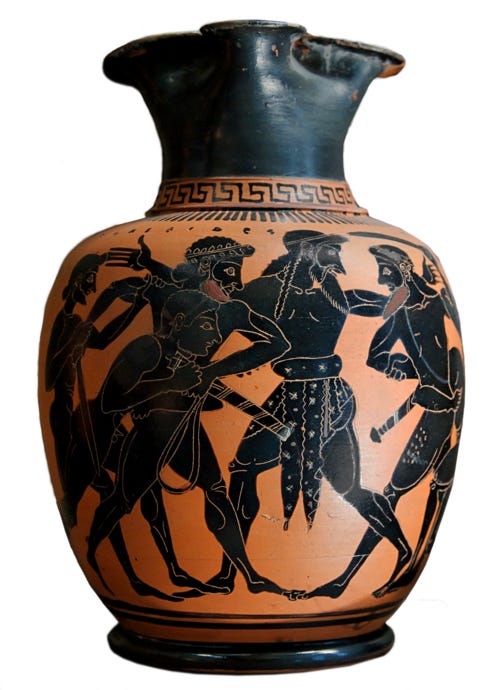
Ajax and Odysseus fight over the armor of Achilles; Attic Black-Figure Oinochoe by the Taleides Painter ca. 520 BCE, about 80 years before Sophocles’ Ajax was produced. In the play, Odysseus and Ajax never fight, but myths were fluid; Sophocles’ was just one version.
Prof. Anna Conser of the University of Cincinnati has created a convincing argument for how the music of Greek tragedy sounded: https://www.uc.edu/news/articles/2025/05/uc-classics-helps-produce-authentic-sounding-antigone-in-greek.html. We were both on a local NPR radio show about Antigone; to hear the music (and me, if you want: https://www.ctpublic.org/show/the-colin-mcenroe-show/2025-09-25/what-can-we-learn-from-the-myth-of-antigone-for-one-its-so-2025
#Homer #greek mythology #ancient Athens #Iliad #Odysseus # Achilles #greek tragedy #greek drama #greek chorus #PTSD #veterans trauma
No posts
Comments
Nothing yet. Say the first thing.
Sign in to join the conversation.