
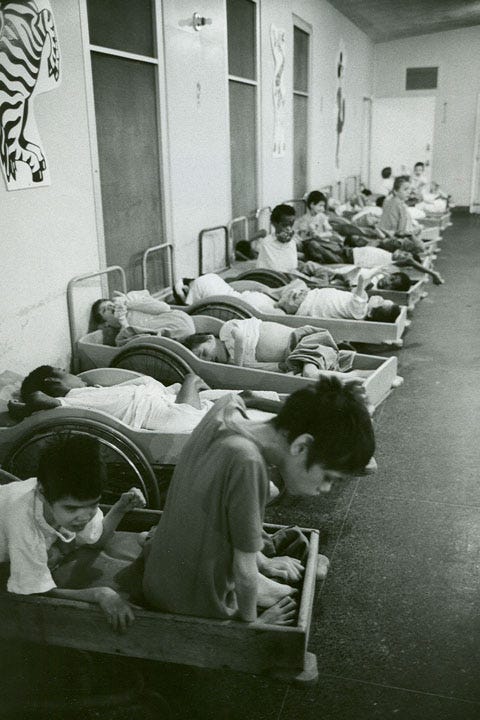
I’ve got something to say here, and it’s not so pretty. I don’t know if you’ve heard about what’s happening in this old country of ours, but it ain’t good for the disabled, among others. My tiny little mother mind™ can’t think about it properly, but I’ve assembled some words from those who can. First, I’ll quote from Public Hostage Public Ransom: Inside Institutional America, a non-fiction book written by William Bronston, M.D., an activist physician who exposed the atrocities of Willowbrook, an institution for intellectual and physically disabled human beings on Staten Island, New York.
There’s this:
Chapter One: Social Control Origins
“Lillian’s family visited her in Willowbrook twice a month. Her grandmother, a great, stout woman of obvious strength, always had the most terrible look on her face when she visited. It was like she was just arriving at the scene of a severe auto accident searching for her loved one and terrified at what she would find…
“Lillian alternately crouched near a wall or lay heaped asleep on the stone floor or dashed about the ward menacing everybody like a great wingless bird. Always alone, moaning, drifting here and there searching for something—broken lips, disfigured nose, matted hair, bare feet, coarse institution pullover dress protruding from below the white canvas and brass-ringed restraint.”
and there’s this:
Chapter Seven: People Become Things – Mass Reduction
We live in a cultural system where things are more highly valued than people. Vitality is gauged by what we possess: home, auto, clothes, family, friends, TV, knowledge, money. We are conditioned to experience our own value by owning things or having the capacity to acquire things. If we have a life, a dynamic, it has been interpreted as this capacity to consume and surround ourselves with objects.
It is an ordeal to refrain from consuming things, let alone to experience ourselves and our relations with other people as basically powerful and productive. It is no wonder that, in a world where things are king and people are the go-betweens, people are easily experienced and interpreted as things, statistics, numbers.
Some things have more apparent social value than others, and so some people have more value. Those people who can retain an image of individuality--a name, a special identity—can temporarily escape being reduced to subhuman status. But once the reduction of that identity is begun, an image of being less than human is fashioned, and the rush toward disappearance into a bunch of things gains momentum.
In order for the institution to carry on its operation, it is vital that the individual be submerged and become nameless, without identity. The alchemy of dehumanization from person to thing occurs.
I won’t waste your time here giving you the whole shebang of Willowbrook. You can look it up on the world wide webs and read about it. Probably one of the most important things to remember is that Willowbrook permanently closed in 1987 — yes, in the latter 20th century — and was a significant catalyst for the modern disability rights movement as well as a shift in how society acknowledges and supports people with developmental disabilities.
I’ll repeat this: “In order for the institution to carry on its operation, it is vital that the individual be submerged and become nameless, without identity. The alchemy of dehumanization from person to thing occurs.”
I’m sure most of you know that Dear Leader and his band of freaks have largely dismantled big operations of the Department of Education. This month, the administration announced that responsibility for special education oversight would be transferred to the Department of Health and Human Services, while education-related civil rights enforcement would move to the Department of Justice. Those “in charge” of this sorry ass country say they continue to “streamline the government.” Those who really know argue that special education is fundamentally an educational issue and should remain under the Department of Education. They worry expertise and accountability could be weakened.(AP News)
Given all of these shenanigans and the utterances of one of the leading freaks whom I wrote about a while back here, I don’t think I’m histrionic to suspect that the goal ultimately is to re-institutionalize disabled persons and do it in a way that gives the usual grifters some profit. Now the law currently protects the rights of the disabled but, hey, we know how closely the law is followed by these people. The legal protections that have kept disabled Americans out of institutions are under attack. By the way, it’s all in Project 2025.
Here’s activist Judith Dayal:
In a memorandum issued by the Office of Legal Counsel, the Trump regime rejected the longstanding interpretation of the Americans with Disabilities Act that has guided disability rights enforcement for decades. The memo argues that the ADA does not require states to provide services in the most integrated setting appropriate for people with disabilities and challenges the legal framework that emerged from the Supreme Court’s 1999 decision in Olmstead v. L.C.
That decision was one of the most important disability rights victories in modern American history. The Court recognized that unnecessary institutionalization can itself be a form of discrimination. The principle was straightforward. Disabled people should not be isolated from their communities simply because it is easier, more convenient, or more familiar for governments to place them elsewhere.
…
The history of eugenics is often discussed as though it belonged to Nazi Germany, but the truth is far more uncomfortable. At its core, eugenics was built on the belief that some human beings were more valuable than others and that society could be improved by preventing certain groups from existing, reproducing, or fully participating in public life. Long before the Nazis came to power, the United States was one of the world’s leading proponents of eugenic policies. Disabled people became some of its primary targets, alongside racial minorities, immigrants and others whom eugenicists viewed as threats to their vision of society. American states sterilized tens of thousands of disabled people, people with mental illnesses, people labeled “feeble-minded,” and others deemed socially undesirable. In 1927, the Supreme Court upheld forced sterilization in Buck v. Bell. Justice Oliver Wendell Holmes Jr. famously declared, “Three generations of imbeciles are enough.”
The consequences were devastating. Disabled Americans were taken from their families and placed in institutions where many spent years or even decades isolated from the outside world. Some were subjected to neglect, abuse, involuntary medical procedures, forced sterilization, and experimental treatments that caused lasting harm. Entire lives were shaped by the belief that disability was something to be controlled, hidden, or eliminated rather than understood and accommodated.
…
The danger is not that America suddenly wakes up tomorrow and finds concentration camps filled with disabled people. The danger is that societies become accustomed to viewing certain groups as problems to be solved rather than people whose rights must be protected.The danger is that legal safeguards are weakened while rhetoric grows harsher. The danger is that exclusion becomes easier, isolation becomes more acceptable, and government power expands precisely where vulnerable people have the fewest resources to defend themselves.
Every era that embraced eugenic thinking began with the same mistake. It stopped seeing certain people as human beings with equal value and started seeing them as burdens, costs, obstacles, and problems to be solved.
This is all so devastatingly familiar.
This is all so exhausting.
This is all such bullshit.
What can we do? What can you do? Well, you can:
Contact your U.S. Representative and Senators.
Contact state legislators.
Attend school board meetings.
Submit public comments when regulations are proposed.
Support organizations that advocate for disability rights.
Watch the documentary Crip Camp and learn how the laws became laws.
Some major advocacy groups include:
The Arc
Council of Parent Attorneys and Advocates
National Disability Rights Network
Disability Rights Education and Defense Fund
If you’re still here, I appreciate you reading all of this. Even though it’s about education literally, it’s about literally everything else.
Disability rights are civil rights.
Comments
Nothing yet. Say the first thing.
Sign in to join the conversation.