

Every few weeks, a founder friend asks me the same question. “What is Obsidian, and what does it actually do?” They’ve seen me mention it, they’re curious, and they want to know if it’s worth the switch.
Here’s the short version. Obsidian is a notes app. The part that matters is what your notes actually are: plain text files, written in Markdown, sitting in a normal folder on your own machine. No database, no proprietary format, no company holding your data hostage. You link notes to each other, and the whole thing is yours. I keep my vault in iCloud, so the same notes are on my laptop, my phone, and my iPad without me thinking about it.
That sounds modest. A folder of text files. But that one design choice is exactly why Obsidian matters now, in a way it didn’t a few years ago. Because the notes are just files in a folder, an AI agent can read and write them directly. Your knowledge stops being a private archive you visit, and becomes a workspace you share with an AI. It helps that Markdown is the format agents read and write by default, so the agent and the app already speak the same language.
I didn’t start here. From 2020 to 2025, I used Roam Research, and I loved it the whole time. Here’s a piece from 2021 on how I used Roam. I knew Obsidian existed and had many benefits, the biggest being that it ran locally and could be synced with any file storing system like Dropbox or iCloud.
I just didn’t want to learn a new tool from scratch and move five years of notes by hand. The switching cost felt too high, so I stayed put.
Then in early 2026, I asked Claude Code’s AI agent to set up Obsidian for me and bring everything over from Roam. It was like having a professional Obsidian user sit next to me and doing the whole migration. It built the structure, moved the notes, fixed the formatting, and explained the choices as it went. That kind of guided transition simply wasn’t possible before agents showed up. The thing that had blocked me for years, the learning curve, basically disappeared.
Today I have around 4,500 notes in my vault. I write almost none of them by hand anymore.
Here’s how that works.
I don’t open a blank note and start typing. I talk through an idea with the agent, and it writes the note for me, in the right place, knowing how I would draft it. The unlock isn’t speed, although it is faster. The unlock is activation energy. I never sit in front of an empty page, and I never deal with formatting or filing. I stay in the part I’m good at, which is thinking, and the agent handles the logistics.
For the structure, I use PARA, a system from Tiago Forte’s book “Building a Second Brain”. If you’ve heard the phrase “second brain,” this is where it comes from. PARA sorts everything into four buckets: Projects, Areas, Resources, and Archive. The logic is that you organize notes by how actionable they are, not by topic. A project you’re shipping this month lives in one place. Reference material you might want someday lives in another.
My current PARA in Obsidian:
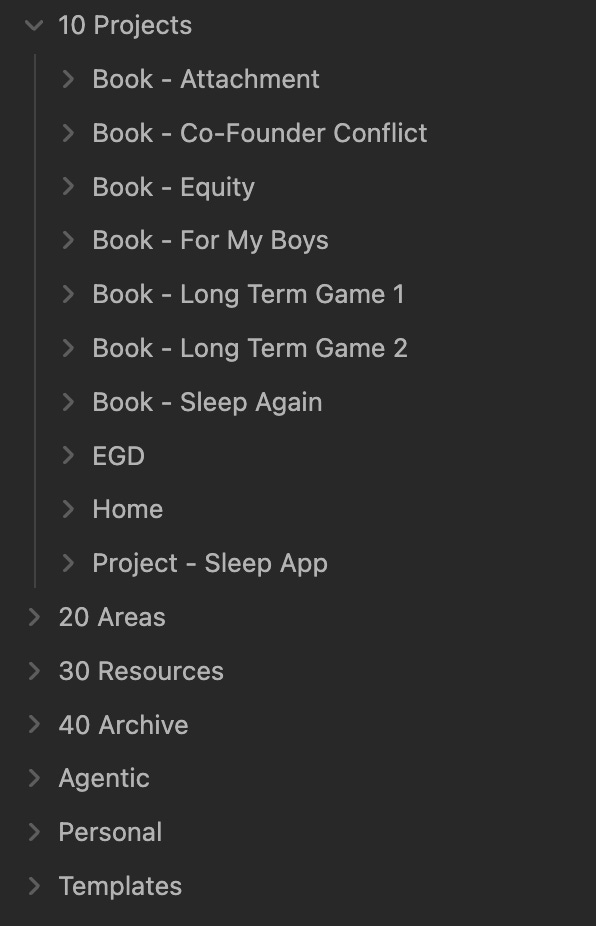
What I didn’t expect is how well PARA works for an AI. When I organize by actionability, I’m also handing the agent a map. It knows that a note about an active book project goes in Projects, and a useful article goes in Resources. A structure I picked for my own clarity turned out to be an addressing system the agent could navigate too.
The piece I’m most proud of is a folder I call Agentic. It isn't notes for future me. It's a shared layer of context that any agent can read from and write to.
Inside it, I keep a writing style guide, so anything drafted on my behalf sounds like me and not like a generic chatbot. I keep records of every platform and vendor I work with, what I’ve learned about each one, what worked and what didn’t. I keep a catalog of my own published work, with every link and detail in one place. I keep reusable playbooks for tasks I do more than once. My personal details, bio, LinkedIn URL, anything that an agent would need when it fills out a form when doing tasks on the web on my behalf.
The effect compounds, and it compounds across agents, not just across my own sessions. Any agent I put to work can read the Agentic folder, and any agent can add to it. When one of them learns something useful about a platform or a task, the next one inherits it without me repeating a word. The folder becomes a shared operating memory for the work itself. Think of it as a collective second brain, owned by me but used by every agent I run. The point isn't that the AI remembers me. The point is that the work carries its own context, so every operation starts further ahead than the last.
None of these pieces is clever on its own. A folder of text files is not new. PARA is a decade old. Syncing notes with iCloud is ordinary. An AI that can write is something millions of people have now.
The leverage is in the stack. Plain files mean an AI can operate on them. iCloud means it’s everywhere. PARA gives it a map. The Agentic folder gives every agent a shared memory. Put together, my notes went from a place I stored things and forgot about, to a partner I think with every day.
If you’ve been curious about Obsidian, that’s the real reason to look now. Not because it’s a nicer notes app, though it is. Because it’s the rare tool that was already built, by accident, for the way we’re going to work with AI. And the thing that used to stop you from trying it, the cost of switching and learning, is the first thing an agent can take off your plate.
No posts
Comments
Nothing yet. Say the first thing.
Sign in to join the conversation.