
I know, I know. Getting to say I interviewed Ann Patchett twice this year is such a flex. Ann is one America’s greatest living novelists, but one of the reasons I admire her so much is because I also consider her one of our great American journalists. She started in magazine writing, and her early profiles and essays are showcases of her wit, sharp mind and wry sense of observation. She obviously brings all of that to bear and adds imagination — and probably my favorite dialogue writing — into her novels and stories. So we talked a lot about writing both times we spoke. But because it’s Ann, the lessons were also about life and love.
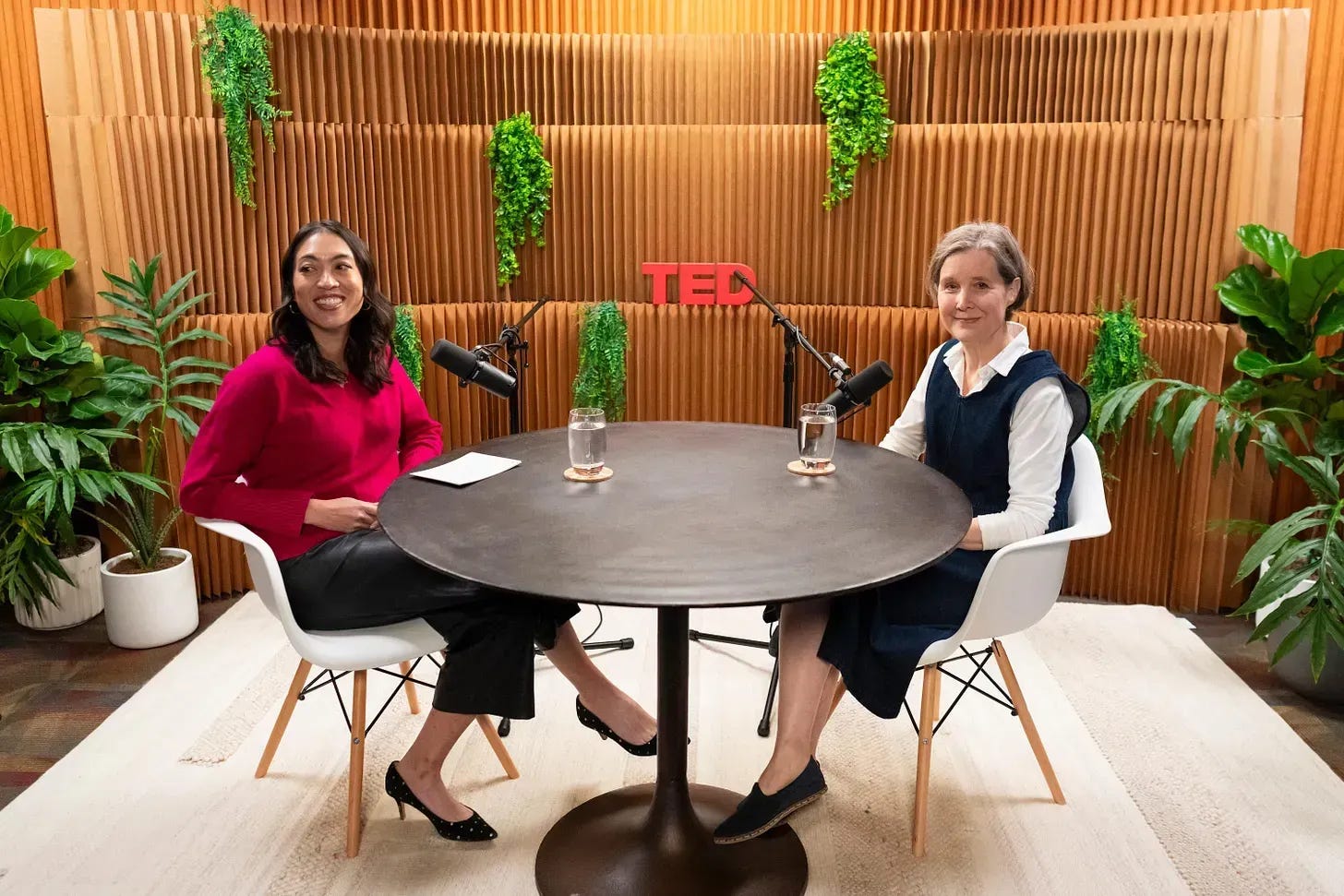
Today, I’ll share some of the lasting takeaways from our conversations, and for paying subscribers, a list of every book she recommended during our talks because she cannot help but drop book recs nonstop. So if you’re a free subscriber and that sounds compelling, it might be a good time to:
Don’t Overlook What’s Good. “From a distance, everything looks absolutely cataclysmically awful. Up close, it can look pretty good. In that people are kind. People come into the bookstore all day long, and I see them interested in reading, but also interested in one another... I see so much goodness in the world, and I think that that is the counterbalance. We’re having a really warm conversation. Everybody here has been so lovely. That’s not to discount the horrible things that are going on in the world that we need to work on helping, solving, and fixing, but don’t overlook what’s good.”
Just find something that you care about and show up for it.
Fight for something that you love.
”Yes, of course, it is important to fight against what you hate and yet it is more important to fight for something that you love. And to just say, I’m not going to solve the problems of the world, but I can look in my own corner at something that’s meaningful to me and do it. So if what I am doing is working to make sure that booksellers who I will never meet have a little bit of extra money to cover the gap in the crisis, I can do that. I can make sure that children in my community who need a free book and who need a visit from an author so that they can know that they can be authors that can do that. You don’t have to take on something enormous or you don’t have to invent it yourself. Just find something that you care about and show up for it because it will make you feel so much better.”
Reading is a gift that keeps on giving. “No matter how much you read, no matter who you are, you’re going to find more books to read and different ways to inform your life … I think that reading and the telling of stories is how we as mammals communicate. This is what the human animal does. We shape our experience into stories. And to my way of thinking, reading and books are so central to that activity because it allows us to connect to the people that we have never met. And you can say, ‘Oh, you can do that on the internet too.” But I think that there is a depth and a thoughtfulness that comes from writing these stories down and then sending them out into the world and everyone having their own experiences with the stories and then coming together.”
Platonic friendships are often some of the most lasting, transformative, loving relationships. Responding to a question about her latest novel, Whistler, which centers around a nourishing platonic friendship, Patchett told me, “I love the friendships in my life and I love the ways in which friendships can be so romantic. They can be so warm and close and intertwined and funny and full of acceptance without any of the anxiety of romance of like, are they going to go to bed together? Are they going to betray one another? Is something terrible going to pull them apart? It’s just like all of the good stuff and none of the anxious stuff.” (See also: My rant about how there should be more co-ed friendships in middle age and beyond)
A relationship that ends should not necessarily be considered a failure. “What my mom said was, “Every relationship you will ever have in your life will end.” Because they will die or you will part. And so she said, ending cannot be a failure, or every single relationship is a failure. And I was 25 when she told me that. And I was like, ‘That’s the most horrible thing I’ve ever heard.’ And I have thought about it so much since then and that it actually is a really beautiful thing to say. You can be with somebody and really love them and have a very successful relationship and it is not a relationship you will have forever. And that doesn’t mean that it was a failure and you don’t need to frame it as a failure.”1
People are generally good and decent and we should trust them. We should orient ourselves toward the notion that people are generally good and can be trusted. “There’s like a small percentage of people that we might need to fear, but we don’t need to design our lives around that,” she said. “I live down the street from a boys’ school and in the morning and I’m walking the dogs, and the boys are walking to school, and you say good morning to them and they look at the ground because they’ve all been trained to not talk to strangers. And I mean, I understand terrible things happen, but for every one terrible thing that happens, a million good things happen. And if you cut yourself off from the potential of the terrible thing, you’re also cutting yourself off from the potential of just the kindness of daily interaction and the warmth of connecting with other people and their dogs when you’re out there.”
Writing about kindness and gentleness takes more craft than writing about darkness. “Think about it. You’ve got a picnic and in that picnic, a terrible tornado blows up and sweeps half the family away and the rest of them are up in a tree and there’s action. There’s action generated by disaster Sure. But if you’re having a picnic of kind people who are talking in a civil way and enjoying their lunch, then you have to really think about what is the tension in the scene and what are these people actually saying to on another and how can I move the story along? I used to do a lot of travel writing and every now and then I would get sent off on a cruise and somebody who was an editor at Travel and Leisure said to me, “We only send the very best writers on cruises because nothing happens. And are you able to write an essay about a cruise ship in which nothing happens?”2
Our initial assessments could deserve a rethink once we’ve grown up. This is a theme that comes through in Whistler, and it’s from Ann’s own life. “Sister Nina, my nun who taught me to read … I hated her. I did not become a comfortable reader until I was in the third grade and Sister Nina stayed on me, kept me in from recess for years because she thought it was important that I learn how to read and I hated her for it. All right. There is my assessment that I made of this woman when I was six years old at six I decided she was a bad person who was really mean. But the interesting thing is I kept that assessment throughout my adult life. And then when I was 39, she called me out of the blue and she was working at a St. Vincent DePaul’s school downtown and she said, ‘We’ve got nothing. We don’t have paper, we don’t have scissors, we don’t have glue sticks.’ She said, ‘We need money. I have been following your career. I want you to give me some money so that we can buy school supplies.” And I said, ‘Sure. And let’s get together.’ When I got there, she was standing out in the parking lot and she’s like 4’11” and weighs 80 pounds and is Italian. I got out of the car and she’s standing there holding out her arms to me and I thought, ‘This woman doesn’t hate me. This woman was never unkind to me. This woman only wanted to teach me to read and I have held a grudge against her all this time.’ And I took that energy, that scenario, and I gave it to Daphne [the main character in Whistler] and her mother.
To watch them, here ‘s my April interview with Ann, and then the one in June.
After the jump, a comprehensive list of all the book recommendations Ann peppered into our conversations this year…
Comments
Nothing yet. Say the first thing.
Sign in to join the conversation.