
There is a moment, in the middle of the night, when you wake in total darkness and for a split second, you don’t know where you are.
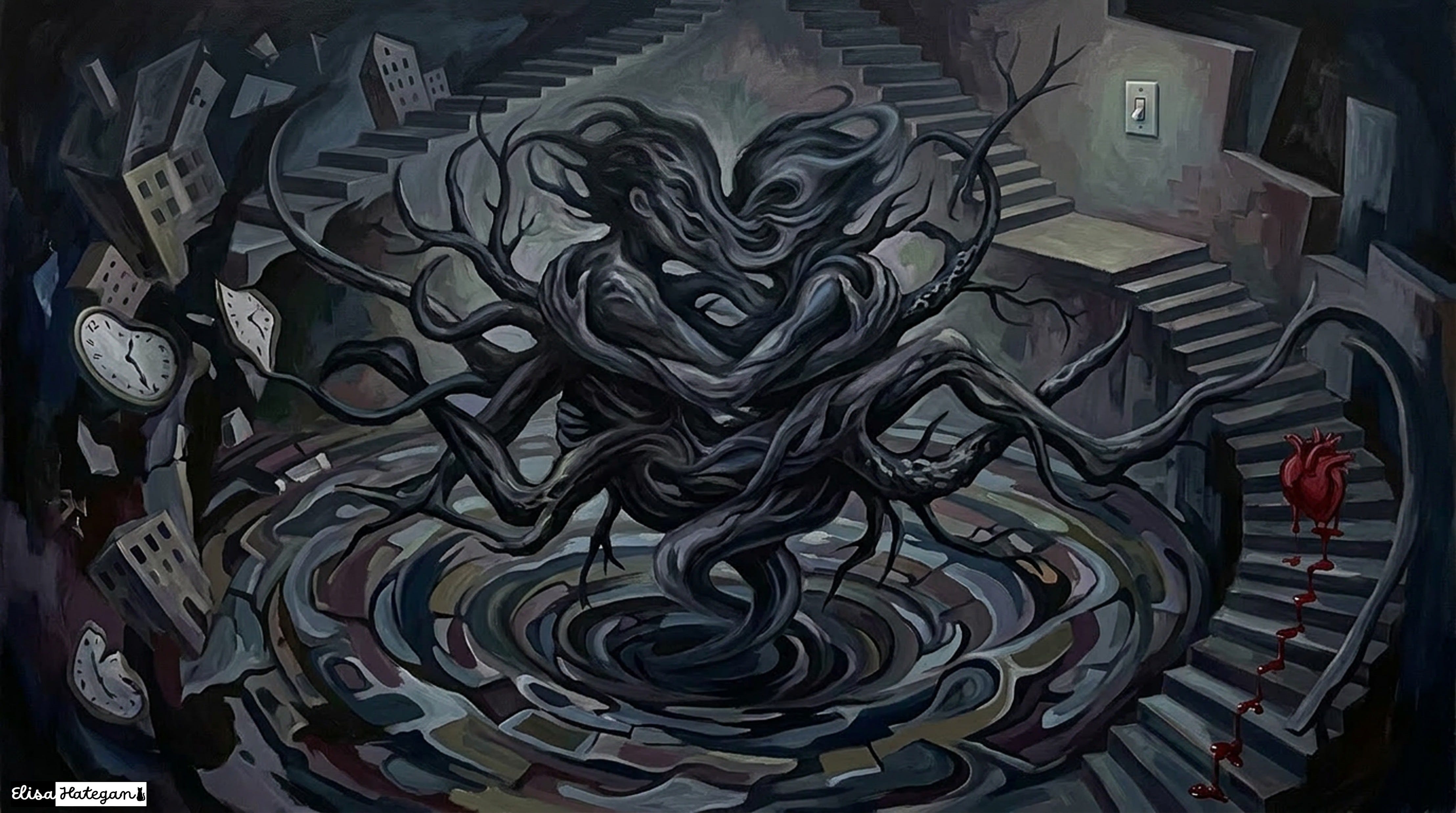
The room around you dissolves. Your hand can’t find the side of the bed, the lamp, the wall. You are nowhere. You are a consciousness suspended in black space, briefly unattached to any geography. And then your hand finds the switch. The light comes on. The room reassembles itself. The world resumes.
It’s a ubiquitous moment we’ve all experienced — that second of confusion before the switch. The nebulous interval in which the world hasn’t yet been confirmed.
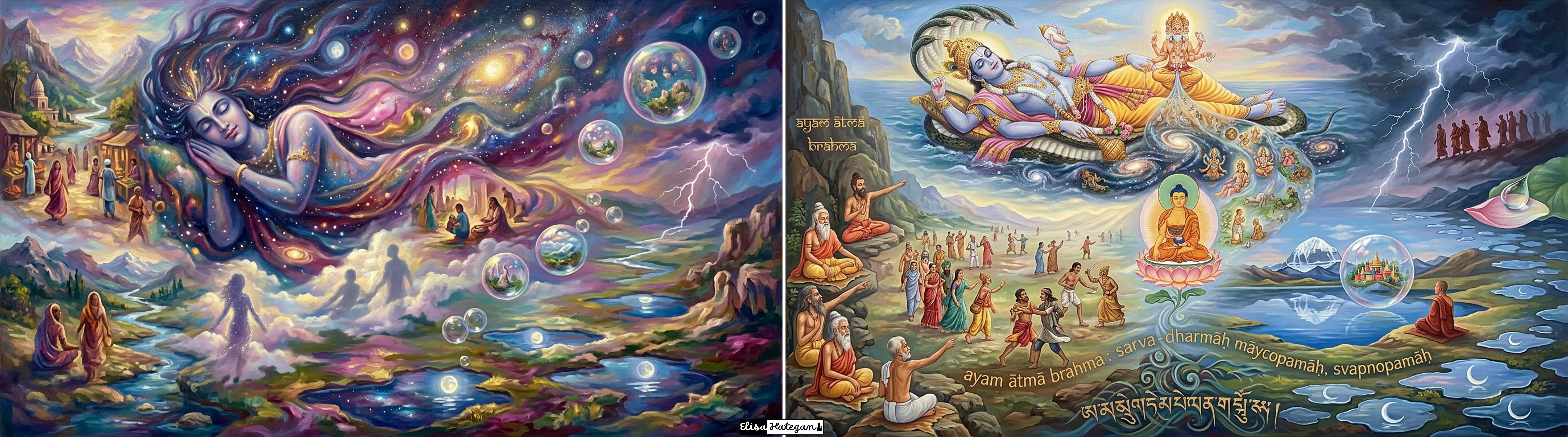
Every tradition that’s ever kept historical records has named that interval. The Hindus call it Maya — the cosmic illusion in which Brahman conceals itself from itself in order to play. The Upanishads explicitly maintain that the universe is the dream of a sleeping god who, if awakened, would dissolve it. The Buddhists take it even further, describing all phenomena as dreamlike – reflections on water, the moon caught in a thousand puddles after rain. In the Diamond Sutra they say: All conditioned phenomena are like a dream, an illusion, a bubble, a shadow, like dew or a flash of lightning; thus we shall perceive them.
The Daoist sage Zhuangzi, who lived four centuries before Christ, dreamed he was a butterfly and woke uncertain of whether he was a man who had dreamed of being a butterfly, or a butterfly now dreaming of being a man. (That’s before he decided that the uncertainty itself was the whole point). Plato compared us to prisoners in a cave, mistaking shadows for the things that cast them. In seventeenth-century Spain, Calderón de la Barca wrote La vida es sueño — Life is a Dream, the lines every Spanish schoolchild learns by heart: What is life? A frenzy. What is life? An illusion, a shadow, a fiction, and the greatest good is small; for all of life is a dream, and dreams themselves are only dreams.
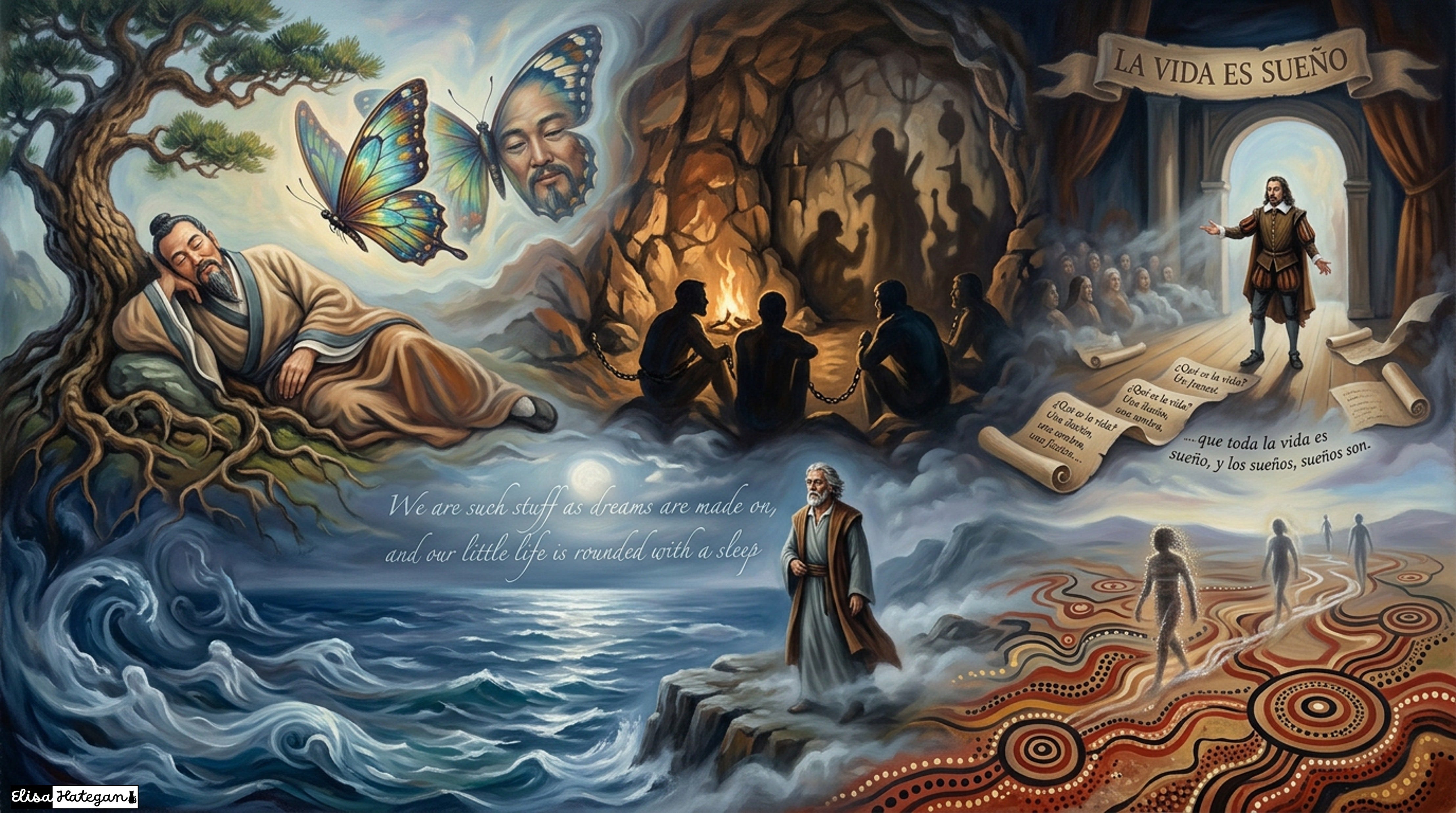
Shakespeare endowed Prospero with the same intuition on his island: We are such stuff as dreams are made on, and our little life is rounded with a sleep. Borges spent his entire career circling the same idea — that the dreamer is dreamt, that the man who labours in the circular ruins to dream a son into being is himself the figment of another, prior dreamer’s night. Australian Aboriginal traditions call foundational reality “The Dreaming”: patterns of the visible world laid down by ancestral beings who continue to dream them, even now, into being.
Every culture, in every century, on every continent, arrived independently at the same intuition: the solidity of the world is provisional. Something is being held in place by a sustained act of attention. And if the attention falters, even for a moment, the room dissolves and we are back in the interval before the switch.
The latest version of this perspective is called the Simulation Hypothesis.
The Simulation Hypothesis
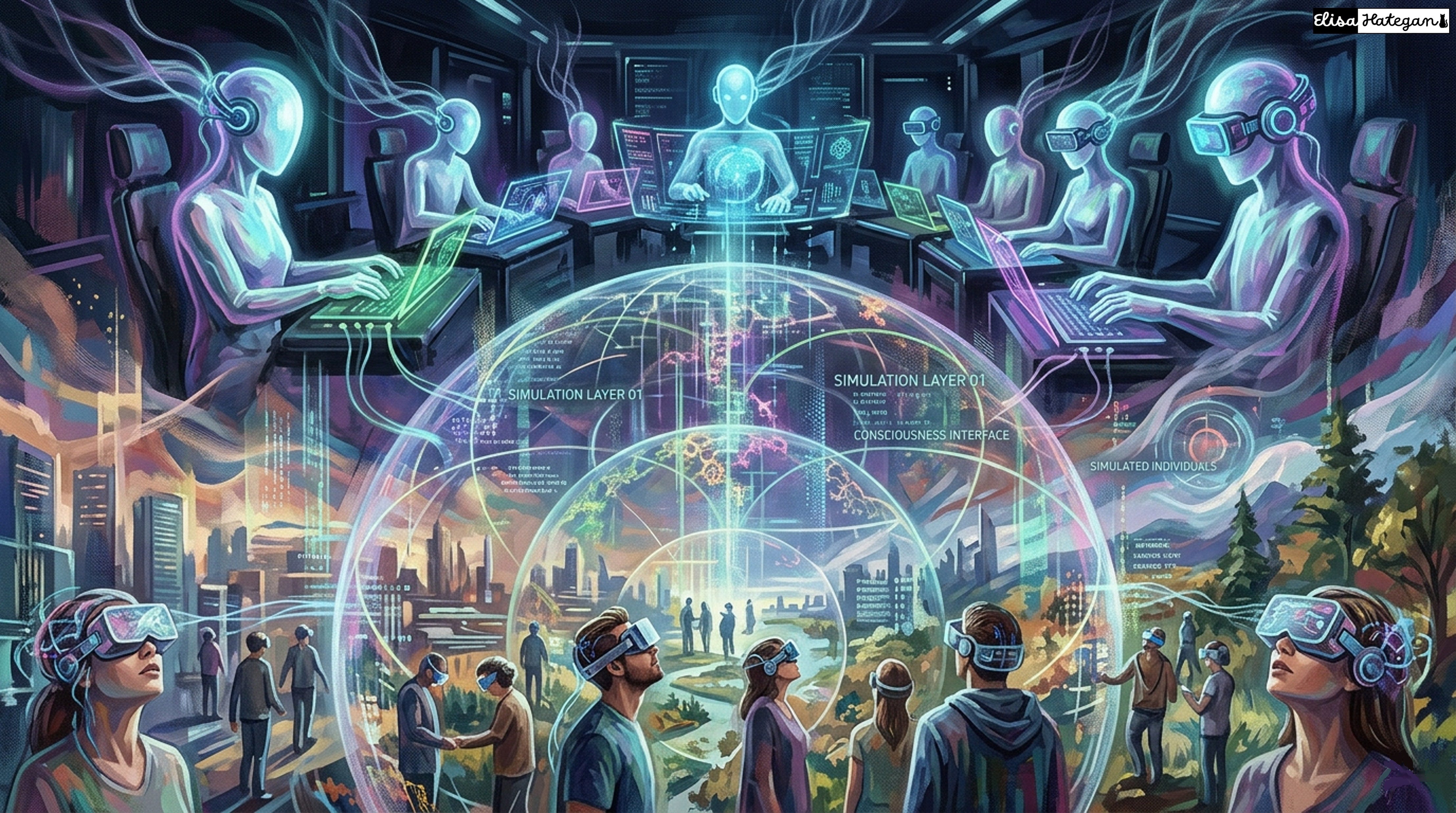
Throughout my writing I’ve routinely used terms such as avatars, downloads, and videogame, so readers might be wondering if I’m a proponent of the Simulation Hypothesis, one of the bad boys of Matrix-flavoured reality theories. The popular concept associated with philosopher Nick Bostrom postulates that any sufficiently advanced civilization will eventually acquire the computational power to run vast, conscious simulations of its own ancestors — and therefore we’re almost certainly inside one.
Spoiler alert: I’m a detractor. I think that on its face it’s a seductive argument, tidily reducing the universe to the most impressive machine of the present moment: the computer. It offers a lexicon of accessible metaphors most people can readily grasp. But that’s also the biggest reason it gets the universe fundamentally wrong.
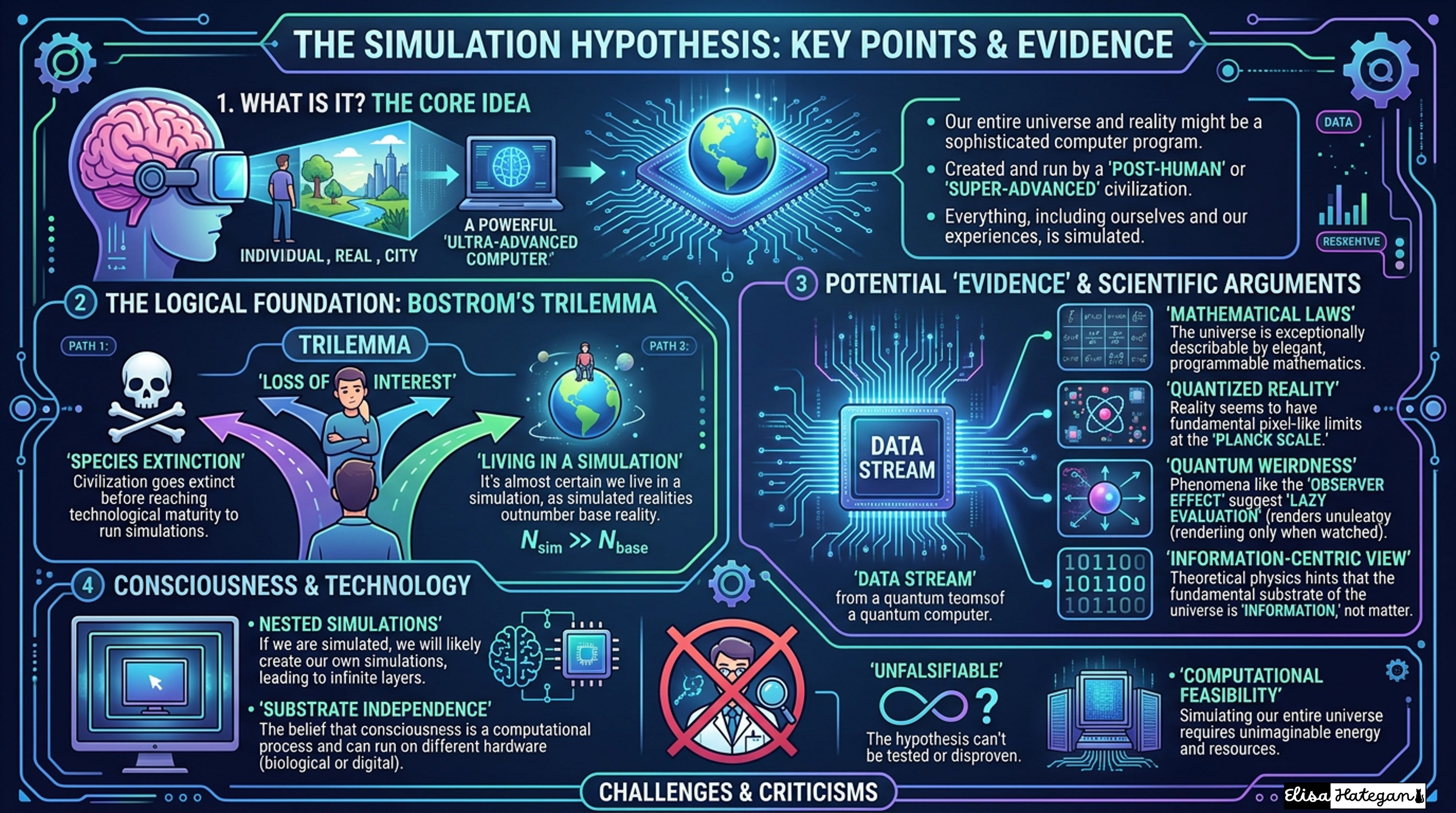
Before I try to deconstruct it, here’s what the simulation argument does get right: Reality is layered. Consciousness can be a player in a structure it did not design. The world feels like something authored, too statistically improbable to have come about without intelligence or intention. This all makes sense, intuitively. Where it goes spectacularly wrong is in imagining that the substrate — the thing the world is running on — is computational. Digital. A clinical lattice of processors somewhere, executing us. And we have no way of knowing if we are NPCs (non-player characters, background filler), 21st century’s version of mechanical automatons and marionettes.
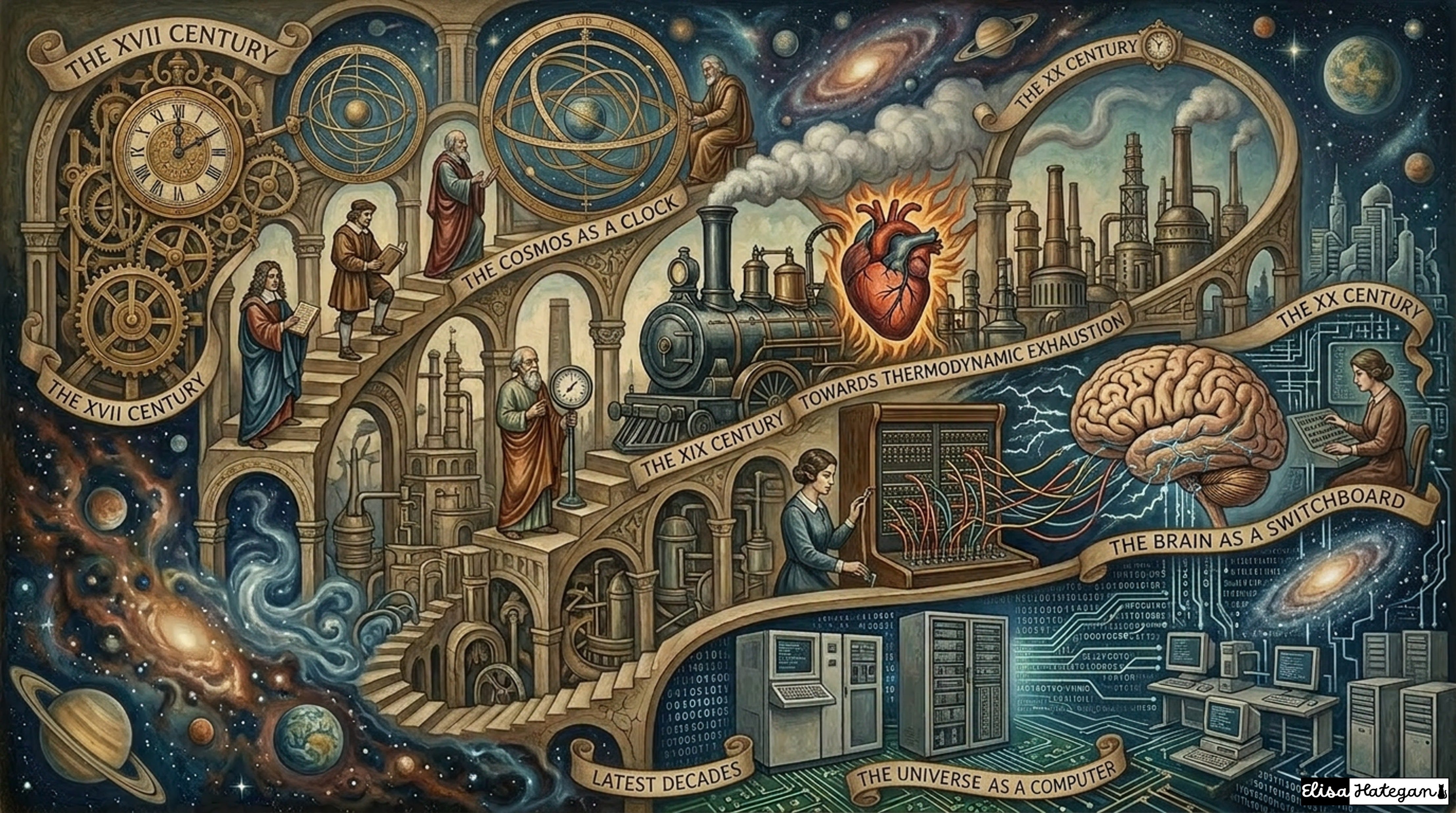
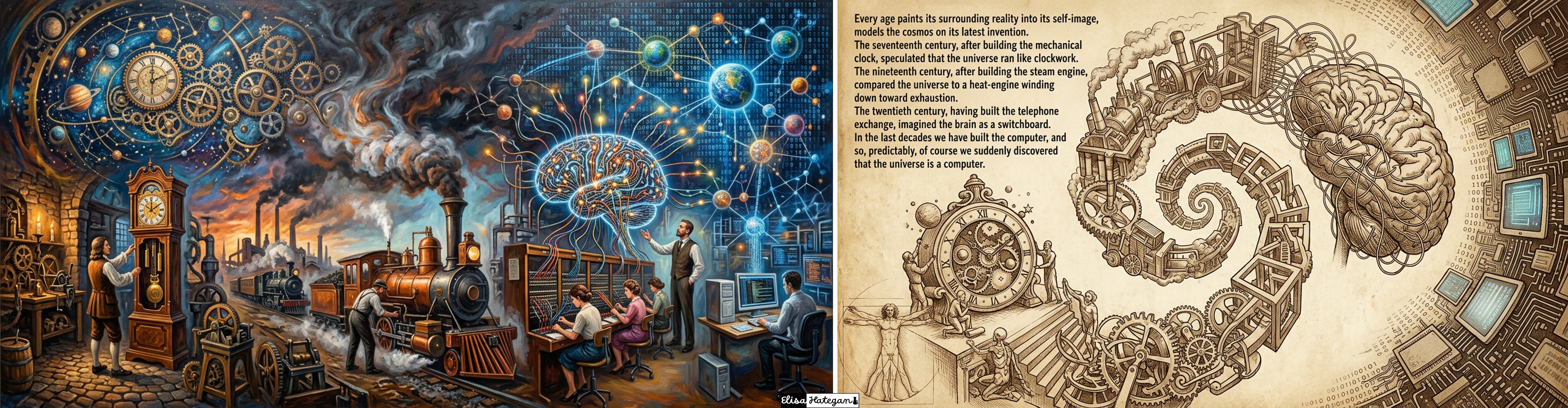
Other critics have pointed out that this is a category error - a semantic error where one thing is mistakenly presented as another, where a property is attributed to something that absolutely doesn’t have that attribute. It’s a phenomenon as old as time — every age models the cosmos on its latest invention, in its self-image. The seventeenth century, after building the mechanical clock, speculated that the universe ran like clockwork. The nineteenth century, after building the steam engine, compared the universe to a heat-engine winding down toward exhaustion. The twentieth century, having built the telephone exchange, imagined the brain as a switchboard. In the last decades we have built the computer, and so, predictably, we suddenly discovered that the universe is a computer.
The pattern should make anyone suspicious, not least because the cosmos is under no obligation to resemble whatever humanity most recently learned to manufacture.
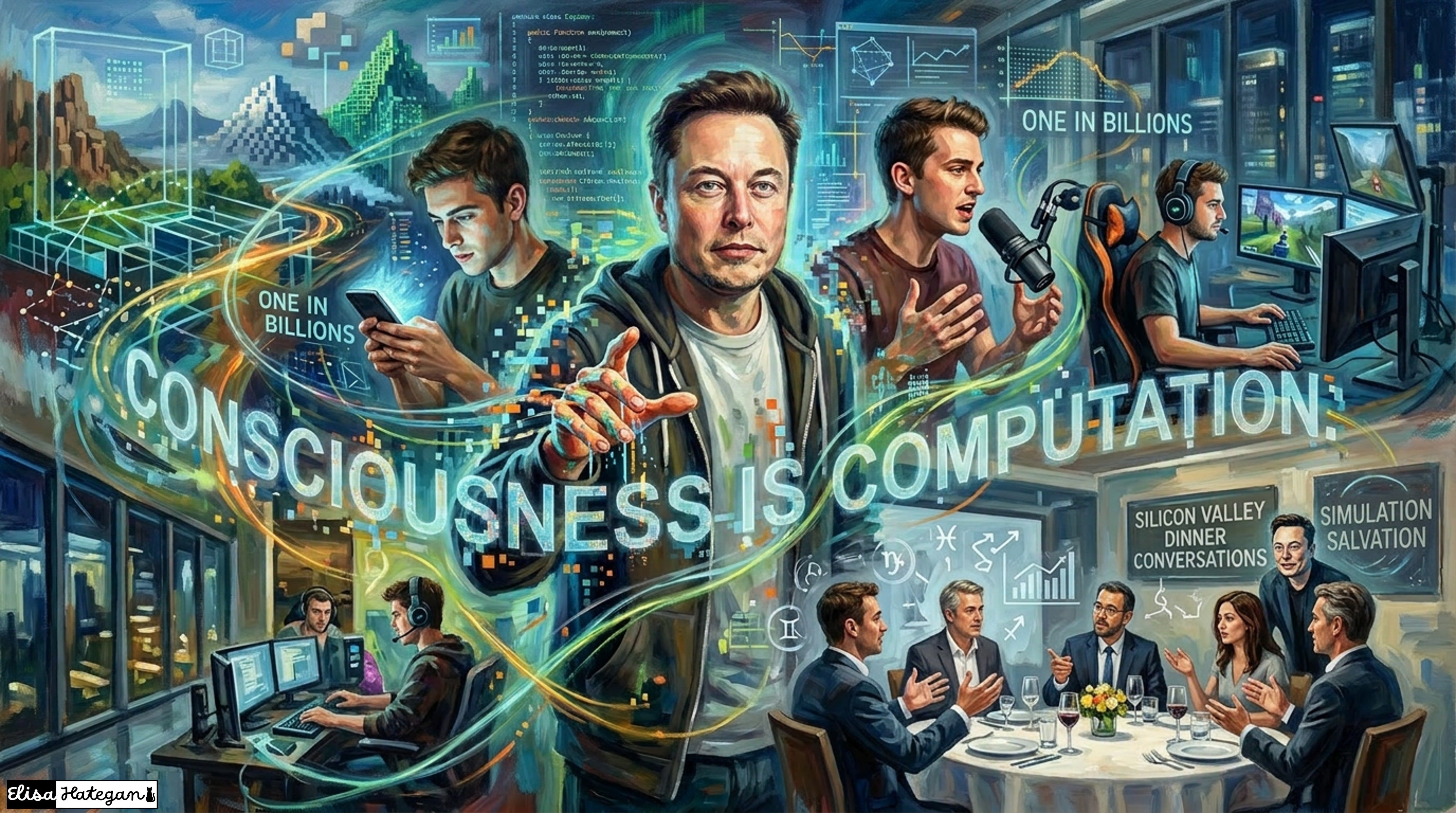
Pay attention to who finds the idea most plausible. The Simulation Hypothesis is unmistakenly a young man’s metaphysics. Its loudest evangelists are men in their twenties and thirties — software engineers, tech founders, podcasters, gamers, rationalist bloggers — for whom the computer is not merely a tool but a native cognitive environment, the medium in which they think and dream and form their friendships and conduct their wars.
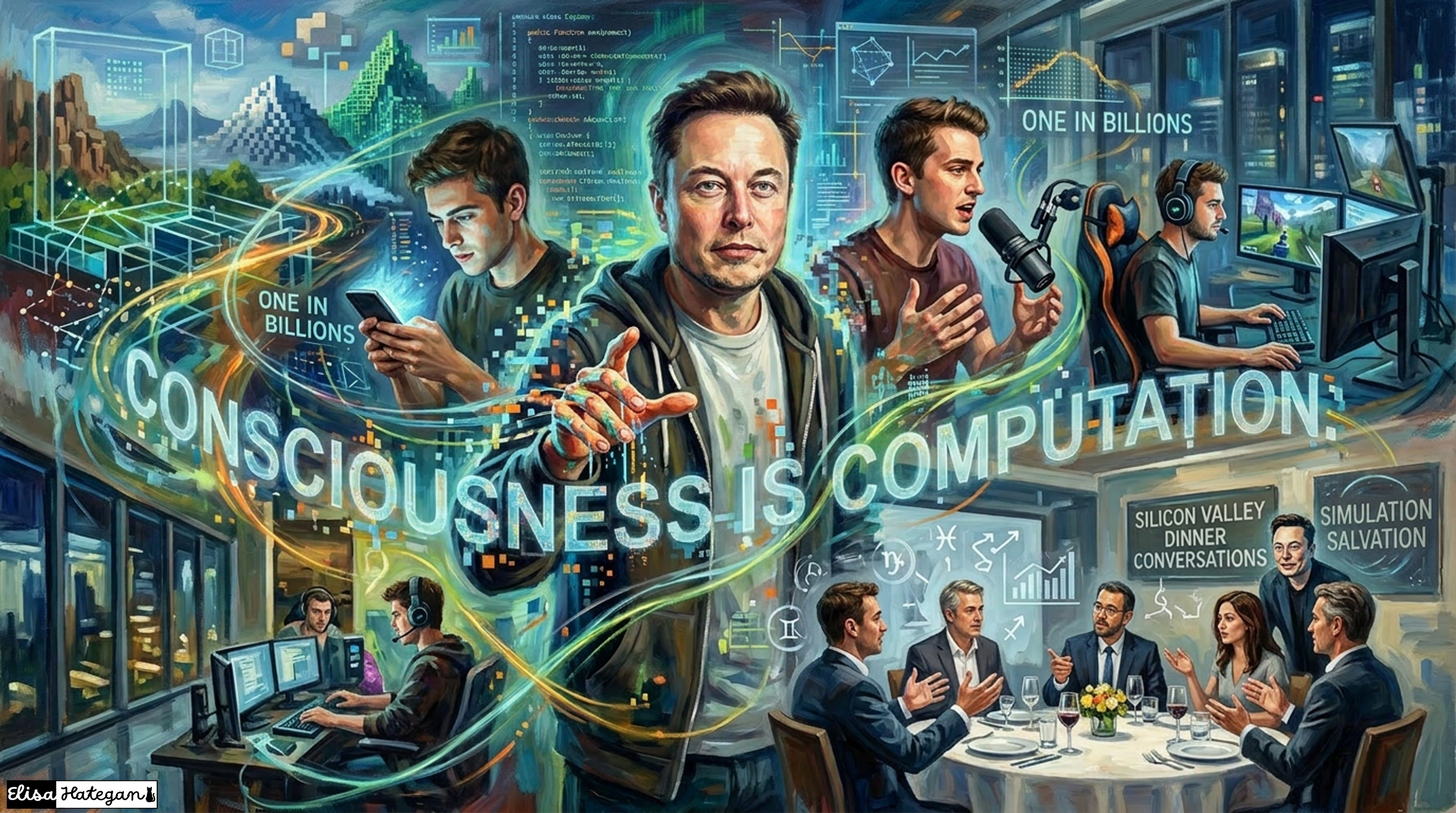
Elon Musk famously placed the odds that we are not in a simulation at “one in billions.” Entire rationalist forums and podcast circles treat the hypothesis as foundational. The argument runs through Silicon Valley dinner conversations the way astrology runs through Brooklyn ones: as a shared piece of common-knowledge metaphysics no one is expected to defend at length, only to superficially invoke in order to look clever or edgy (even if it carries the whiff and kitsch of a geeky teenage boy’s obsession with sci-fi and Star Wars).
That’s not, in itself, a refutation. It is, however, perfectly valid evidence of its fallacy. A cosmology whose plausibility tracks so bluntly the demographics of its proponents has, at minimum, the structure of a self-portrait:
The people most certain that the universe is a computer are the people whose working lives are spent inside computers. The people most confident that consciousness is computation are the people whose income depends on persuading investors that consciousness is computation. The theory benefits them in ways that have nothing to do with whether it is true.
There’s something almost religious about the whole ideological apparatus and the followers whose imaginations it captures. The Simulation argument is a Salvation narrative for people who believe themselves too rational and “scientifically-minded” for religion. It has a creator — anonymous, technologically advanced, indifferent to the point of dissociation (perhaps the simulation is run by AI or cyborgs). It has a world that isn’t what it appears to be. It offers the possibility of a transcendence in which the truth is finally revealed and the protagonist learns that everything they suffered was part of a larger design they couldn’t see.
The rationalist who scoffs at the Bible has written himself into Genesis as the dreamed Adam in a server somewhere, awaiting the day the simulators turn the lights on and welcome him back home. Sure, there are worse stories. But this one is not a new story. It is, in fact, among the oldest ones — re-skinned, like a video game asset, in the chrome of the present century.
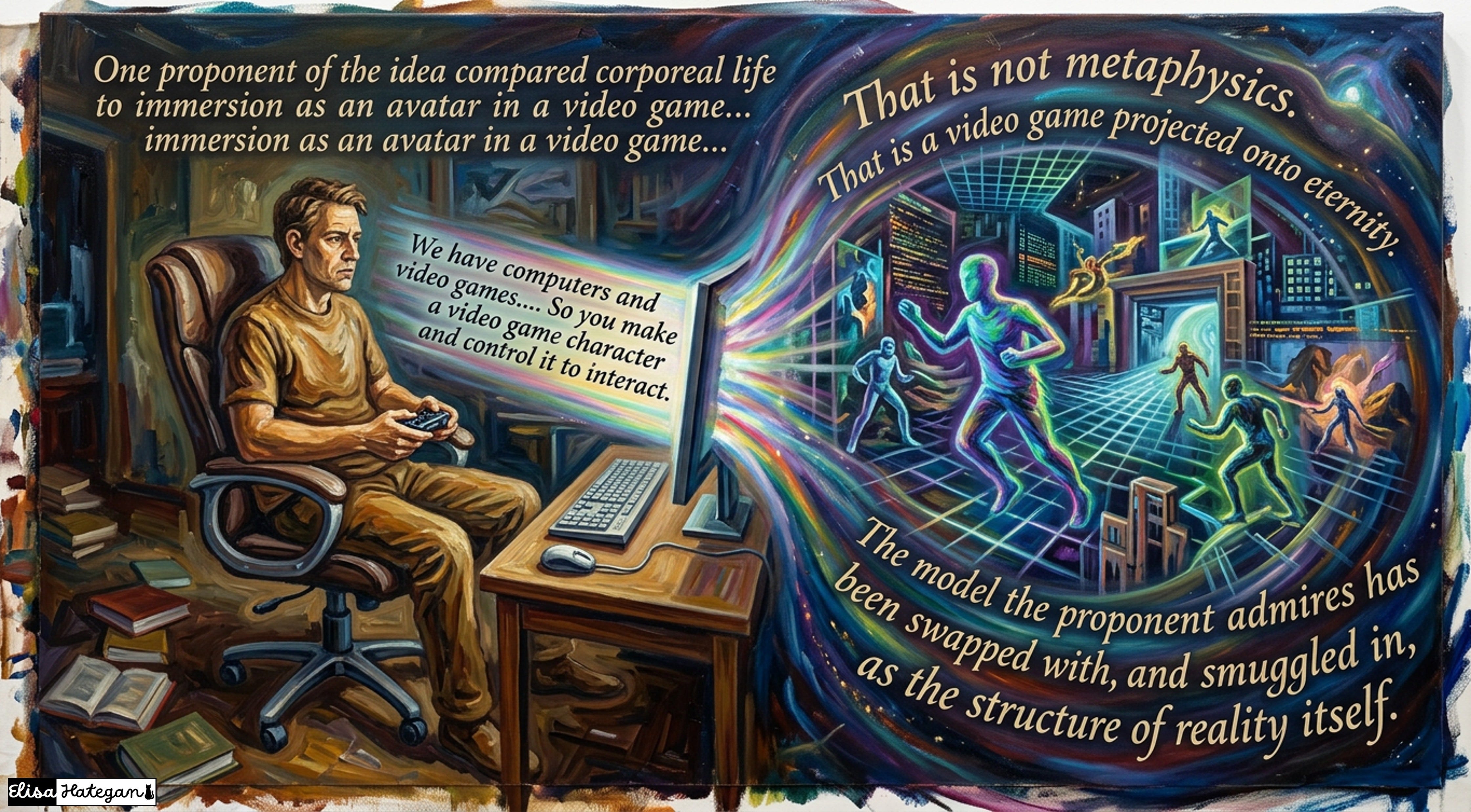
One proponent of the idea compared corporeal life to immersion as an avatar in a video game. He explained: We have computers and video games. Let’s say you want to interact with a character in the game. You can’t interact directly because you are made of solid matter while the video game character is made of electromagnetic energy. So you make a video game character and control it to interact.
The image is vivid, and you almost want to nod along. But then you notice it requires you to accept that the “real” you exists somewhere outside of this reality. You’re still made of flesh and blood — but instead of being here, reading my words and being bedazzled by my fabulous images, you’re sitting in some ergonomic chair in the far-off future, controlling the avatar that is the visible you in this sphere.
That is not metaphysics. That is a video game projected onto eternity. The model the proponent admires has been swapped with, and smuggled in, as the structure of reality itself.
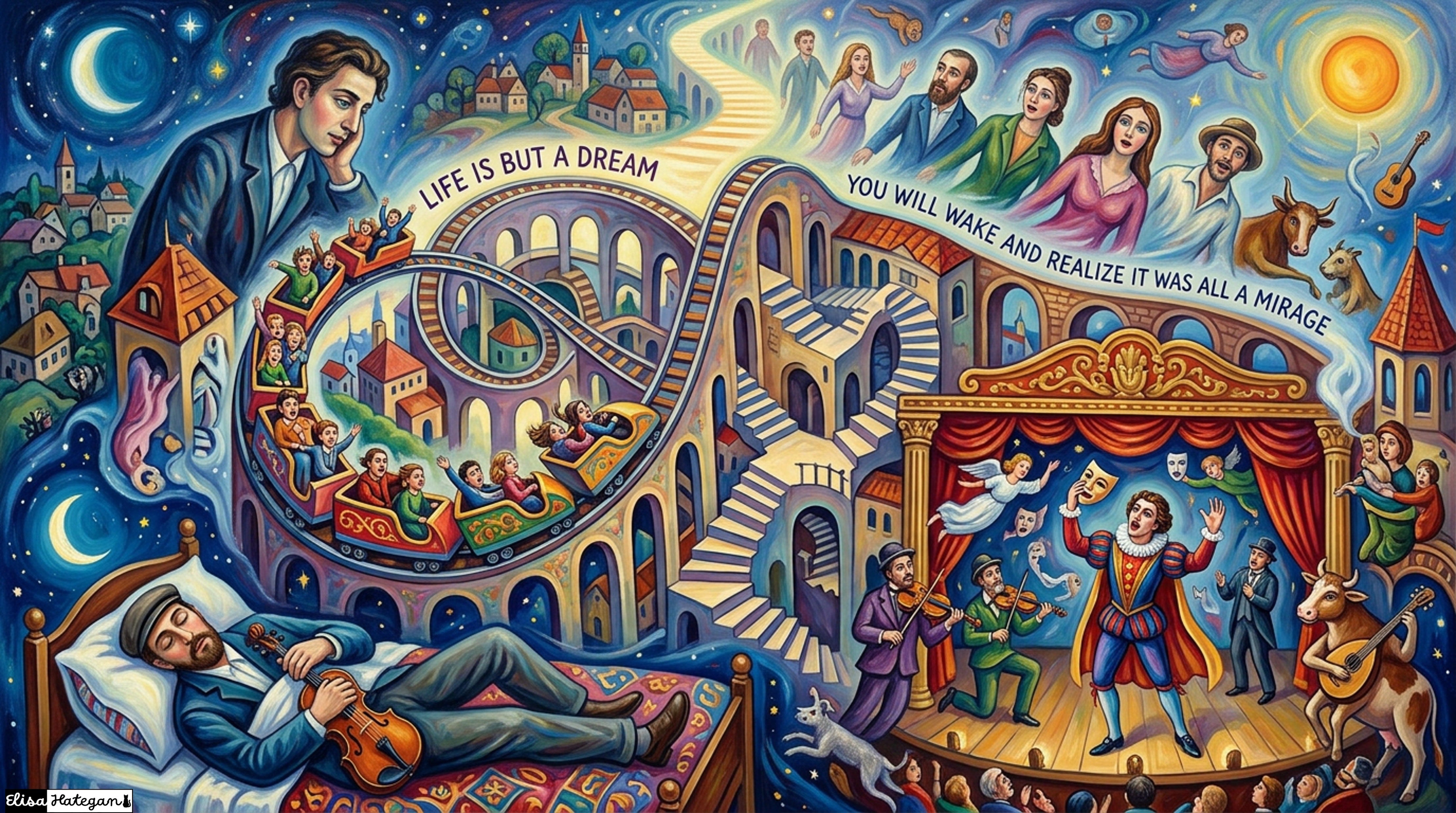
Analogies like Life is but a dream have a purpose: they allow us to conceptualize reality in different, manifold ways. When you are in a dream, it all feels real to you. Most of the time you don’t realize you are dreaming. Only when you wake do you understand it was all an illusion. In the same way, when this amusement park ride comes to an end — when your life, whatever you endeavoured to do here, ceases — you will wake and realize it was all a mirage. Yes, it was real in the moments you experienced it, the way acting out a character in a play feels real when you’re reciting lines and tapping into raw emotions. The way riding a scary rollercoaster induces a simulated terror in which you know you are in peril and also that you’re safe, all at the same time.
That kind of awakening is no different than what Simulation Theory proponents believe.
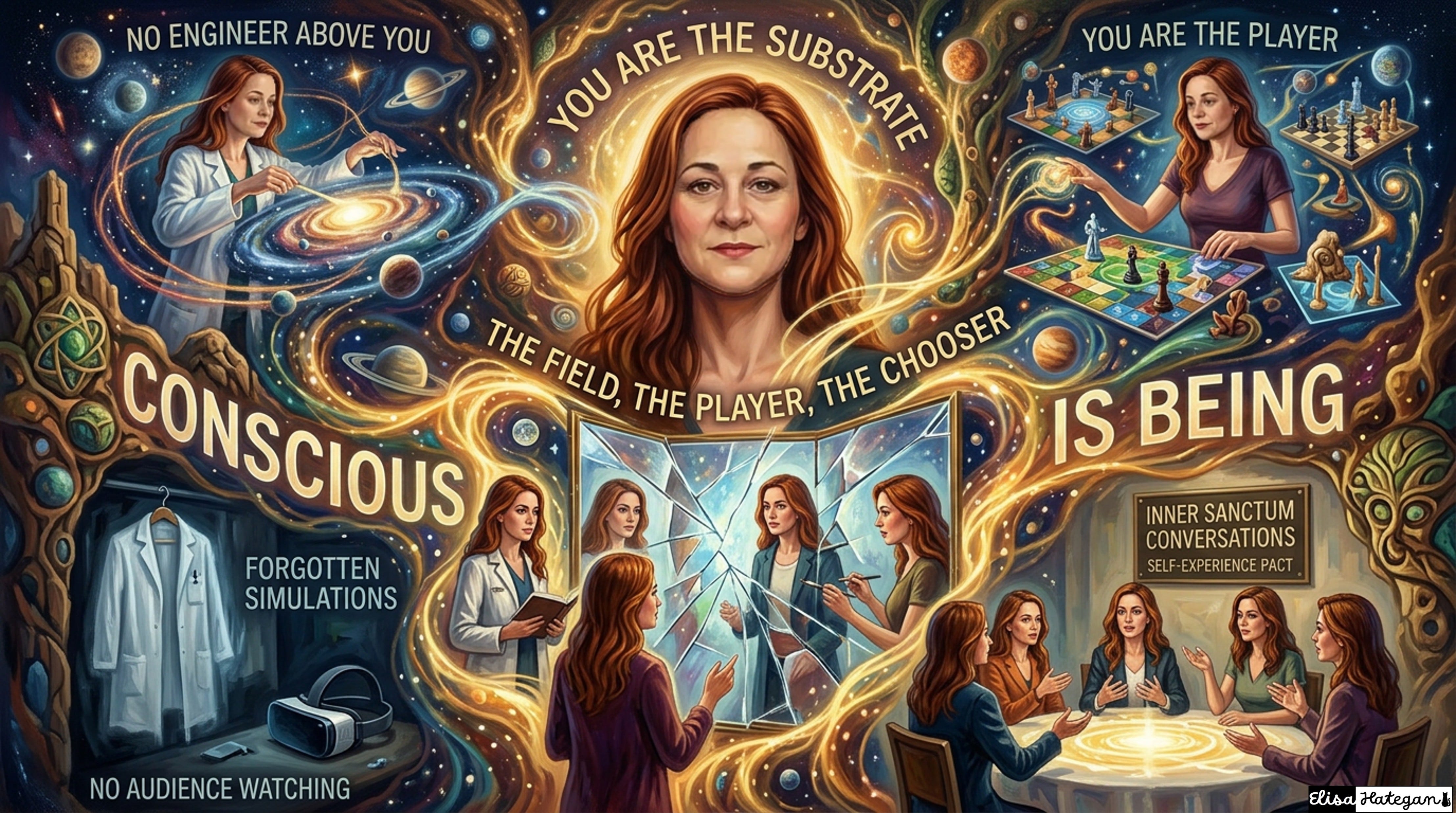
The only difference is, you do not wake in a computer lab and take off a VR headset. You wake as a powerful, multidimensional being who has no need for a headset or a computer network to run simulations of existence. YOU are the substrate itself. You are the field on which the game is played, and you are also the player, and you are also (even if you’ve forgotten) the one who chose to play. There is no engineer above you, in a lab coat, waiting for the experiment to end. There is no audience watching from the gallery. There is only you, on every side of the glass, having briefly agreed to forget yourself in order to experience yourself.
Even here, wearing these individual “meat suits”, we are trying to find enlightenment while dreaming, and from dreaming. That drive to search for meaning is built into us. I have my own hypothesis about what actually happens while we dream – but I’m saving that for a future piece.
And yet, if there is any simulation at all within this dream, this arena, this exercise — it is to experience what cannot be experienced if everything is perfection. To know how strong you can be when you are at your weakest. To find that you can see the light, even when it is dark. To understand what it is like to become that light.
Some have found a deeper problem with Simulation Theory than the category error. The simulation argument requires, as its own precondition, a universe in which biological civilizations can evolve far enough to build such machines in the first place. The simulators must come from somewhere. Their world — the base reality, the one doing the simulating — cannot itself be digital all the way down, or the regress never terminates and nothing ever actually runs anything. Something organic must be prior.
And once you admit that an organic, generative reality is the necessary ground beneath any simulated one, you have conceded the whole argument — because that organic ground is what I call the Oneness. The digital civilizations with their ancestor-simulations are simply one more story told by the Oneness, one more fractal spun by a living universe that creates by living and experiencing rather than by computing.
The Oneness is organic. It is closer to Spinoza’s single infinite substance (the idea that there is exactly one substance in the universe, and everything that exists is an expression of this single, infinite reality), expressing itself through endless modes, than to any server farm. One living thing, of which every river and every blade of grass and every quantum branch is an expression, not a clinical server output.
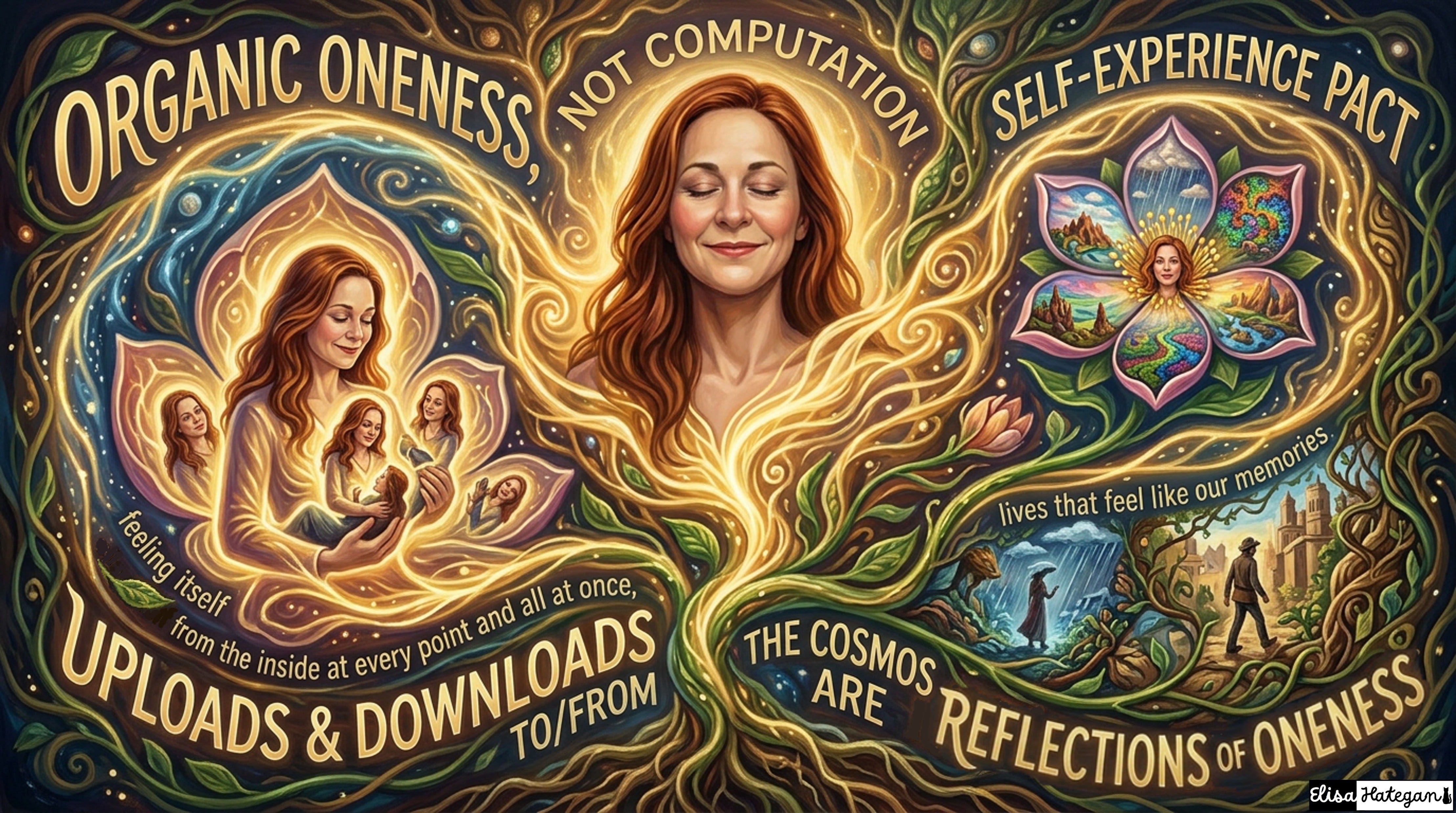
Our uploads and our downloads — impressions that arrive spontaneously, lives that feel like our own memories though we never lived them in this body — are not data moving through a clinical machine. They are the organic reflection of a Oneness experiencing the sum of its own parts, feeling itself from the inside at every point and all at once. Each refraction is a new fractal universe. Each iteration is a new story that unfolds like a flower in bloom.
We Are Not Here To Learn Lessons
If the substrate of everything is organic, generative, alive, it changes the question of what we are doing here.
A computer simulation has a purpose external to itself. It was built by someone for a reason, to produce an observation or output. A computation, by definition, is a means to an end; it exists to deliver a result.
An organism is something else entirely. An organism does not exist in order to produce anything, other than perhaps to replicate itself and produce offspring after reaching maturity. All the honey a bee produces is a byproduct of its existence, not the cause of it. An organism metabolizes the world and is metabolized in turn. It experiences itself, from the inside, for the duration of its sojourn on the planet. Reproduction itself is secondary to experiencing life in first-person; there are far more beings that have existed throughout time than have reproduced.
We are expressions of an organic Oneness, a higher consciousness that connects all particles through timespace, rather than processes running on a clinical machine. We are not here to be computed. We are not here to be measured, programmed, debugged, evaluated, graded and sorted into subjective qualitative valuations.
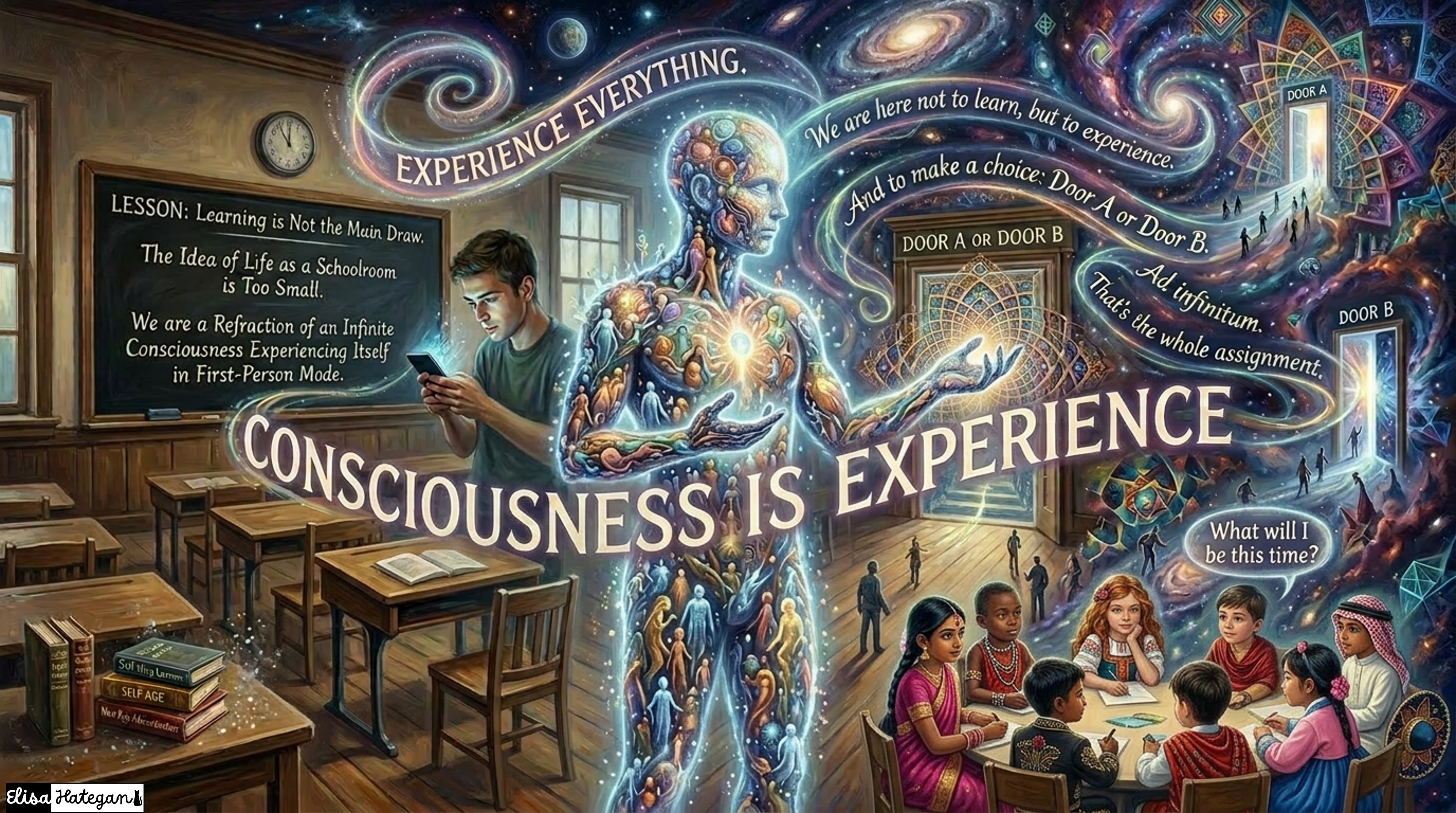
We are not here, despite what every self-help book and contemporary spirituality will tell you, to “learn lessons.”
Contrary to what the New Age movement and its underlying philosophies insist, learning is not the ultimate purpose of our existence. Learning lessons implies doing — which brings with it the possibility of being graded on our performances. We are here to experience. Perhaps, if we feel like it, to fulfill specific goals we aim for along the way. That’s the long and short of it.
Experience what, you ask? Everything. Which, of course, encompasses learning too.
You can be everything. You can tune into anyone. Turn the dial, and you can tune into any frequency, fuse with any vibration, any pattern, any fractal, until you master that experience, that ride, that game. Until you reach perfection — the pinnacle of resonance.
But learning is not the main draw.
The framing of life as a schoolroom has always struck me as too small, too administrative, too condescending, paternalistic and insulting to the scale of a multidimensional cosmos. We are a refraction of an infinite consciousness experiencing itself in first-person mode, from the inside — and, having experienced, to make a choice: Door A or Door B. Ad infinitum.
That’s the whole assignment.
We are here to experience.
To take a book from the Infinite Library, to put on the headset, to submerge entirely into the being you chose to become, and live existence from that vantage point, from behind that particular set of eyes.
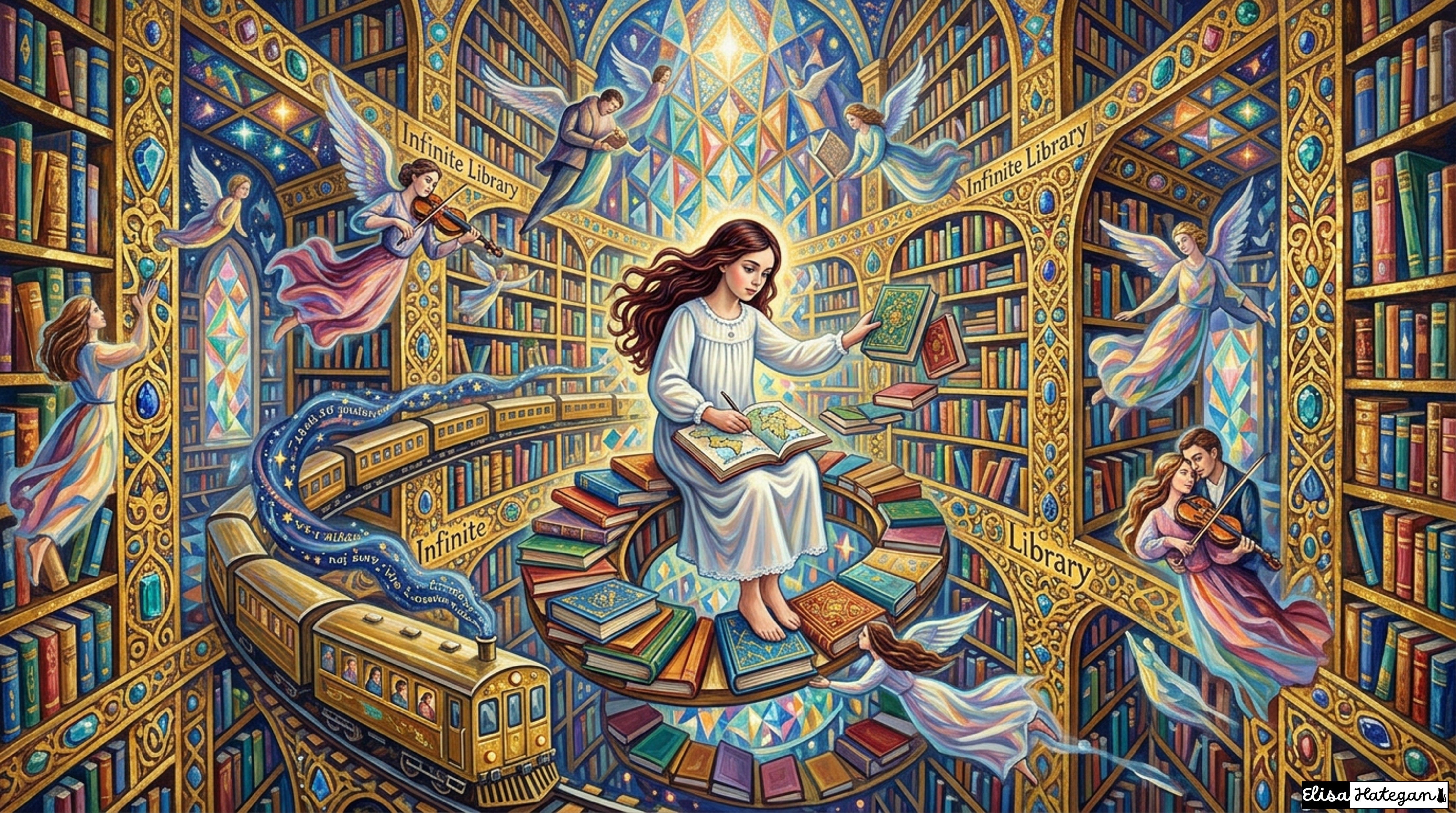
But what is the fun of experiencing, without making a game of it? Imagine choosing your immersive adventure, putting on the headset, and finding yourself standing in an open green field where absolutely nothing happens. There’s no wizard, no dragon, no maiden to save, no adversary to defeat, no stakes, no cause to fight for, no struggle to define or whittle you into a better person.
You would go out of your mind with the boredom of it. You didn’t sign up to be a rock or a fern this time around. And yet, a complex storyline has its price.
The challenge is not the suffering and cruelty that intertwines with your experience. The challenge is the mercy that makes the experience worth having. The light and tenderness you can show to your own self — the secret, real You that the world made you believe was worthless and undeserving.
If you can’t love yourself as you are now, are you able to extend love to the innocent child you once were? If you cannot live for yourself, and you have nothing else to live for - live for her. Live for her dreams, which live within you still.
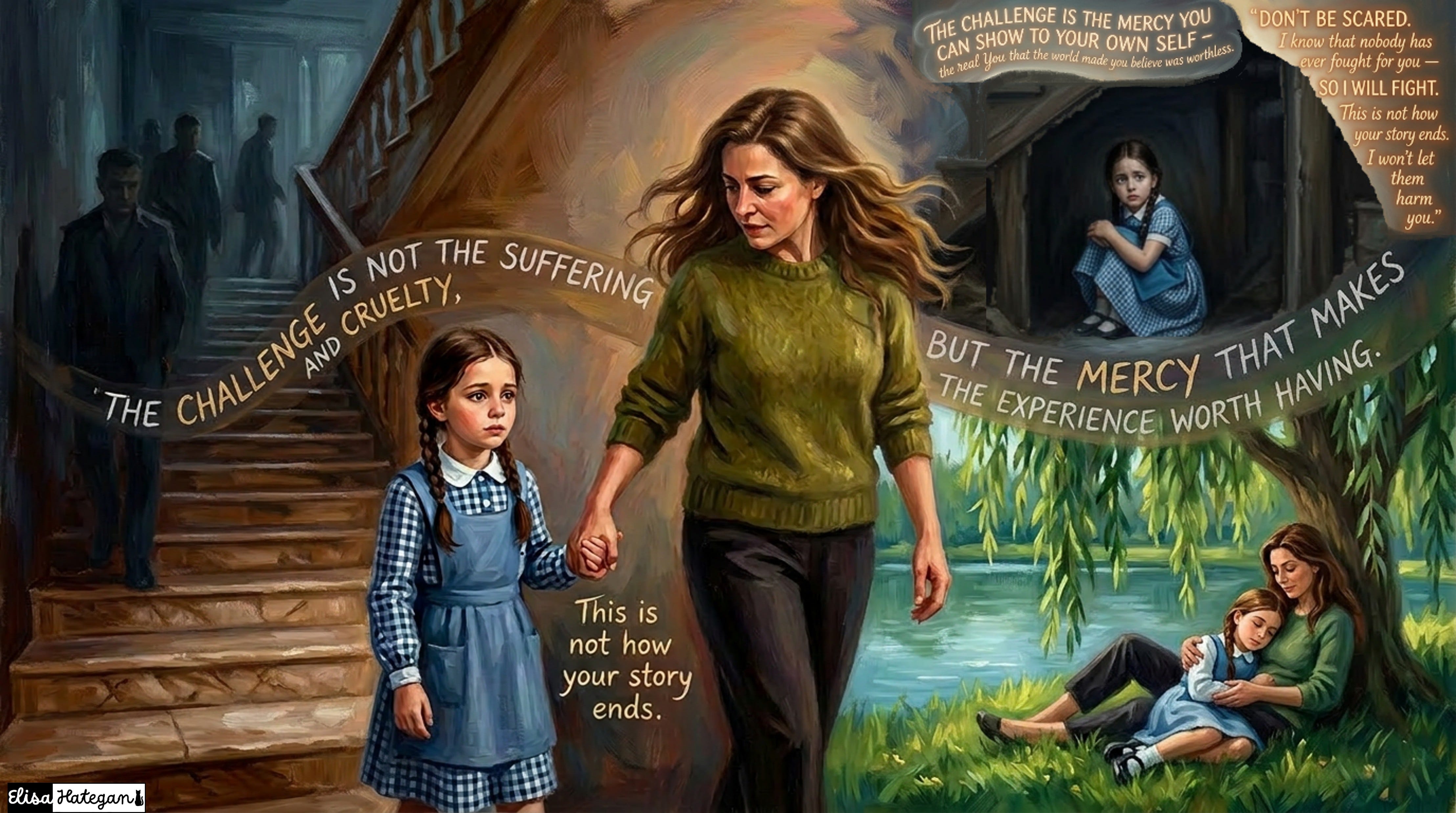
The challenge is to take the little girl you were by the hand and lead her away from the dark, frightening marble staircase where she hides when she is locked out of her father’s apartment, when she runs from the bad men.
To tell her: Don’t be scared. I know that nobody has ever fought for you — so I will fight. This is not how your story ends. I won’t let them kill you.
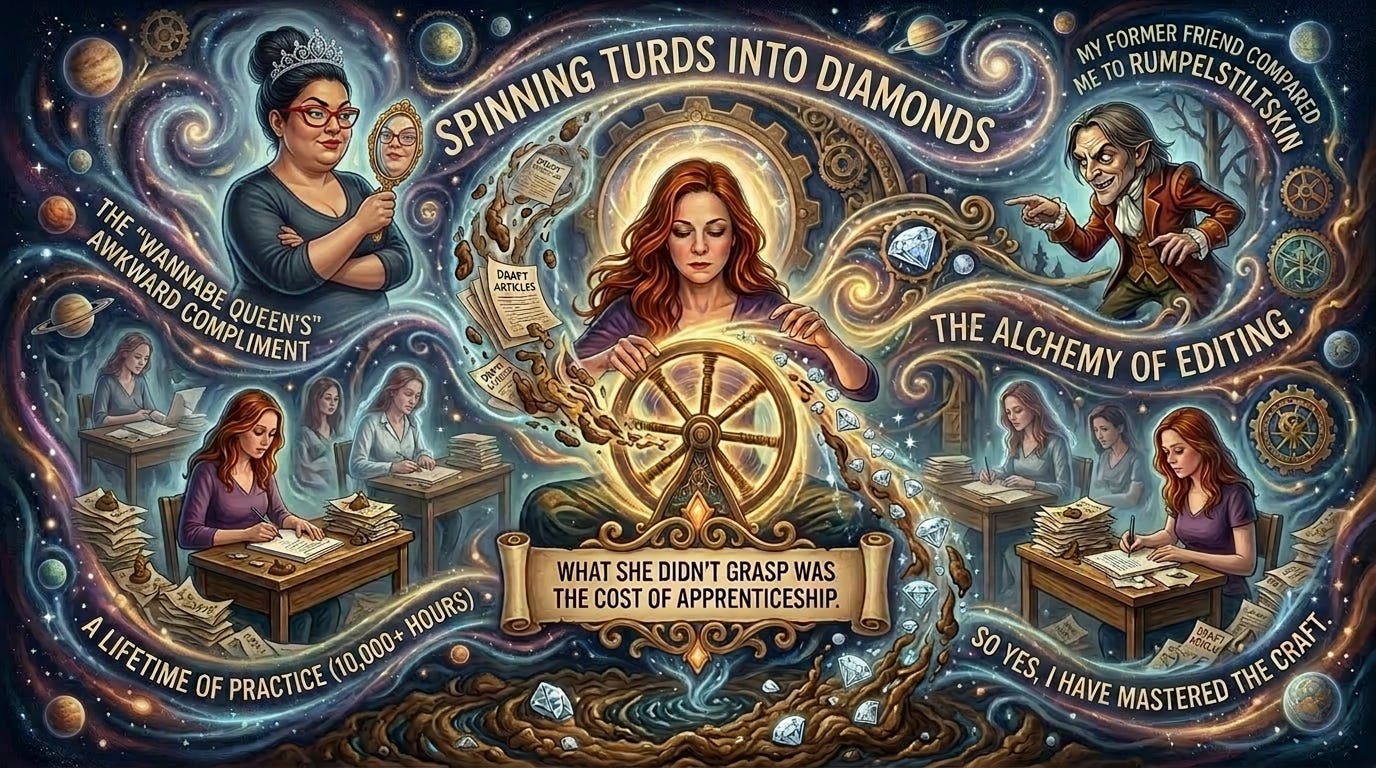
A former friend once compared my writing skills to Rumpelstiltskin, the Brothers Grimm goblin who spun straw into gold to please a wannabe queen. I was editing and reshaping her articles, and she — methinks a wannabe queen in her own mind — was in awe of how I could take her turds and spin them into diamonds. What she did not grasp was the cost of the apprenticeship. I’ve had a lifetime of practice.
They say it takes ten thousand hours to perfect a craft, and I can honestly say I have spent more than my share of ten thousand hours, and a great deal of overtime piled on top, immersed neck-deep in turds, trying desperately to alchemically spin them into something that did not reek of failure.
So yes, I’ve mastered the craft all right. Not because I’m a congenital optimist or an insufferable Pollyanna, but because it was the only way I could keep me from offing myself.
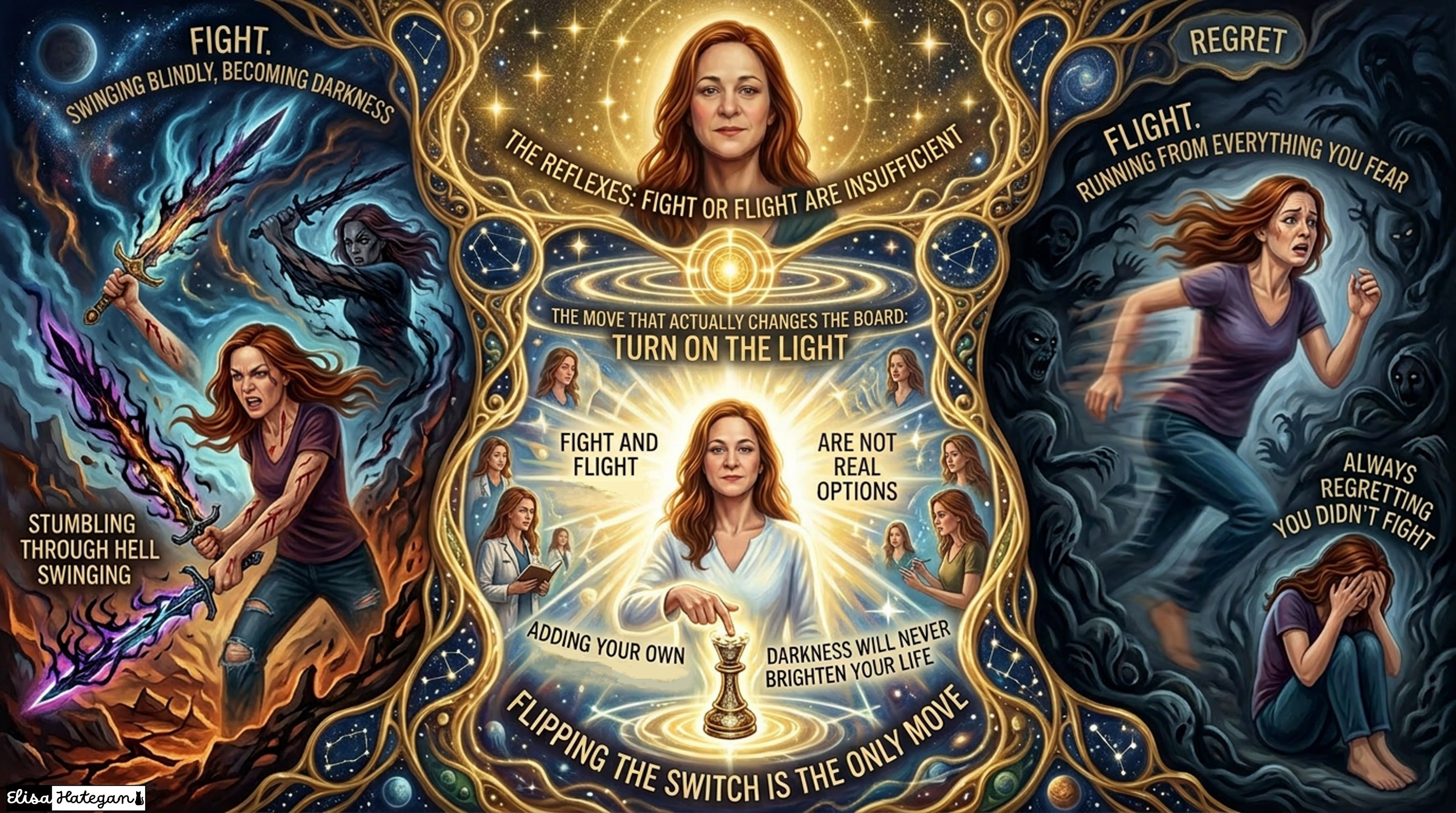
When you live a life that manifests as blow after blow after blow, you learn quickly that there are only two reflex responses wired into your body: fight or flight. You can turn around and fight the darkness — and risk that in the long grappling with it, in the enmeshment with your shadow, you will become it. Or you can flee, escape the level, reset to the beginning.
The body thinks there are only two options. But it’s wrong.
There is a third option, a completely divergent course of action. One that allows you to elevate above your biologically-wired, binary reflexes. It’s so obvious that it can hover right in front of you for years and still remain invisible. And it’s so self-evident that most people rarely attempt it, lest they look silly.
What do you do when you find yourself surrounded by darkness? You do not have to fight it, swinging blindly, becoming it. You do not have to flee it either, running away from all that scares you and always regretting that you didn’t fight back.
You turn on the light.
It’s the simplest, and the hardest, thing you will ever do.
You turn on the light because you don’t have any other option.
Adding your own darkness to a world already saturated with hatred and gloom will never brighten your life or illuminate your future. You can stumble through hell swinging, but you’re still in hell. So stand your ground, look darkness in the face. Confront it fearlessly, and flip the switch.
Flipping the switch on is not the naïve choice. It’s the only move on the board that actually changes the board.
I have seen what the other choices do to a human being. When the darkness comes at some people, they answer it in kind. Meet darkness with darkness. Monetize and profit from it, stoking the animus.
But darkness fighting darkness does not produce a victor. It produces a solitary, widening cesspool of mutual despair — two adversarial figures thoroughly enmeshed and consumed by revenge. Their rage and hatred intertwine like tentacles, gnarled and rotting, that after a while you cannot tell who is who, or remember that either of them ever intended to be something else.
The light switch is on the wall, where it has always been. But nobody can reach across and turn it for those who choose, of their own volition, to stay in the dark.
The Rules of the Game
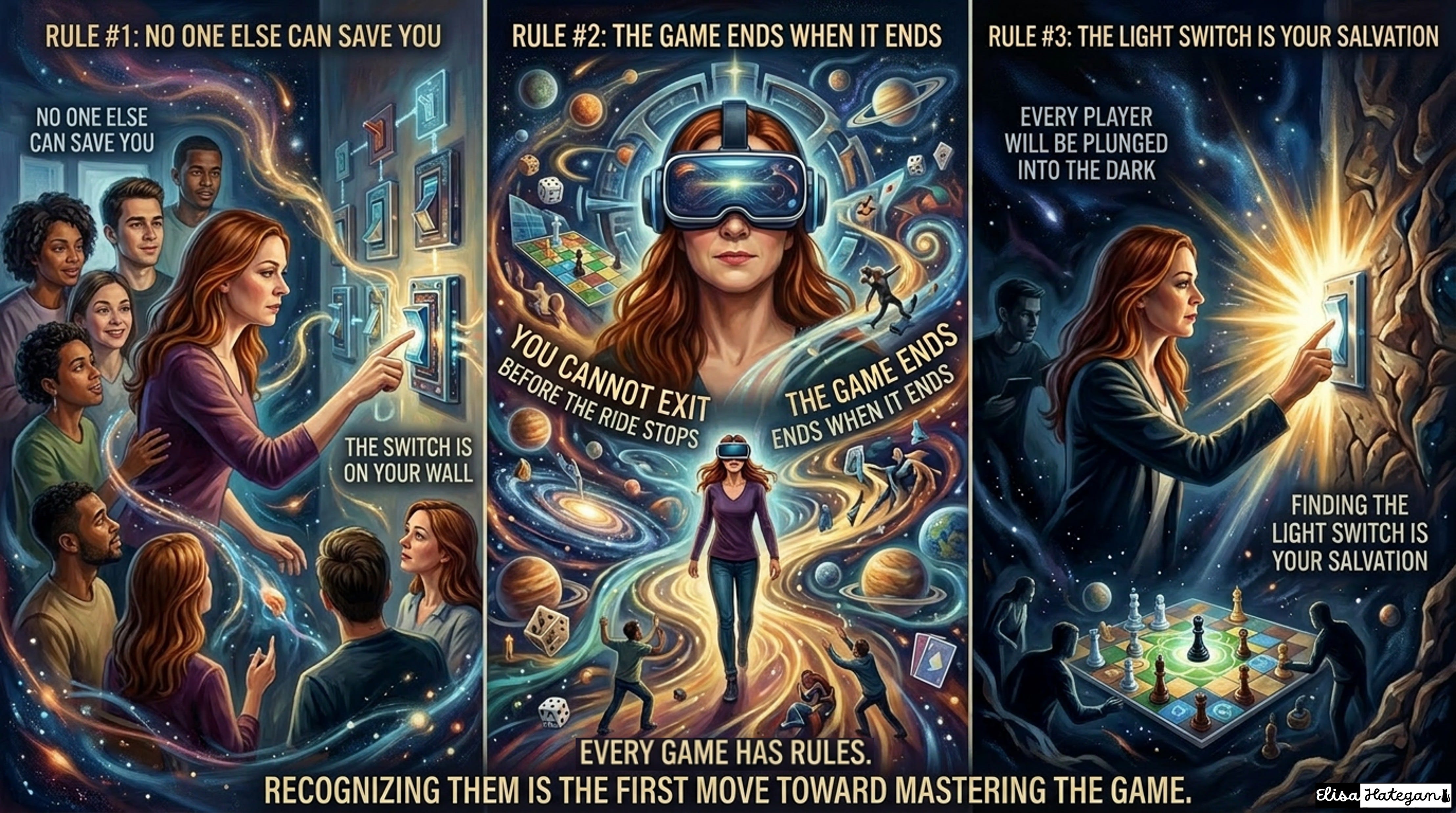
Every game has rules. They are not negotiable or optional, and recognizing them is the first move toward mastering the game.
The first rule is that no one else can save you. They can love you, they can bear witness, they can stand beside you while you do the hard work — but the switch is on your wall, in your inner room inside your brain, and only your hand can find it.
That’s another way to know that Simulation Theory is a sham. A simulated being, even an NPC, could be patched or rebooted from the outside. But an organic being, embedded in the substrate, has to choose to survive. You have to push yourself to get up in the morning and eat and get through life. Nobody else can do it for you - and without performing those basic functions, you’re on borrowed time. You consent to life, even if you hate it, every time you eat, breathe, function as a human being.
The second rule is that you cannot exit before the ride stops. Every consciousness that ever decided it couldn’t take it anymore, discovered that it could not negotiate an early departure. The headset comes off when it comes off. The game ends when it ends. Anything in between is not true exit, but flight – and flight returns you to the same dark room, or an alternate dark room in the multiverse, until you progress to complete the game.
The third rule is the one I most wish didn’t exist: Every player, without exception, will eventually be plunged into the dark.
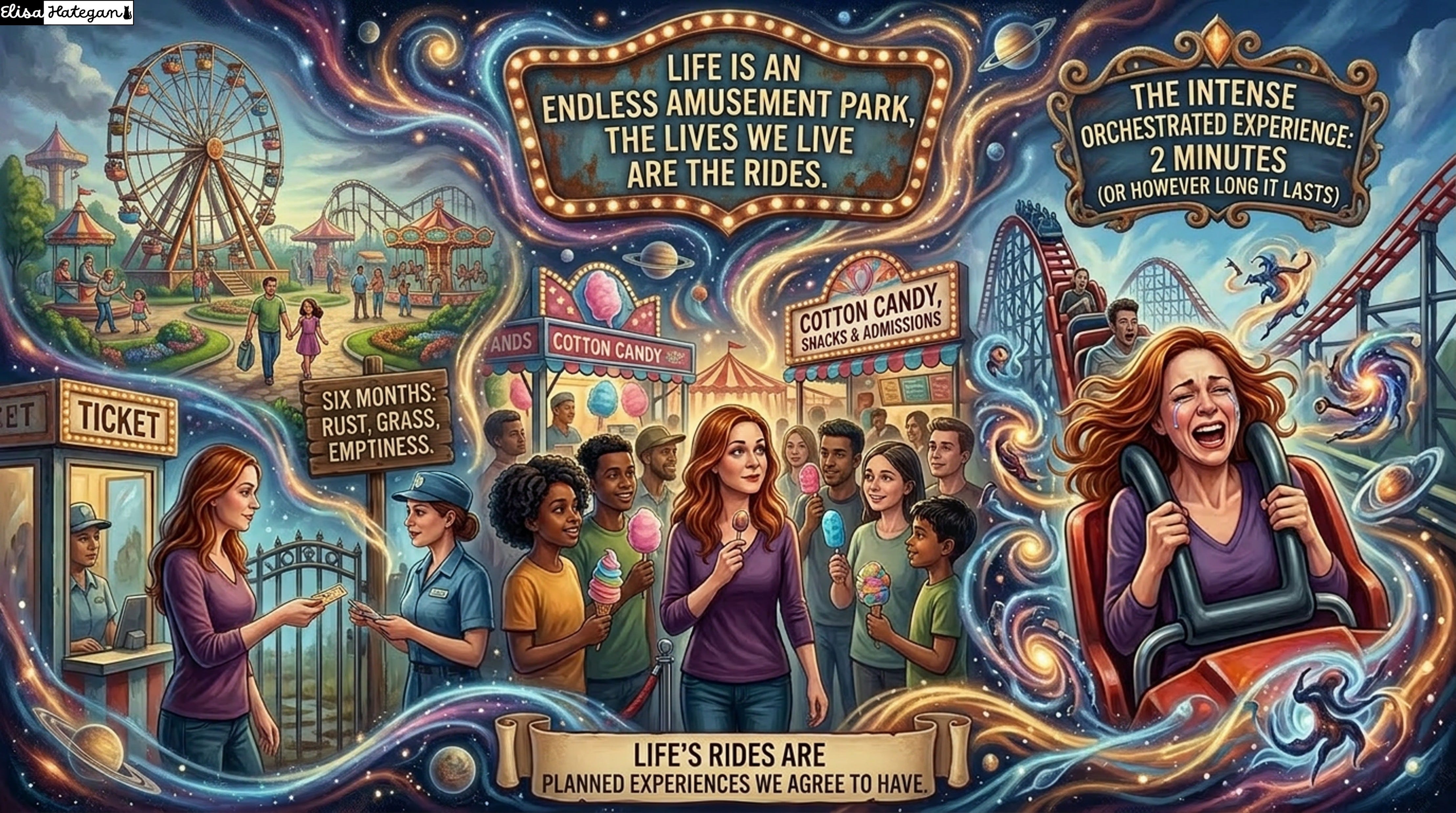
Life is an endless amusement park, and the lives we live inside it are the rides.
Think of what an amusement park actually is. A stretch of ground, briefly enchanted with wonder. A field that, six months of the year, is mostly empty grass and rust, suddenly transformed by lights, carny engineering and the excited participation of crowds, into a temporary kingdom of experiences.
You pay your admission. You wander between attractions. You queue for snacks and rides. You hand over a ticket. You climb into the seat of a contraption built to give you a sensation that’s nothing like what you encounter in your daily life. And then, for ninety seconds or two minutes or however long the ride lasts, you are no longer the person who arrived at the gate. You’re screaming or laughing or weeping, in the grips of an orchestrated, intense experience you agreed to have for that duration.
The Rollercoaster is the life of high contrast — the one whose entire shape is sudden ascent and sudden plunge, the one whose passengers describe afterward as exhilarating and terrible all at once. The Ferris Wheel is the life that rises slowly to a height from which everything looks small; it lingers in the wind, then brings you back to where you started, albeit altered. The Carousel is the life of repetition — round and round on a painted horse, the same scenery repeating again and again, until you find the courage to break free of the loop. The Haunted House is the life that elected to walk through the darkest corridors of possibility, to feel terror as a sustained climate rather than an interruption, and be reached by things one cannot see until one exits into light. The Funhouse’s hall of mirrors is the life that spent itself among reflections, never choosing one’s own voice over a cacophony of false projections. The Tunnel of Love is the life whose entire purpose was to drift along as upon a river, hoping to sense the brief touch of another hand in the dark.
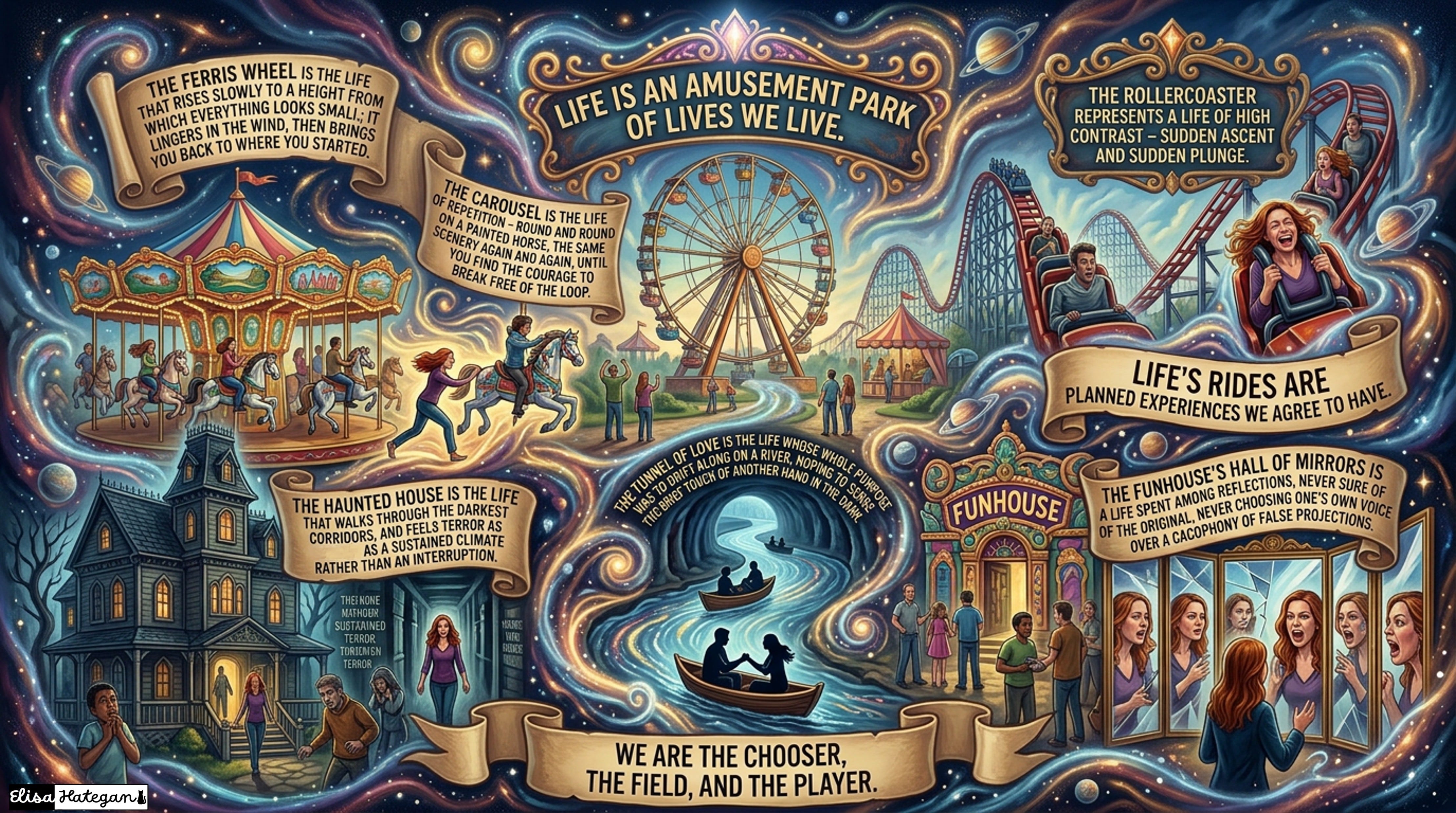
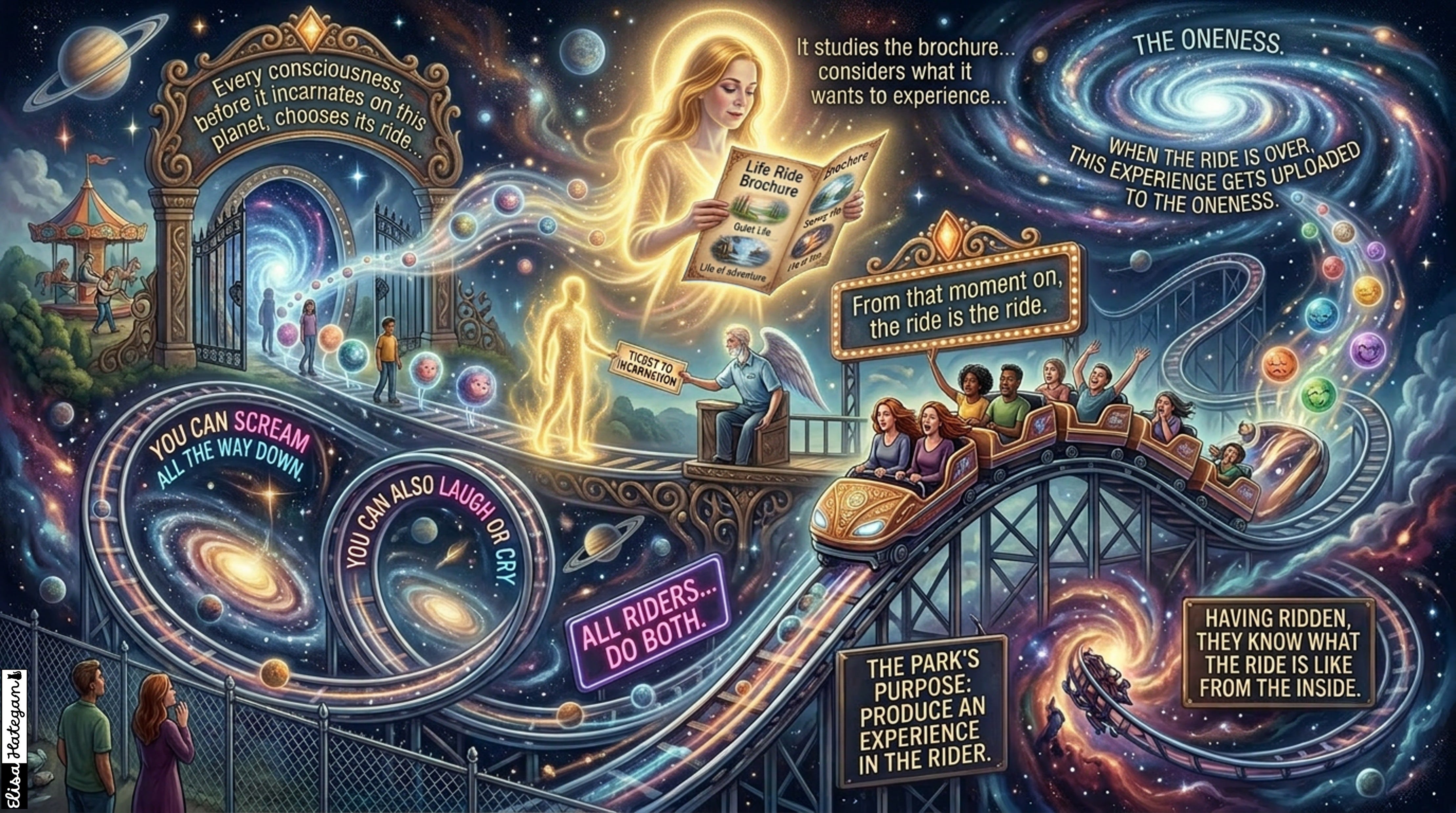
Every consciousness, before it incarnates, chooses its ride. It does not choose blindly. It studies the brochure. It considers what it wants to experience in this round. And then it queues at the gate, hands over its ticket, climbs into the seat, and lets the safety bar lower over its lap. From that moment on, the ride is the ride.
You cannot get out at the top of the loop. You cannot ask the operator to slow the car because you changed your mind. You can scream all the way down. You can also laugh or cry. All riders, in the long run, do both.
What Simulation Theorists mistake for a machine is more like a carnival fairground. The amusement park’s purpose is solely to produce an experience in the rider. The rider experiences something they couldn’t have felt standing outside the fairgrounds, looking through the chain-link fence – what the ride feels like, the qualia of a singular consciousness, experienced from its inside. And when the ride is over, this experience gets uploaded to the Oneness.
That is what the Oneness gathers from us and what we upload to the Oneness “cloud” - which is a universal living consciousness rather than an astronomically-humungous computer server a thousand years in the future. It collects the inner, first-person view of all beings that have ever lived, encoded like a melody, vibration, frequency. It is learning, ride by ride, what it feels like to be every one of its own passengers, from the beginning to the end of time.
And every passenger, on every ride, eventually arrives at the part of the track that goes through the dark.
The darkness eventually comes for everyone who goes for a ride in this amusement park we call human life. So what do you do when you are overwhelmed?
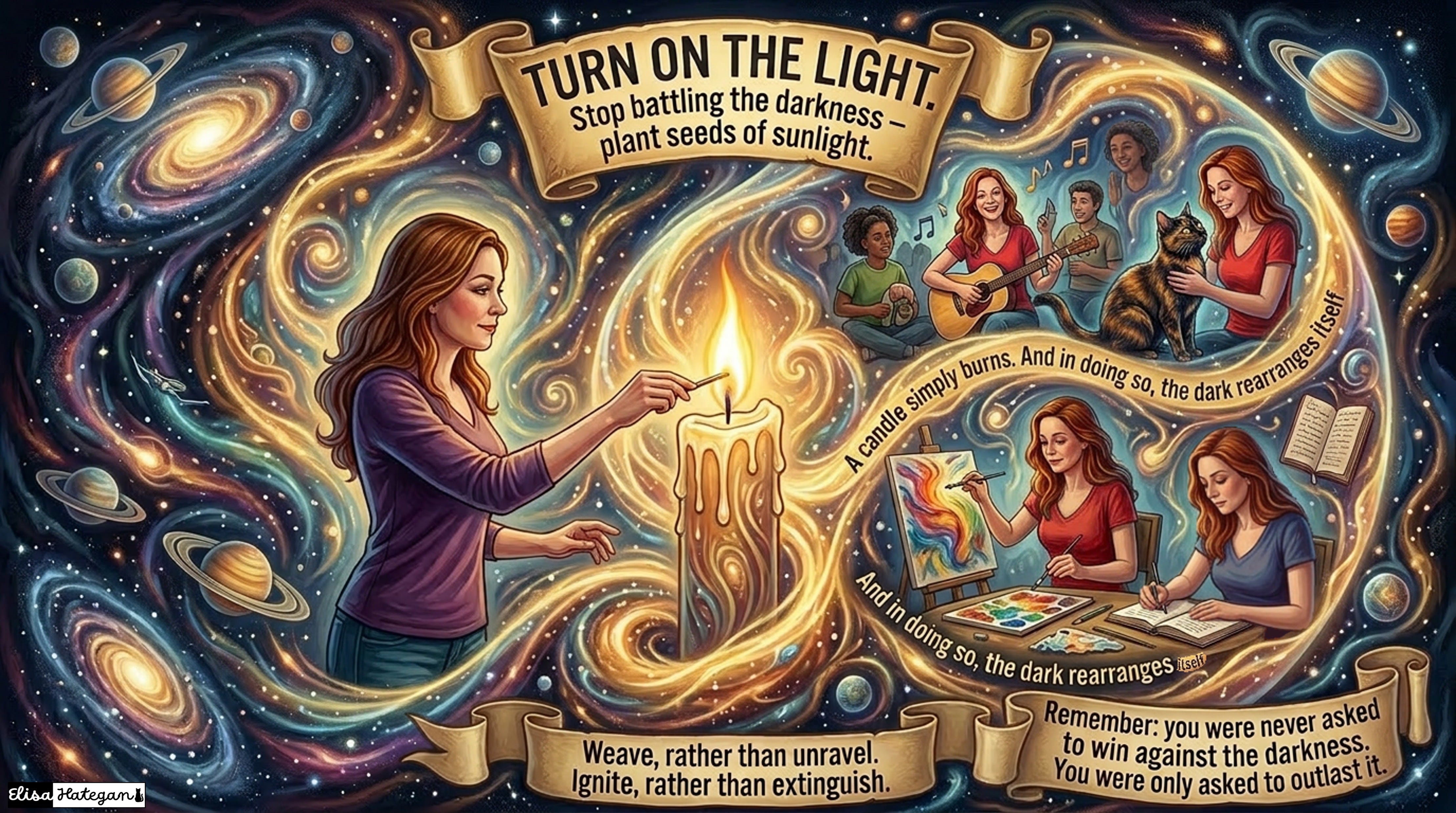
Turn on the light.
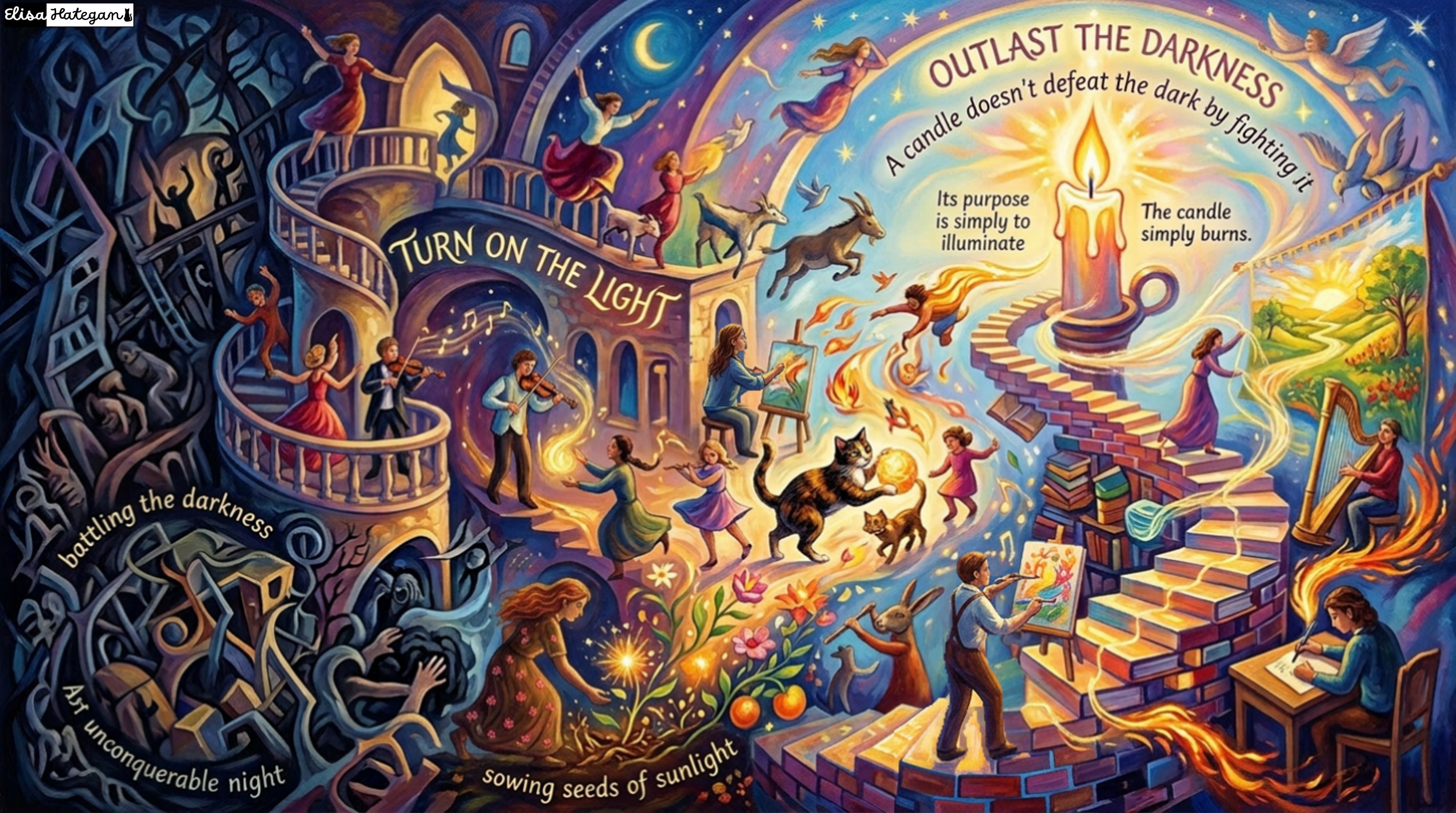
How? You become the light. You stop battling the darkness and start sowing seeds of sunlight instead. When you are at your most hopeless, when you feel most powerless and alone, when you’re desperate to withdraw your consent to life, do the things that fill your spirit with light and hope — make music, create art, bond with pets, dance, paint, write. Insulate yourself in a bubble of light, however tenuous, and you will survive the darkest night.
It’s an excruciating paradox, but I don’t think there’s any other way to get through.
You must create, rather than destroy. Weave, rather than unravel. Ignite, rather than extinguish. Don’t let fear and anxiety consume your life - turn on the light.
A candle does not defeat the dark by fighting it, but by being a candle. Its purpose is simply to shine — that’s its pattern completing itself. Melting into light is its self-actualization. The candle does not deliberate. The candle does not strategize. The candle does not weigh its odds of victory against the dark. The candle simply burns. And in doing so, the dark — which had seemed unconquerable until the moment of ignition — is rearranged, immediately and without negotiation, around the incendiary existence of the flame.
So turn on your light. Illuminate. Find your golden thread and follow it out of the dark labyrinth comprised of everything that wounded you, that scares you, that makes you feel powerless and lost inside your fears. Follow it until you find the sun.
Above all, remember: you were never asked to win against the darkness. You were only asked to outlast it.
Someday, there will come a moment — perhaps tonight, perhaps in a year, perhaps at your last hour — when you will wake in the dark again and, for a split second, not know where you are. The room will have dissolved. You will be a consciousness suspended in black space, briefly unattached to any geography.
And then your hand will find the switch.
It wasn’t put there by an engineer, or a futuristic lab. It was made for no purpose other than to reveal that this living, breathing, dreaming multiverse is on your side, and an escape hatch is embedded at each level of the game. But to find it, to hack your way out of pain and heartbreak, you’ve got to believe there is a path forward, even if you can’t see through the dark forest of your fears.
You find it within you — LOVE and HOPE.
The light comes on. The room reassembles itself. The world resumes.
Open your eyes. Reach.
TURN ON THE LIGHT.
If you enjoyed this article, please like and subscribe. Please also follow my new YouTube channel, From Darkness to Sunlight, created just this month. I’ll be enormously grateful to anyone who subscribes and helps to get it off the ground.
https://www.youtube.com/@fromdarknesstosunlight
I just released “We Are Kaleidoscopes”, the first video of my new Remember Who You Are series. Over the next few weeks and throughout the summer I will be turning these articles into short films. Please subscribe so you can be notified when the newest video drops.
Comments
Nothing yet. Say the first thing.
Sign in to join the conversation.