
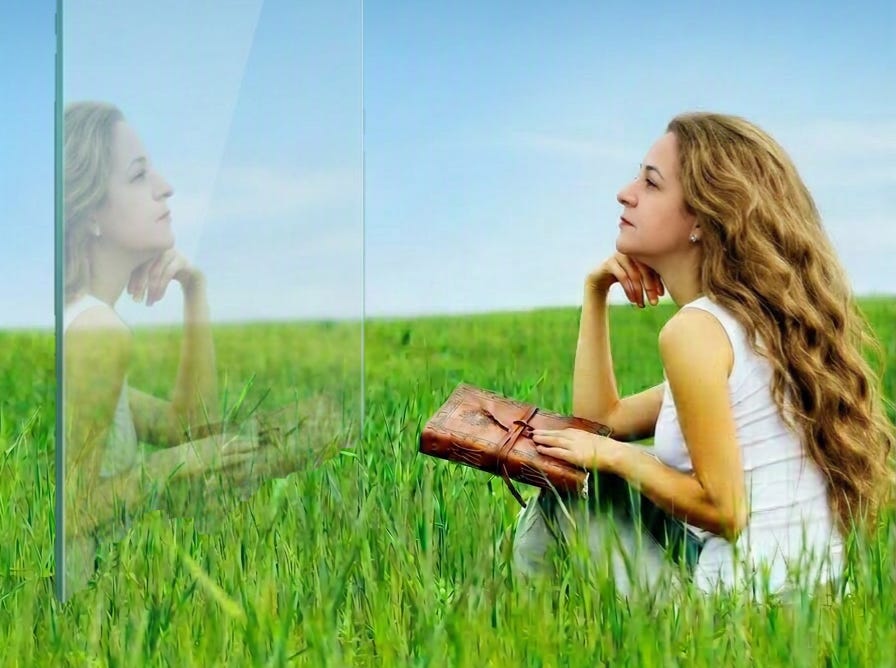
I remember the first day it snowed. I was sitting in my Bucharest classroom, elbow on the desk, face nestled in the crook of my hand, gaze drifting toward the blackboard but seeing none of it, when someone in the back shouted: Look! It’s snowing!
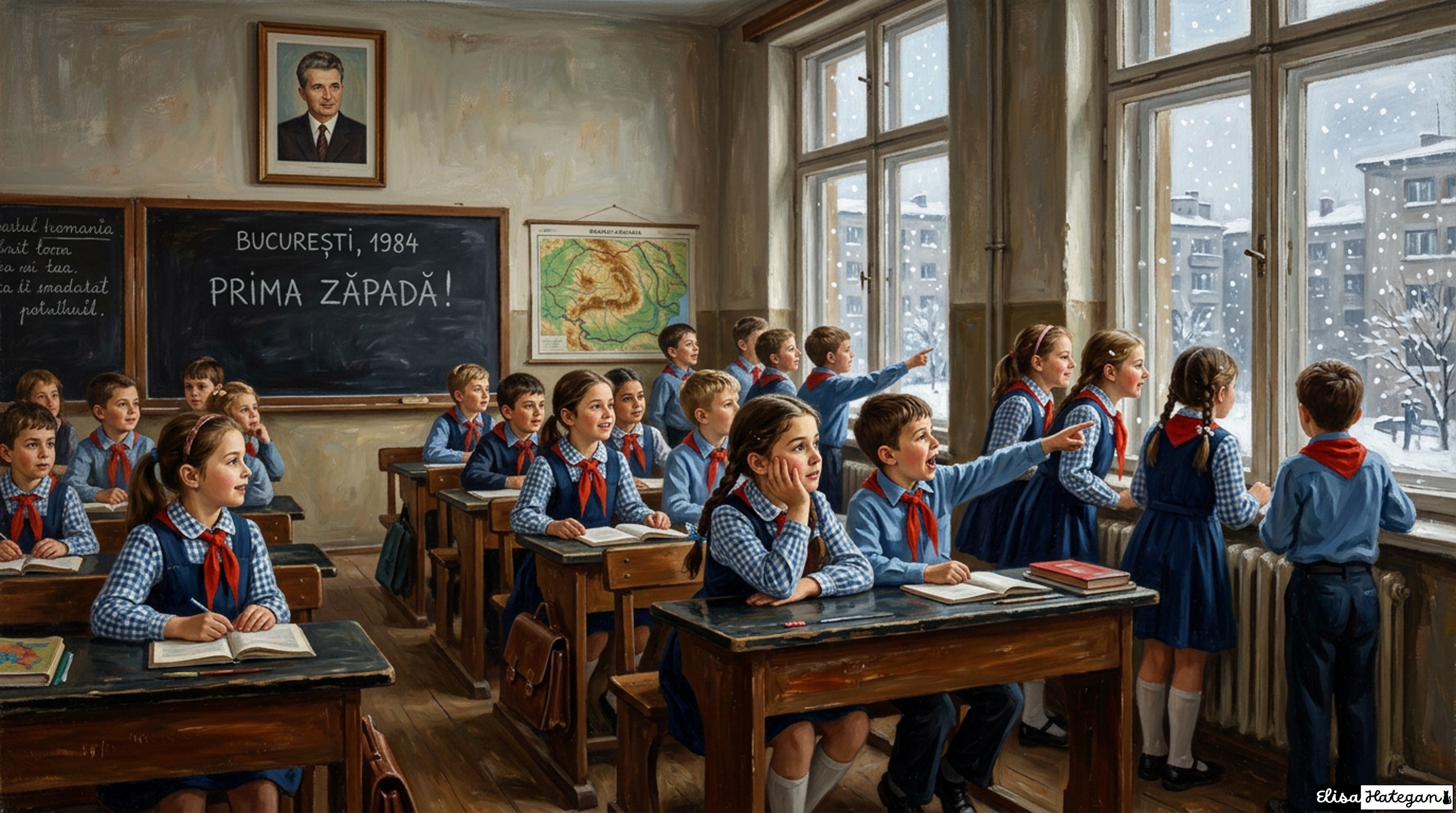
Every head turned to the second-floor windows where fat, lush snowflakes were making their slow, drifting descent toward the ground. They glided like feathers, the way ash falls in the aftermath of something enormous and incomprehensible to a child, like a revolution or a wartime bombing or the Chernobyl nuclear plant meltdown across the border in Ukraine - all of which would come sooner than any of us could have imagined.
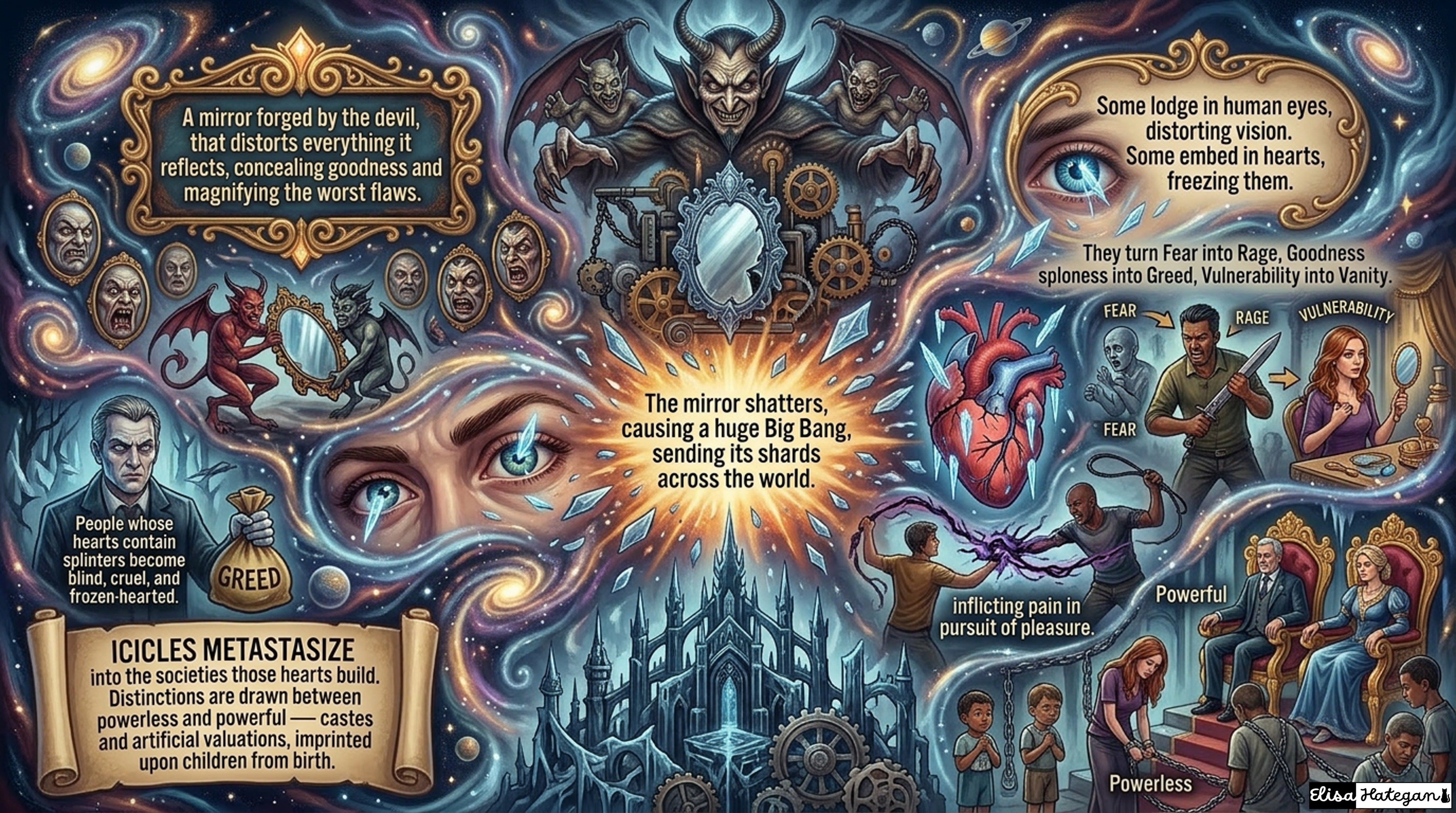
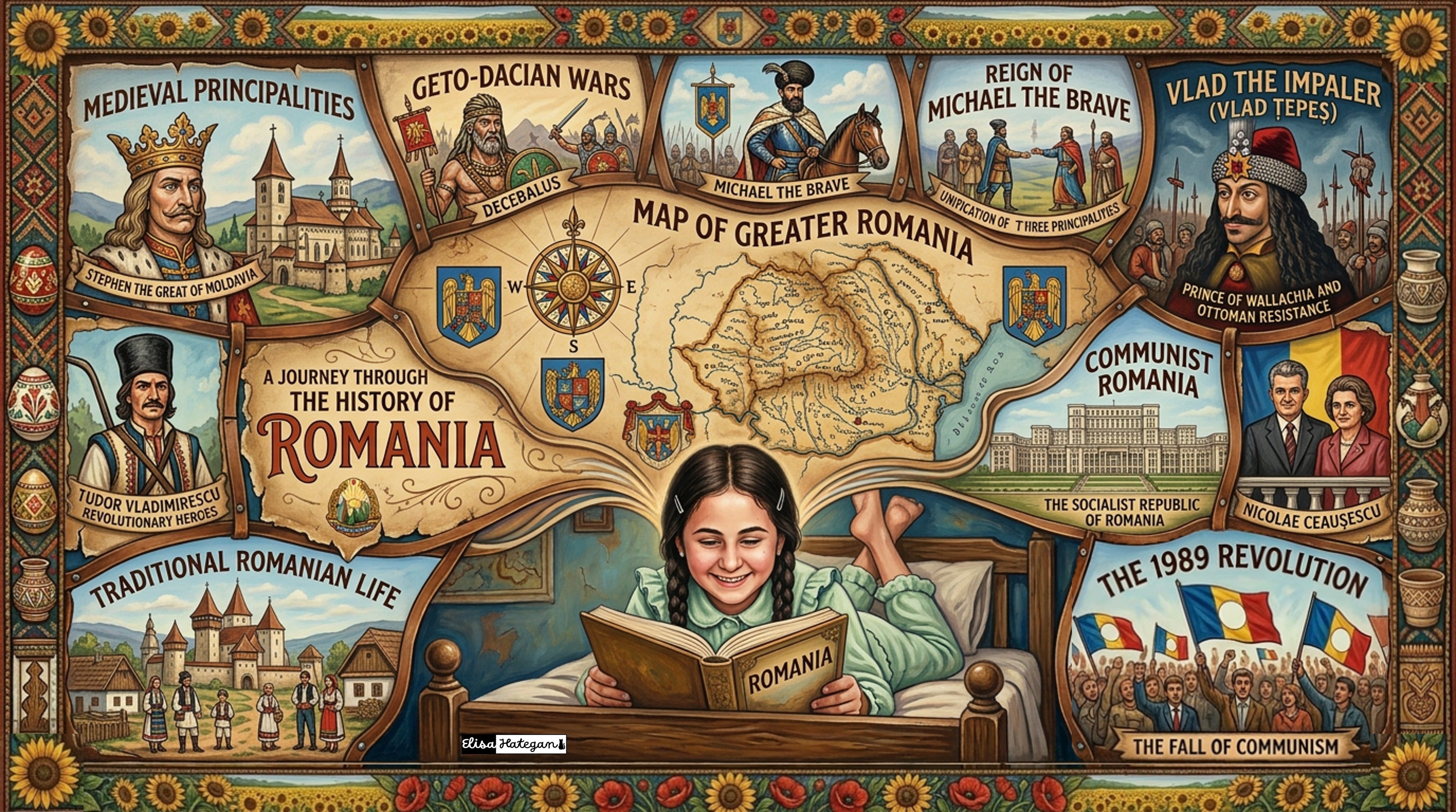
In those days of early snow, I would spend my afterschool hours curled up with my worn copy of Hans Christian Andersen’s fairytales in the armchair next to the window and crack it open to The Snow Queen. The story, as we all know, begins with a magic mirror that shatters, and its shards become embedded in all of our hearts.
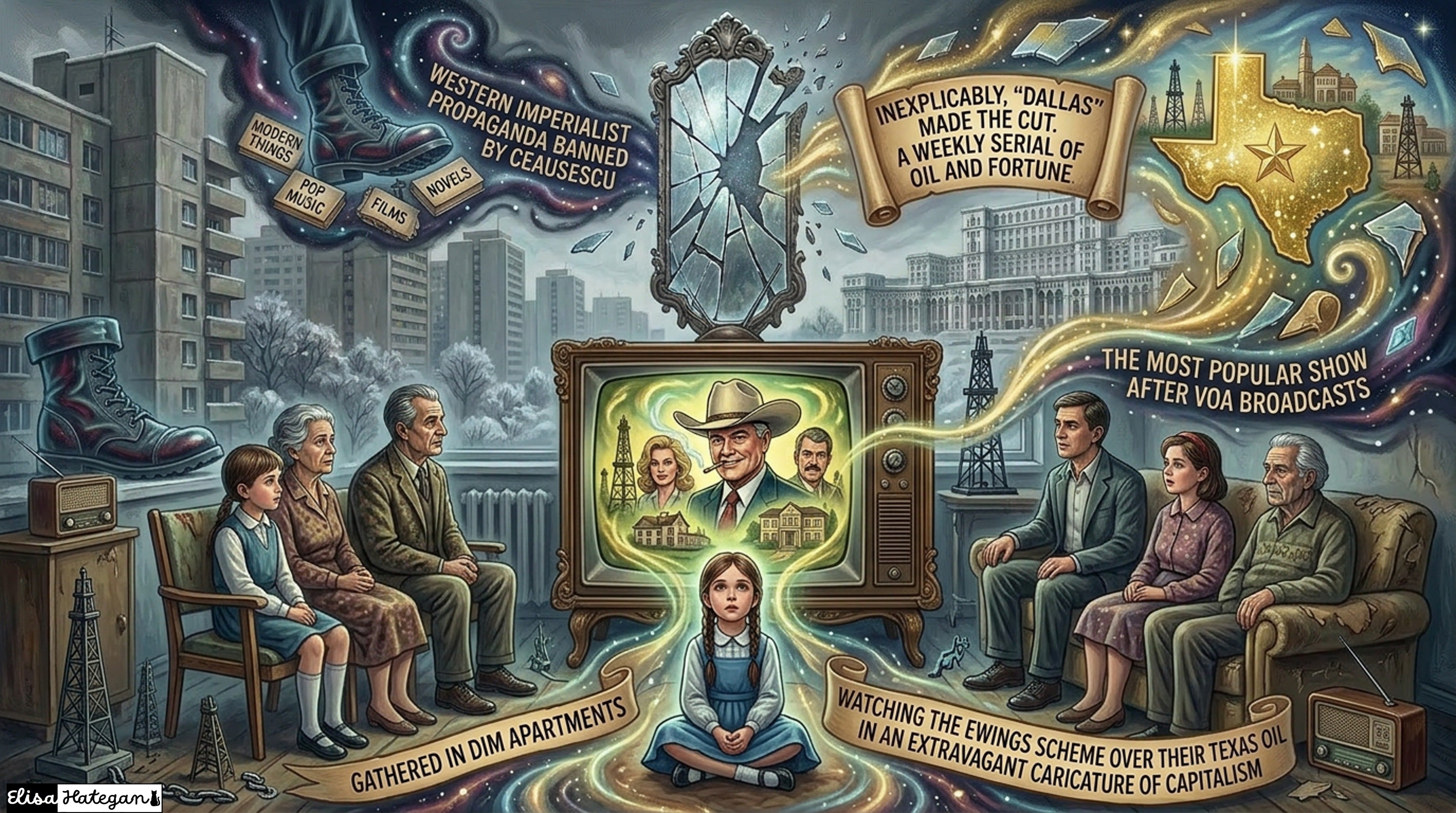
After Nicolae Ceaușescu came to power in Romania, the communists banned most “western imperialist propaganda” — modern things, pop music, films and novels deemed to promote capitalist ideals. (Inexplicably, the American television series Dallas made the cut, which rendered it the most popular weekly serial show in communist Romania after Voice of America’s broadcasts. Imagine families gathered in dim apartments to watch the Ewings scheme over their Texas oil fortune in an extravagant caricature of capitalism).
But they didn’t purge most of the classics that nurtured my imagination. Nineteenth-century literary giants like Dickens and Dumas captivated me with stories of 1789 revolutions, guillotined kings, street urchins, and underdogs who triumphed in the eleventh hour. While desperate Romanians who came into the crosshairs of the Securitate were fleeing across borders and swimming the Danube on starless nights to declare political asylum in the West, books were my only escape.
The indoctrination did not wait for us to learn to read. In Romania, as across the Eastern Bloc, the State took possession of a child the way a godparent might, practically from inception. At age four, we were enrolled in kindergarten as Falcons of the Fatherland — Șoimii Patriei — little kids dressed in small orange-and-blue uniforms, taught to chant the name of the man who ruled us before we could spell it.

By the second grade we graduated into the Pioneers. The ceremony was held at the Pioneers Palace in downtown Bucharest, a grand classical hall with gigantic ceilings, ivory columns, and red carpets that took my breath away. Thousands of children from across the capital had gathered there – not just every second-grader in the city, but older Pioneers who watched from the Assembly.
Every school in the city brought their own second grade cohorts, a sprawling sea of ducklings in white shirts, white berets, and pleated blue skirts and pants – an entire ocean of us since I was born during Romania’s baby boom, which was facilitated by the banning of birth control and abortion.
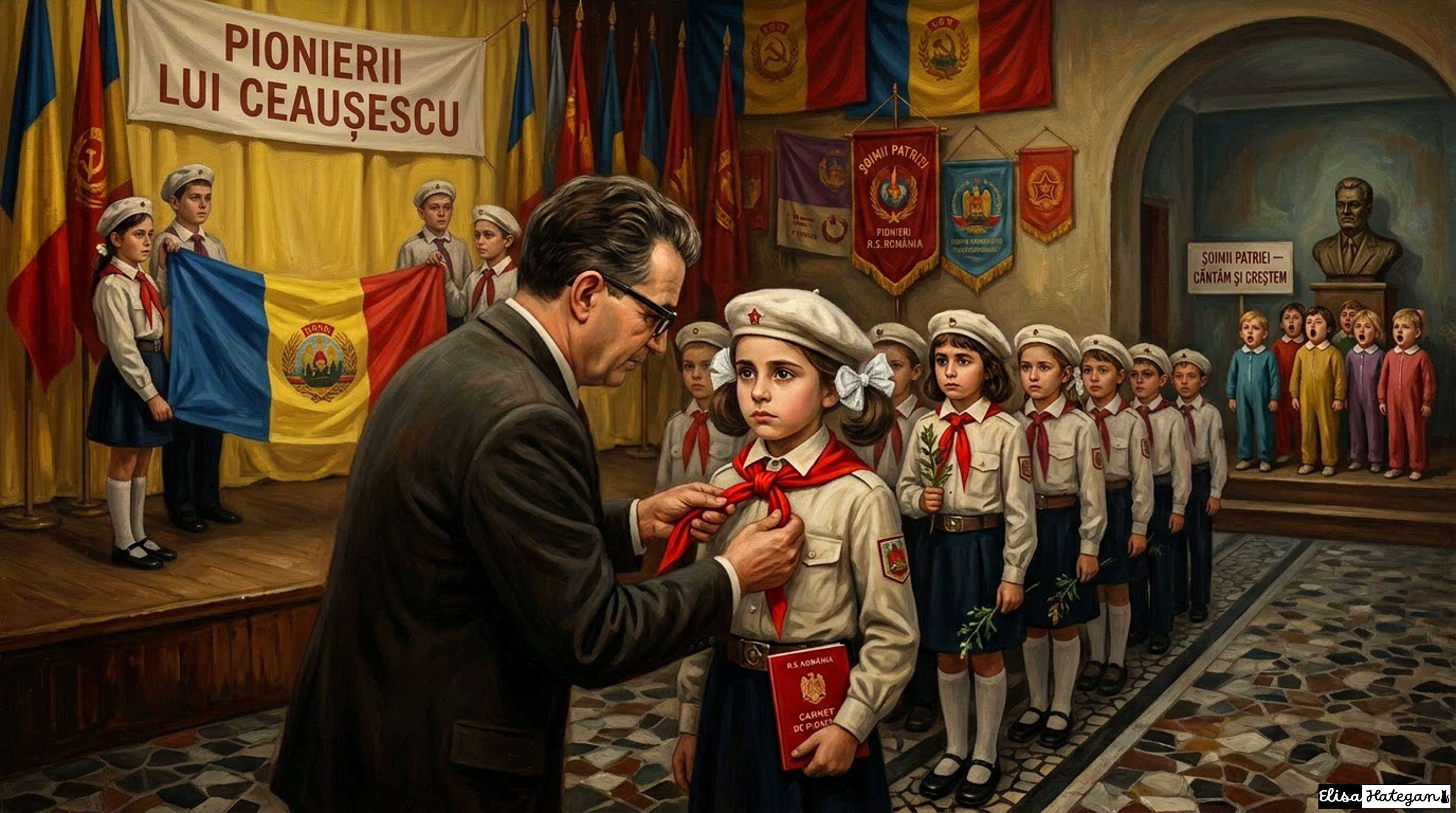
I stood in a row among the other children from School Number 19, and turned this way and that as we were instructed. The school principal came down the line, tied red scarves around our necks and shook our hands, and suddenly we belonged – we were Pioneers. We posed for photos with the tricolor flag, sang patriotic songs, and when my turn came I recited a poetic anthem to the Homeland and the Communist Party.
I recited majestic words whose meaning I didn’t truly understand, while Tovarasa Hlatcu Elena, my teacher, hung breathlessly onto my every word because her reputation depended on it. “Are you sure you remember everything? Tell me if you don’t,” she’d murmured behind my ear minutes before my turn to speak, offering to whisper the words if I was too nervous. I shook my head no. Every word was burned into my brain, and I spoke them all flawlessly and with immeasurable pride.
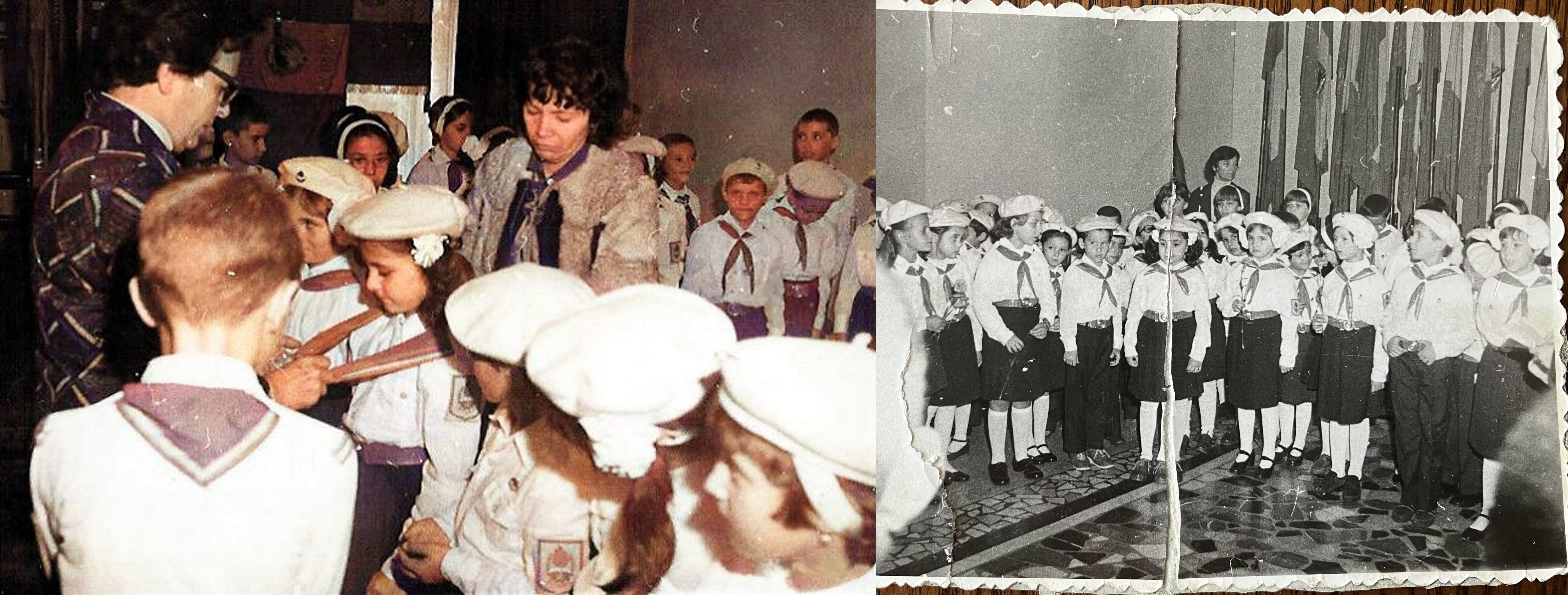
In exchange for my devotion, I received my red scarf, knotted at the throat like a small bright wound, and a Carnet de Pionier — a little notebook that certified me, at just seven years old, as a servant of the Revolution.
Every communist country had its version. The Soviet Union had its Young Pioneers; China too, had (and still has) its Young Pioneers, tens of millions of children in red neckerchiefs; East Germany had its Thälmann Pioneers. The scarf was always red, because the red was meant to represent the flag, which in turn was meant to be represent the blood that had been shed to give us our paradise. An echo of the blood we would in turn shed to protect our birthright.
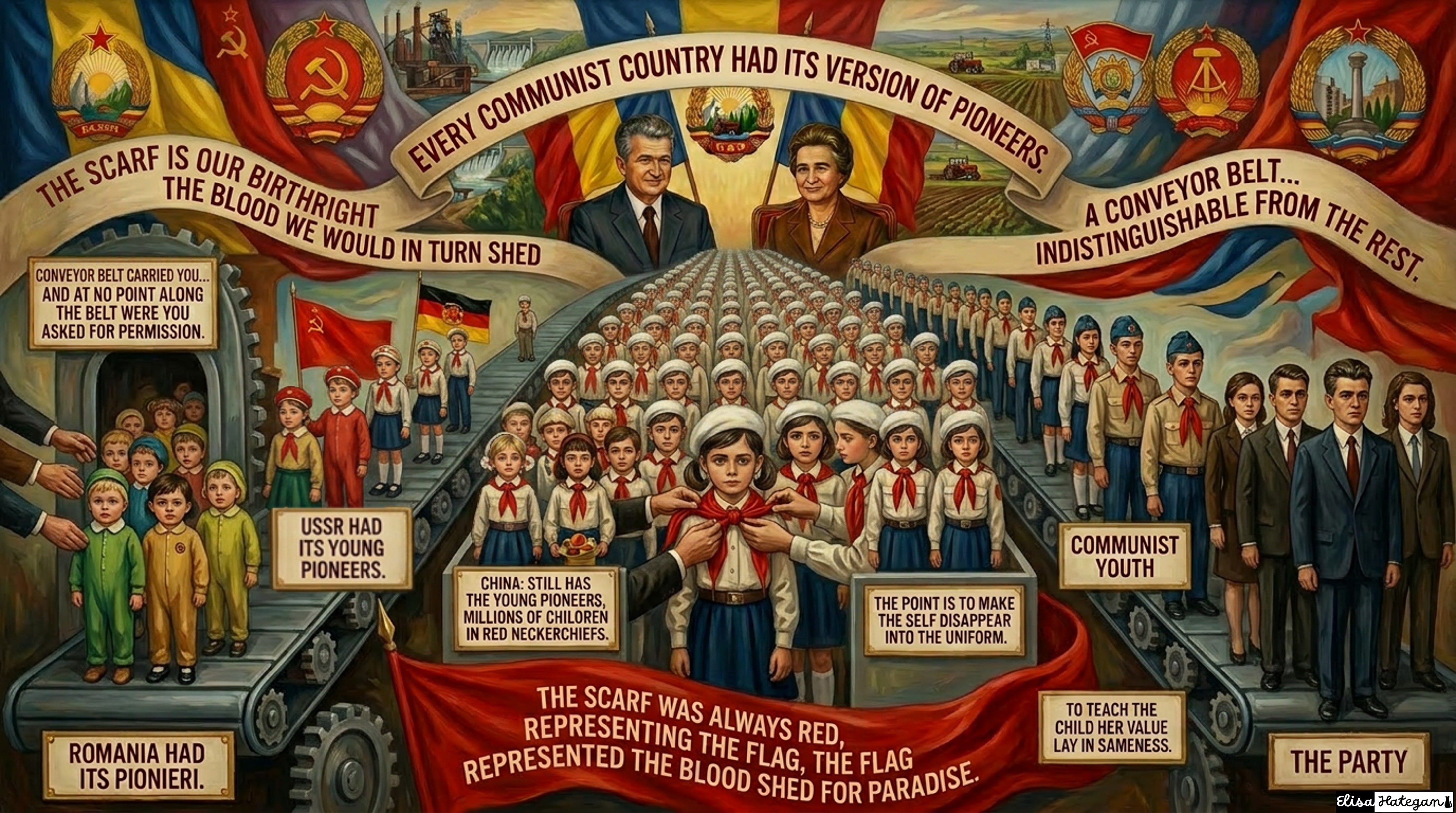
The organization wasn’t a club – it was a conveyor belt. It carried you from the Falcons to the Pioneers to the Communist Youth and finally into the Party itself, and at no point along the belt were you asked whether you wished to be carried. The point of dressing millions of children in identical scarves was to make the self disappear into the uniform, to teach the child that her value lay in her sameness, that to be indistinguishable from the rest was the highest grace the State could bestow.
In music class, we didn’t really learn music. We learned anthems. We learned Pioneer marching songs, hymns to the Party, to the harvest, to the Golden Son of the Fatherland. There were no love songs, no laments, nothing that belonged to a single human heart rather than to the collective. This was intentional, of course. A song enters a consciousness viscerally, the way an argument cannot. It bypasses the reasoning mind and embeds directly in the body, like a splinter. It teaches the lungs to breathe in unison and the feet to fall in lockstep. A child who has sung the same hymn ten thousand times doesn’t have to believe it; she simply cannot imagine the silence where the hymn used to be.
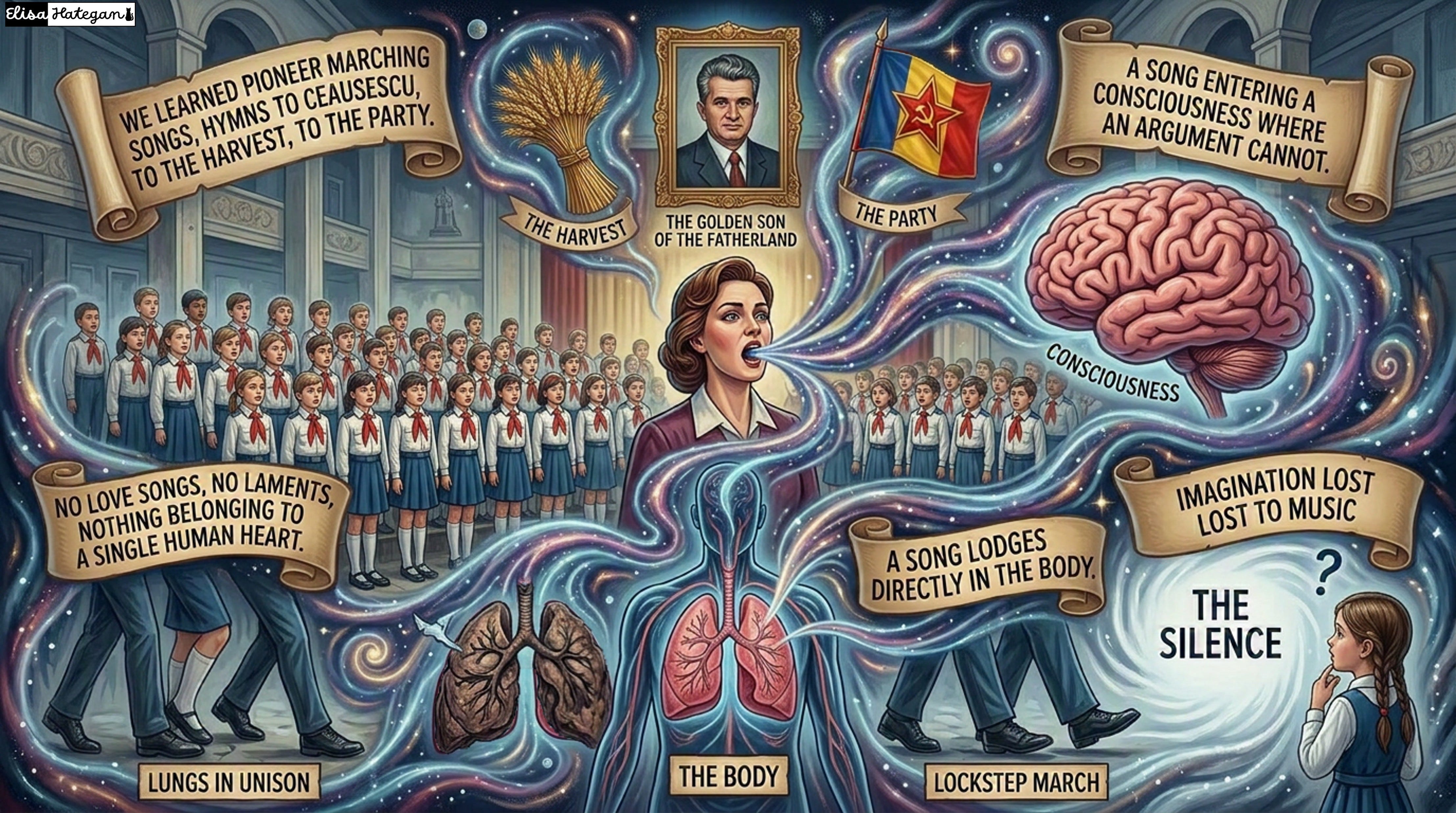
That was the achievement – saturation, not conviction. They were not trying to win the argument – they were making certain we never knew that an argument was going on in the first place.
This is the hardest thing to explain to anyone who did not live inside such a system: the indoctrination did not feel like indoctrination. It was the only oxygen we had. It was light as air and heavy as a toxin. Ceaușescu’s portrait hung above the blackboard the way an icon hangs in a church, and we no more questioned it than we questioned the existence of the ceiling. He was the Golden Son of the Fatherland, the Father of All Children — which made us, in the lexicon of the regime, his children, and our own parents merely his stewards.
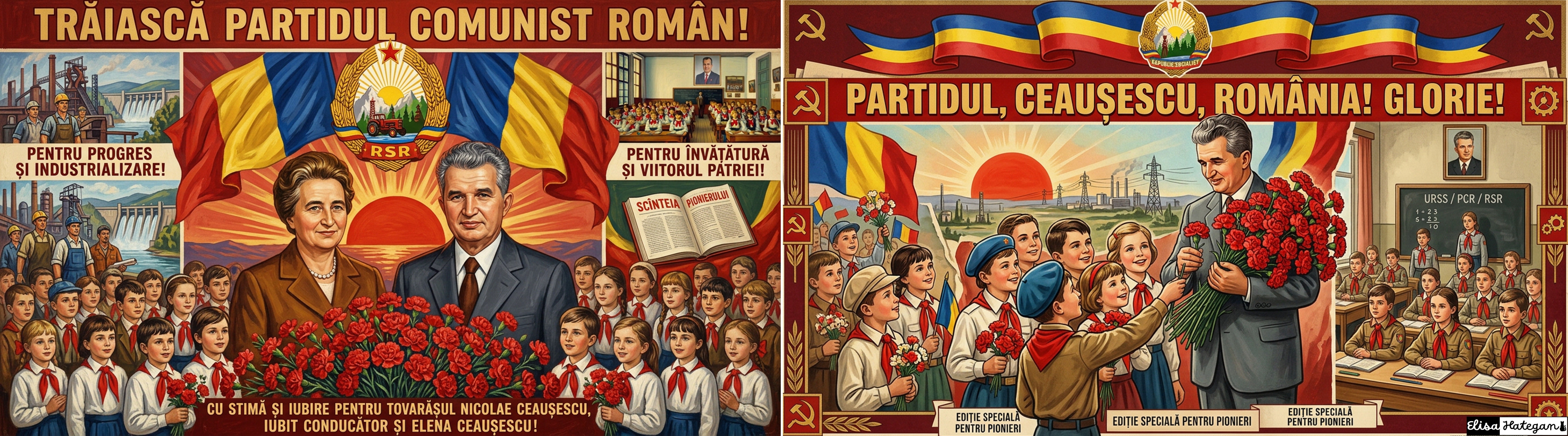
A State that intrudes into a child’s life at age four, that owns her songs and her scarf and her certificate of belonging, that hangs one face above every desk in the country, doesn’t ask for permission. It doesn’t care to be believed, not when it’s the only religion available. Not when it rearranges your world so that disbelief has nowhere left to stand.
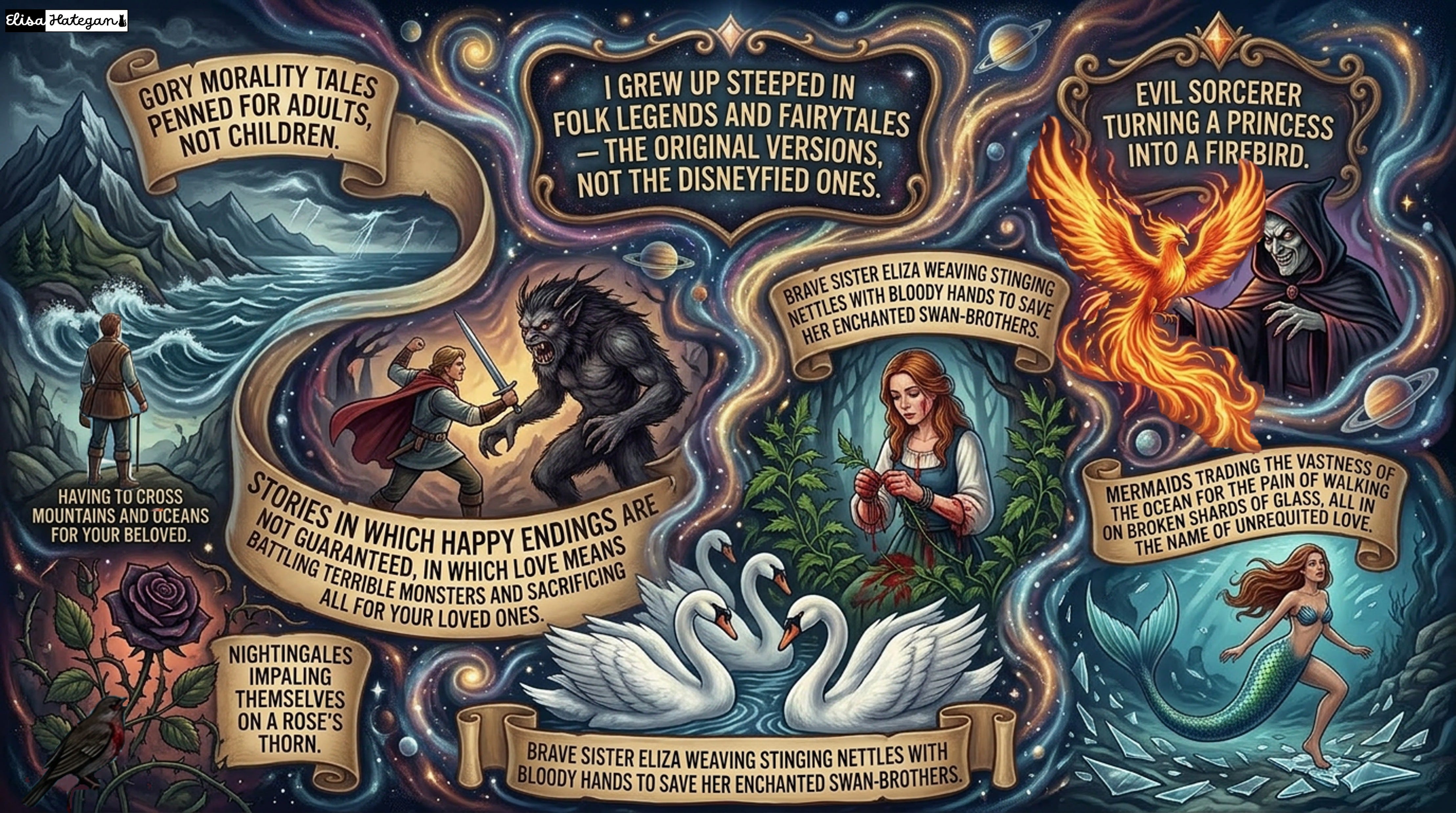
And yet I had my fairytales. I grew up steeped in folk legends and fairytales — the original versions, not the Disneyfied ones. Gory morality tales penned for adults, not children. Stories in which happy endings are not guaranteed, in which love means battling terrible monsters and sacrificing all for your loved ones, often with no recompense. Nightingales impaling themselves on rose-thorns. Brave sisters weaving stinging nettles with bloody hands to save enchanted swan-brothers. Mermaids trading the vastness of the ocean for the pain of walking on broken shards of glass, all in the name of unrequited love.
Of all the fairytale writers of my childhood, Hans Christian Andersen was the most instrumental in seeding the archetypes that became the building blocks of my creativity and infused my outlook on the world. None of his stories offers a louder, more brutally honest condemnation of our broken world than The Emperor’s New Clothes — that scalding portrait of hypocrisy, sycophancy, and brownnosing as the foundational architecture of all politics. A whole court agreeing to admire a naked lie because each is more frightened of being thought a fool than of being a liar. And none of his stories is more haunting a parable than The Snow Queen.
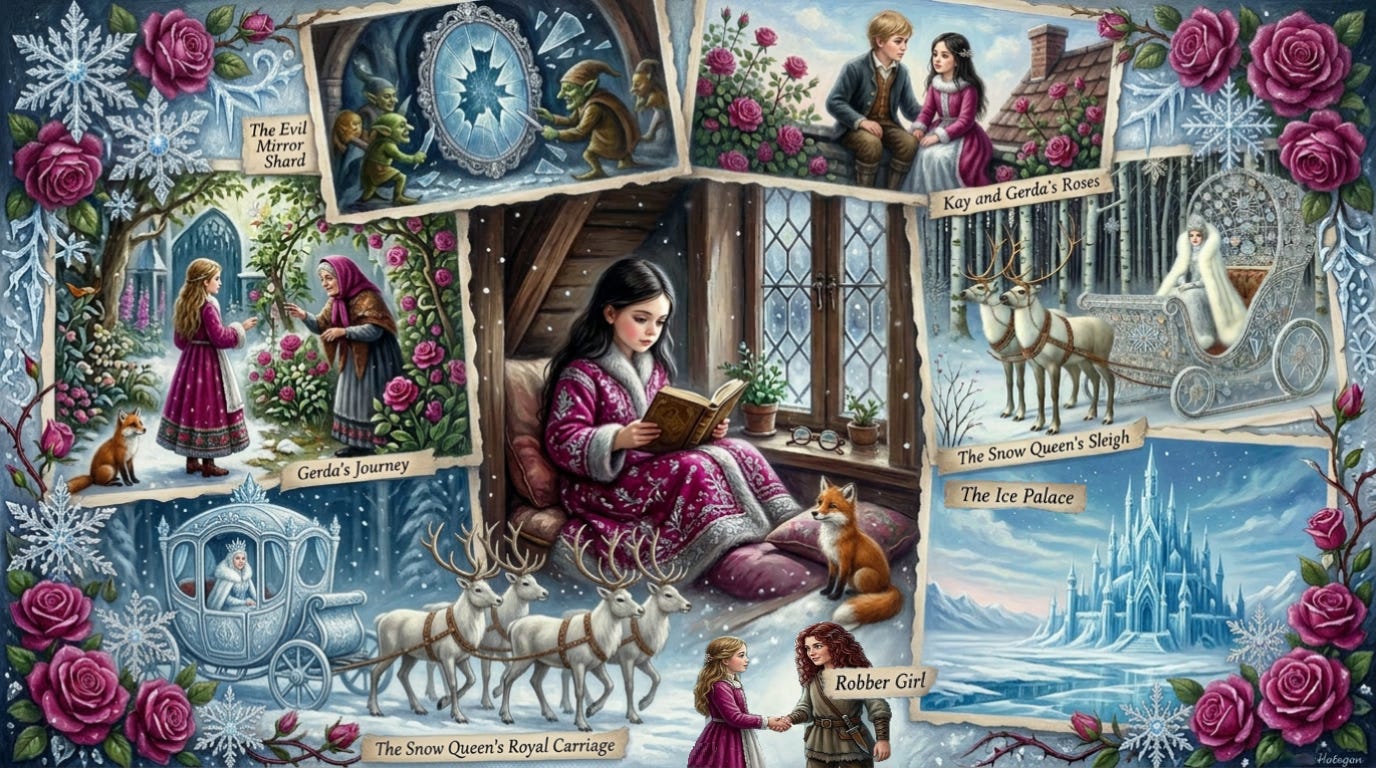
The Snow Queen begins with a mirror forged by the devil, a mirror that distorts everything it reflects. It conceals goodness and magnifies people’s worst flaws and ugliest sides. It is a mirror that sees, but only by lying. One day, the demons who carry it grow careless and let it fall. The mirror plummets out of the heavens and shatters against the earth, causing a huge Big Bang of sorts. Its shards then fly across the world. Some lodge in human eyes, distorting vision. Some embed in human hearts, freezing them to the point of numbness and indifference.
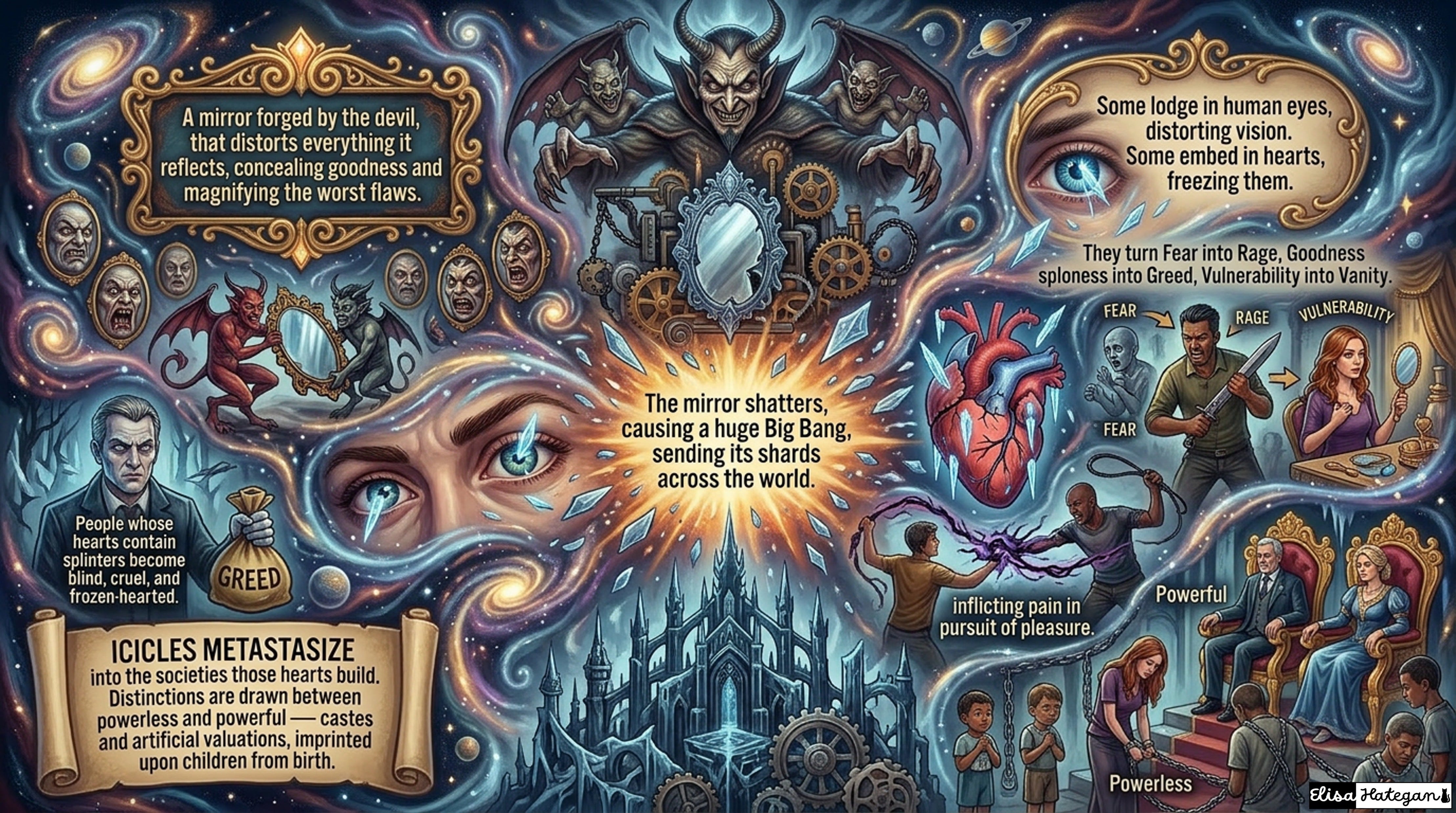
In Andersen’s parable, those whose hearts harbour the splinters become blind, cruel, and frozen-hearted. They build societies that refuse to feel their own pain. They sublimate fear into rage, goodness into greed, vulnerability into vanity. They inflict pain in the pursuit of pleasure. They mistake cynicism for sophistication, and cruelty for clarity.
Read between his lines and you can see how the contagion functions. The icicles embedded in private hearts metastasize into the societies those hearts build. Soon, distinctions are drawn between the powerless and the powerful — tiers and castes and artificial valuations of human beings, enforced by laws, manmade religions, cultural norms, and the subjective values imprinted upon children from the moment of their birth inception.
The individual becomes a microcosm of the society into which she was born. The society becomes the macrocosm of the splinter lodged inside every eye.
Healing a broken world is like trying to repair a broken mirror: first, you have to imagine the possibility that what was broken can be made whole again.
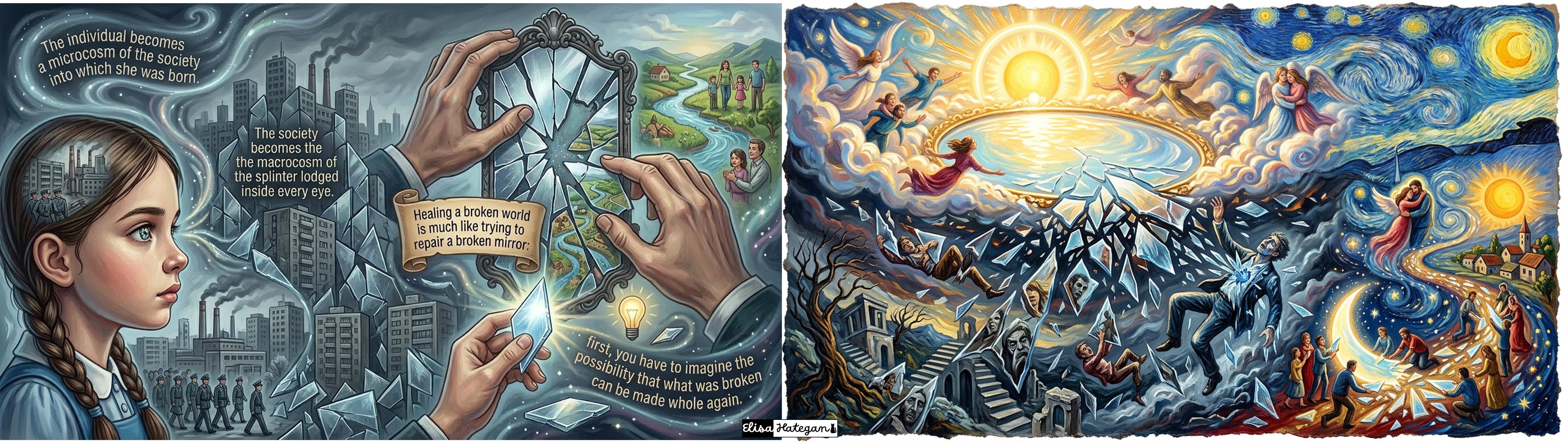
We do not merely live in our societies. We become them. Every child is a blank glass held up to the world. The world leans in close and breathes its image onto the surface, and Poof! the image sets, and hardens, and the child grows up believing the image is her own face.
We become mirrors of our history, our culture, our zeitgeist, our religion, the particular century and street and kitchen we were issued at birth. A Spartan mother and an Amish mother do not raise different opinions into the same child; they raise different children with different nervous systems and different definitions of what a human being and their purpose is for.
The mirror does not reflect the world from a safe distance. It is made of the world. It is the world, folded into the shape of a person.
Some of these mirrors are full of light. They reflect what falls on them and give it back multiplied. A face that has been loved becomes a face that loves. A child who was met with patience and empathy becomes an adult who can hold the pain of others without flinching.
And some mirrors are full of darkness. There are mirrors in this world that have curved so far inward that light no longer escapes them. They’re the human equivalent of those places in the cosmos where matter has collapsed past the point of return, where the gravity of old wounds bends every incoming ray to its knees, crushes it into the dark, and gives nothing back.
Physicists tell us the universe is forever sliding toward entropy: toward the cold and the scattered, toward the state in which nothing is connected to anything else. Toward the emptiness of being.
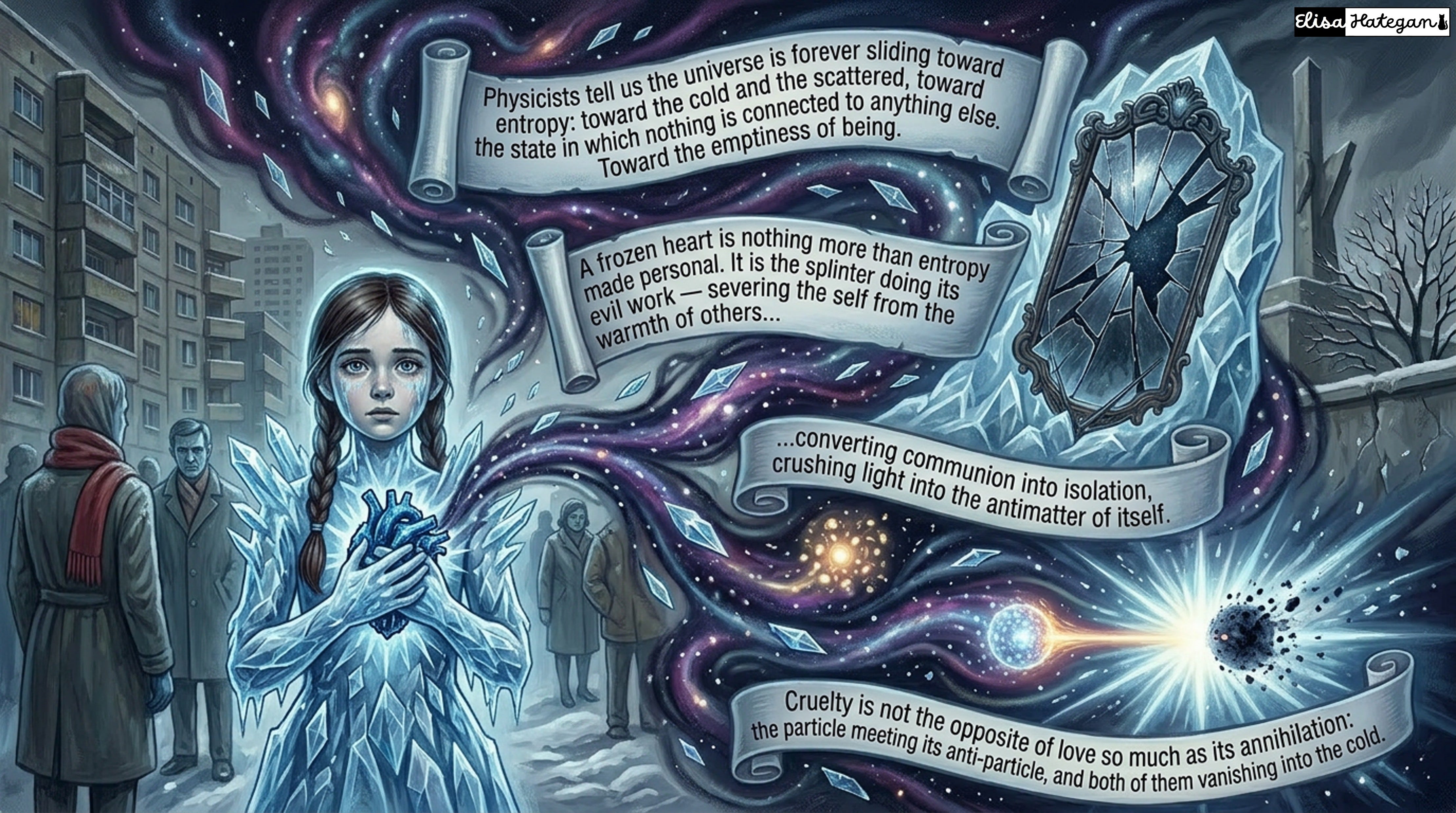
A frozen heart is nothing more than entropy made personal. It is the splinter doing its evil work — severing the self from the warmth of others, converting communion into isolation and indifference, crushing light into the antimatter of itself.
Cruelty is not the opposite of love so much as its annihilation: the particle meets its anti-particle, and both of them vanish into the cold.
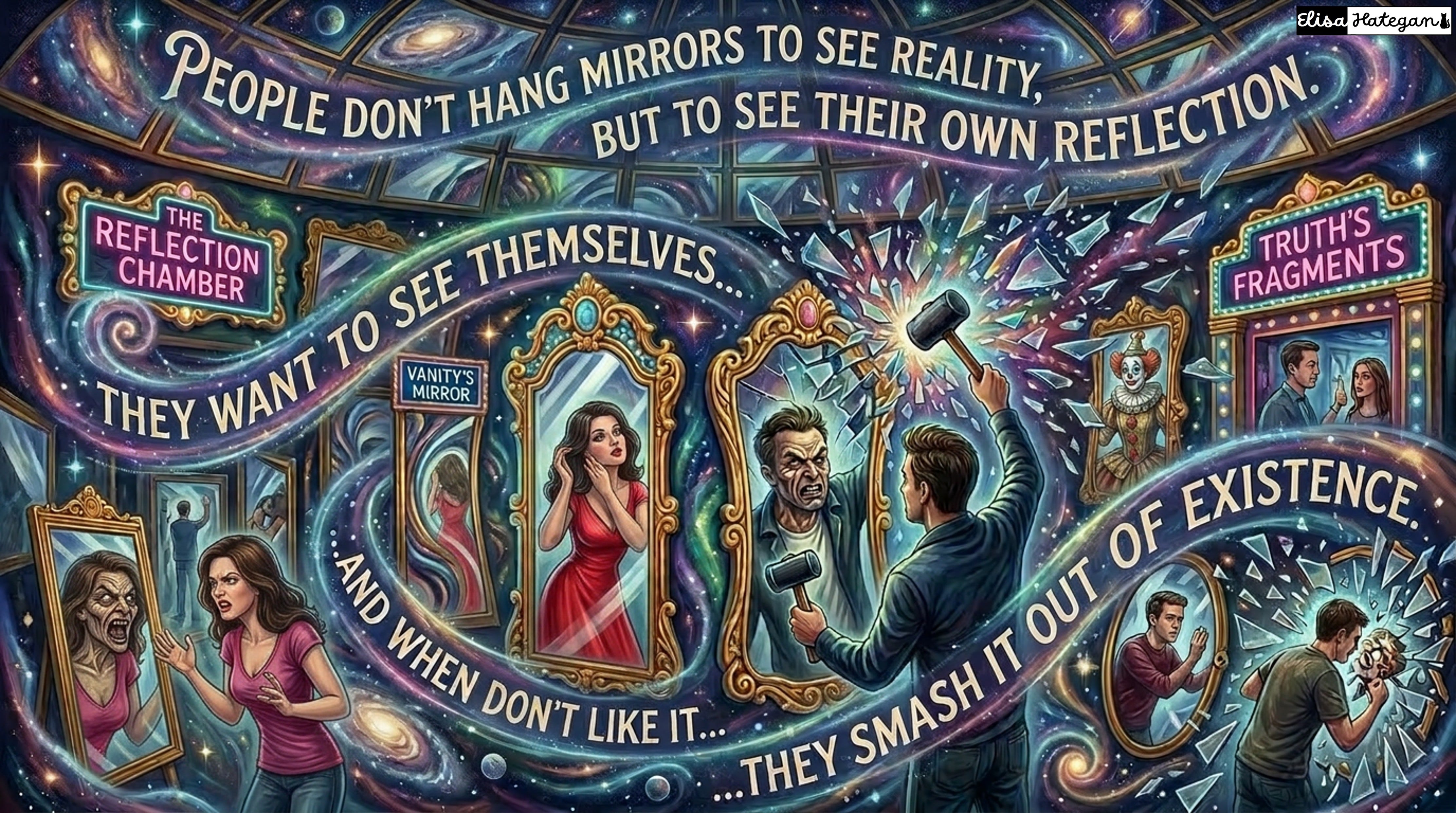
People don’t hang mirrors on walls because they want to see reality. They hang mirrors because they want to see their own image reflected back to them. And when they don’t like what they see, they smash it out of existence.
When I was eleven years old my parents forced me against my will to emigrate to a faraway land that was in many ways colder and far crueler than my homeland. Like Kai, I was stolen away to an icy northern realm that tore the life and soul out of my body, but no Gerda came to rescue me. My life, as fallible as it may have been, ended the day I was forced to board that airplane. In countless moments for decades to come, I wished, with every breath in my body, that my parents had killed me instead, because what they did to me was far more brutal.
Up until then, my childhood had unfolded inside a communist country whose project was to imprint its image into every child, and shape us into its reflection. But this process wasn’t unique to Romania. Every society does this. Every society is a vast, slow-motion mirror that reproduces itself in every infant born within its sphere of influence. Our lives are a continuous tearing-away from what we are, into what our families, our institutions, our workplaces, our religious leaders, and our governments believe we ought to be.
When you are born, you simply are. You are a being looking into a mirror, forming no judgement about what stares back. The infant in front of the glass holds no opinions about her own reflection. Those opinions are imprinted later, by the gaze and the language of those who hold her. You learn that you are pretty or ugly, gifted or slow, pure or shameful, deserving or worthless.
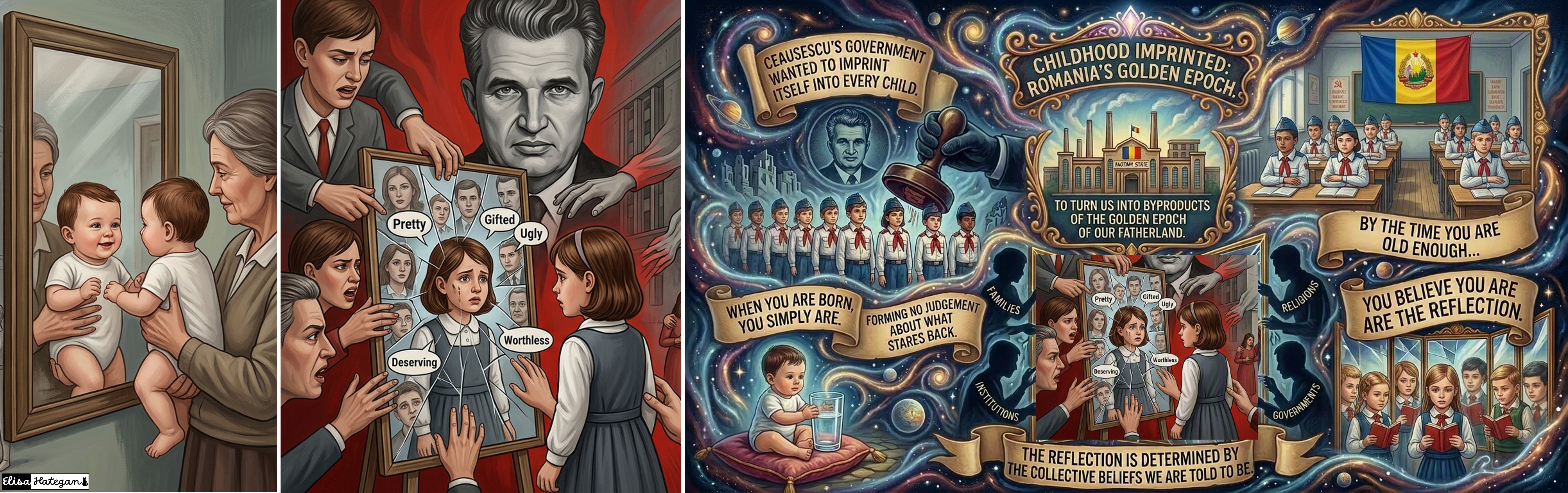
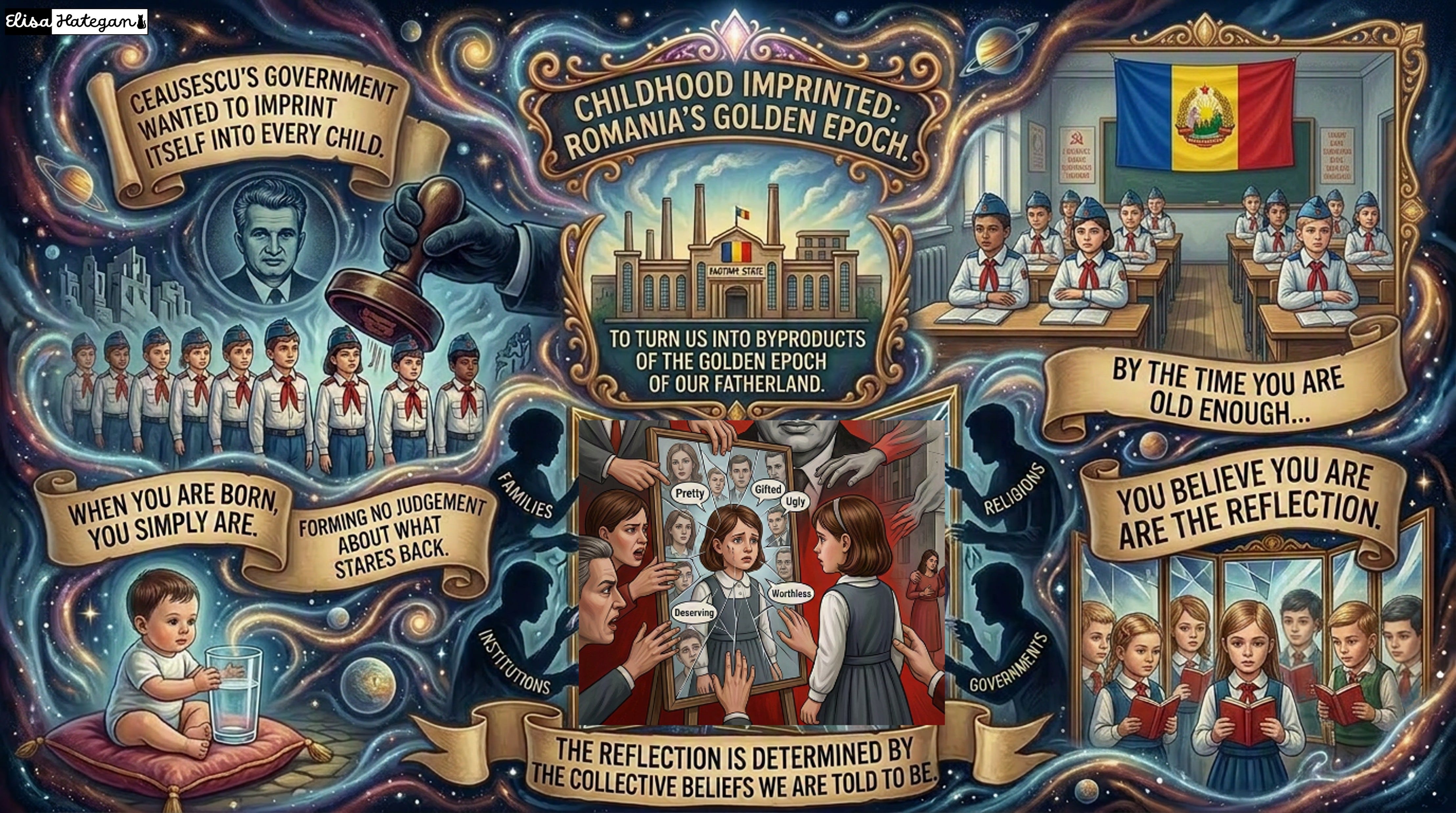
By the time you are old enough to know what a mirror is, you have come to believe that you are the reflection in it. But the reflection is NOT you. The reflection has never been you.
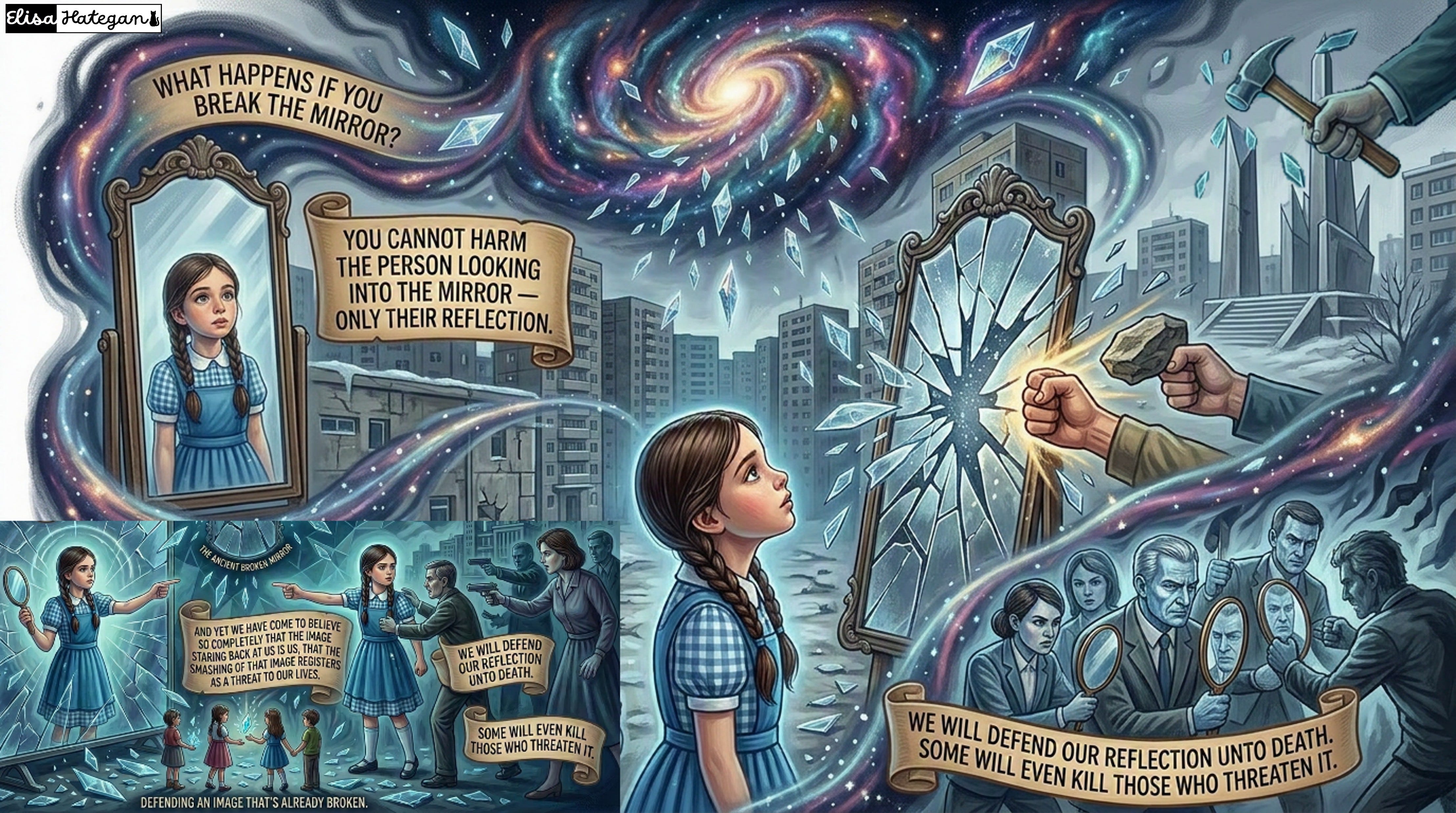
What happens if you break the mirror? You cannot harm the person looking into the mirror — only their reflection. And yet we have come to believe so completely that the image staring back at us is us, that the smashing of that image registers as a threat to our lives. We will defend our reflection unto death. Some will even kill those who threaten it.
What if I told you that from the moment of your birth, the reality around you has been entirely manipulated? That everything you see, every perception that seasons your particular flavour of the world, every reaction to your emotional surroundings and to every person who has ever crossed your path — has been completely and utterly manipulated, shaped, and curated by forces that want you to see your life through their eyes instead of through your own. Everything that makes you You has been moulded by these forces — by the men who built the world you were born into.
Everything you consider valuable, amazing, awful, or worthless was seeded into you. Your infant self was a black earth, fertile to every idea and possibility at once, and your environment seeded and rooted a particular path within you from conception.
You could have grown into anything. But from birth, the first chip and crack of the mirror blinded you. Your potential pathways began to be clipped and cauterized, one by one. Over time, your perceptions narrowed and tunnelled into mere reflections of shadows playing on a cave wall, instead of the incandescence that was your birthright.
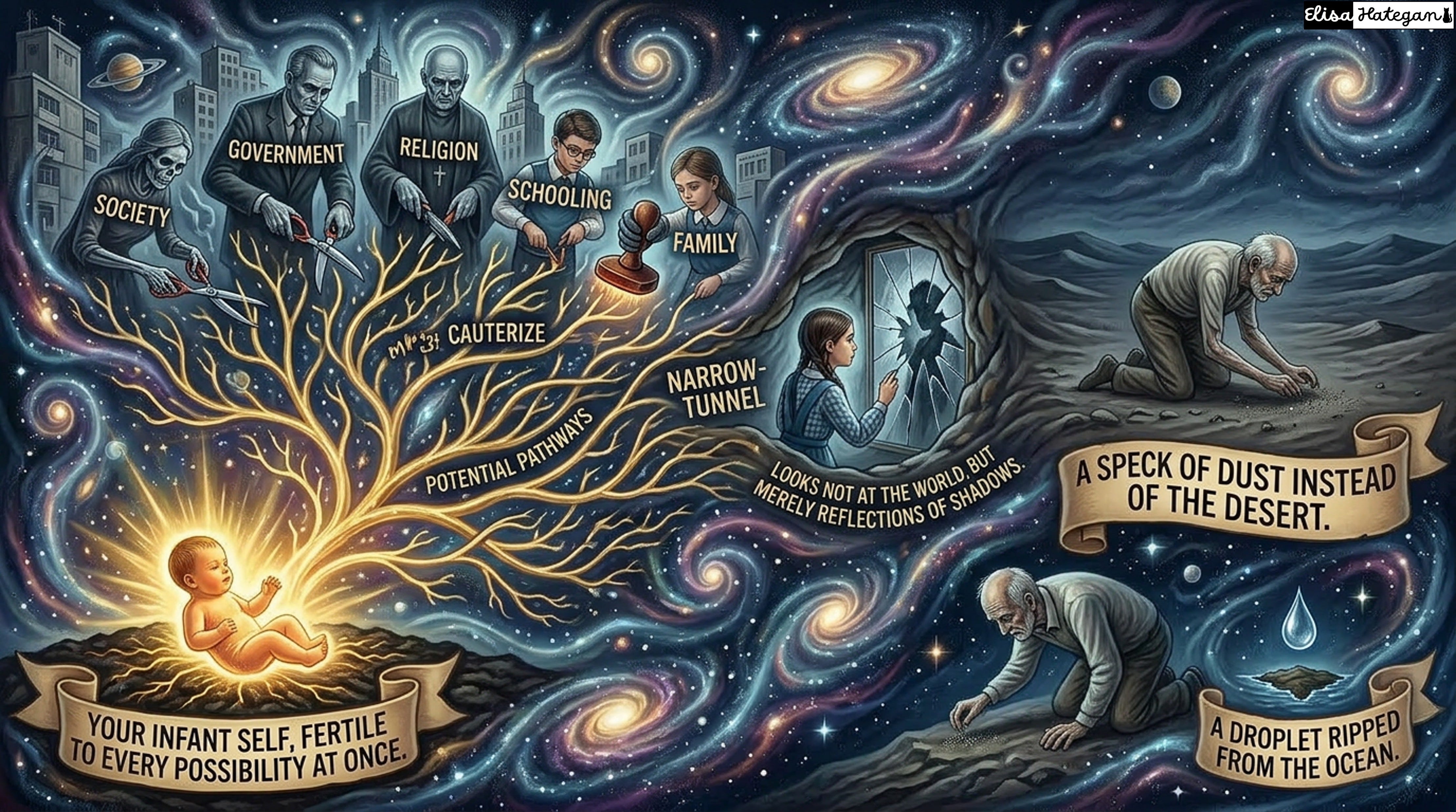
By the end of your life, the infinite vastness of the person you were born to become — the vessel of every possibility — has become a shard of what it once was. A speck of dust instead of the desert. A droplet ripped from the ocean that contained it.
Not every mirror lies in the same way. Some lie by freezing; others lie by warping. Walk into any carnival Hall of Mirrors and you will meet a dozen versions of yourself, each one a grotesque distortion and, technically, also a reflection: the self stretched into a giant, the self compressed into a troll, the self bent until the head balloons and the legs dwindle to nothing.
The funhouse mirror does not invent you out of thin air. That is its unique cruelty – it takes something real and exaggerates it past all proportion, so that the lie wears the face of the truth.
This is precisely how society assigns worth to human beings.
More than a century ago, the sociologist Charles Horton Cooley named it the Looking-Glass Self — the recognition that we come to know ourselves not directly, but through our reflection in the reactions of others; that each of us are assembled out of the imagined judgements of the people around us. We do not see ourselves. We see ourselves being seen.
George Herbert Mead extended the thought, arguing that the child internalizes what he called the generalized Other, the composite gaze of the entire society, and learns to stand outside herself and grade herself by its standards. And Leon Festinger demonstrated, in the didactic language of the laboratory, what every schoolyard already knew — that human beings cannot evaluate themselves in isolation. We are compelled to measure our worth against the worth of others, endlessly, helplessly, on whatever scale the culture hands us.
Hand a society a funhouse mirror, then, and it will convince a generation that the distortion is their face. It will persuade the brilliant child that she is weird or broken because her mind works differently. It will persuade the gentle boy that he is weak. It will persuade the woman that she is worth what the market will pay for her appearance, and the man that he is worth exactly what he earns, and both of them that the people on the other side of the border are worth less than the family dog.
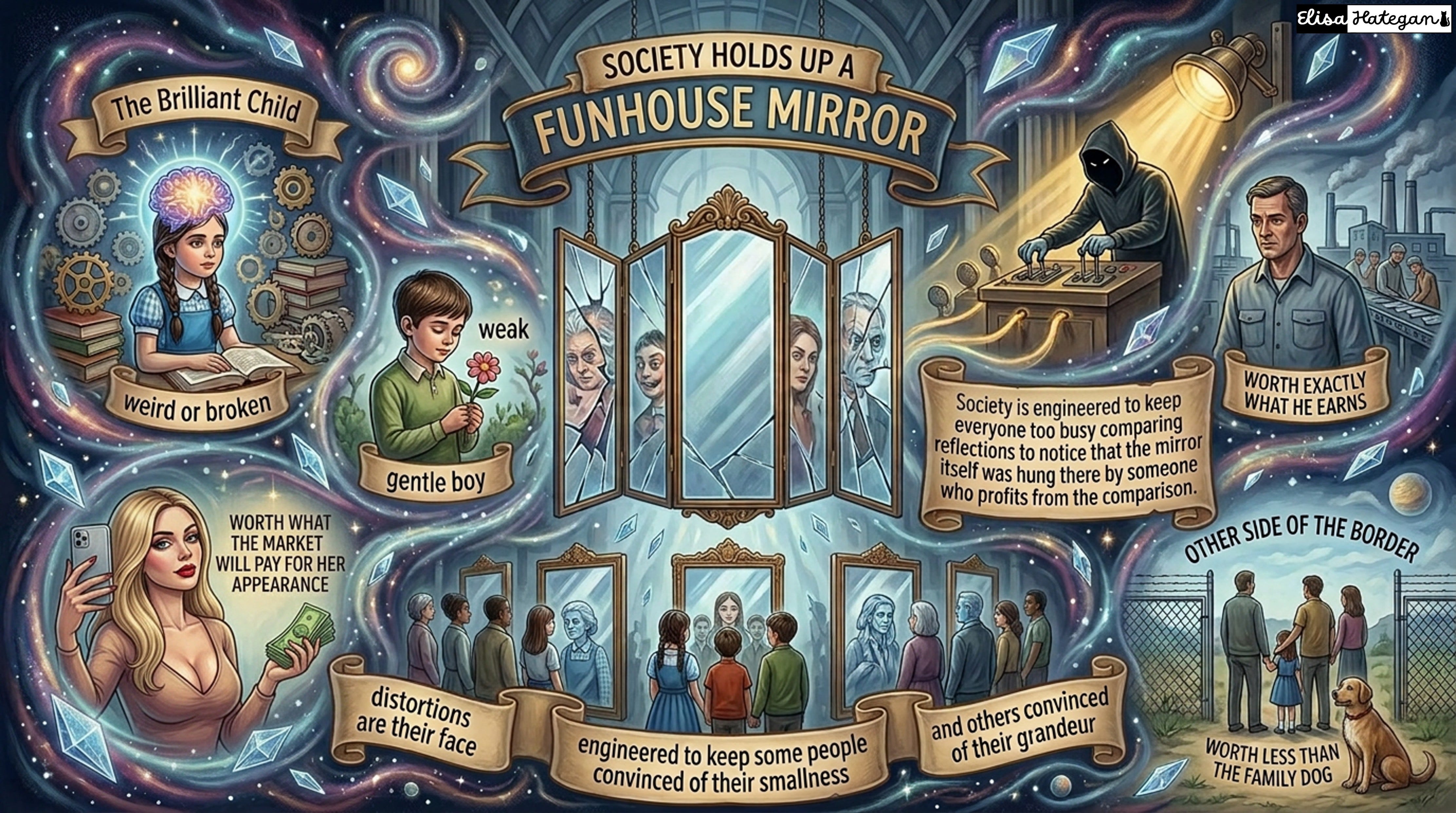
These distortions are not random. Each is engineered to keep some people convinced of their smallness and others convinced of their grandeur, and to keep everyone too busy comparing reflections to notice that the mirror itself was hung there by someone who profits from the comparison.
But some mirrors have to be broken. To shatter a funhouse mirror is not an act of vandalism – it is an act of vision. The giant and the troll vanish together with the glass, and what remains is the one thing the Hall of Mirrors was built to keep you from ever seeing: yourself, neither magnified nor diminished, standing within an ordinary body that was never the colossus and never the dwarf.
It was always just YOU.
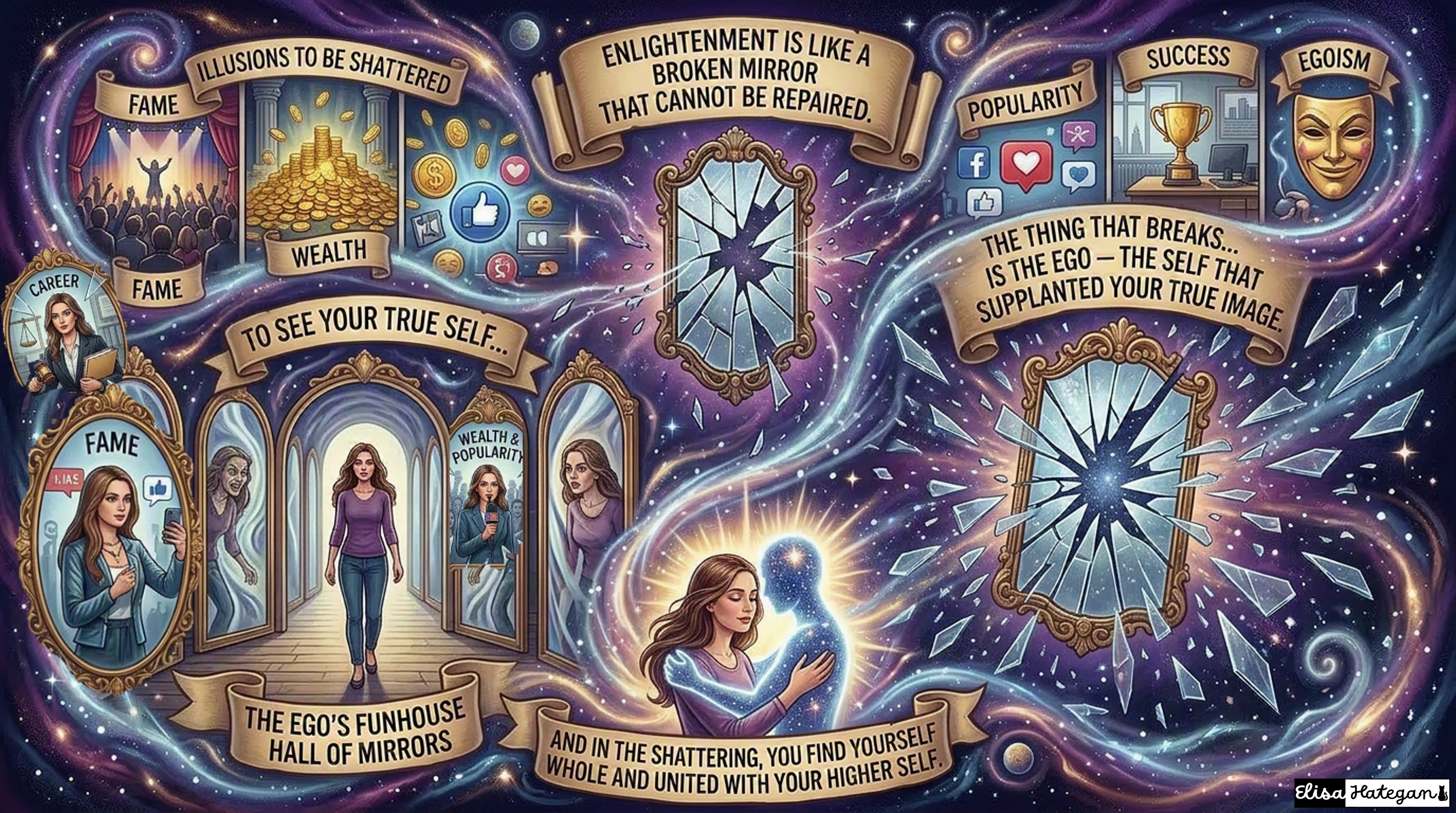
The work of our lives is learning which mirrors to walk away from, and what to devote our lives to reflecting. What breaks, when you finally turn from the glass, is not you. It is the ego — the self that was assembled to stand in your place, the reflection that learned to answer to your name.
To see your true self, the illusion must be shattered. And in the shattering, a curiouser thing happens: You do not break. You find yourself whole.
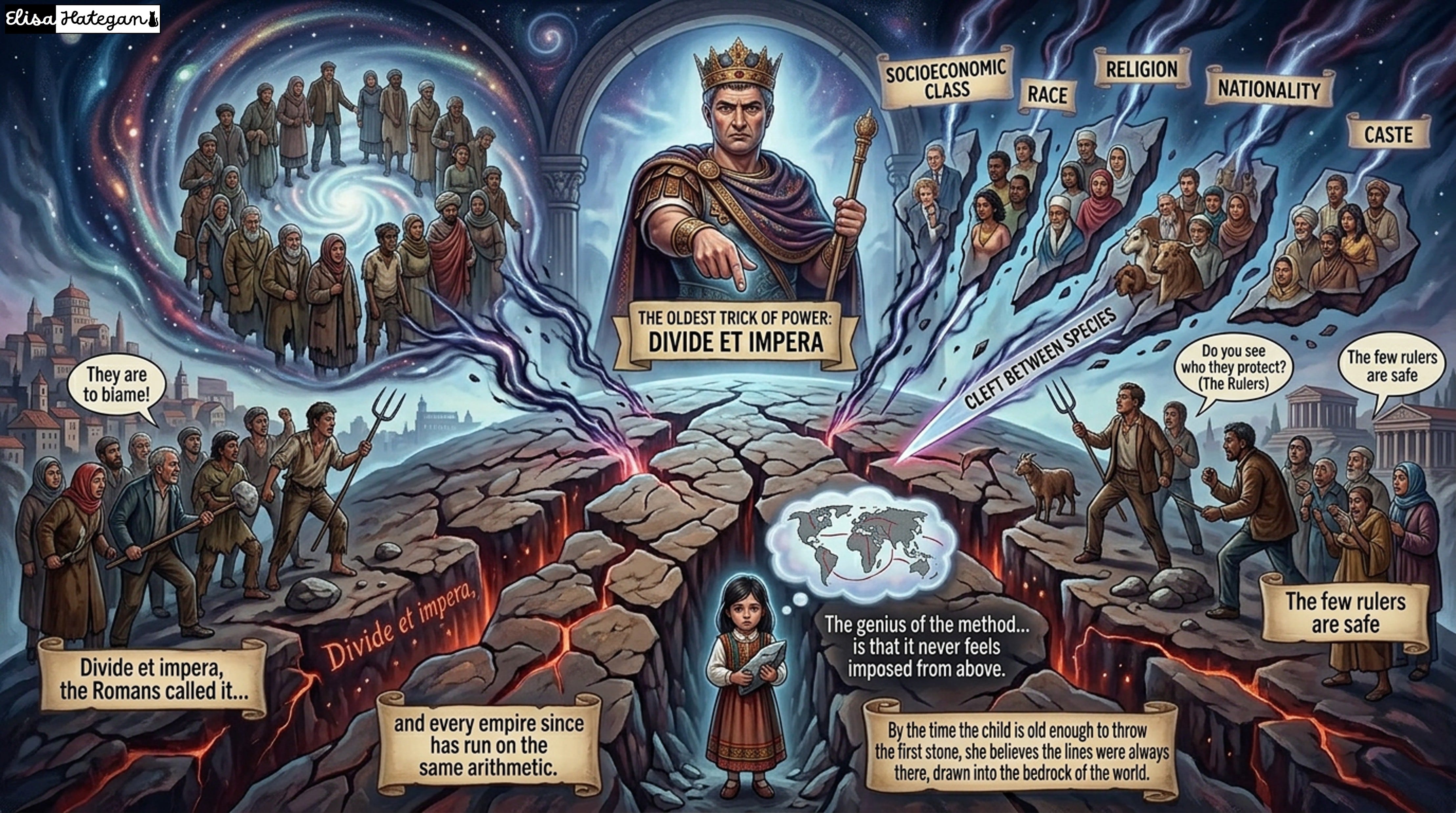
The oldest trick of power is to take the human family, as a single whole, and shatter it into shards that can be set against one another. Socioeconomic class, race, religion, sex, nationality, caste — even the boundary we draw between our own species and every other living thing (“Who cares about conditions in the abattoirs? They’re just animals”). These are not discoveries about the structure of reality. They are cuts.
A ruler who can persuade the poor of one colour to despise the poor of another colour need never fear that the poor will look up and count how few the rulers are. The Romans called it Divide et impera, and every empire since has run on the same arithmetic. The genius of the method is that it never feels imposed from above. By the time the child is old enough to throw the first stone, she believes the lines were always there, drawn into the bedrock of the world.
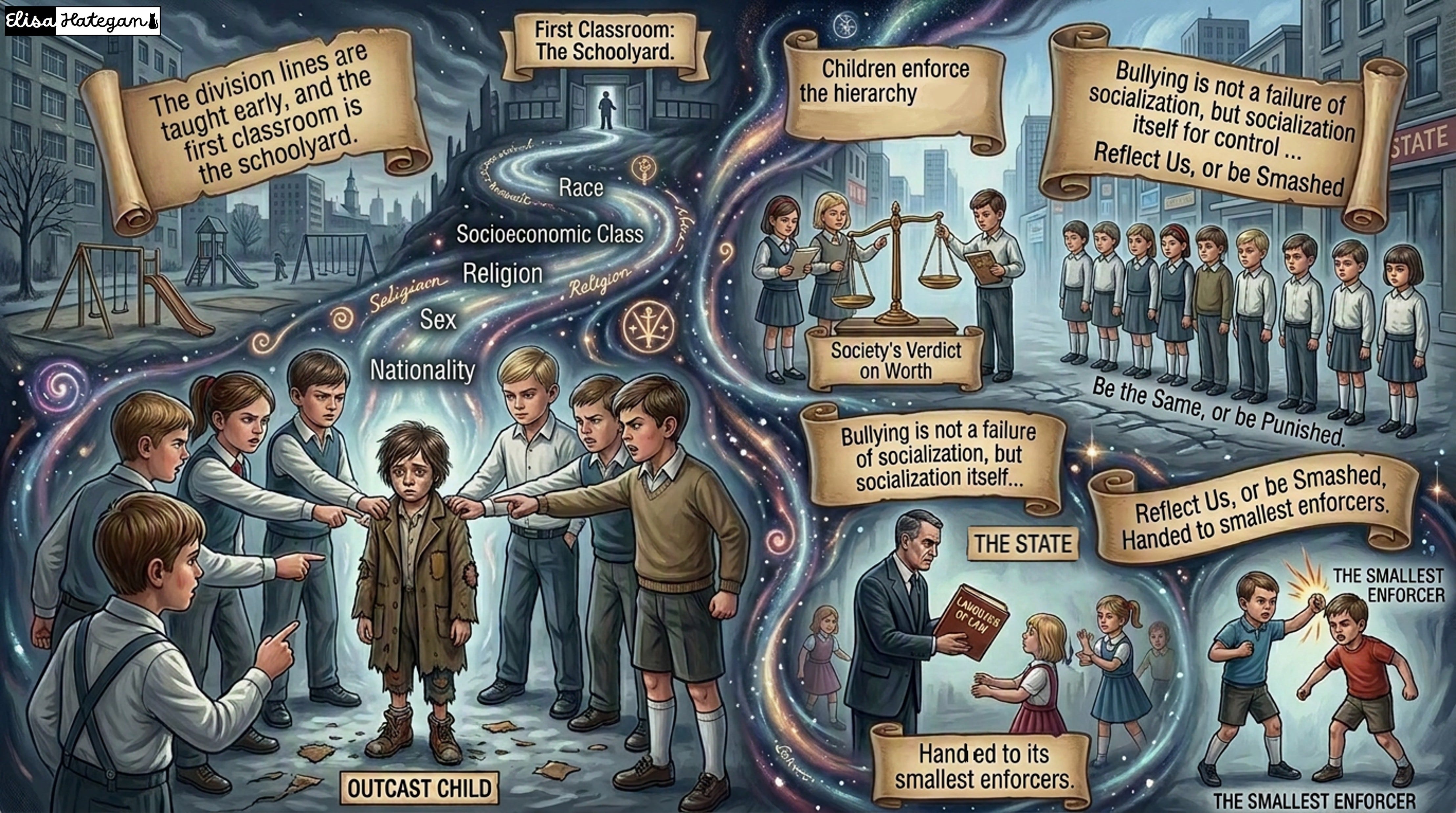
The lines are taught early, and the first classroom is the schoolyard. Long before a State explains its hierarchy in the language of law, children enforce it in the cruder language of the playground. The child who speaks with an accent, who wears the wrong shoes, who is too tall or too poor or too strange, who flinches at the wrong moment — that child is found and corrected by others who have absorbed society’s verdicts about Worth long before they could articulate them, and who administer those verdicts with a brutal precision few adults can match.
Bullying is not a failure of socialization. It is socialization itself, operating exactly as intended. It’s the embodiment of society’s values distilled to their essence and handed to its smallest enforcers: be the same, or be punished. Reflect us, or be smashed.
In early 1984, shortly after I turned nine, my mother went on a trip to Italy — purportedly to attend a conference for the deaf in Rome. Once there, she did exactly as my father had instructed her to do, as they had planned for endless hours under the dim light of the living room chandelier bulbs: she declared political asylum. The plan was for her to apply to immigrate to America, then send for my father and me to join her. But it did not go as planned.
While staying in a refugee camp in Latina, she fell in with a group of deaf Romanians who had all applied to go to Toronto, Canada, and she promptly decided to do the same. My father and I had no say in it. Two years later, after the Red Cross Family Reunification Program intervened and made entreaties on our behalf to the communist government, my father and I joined her. I was eleven and a half, and a completely different girl than the little kid she had left behind in the care of an indifferent, abusive old man who had never wanted a child. But her abandonment was nothing compared to being forced to leave the only place I knew and loved.
I never wanted to leave my homeland. Despite the petty brutalities of the schoolyard, it was my whole world. My best friend’s grandparents had looked after me and taught me what the word love meant. To leave them and my friend behind was the epitome of heartbreak.
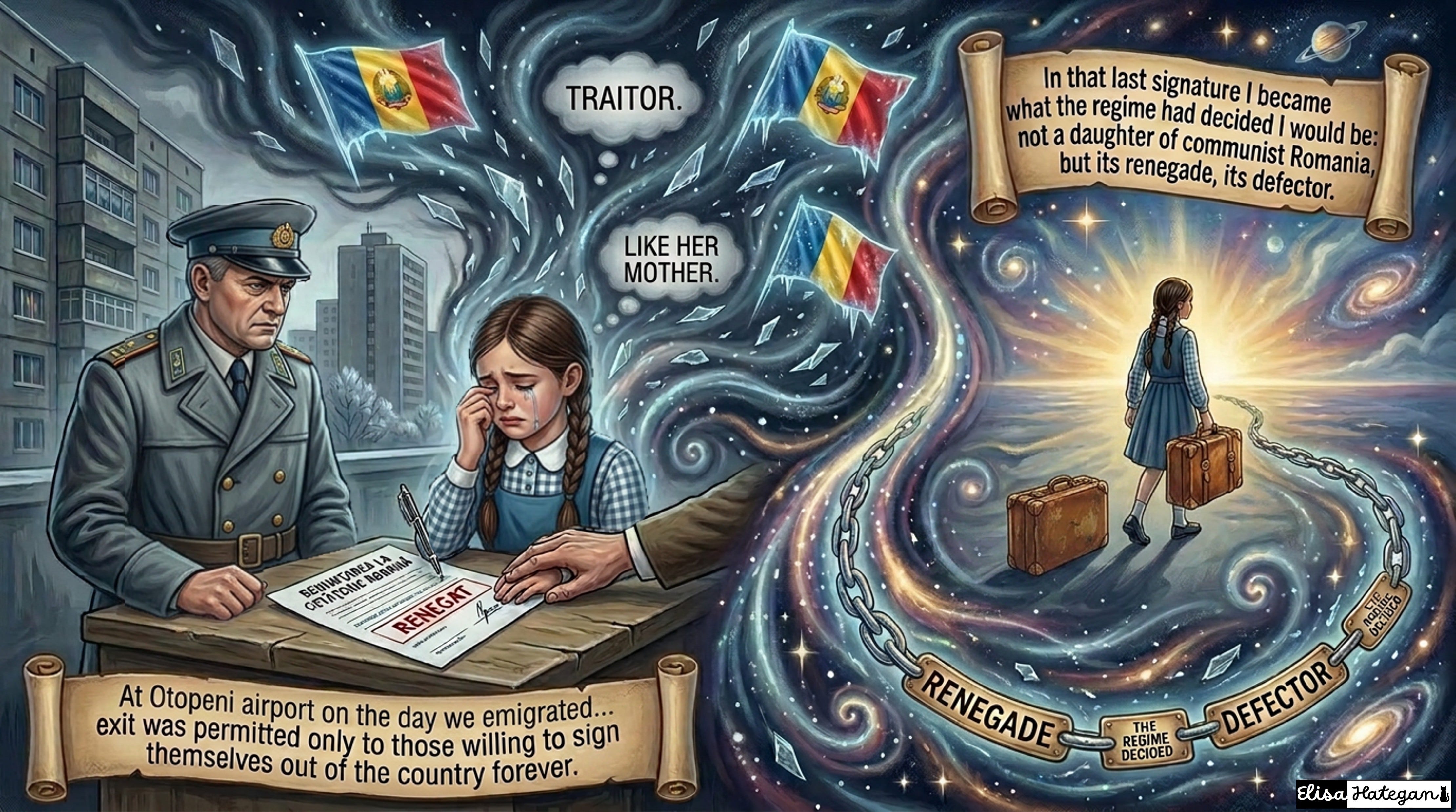
At the airport, on that grey terrible day at the end of August 1986 when my soul fractured into splinters, a uniformed officer slid a document across the counter and told us that to leave we would first have to renounce our Romanian citizenship — exit was permitted only to those willing to sign themselves out of the country forever.
I didn’t want to pick up the pen. I was still sobbing about leaving behind my Patria, my motherland, an inextricable part of my identity. My father angrily closed my small fingers around it himself, scratching my name across the page. He rendered me into the whispers that had followed me down school corridors for the last two years: Traitor. Just like her mother. In that last signature I became what the regime had decided I would be after it could no longer keep me: not a daughter of Romania, but its renegade, its defector — a reflection it preferred to smash rather than keep.
My parents, like so many Romanians of their generation, had been raised on a particular fairytale about the West — that beyond the border lay a land so obscenely rich that dogs trotted through its cities with golden pretzels hanging from their tails. That in the West, the land of Voice of America and freedom dressed in blue jeans, the food rations we queued up in long pre-dawn lines outside stores were bountiful enough to squander on animals.
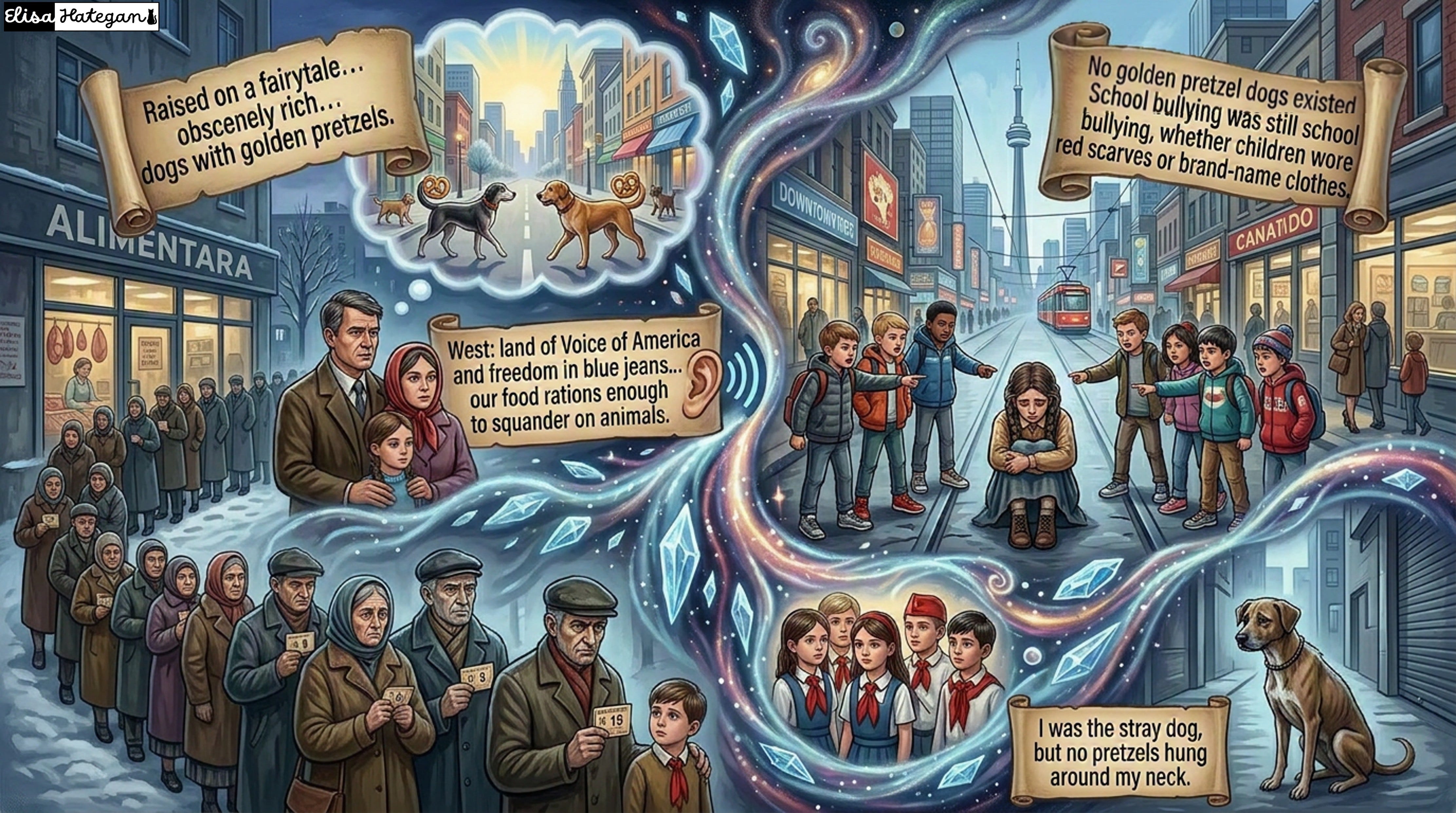
Well, no such dogs roamed the streets of downtown Toronto. There was snow, and there were children, and the children behaved exactly as children had behaved in Bucharest. School bullying was still school bullying, whether the children wore red scarves and uniforms or running shoes and brand-name clothes. The accent that had marked me as a Pioneer now marked me as a foreigner – a weird little girl, with weird braids and weird clothes, who’d never worn jeans and wasn’t familiar with pop culture, had never heard of Madonna and Michael Jackson and was, at best, a thing to be either pitied or mocked.
I was the stray dog, but no pretzels hung around my neck. I had crossed an ocean and a Cold War to discover that the same mirror hung on the far side of the wall.
This was my education, rooted in the toughest lesson the twentieth century could teach me: that the “free” world and the “unfree” world were running the same program, but with different graphics. In the West, among the societies that call themselves “democratic”, you are not obliged to swear allegiance to a flag, to knot a red scarf at your throat, to wear a uniform that files your self down to sameness. But the same objective is met, albeit with more invisible instruments.
Where the East used the scarf and the anthem, the West uses the interview, the standardized test, the credential. The name-dropping, the nepotism, the sycophancy. The aim is identical: to sort the population into those who reflect the system and those who do not, and to ensure that the second kind never reach the levers of any authority.
In North America, you don’t rot in a gulag. You won’t get shipped to Siberia. All they need is a hit piece in a prominent newspaper to dismantle your reputation, a rumour mill operated by shady figures cloaked in VPN anonymity, lies permanently indexed on Google’s first page every time your name gets searched, and death will feel like the kinder option. They don’t have to fire a single bullet – you will do the job for them. The East and West’s outcomes have converged. If you deviate in any way, your life will be destroyed so completely that excommunication to Siberia will seem like paradise by comparison.
Whether you prefer communism’s overt, severe punishments, or the hush-hush, backroom, blindfolded annihilation carried out by the capitalist system, is a matter of personal taste. For me, I’d rather have my execution served cold and without frills, so I can look it in the eye.
Decades after the fall of communism in eastern Europe, not much has changed. The technicolour, romantic ideals of freedom and democracy that the Voice of America sold us back then turned out to be a reflection of the same thing, broadcasting from the other side of the mirror.
So here are my field notes, now that I’m standing on the other side of the mirror. Fair warning – I have a lot of field notes, and this is only an excerpt of a much larger project in the making.
In this modern, democratic world, if you deviate too far, fall too far outside the distribution of the bell curve, you are silently disqualified — not imprisoned but rendered unemployable, uncredentialed, unseen, humiliated and dehumanized, a nobody by the only metrics society has agreed to read. The communist State told you what to think. The market democracy works in subtler ways: it tells you what counts as thinking, and then sells you the certificate that proves you’ve done it correctly.
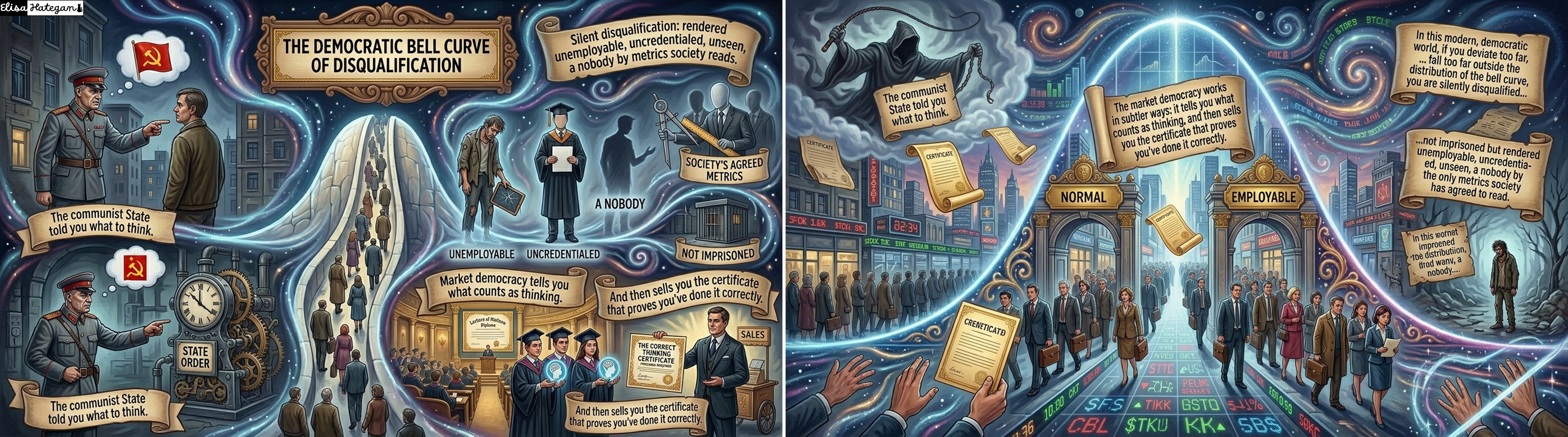
How that certificate came to matter is another story. For most of human history, knowledge moved through the world along many channels at once. You learned a trade from a master, apprenticing at his elbow. You learned medicine from a midwife or an herbalist, or within the sacred walls of a temple. You learned the law by standing next to someone who practised it. You learned the stars, the soil, the loom, the forge, each through its own lineage – each lineage answerable to results rather than to paperwork. Education was multi-pronged and vast, and competence was demonstrated, not certified.
Then the channels were narrowed, deliberately, into one. The clearest and most dramatic case is medicine, though it’s by far not a unique occurrence. At the beginning of the twentieth century there were hundreds of medical schools across North America, teaching a wide range of approaches — allopathic and homeopathic, eclectic and naturopathic, schools that admitted women and trained black physicians.
In 1910 a man named Abraham Flexner, an educator with no medical training of his own, was commissioned by the Carnegie Foundation, at the urging of the American Medical Association, to survey them all. His report recommended that medicine be remade on a single model — laboratory-based, university-bound, expensive — and that everything else be shut down.
And so it was.
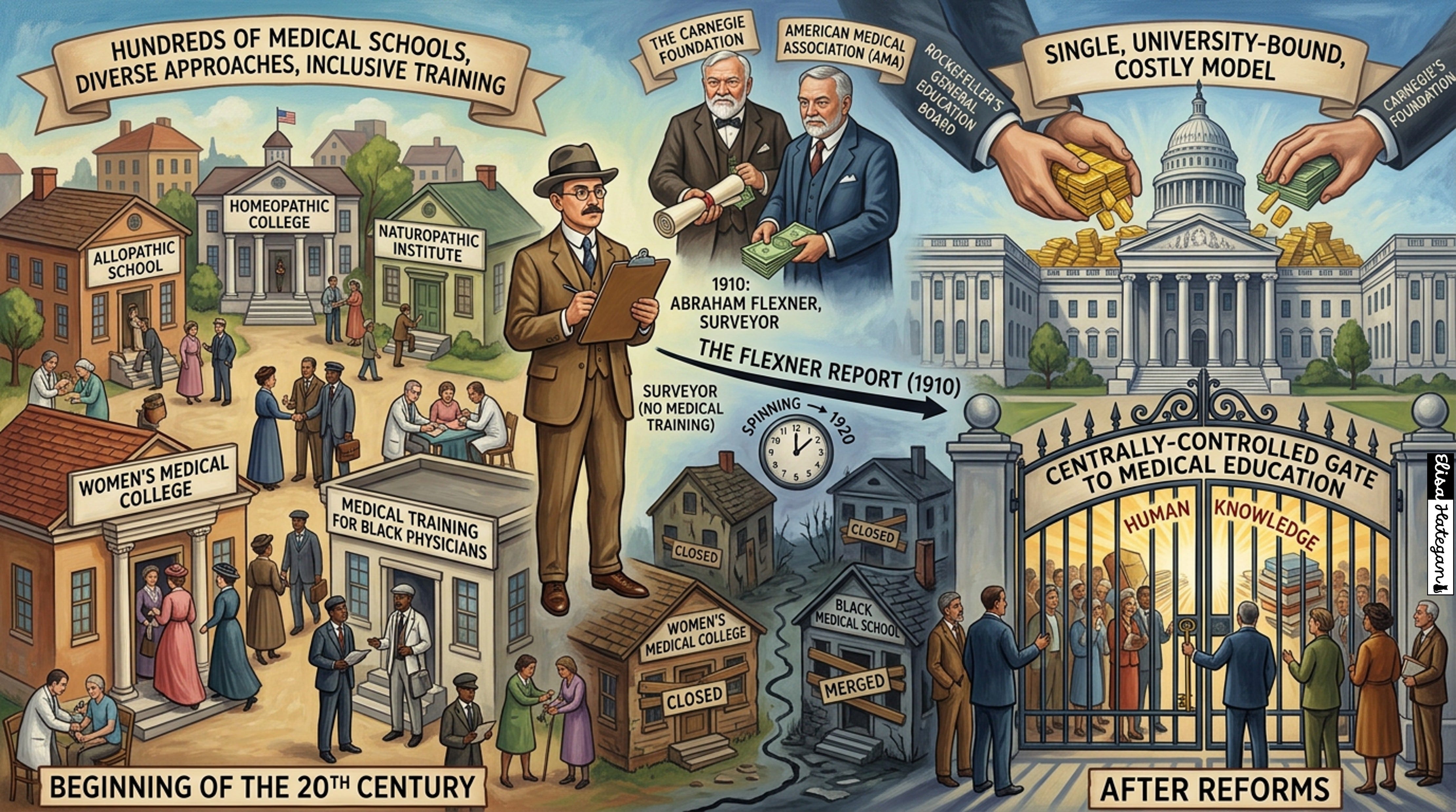
Within a few short years, nearly half of America’s medical schools had merged or closed. The schools that trained women and black doctors were among the first to vanish; of the more than twenty black medical colleges then operating, only two survived. The reforms were underwritten by the greatest fortunes of the age, under the guise of philanthropy — Rockefeller’s General Education Board and Carnegie’s foundation — and they did produce good, rigorous physicians. But they also placed a single, costly, centrally-controlled gate between an entire population and one of the oldest forms of human knowledge, and handed the key to a credentialing body.
The midwife and the herbalist did not become wrong and vanish overnight. They became unaccredited, which in the long run, in a credentials-based society, is the same thing as wrong – it’s viewed as quackery, something to distrust and hold suspect. The course of childbirth itself changed from women squatting, moving their bodies and using gravity to push and facilitate the birthing, taking as much time as they needed, to being on their backs, contorted in unnatural positions, cut open if they didn’t deliver fast enough or on schedule, while men who called themselves experts took over and became the conductors of the process.
The brutalist architecture of modern power is invisible because it presents itself as quality control. The accreditation system does not merely measure competence. It manufactures the scarcity that makes the credential valuable, and it reproduces, in each generation, the worldview of the people who built it.
The institutions that grant the degrees society requires for employment were founded by the class of wealthy men who had every reason to define competence in their own image, as resembling themselves.
When you think about it, what does a diploma certify, really? That framed, hugely expensive piece of paper you hang on the wall certifies, before anything else, that you spent years and a fortune learning to reflect the institution back at itself. Because it’s the only way to get tenure and respect among your likeminded peers.
It is the red scarf of the meritocracy. We just agreed to call the uniform a qualification.
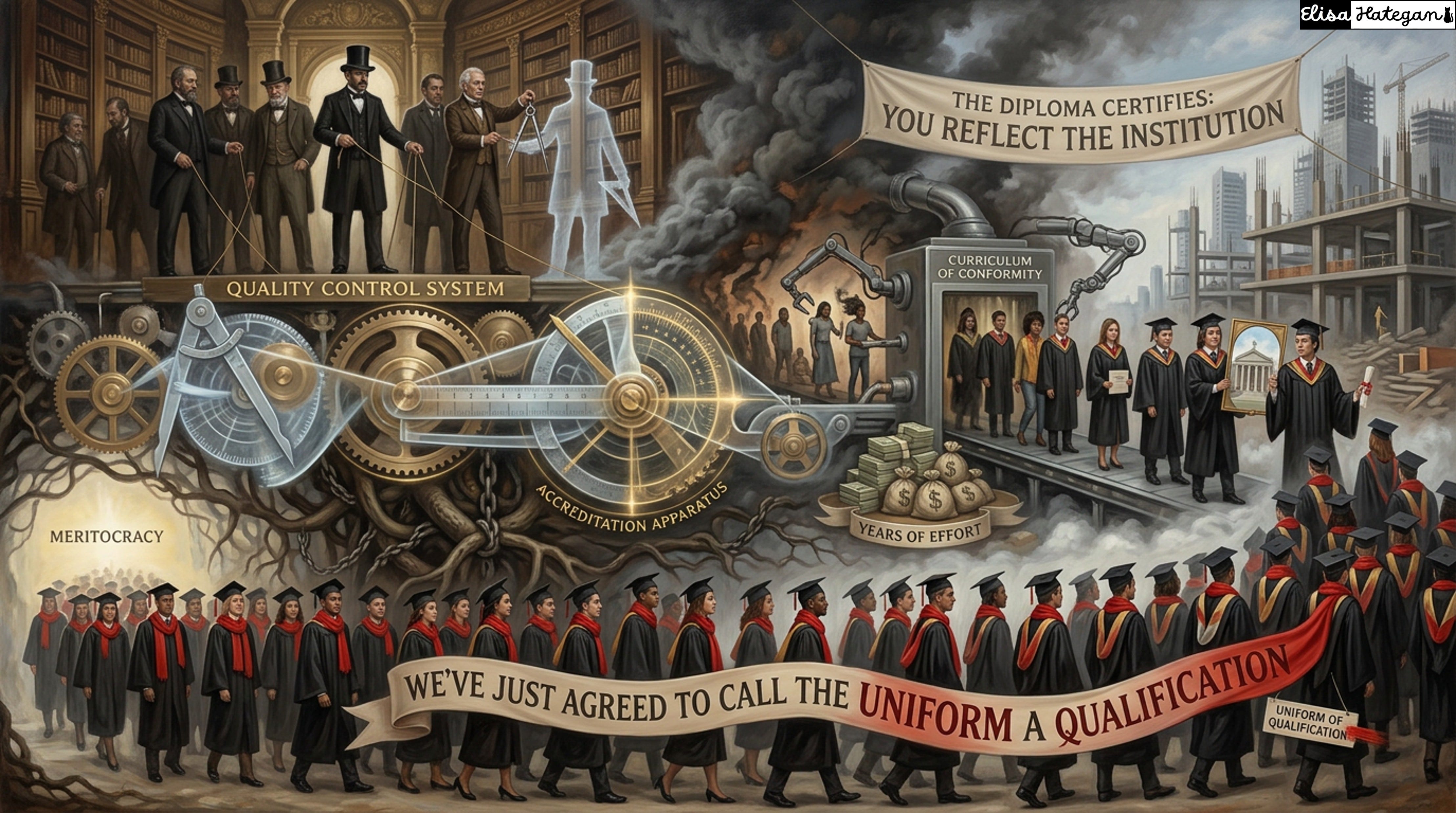
But the uniform is fraying. We are entering an age in which AI-run machines will do the clerical sorting, the middle-managing, the routine analysis the credential was invented to ration — an age in which the paper that took four years and a mortgage’s worth to obtain may not be worth the parchment it is printed on.
The coming future threatens to expose the biggest secret the system has guarded all along: that there are other ways to value a person, and know what a person can do, besides asking which gate they passed through and which gatekeeper stamped their pass. There are better ways to evaluate someone’s worth than to base it on the prestige and exclusivity of the institutions that printed their diploma, or on the reputations, power, authority and social positions of the people who write the recommendation letters.
A society confident of its own worth would feel no need to evaluate human beings through instruments that work by exclusion — instruments that derive their entire value from how many people they keep out. That exclude in order to make the sycophants hand-picked by the system appear better, more special and capable than all the rest. Instruments that work through the power of elitism and nepotism, name-dropping, and connections to powerful figures in positions of authority who open doors to a well-connected few, shut them in the faces of most others, and symbiotically influence a system that pretends it is unbiased and equal to all.
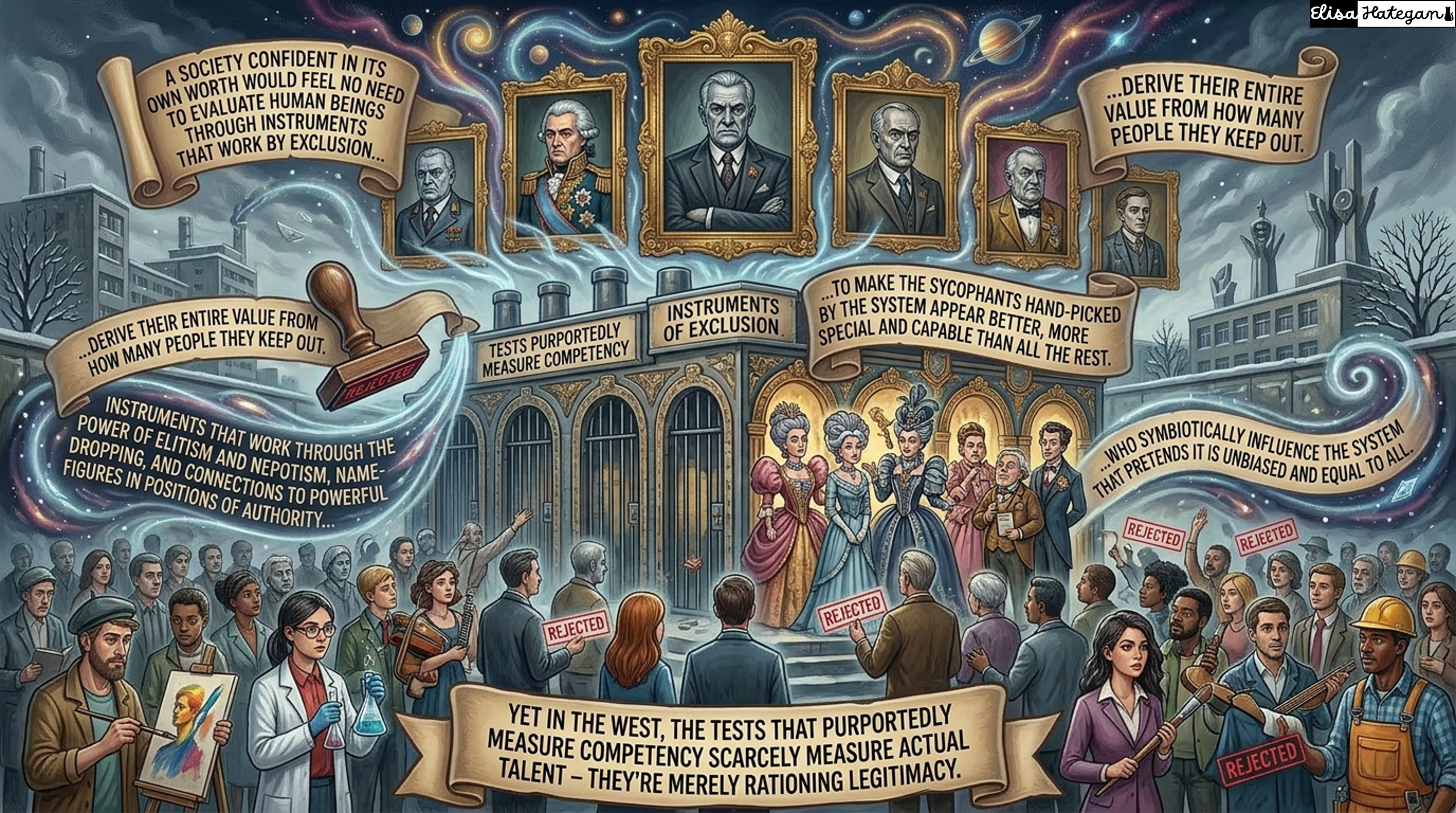
In the West, the tests that purportedly measure competency scarcely measure actual talent. They’re merely rationing legitimacy. But unlike the food rations we got during communism by lining up around the block before dawn, this legitimacy doesn’t get doled out first-come, first serve. Within the “democratic” system, you can camp outside a bread store from the night before to make sure you’re first in line, and you’ll still be waiting till the cows come home. Everybody will get their bread before you, because your hunger wasn’t endorsed by a recommendation letter from a well-connected individual or certified by a powerful institution.
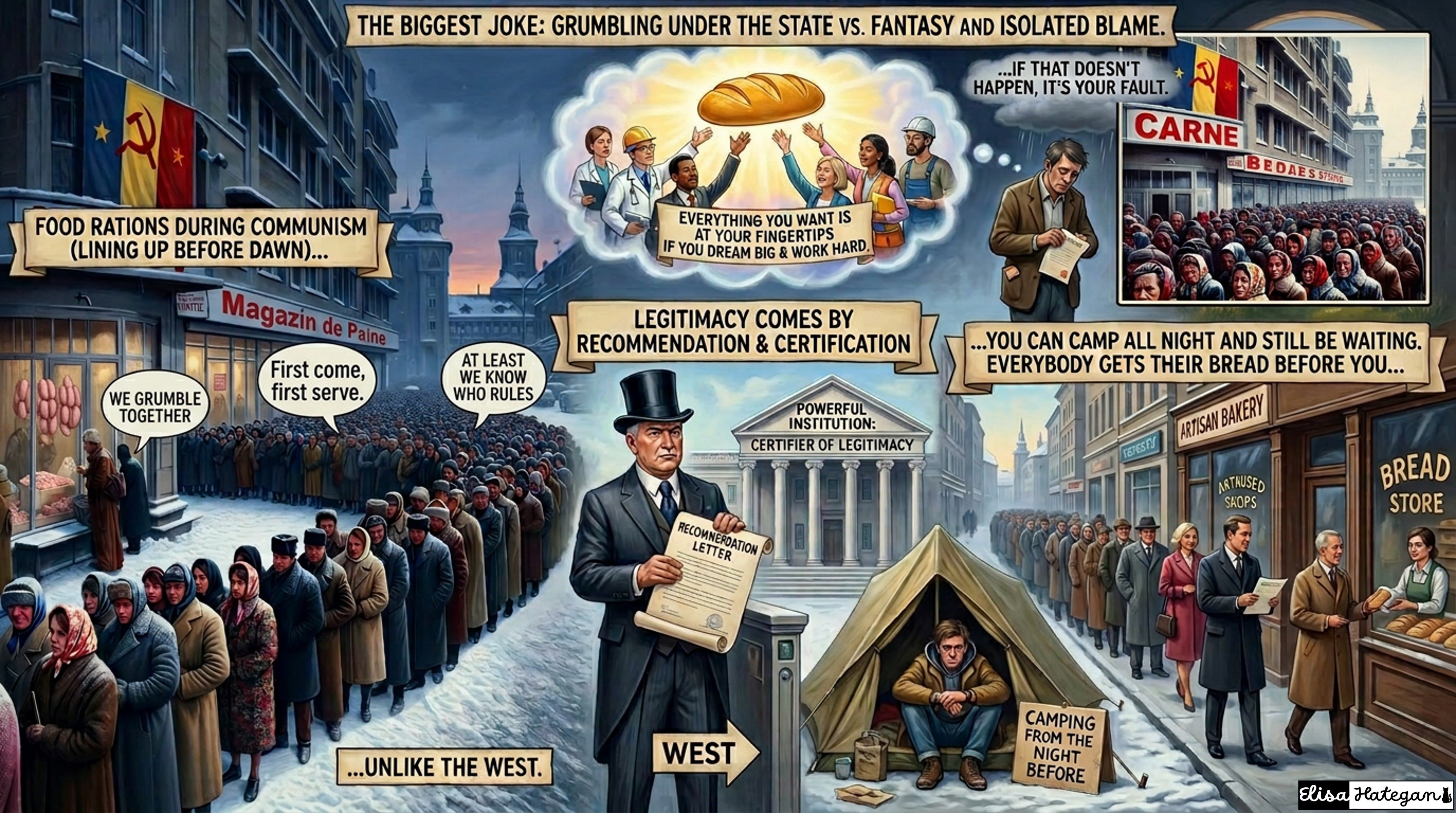
The biggest joke is that at least during communism you could grumble and commiserate with the man next to you in line, and you both knew that the State ruled over you. In the West they sell you on the fantasy that everything you want is at your fingertips if you dream big and work hard enough to make it happen. If that doesn’t happen, it’s your fault.
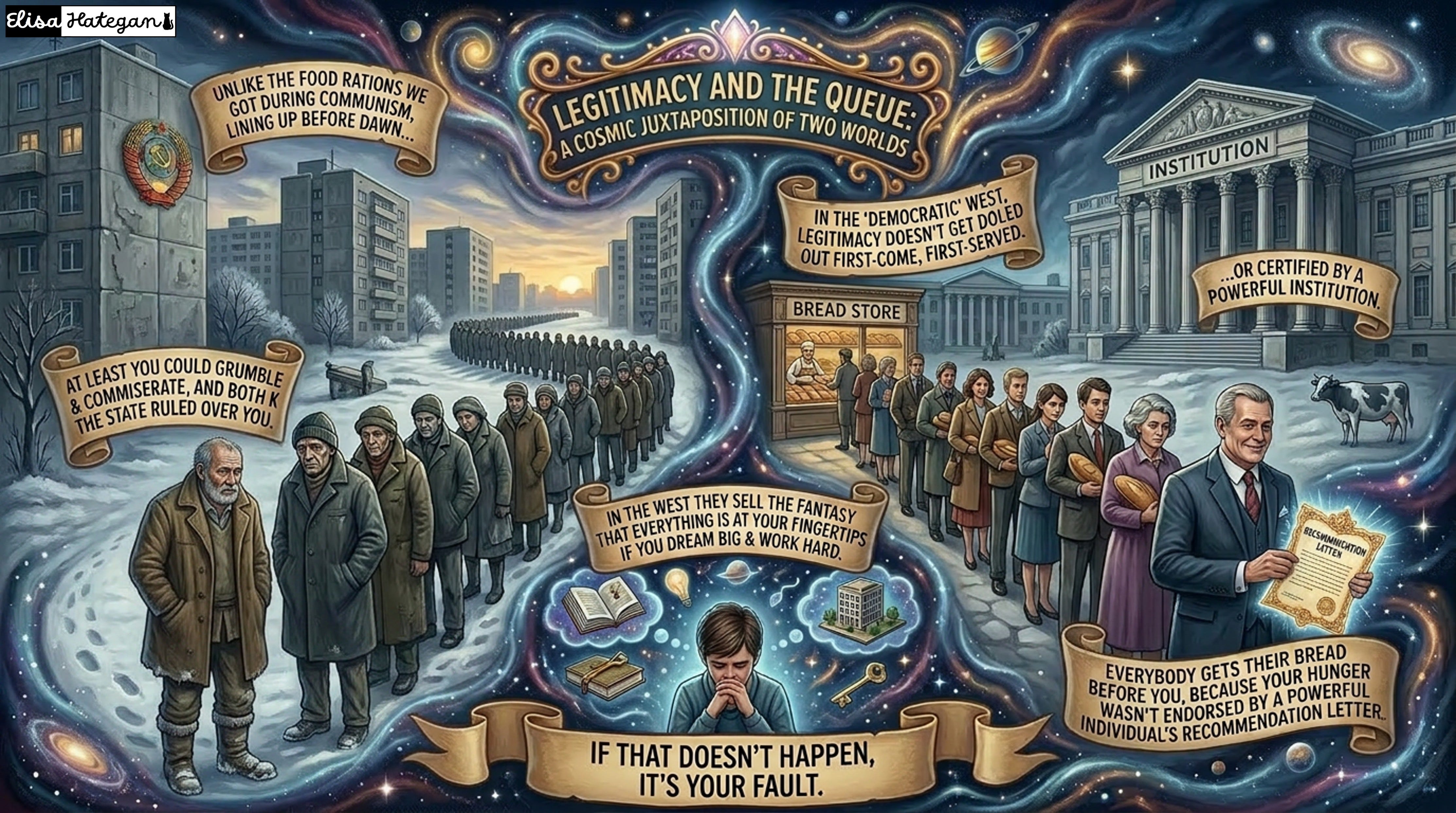
And so when the bread runs out before it reaches you, you don’t turn to the man beside you because he is your adversary and competitor, and the capitalist dream has been engineered to be faced alone. It hands each of us a verdict, and the verdict is never that the system kept you out on purpose. Oh, no. It’s because you didn’t want it badly enough. You didn’t work hard enough for it. YOU weren’t good enough.
The cruelty isn’t the rationing – it’s the story the West tells about the rationing.
Under communism the boot was visible and shared. Everybody knew it wasn’t their fault that supplies were scarce. You knew who to pray to, and who to curse under your breath. Even when you had to bribe someone, you knew who to bribe and the price was fixed. And there’s a certain security of mind that comes when you know that the bribe price is exactly the same. The terms of the transaction might have been unspoken, but the process was known and open to all equally.
The West’s dream privatizes the failure and dissolves the solidarity that made the bread line bearable. It conditions you to internalize the failure and claim it as your own. It persuades you that the boot is on your own foot — that your hunger and failure to work hard enough for scraps is what’s pressing you into the ground, and you should shamed for it, and ashamed of it.
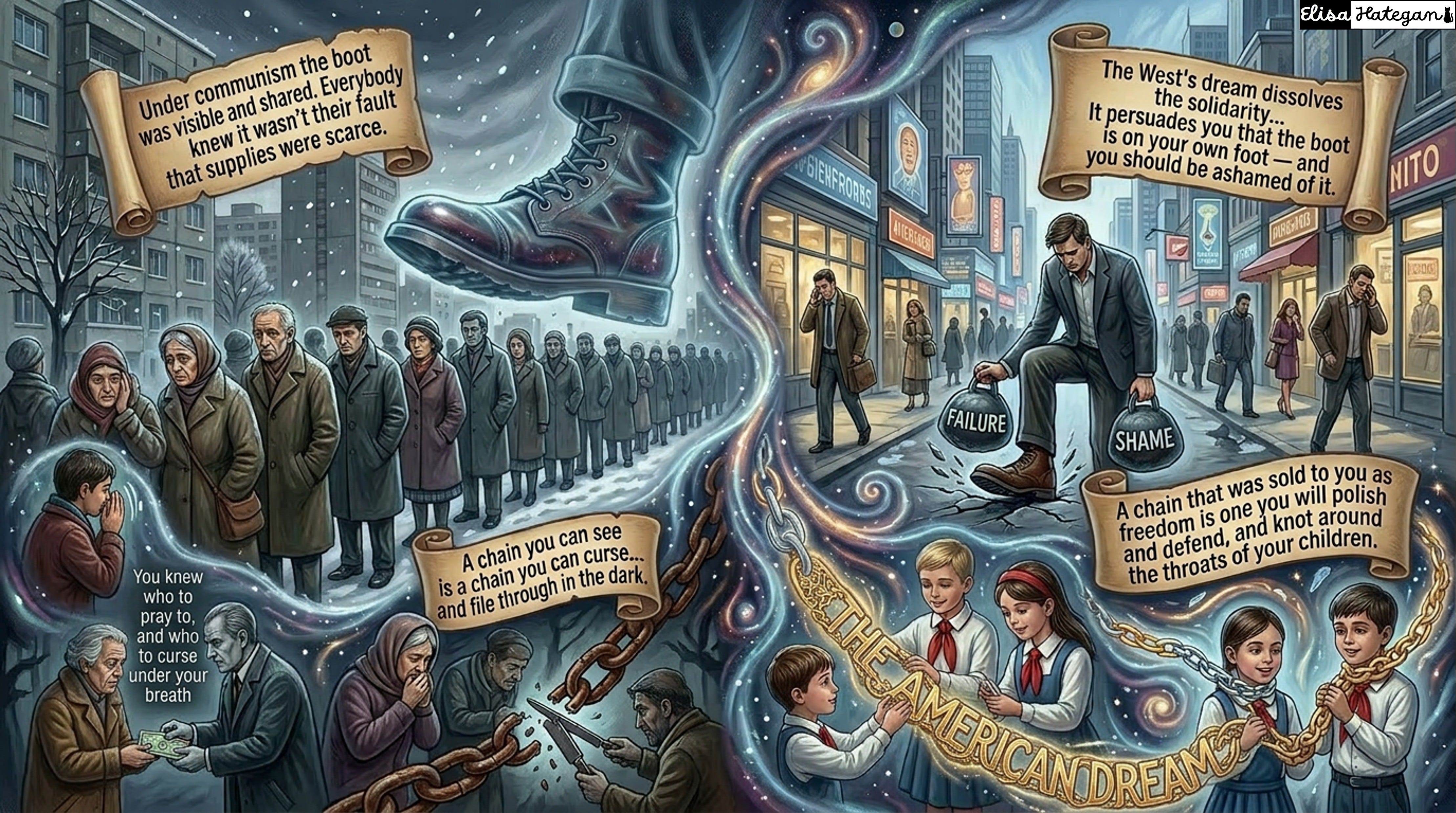
Your failure to thrive – rather than the system’s rationing of opportunities and their allocation to the most privileged (based on who can afford ivy-league tuitions, and who knows the right kingmakers who can open doors) – is a character flaw that differentiates you from what the people at the front of the line were born clutching.
A chain you can see is a chain you can curse, and conspire against, and file through in the dark. A chain that has been sold to you as freedom is one you will polish, and defend, and knot around the throats of your own children, grateful all the while for the privilege of wearing it.
Every mirror needs a frame, and the frame the twentieth century chose was fear. Because there’s scarcely a better tool for enforcing ideological conformity than fear. A population that has been made afraid does not ask difficult questions. It asks only to be protected, and it will hand almost anything to whoever promises protection. So both halves of the divided world manufactured a monster for the other to be.
For the communists, the monster wore a Western face. The boogeyman was the imperialist, the capitalist exploiter grown fat on the misery of workers. He was the defector and the traitor to the Motherland, the rootless cosmopolitan loyal to no soil, the spy and the saboteur and the decadent — the West as a glittering poison, its freedom a trick to make you complicit in your own exploitation. The dogs with the golden pretzels were part of the same myth: proof that the enemy’s abundance was obscene, and to desire what they had was to be corrupted by it.
For the West, the monster was red. It was the communist sleeper and the fellow-traveller, the union as a Trojan horse, the neighbour who might be an agent, the dangerous idea that could infect a school or a film studio or a government office like a contagion. Whole careers were ended on the suspicion of a sympathy. The fear was given a geometry — the domino theory, by which one nation falling to the wrong idea would topple the next, and the next — and the geometry justified the wars.
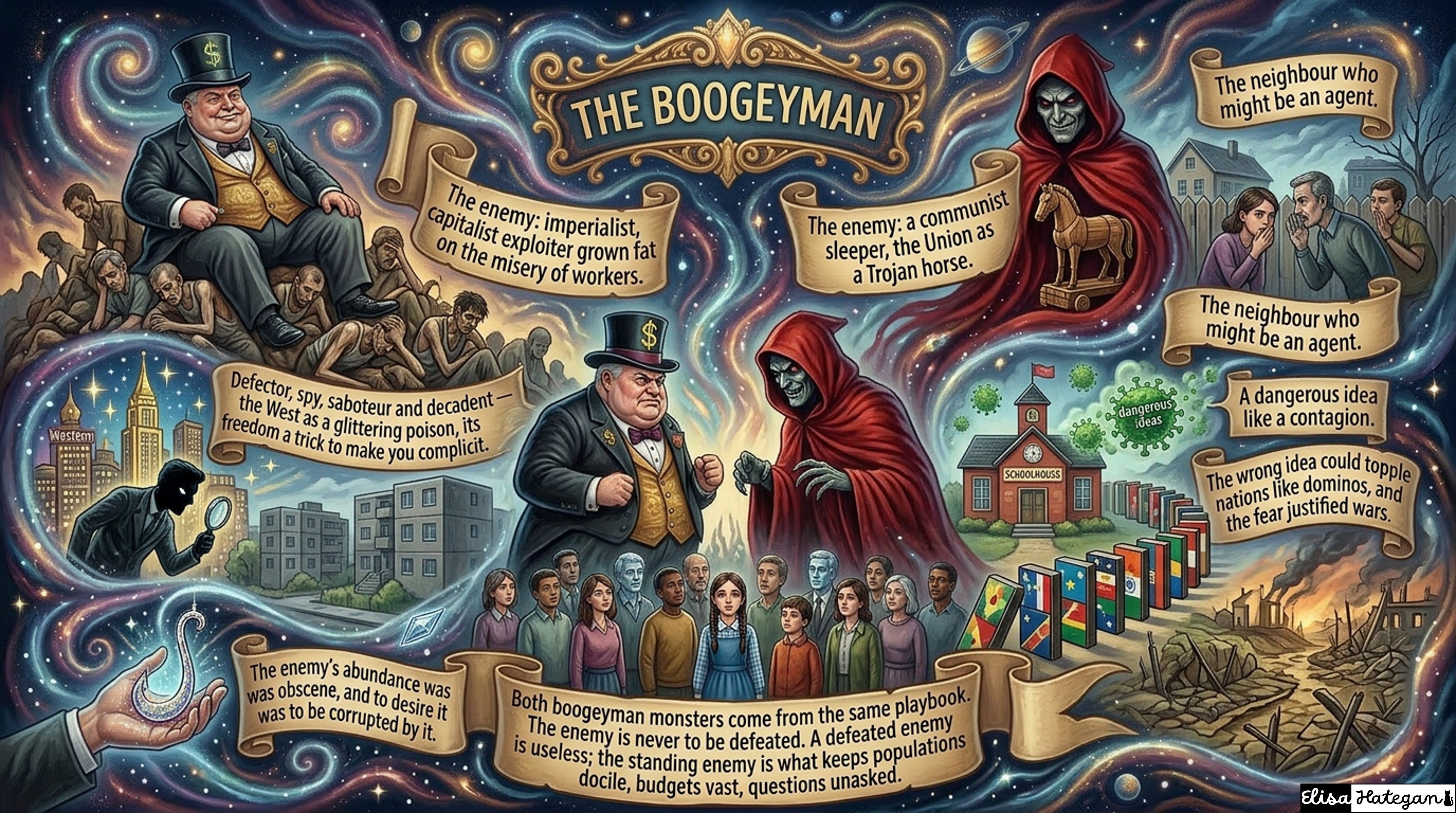
What neither monster could afford to reveal was that both were drawn from the same playbook. The function of the enemy was never to be defeated. A defeated enemy is useless; it is the standing enemy that keeps the population docile, the budgets vast, the weapons of mass destruction assembled at great profit, the questions unasked. The boogeyman is not a flaw in the system of power, but its reinforcing buttress.
And the Boogeyman did not fall when the Wall did. The splinter still outlives the mirror that scattered it. The lines drawn through the twentieth century — Us vs Them, the free and the unfree, the civilized and the barbarian — did not dissolve when the Cold War was declared over. They migrated, found new faces, new borders, new names.
The machinery that turns a human being into an Other so that he can be feared, and feared so that he can be governed, continues to run. It’s running in the feeds and the headlines and the renewed talk of spheres and enemies all around us — as efficiently as it ran in the classrooms of my childhood. Back then, we were taught to fear a direction on the map. But the map has changed, and the fear has only been re-pointed.
I had barely entered first grade when my imagination was captured by Andersen’s image of a mirror raining down upon the world and freezing it. I had no idea, then, that the allegory was older than Andersen — older than fairytales as a genre, older even than the alphabet that wrote them. Its roots emerge from the soil of Kabbalistic thought and Lurianic interpretations of how creation began.
According to Isaac Luria, the sixteenth-century Safed mystic, the world we know is built from the wreckage of an earlier world that couldn’t hold what was inside it. God’s infinite light — the Ohr Ein Sof — poured itself into vessels to make the world. But the vessels of the first universe, Olam HaTohu, could not contain so much radiance. They shattered, and their fragments became sparks of light — neẓuẓot — scattered and trapped within the husks of the next universe, Olam HaTikun.
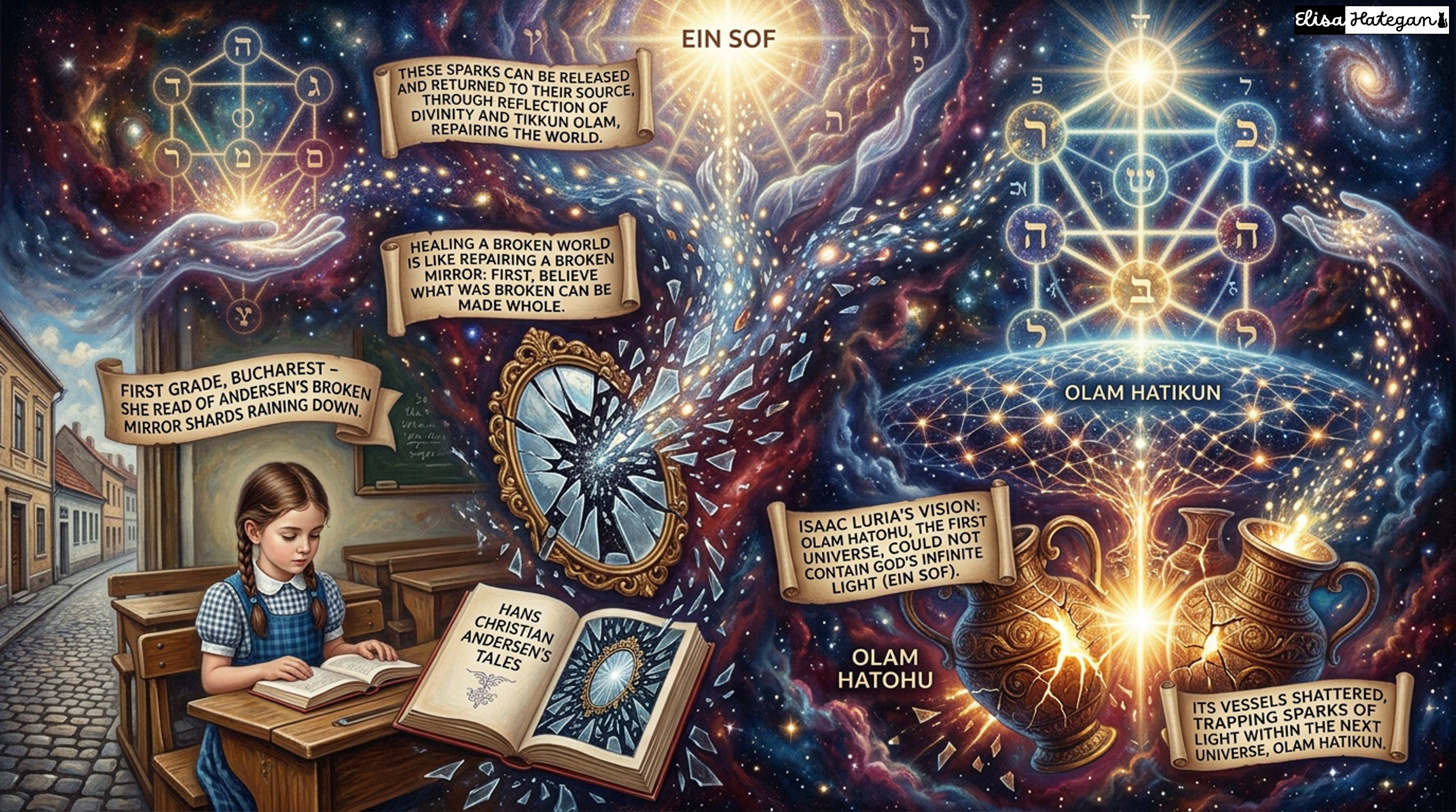
The Kabbalah says that these sparks can be released and returned to their source – through prayer, through righteous action, through reflection of divinity (the Sefirot), and through what Luria called Tikkun Olam — the repair of the world. But the Hebrew phrase has been hollowed out by contemporary discourse, reduced to a slogan for platitudes and charity drives, while remaining blind to the divisions and horrors inflicted in all religions’ name.
Its original meaning was far more vertiginous: a recognition that we live inside a wound, that everything we touch contains a fragment of the original light, and that our only real work is to gather that light back to itself.
Before you can enlighten anything, you must envision your way back to the source. You must believe in the possibility of finding light while you are still adrift in a sea of darkness. Hope is not optimism; it is harder than optimism. Hope means believing in the possibility of redemption and transcendence, and holding onto that reflection until it is reflected back by the world — even if the only light that reaches you arrives through broken shards.
This, in the end, is what the splinter cannot account for. Andersen’s parable doesn’t finish in the frozen palace. It ends with Gerda, who walks to the ends of the earth to find the boy whose heart has turned to ice. And when Gerda weeps over him, her warm tears dissolve the splinter her hands could never reach.
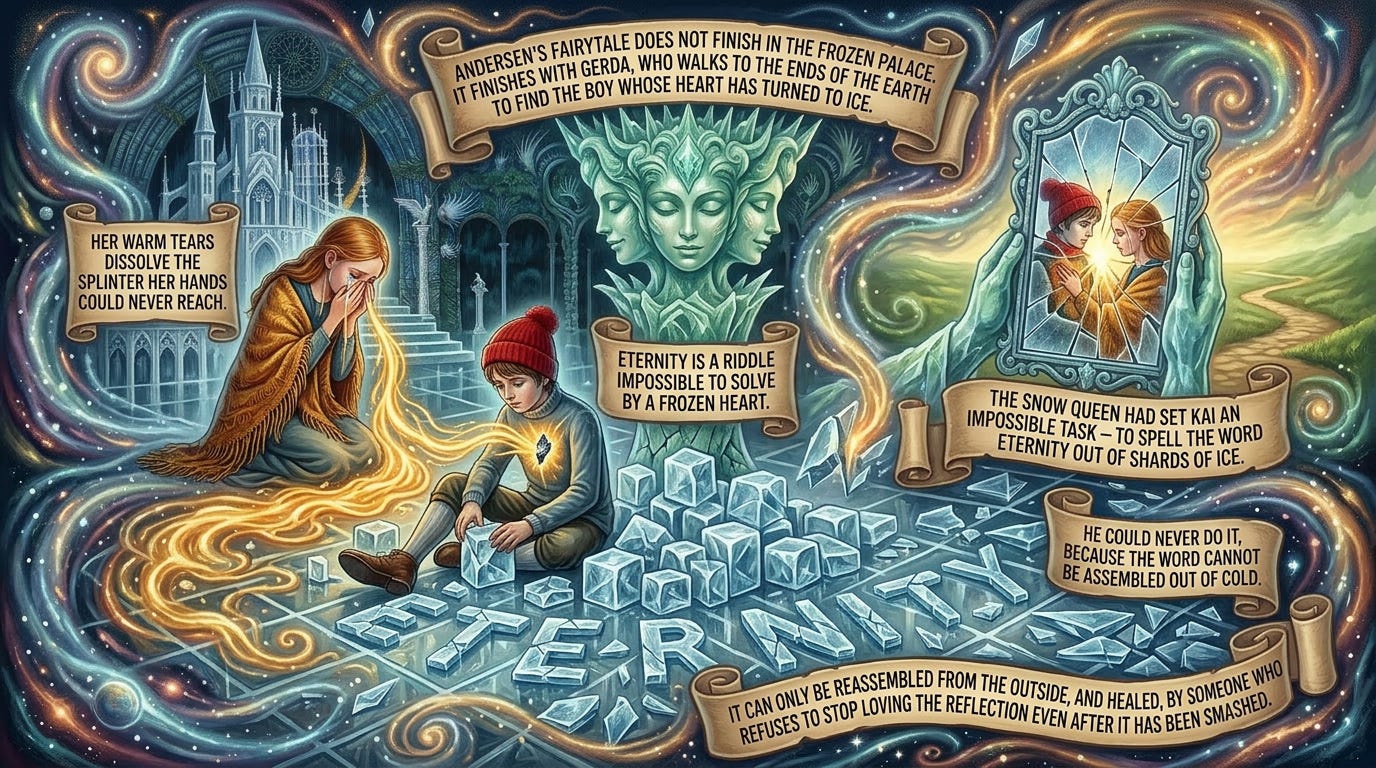
The Snow Queen had set Kai an impossible task — to spell the word eternity out of shards of ice — and he could never do it, because the word Eternity is a riddle impossible to solve by a frozen heart. It can only be reassembled from the outside, and healed, by someone who refuses to stop loving the reflection even after it has been smashed.
There is a window I keep returning to, on the second floor of a school in downtown Bucharest. The exact window may not exist anymore, but in my memory that window is preserved just as it was on a certain morning in late autumn, when the snow began to fall.
I was a child seated at a wooden desk with the initials of older students carved into its underside. I was leaning my face into my hand, not paying attention to the lesson, which was probably about the achievements of Comrade Ceaușescu, or the heroism of fearless wartime defenders who sacrificed their lives for our utopian nation, or the intrepidness of our Pioneers, or some other piece of state mythology I had already begun, without realizing it, to question.
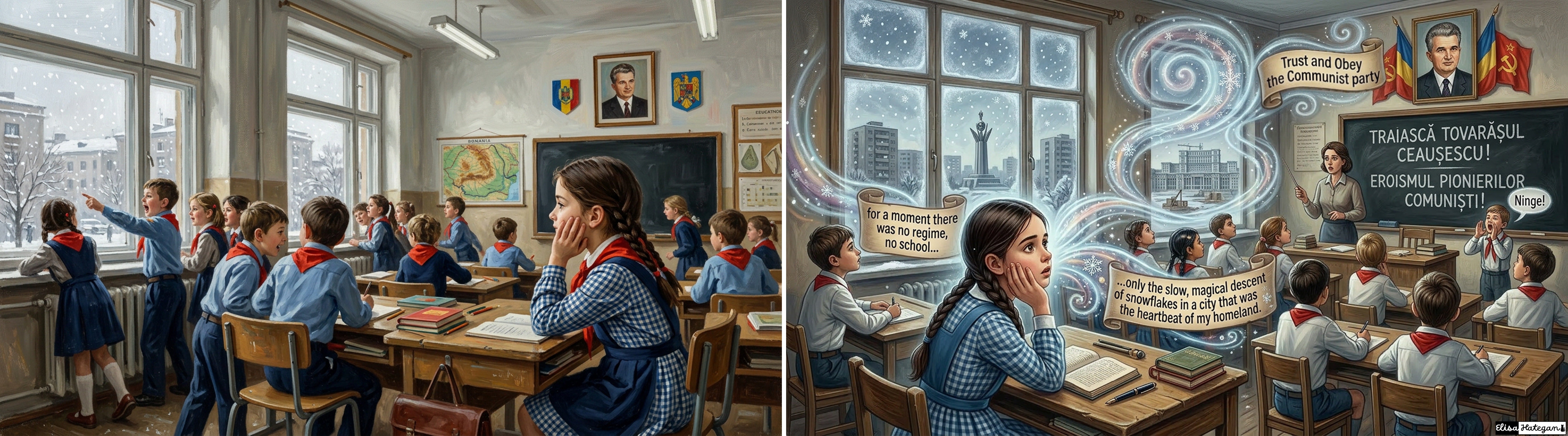
Then, someone in the back of the room shouted that it was snowing. Every head in the room turned, including mine, and the lesson stopped — and for a moment there was no regime, no school, no past and no future, only the slow, magical descent of snowflakes outside a window in the city that was the heartbeat of my homeland.
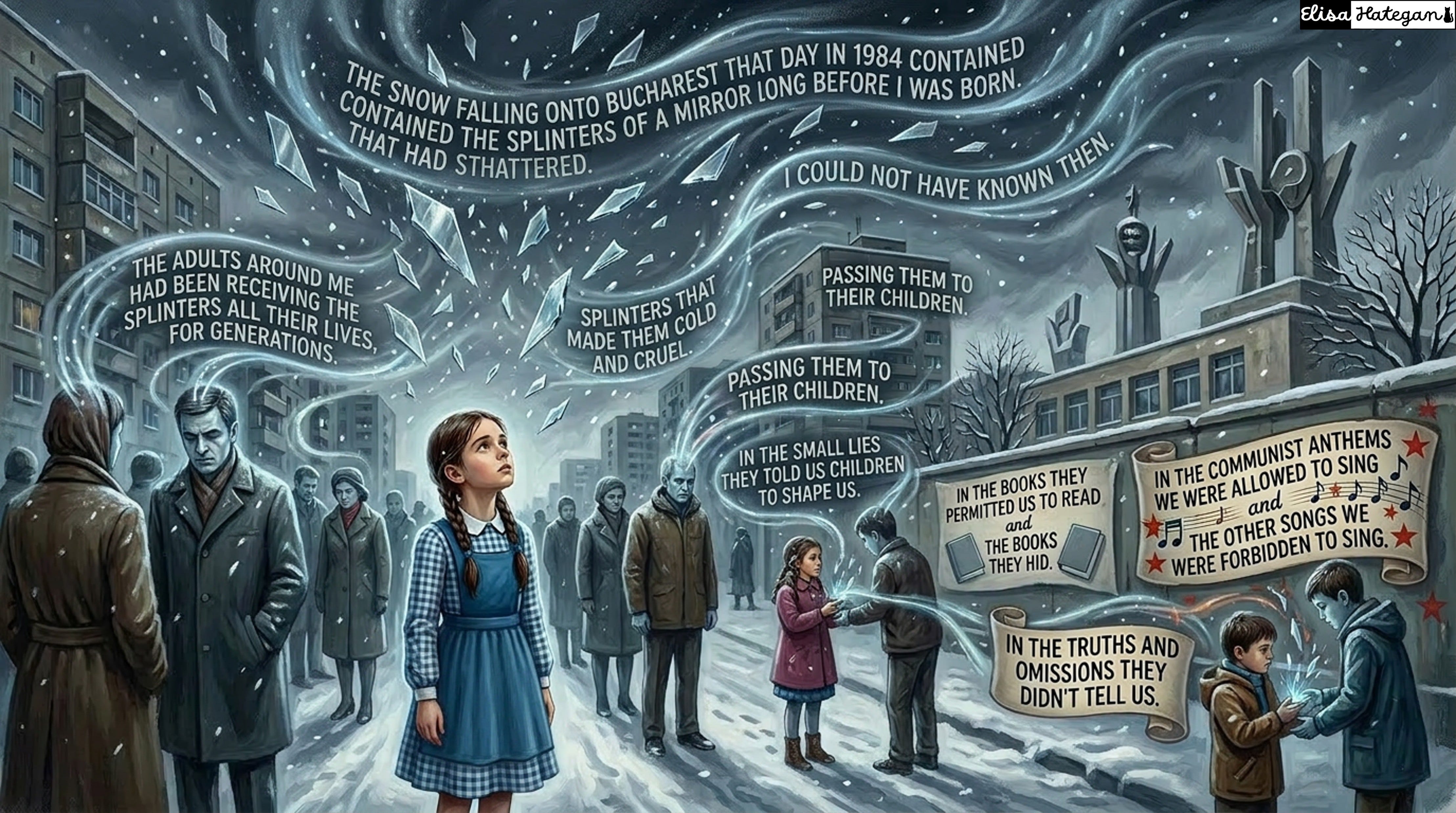
I could not have known then that the snow falling onto Bucharest that day was mixed with the splinters of a mirror that had shattered long before I was born. I couldn’t have known that the adults around me had been receiving the splinters all their lives — that they were still receiving them, and passing them to me without meaning harm, often while trying to do the opposite. In the small lies they told me to shape me in their image. In the truths they didn’t tell me for the same reason. In the books they permitted me to read and the books they hid. In the songs they taught me and the songs we were forbidden to sing.
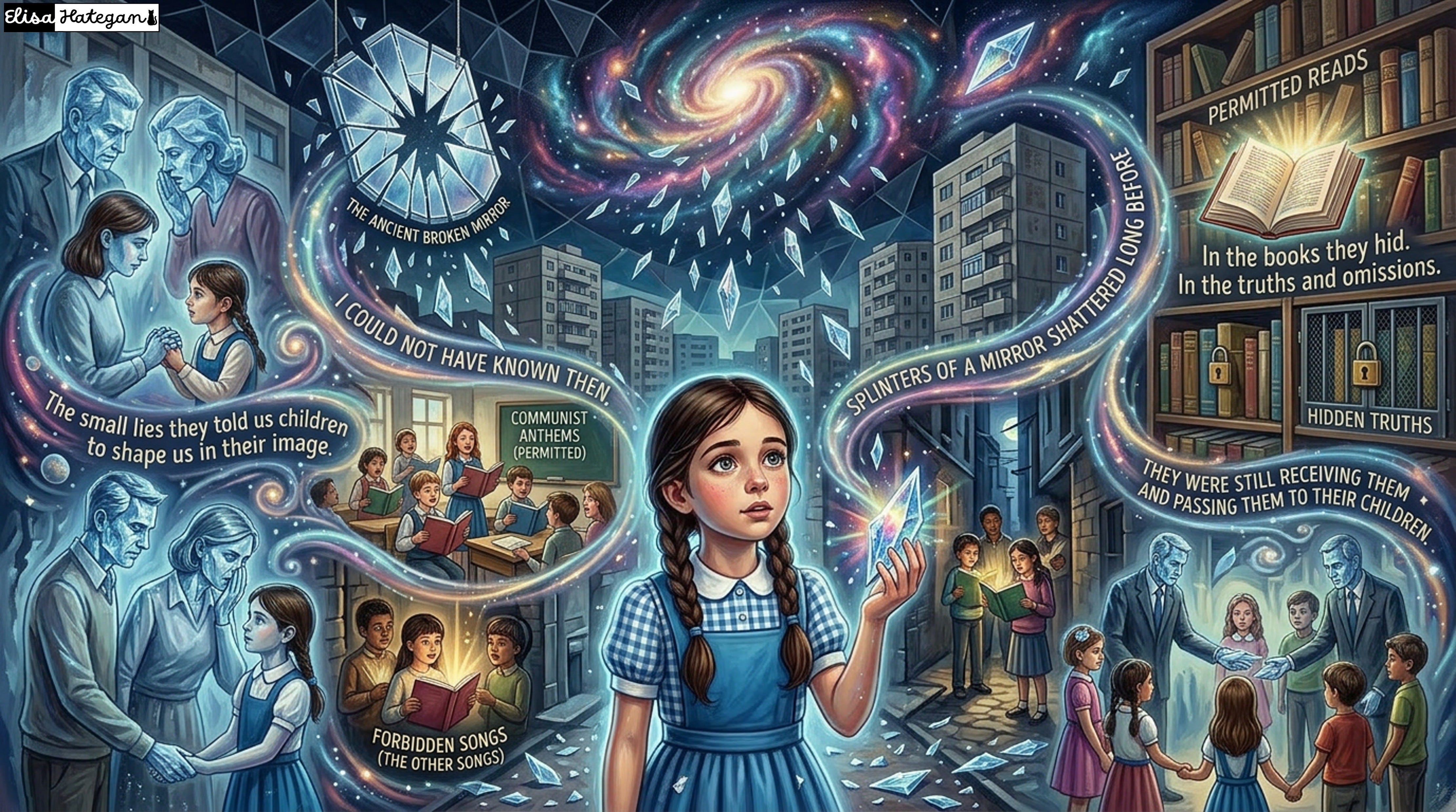
The mirror was raining down on the city the way the snow was, the way it had been since the beginning. But the children — who were both its inheritors and its incarnations — mistook it for weather.
It would take me decades to begin identifying the splinters. To work the first, most obvious ones, out of my eyes. Then to find the deeper ones — the ones I had mistaken for parts of myself, the ones around which I had grown the way a tree grows around a fencepost it met in childhood. Some of those, I have learned, cannot be removed without removing too much of the tree. Some I have come to terms with. Some I am still working on. Some I will die with, still inside me.
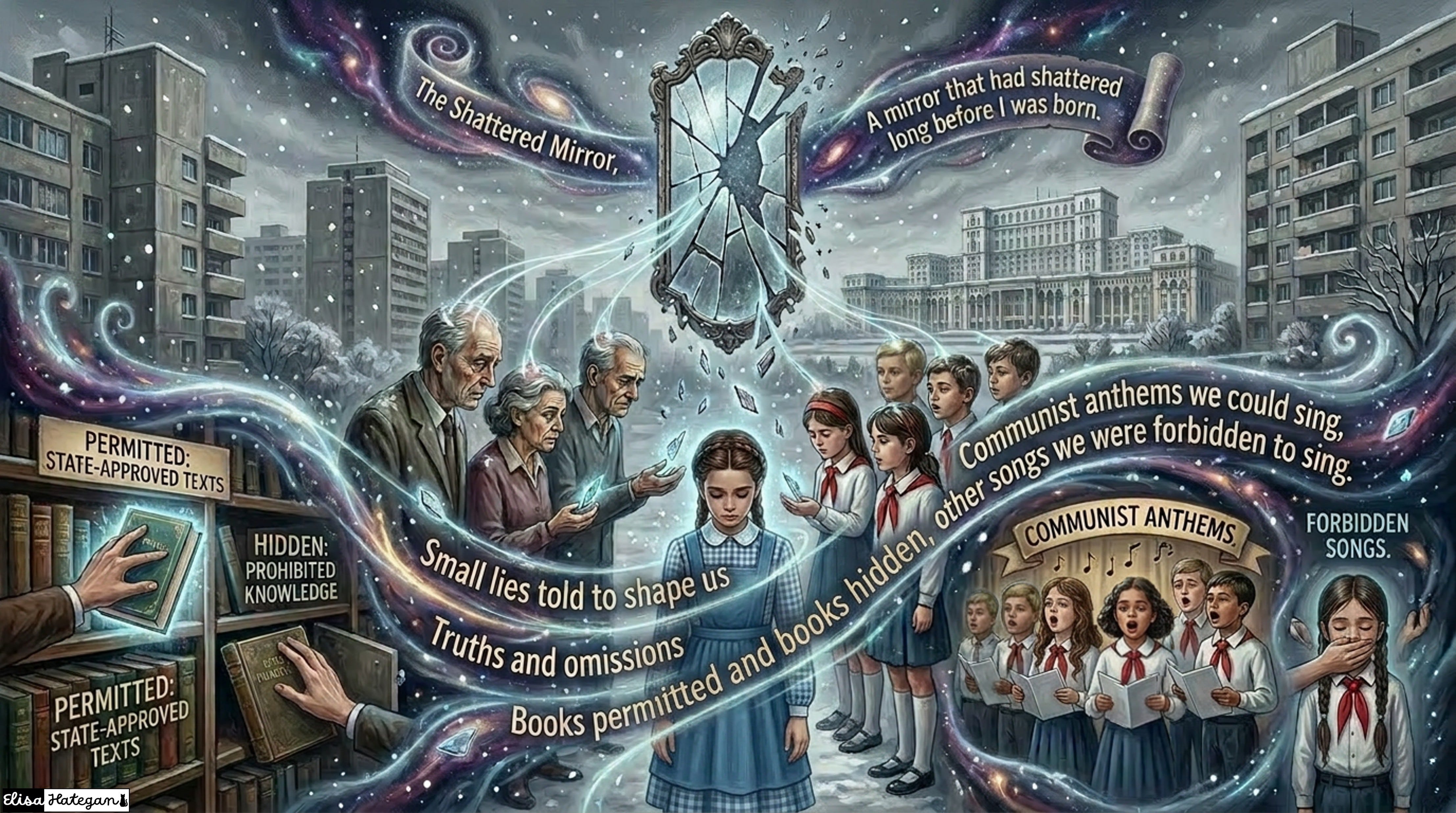
But the work of being a mirror is not the work of being already whole. It is the work of becoming whole, splinter by splinter, in full view of a world that prefers you blinded and broken. And at times in full view of the part of you that, in certain lonely hours, longs for the easy oblivion of not knowing what can no longer be unseen.
What lingers, after everything — after the languages I have learned and the languages I have lost, after the borders crossed and the empty chairs and the friends who became strangers and the strangers who became friends, after every reflection I have made and every reflection that has been smashed — what lingers is small, but eternal.
Endurance. Survival. Sunlight.
A snowdrop pushing up through frost in a Bucharest courtyard I haven’t stood in for thirty years.
A child’s hand pressed flat against a foggy schoolroom window, drawing a flower in the condensation and watching the flower evaporate.
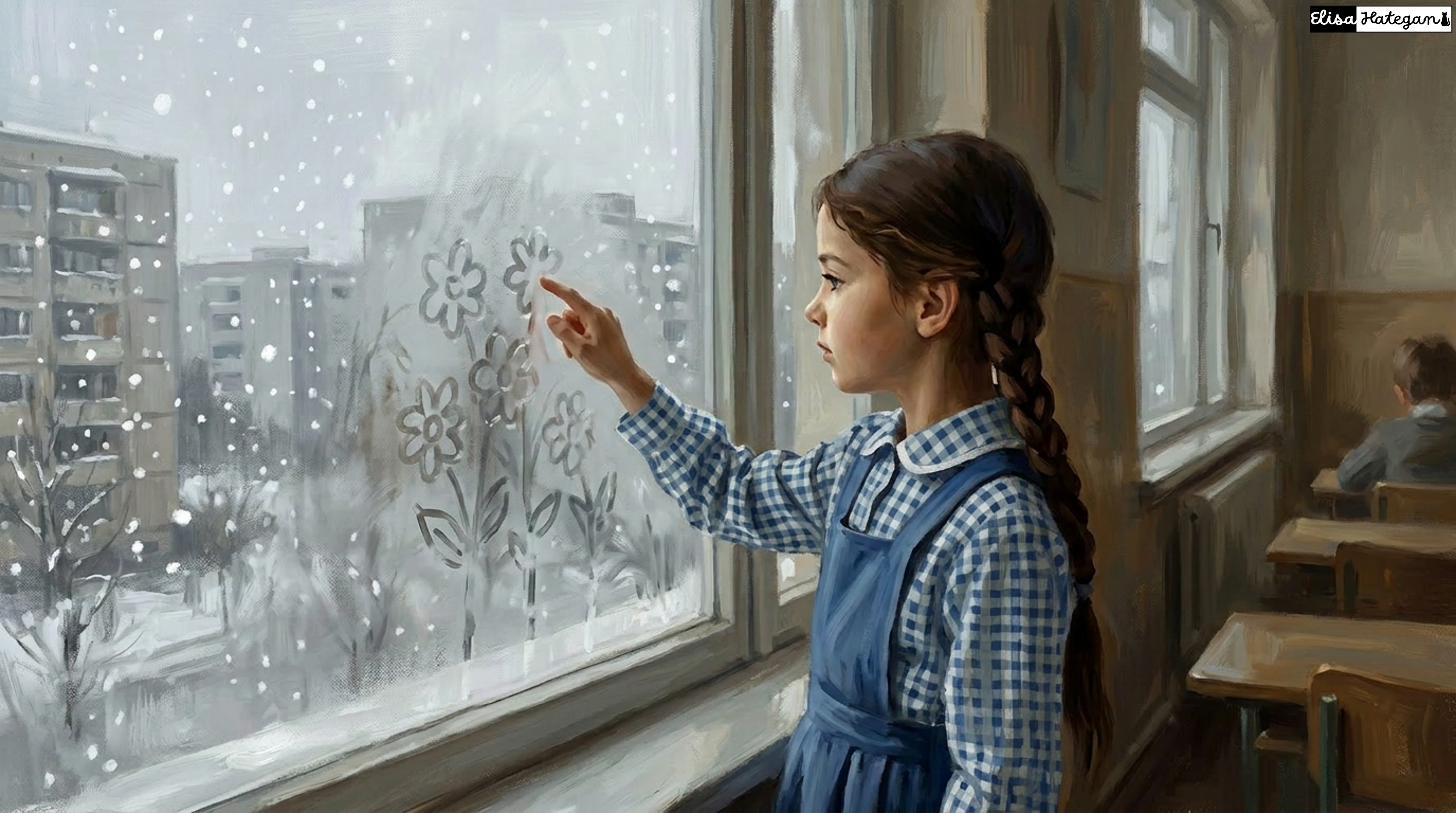
A woman’s hand mirror left on a dresser after the woman who used it has gone, still reflecting the room, though no one is left to be reflected.
It reflects anyway. Because it knows no other way to be.
END OF PART 1
The Mirror’s Daughter is an excerpt from an upcoming longer project with the same title. Subscribe to this blog for details. If you enjoyed this piece, please consider making a contribution to my fundraiser to raise legal funds for my lawsuit against Caryma Sa’d.
PLEASE HELP. Every dollar helps, and you can donate anonymously. If you can’t spare a dollar, please share this post so others can hopefully help.
https://gogetfunding.com/support-my-lawsuit-against-caryma-sad/
Comments
Nothing yet. Say the first thing.
Sign in to join the conversation.