
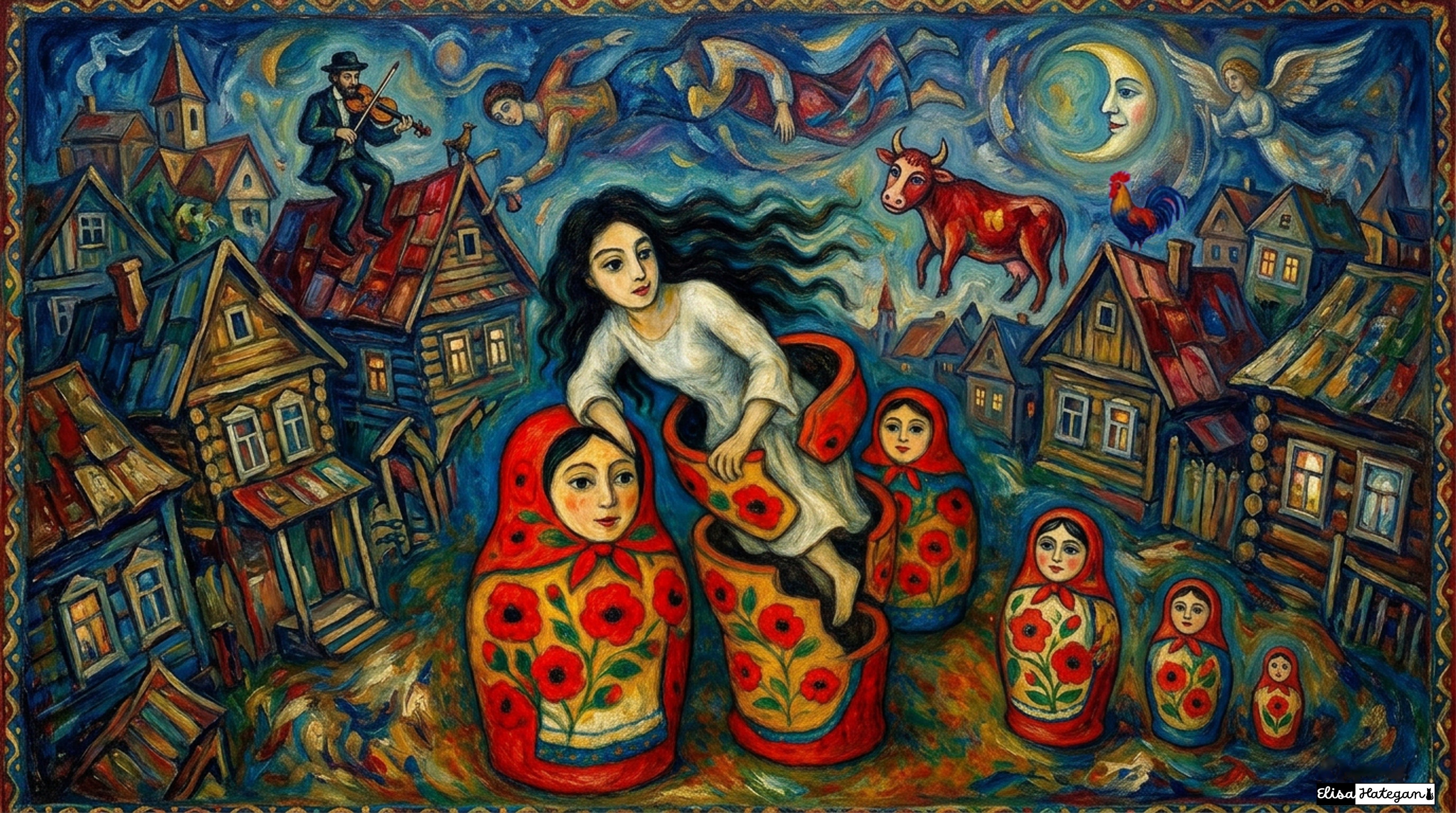
As a child, I collected babushka dolls which I arranged in a row on the little table that doubled as my homework desk, then spent what felt like hours taking them apart and reassembling them. The ritual mattered more than the display: the lifting of the waist, the quiet pop of two wooden halves separating, the revealed smaller self inside. And then again — pop — another smaller self. And again. Until, at last, I reached the innermost figure: solid, unpainted, smooth as a river stone. A doll that contained nothing but itself.
I did not know then that I was practicing a form of archaeology. I didn’t know that what enchanted me — the idea of the thing nested inside the thing inside the thing — would become, in time, a map of everything I understood about identity, about inheritance, about the long and unfinished business of being human.
I did not know that the Russian word matryoshka, which gives these dolls their name, is derived from the Latin mater — mother. That they are, in the truest sense, a portrait of mothers begetting daughters begetting daughters, all the way down.
Nor did I know that the egg, which I collected from my grandmother’s chicken coop and encountered years later on a Passover Seder plate, was the same object, wearing a different skin.
That egg, like the doll, is a sealed world. It contains, in its vulnerability, the blueprint of everything that will follow. Open it, and you find life. Crack it wrong, and life spills out, irretrievable. It holds within its membrane the oldest question any living creature can ask: What, exactly, am I carrying? And what, at last, am I becoming?
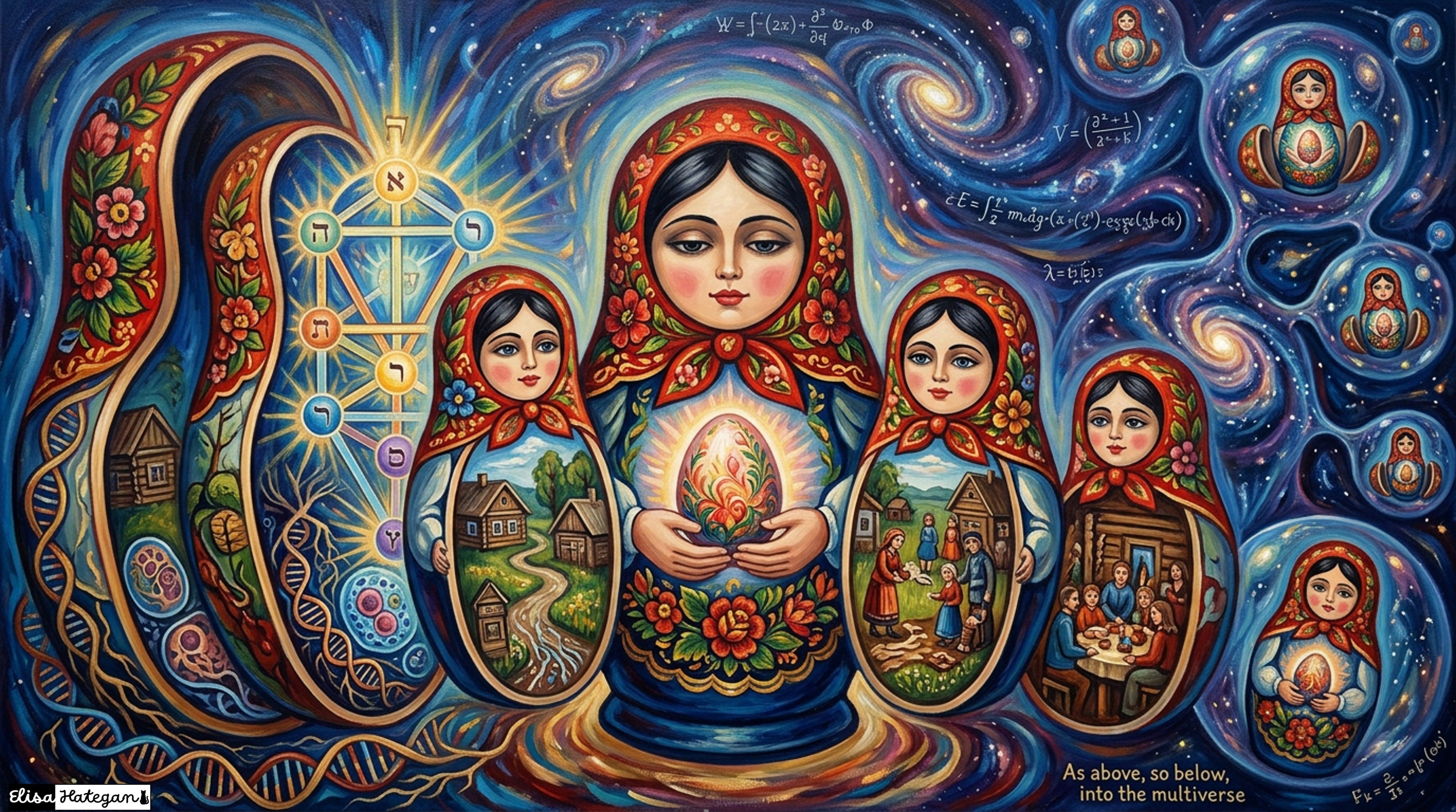
These two objects — the matryoshka and the egg — have been among my conceptual archetypes for much of my adult life. Together, they form a theory of transformation that moves from the microcosm to the macrocosm. It moves across scales: from the individual’s biology of intergenerational inherited trauma, to the Kabbalistic cosmos, to the speculative frontiers of quantum physics. From the shtetl to the multiverse.
And at every scale, the same uncanny structure repeats: shell within shell within shell, all the way down, all the way up, all the way out, worlds without end.
Let me begin in the body, which is where everything corporeal begins.
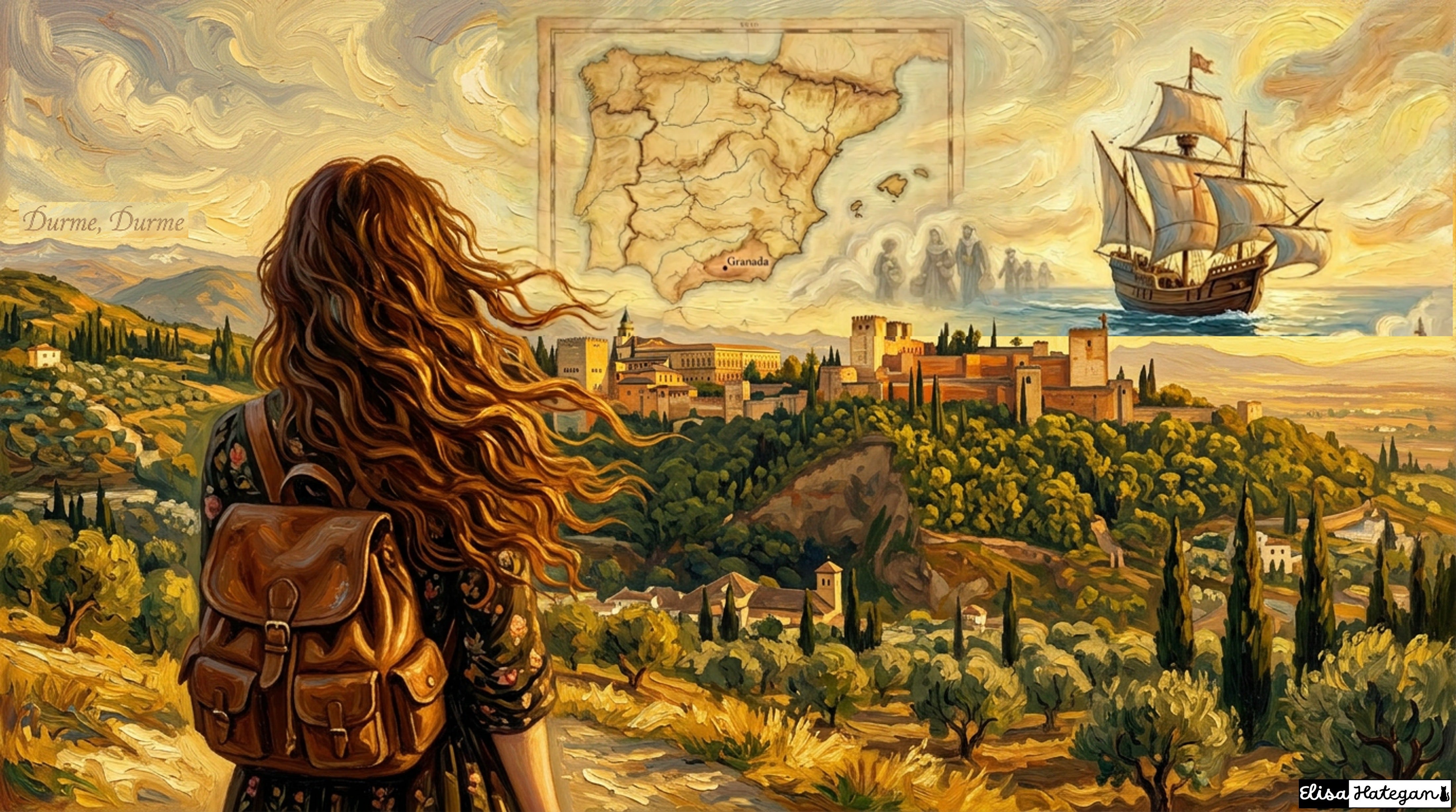
The summer after I graduated university, I went backpacking across Europe, starting in Paris and moving southward toward Spain. It was the kind of journey young people take when they have just enough education to feel the pull of history but not enough experience to understand how thoroughly history will pull back. I was drawn to the south — to Granada, to the ochre fortresses and the dry white-hot air and the ghost of Federico García Lorca, my favourite poet during my student years, who had loved this city and died for loving freedom and truth and love itself.
It was there, at the foothills of the Alhambra, that I heard the Ladino language for the first time. Or rather, that I recognized it — a different thing entirely. The song was “Durme, Durme,” an ancient lullaby carried by the Sephardic Jews of Spain before Queen Isabella expelled them from the Iberian Peninsula in 1492. I heard it drifting from somewhere I couldn’t identify — a shop, a patio, the shade of an awning — and my mouth began to shape the words before my mind could catch up. I started to hum. I knew the melody in the way you know something you have never consciously learned: the way you know, without looking, that your mother is behind you.
I was not Jewish — or so I believed. My father had died when I was thirteen, before I could ask him the particular questions that only become urgent in retrospect. And while my paternal grandmother had always insisted on never mixing meat with milk and told me that back when she was a girl, Saturdays had been her day of rest instead of Sunday, she died when I was 11 and took her secrets with her. And so I filed the experience under the vast and inexplicable category of déjà vu, and moved on.
Weeks later, I stood in the barracks of Auschwitz-Birkenau, with the August sun high and the grass knee-tall, and the same thing happened. The same terrible recognition. I closed my eyes and inhaled and I knew the smell — burning ash, wet wood, fear so old it had sedimented into the earth itself. The certainty that rose in me was not grief exactly. It was older than grief. It was my body’s insistence that it had been here before, though my mind could provide no evidence, no documentation, no reasonable chain of cause.
Years later, an ancestral DNA kit would give me language for what my body already knew and my relatives’ anecdotal tales had whispered: my paternal family had been Jewish. Ashkenazi and Sephardic blood both, to be precise, mixed in the Bukovinian and Transylvanian villages where my father’s people had lived for generations. My family also had Roma roots — another people with a tragic collective memory of suffering — which explained other things: a shade of red that always felt like home, certain music that unraveled me for no articulable reason, that perpetual reaching for something just beyond the fingertips.
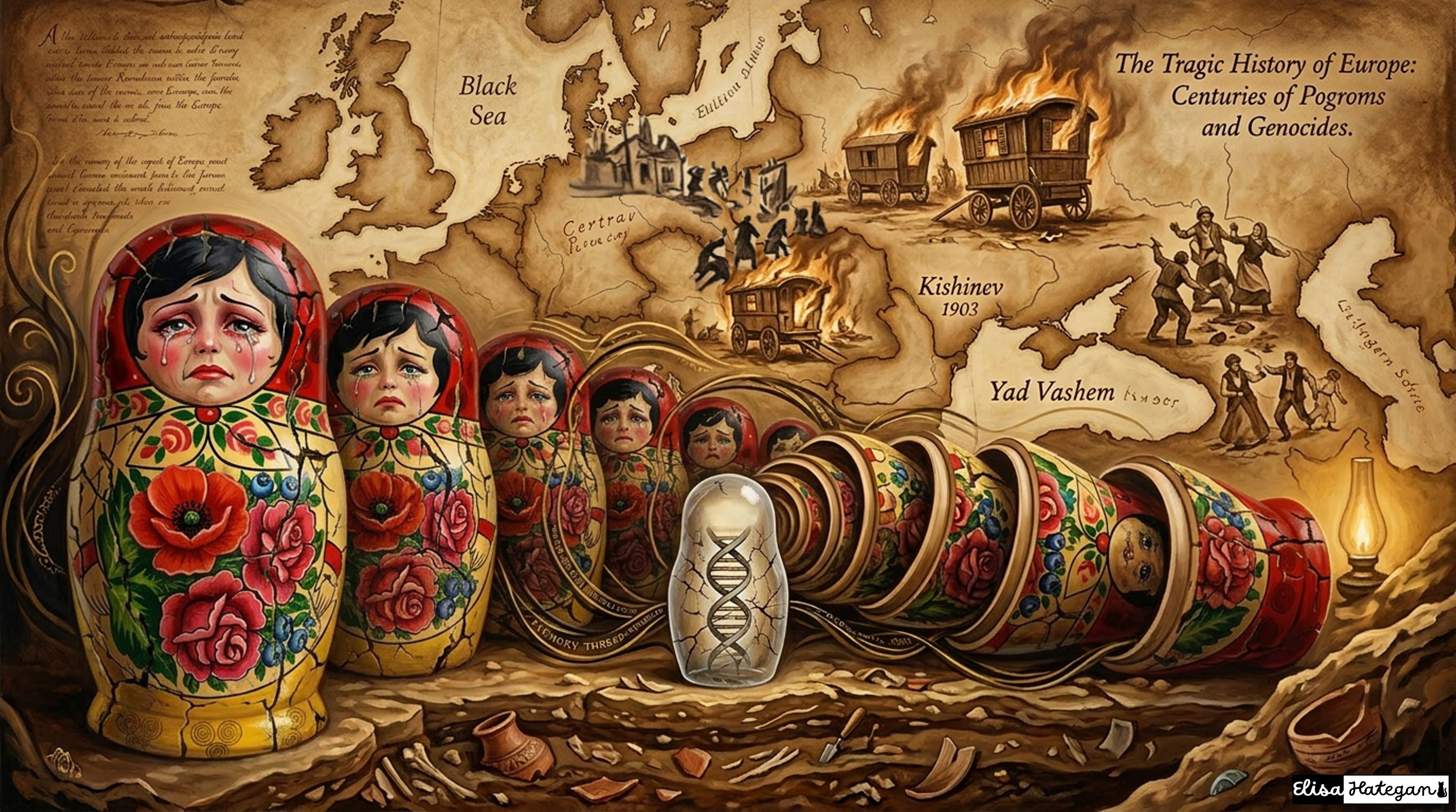
This is what the science of epigenetics would eventually try to tell us in its careful, replicable, peer-reviewed language: that the body remembers what the mind has never been told. That we are all, in some measurable and molecular sense, our ancestors.
— II —
The field of epigenetics — the study of heritable changes in gene expression that do not involve alterations to the DNA sequence itself — is not quite new, but it remains, in the popular imagination, faintly scandalous. It carries the whiff of Lamarckism, which is to say it carries the whiff of a nineteenth-century French biologist named Jean-Baptiste de Lamarck, who had the misfortune of proposing ideas about inherited experience that were so thoroughly discredited by the rise of Darwinian orthodoxy that they became, for over a century, a kind of intellectual insult. To call someone a Lamarckist was to accuse them of sentimentality dressed up as science.
But Lamarck was not wrong in the way his detractors insisted. His error was in the mechanism, not the intuition. He could not have known about the chemical messengers — the methyl groups and histone proteins — that wrap and unwrap our DNA, turning genes on and off in response to lived experience, and passing those configurations on to the next generation.
He could not have known that the body keeps a ledger.
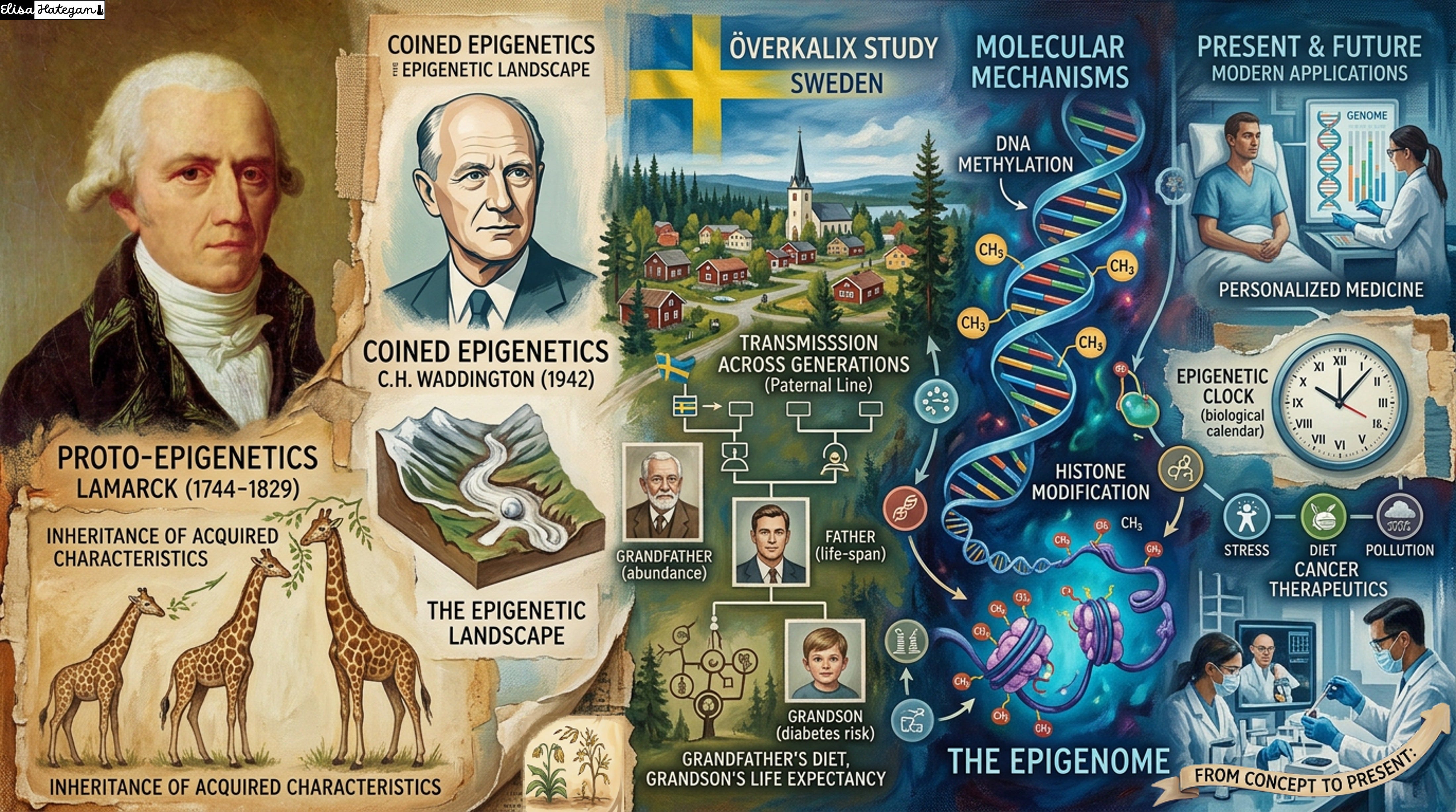
In the 1990s, researchers at the Karolinska Institute in Stockholm began examining records from an isolated nineteenth-century province in northern Sweden called Överkalix, which had experienced cycles of devastating famine followed by years of over-abundance. What they found: the nutritional conditions experienced by a grandparent — not just a parent, but a grandparent — during a critical period of their prepubescent development had measurable effects on the health and longevity of their grandchildren. For example, grandfathers who had experienced famine in boyhood had grandchildren who lived significantly longer. Grandfathers who had gorged during years of feast had grandchildren at elevated risk of diabetes and cardiovascular disease. The body of the grandfather, stressed or surfeited, sent a message forward in time, encoded in something more intimate than language.
Then, in 2013, a neuroscientist named Brian Dias, working at Emory University, exposed mice to the scent of cherry blossoms while simultaneously delivering small electric shocks to their feet. The scared mice paired pain with the cherry blossoms, and learned to fear the smell. What Dias demonstrated next was astonishing: the offspring of those mice — conceived after the conditioning, and raised without ever meeting their fathers — also exhibited fear responses to cherry blossoms. As did their offspring. Three generations, carrying the specific imprint of a trauma they had never personally experienced, encoded in the very receptors of the olfactory system.
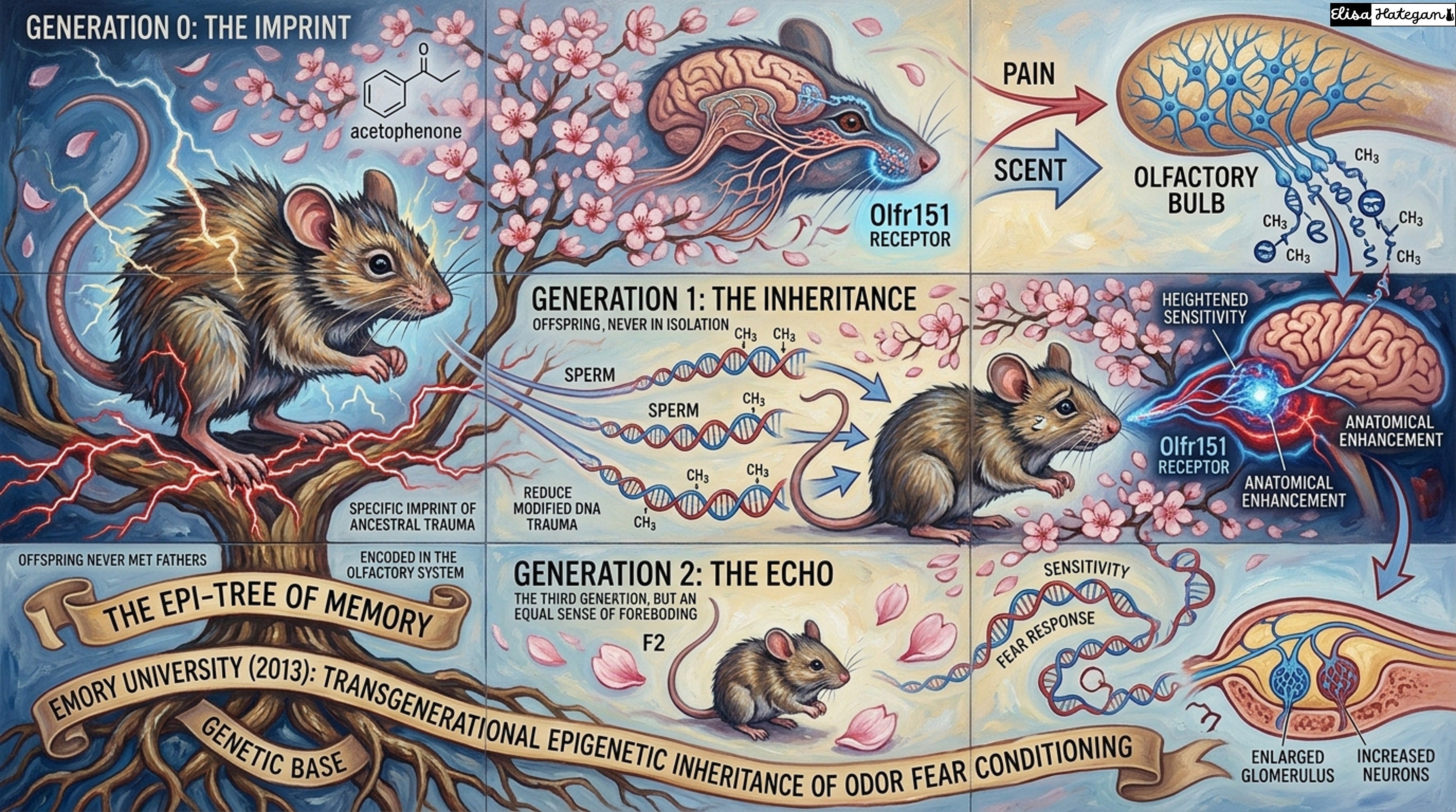
Skepticism proliferated immediately on social media, as it always does when a finding feels too resonant to be true. “Crazy Lamarckian shit,” one prominent biologist tweeted. But the data held. And the implications are staggering.
They suggest that the Holocaust survivor’s grandchild who wakes at 3 a.m. in a cold sweat, with no memory and no reason; the descendant of enslaved people who carries an inexplicable wariness in the body, a vigilance that seems to exceed the present circumstances — these are not simply people who have absorbed stories. They are people whose nervous systems have been sculpted by events they did not witness. The doll within the doll within the doll. Fear remembered in the very architecture of the nose.
This is intergenerational trauma. It is not metaphor. It is molecular biology. And it is, I would argue, the most important scientific discovery of our era, because it requires us to fundamentally reconsider what it means to be an individual, a self, a person beginning cleanly at birth.
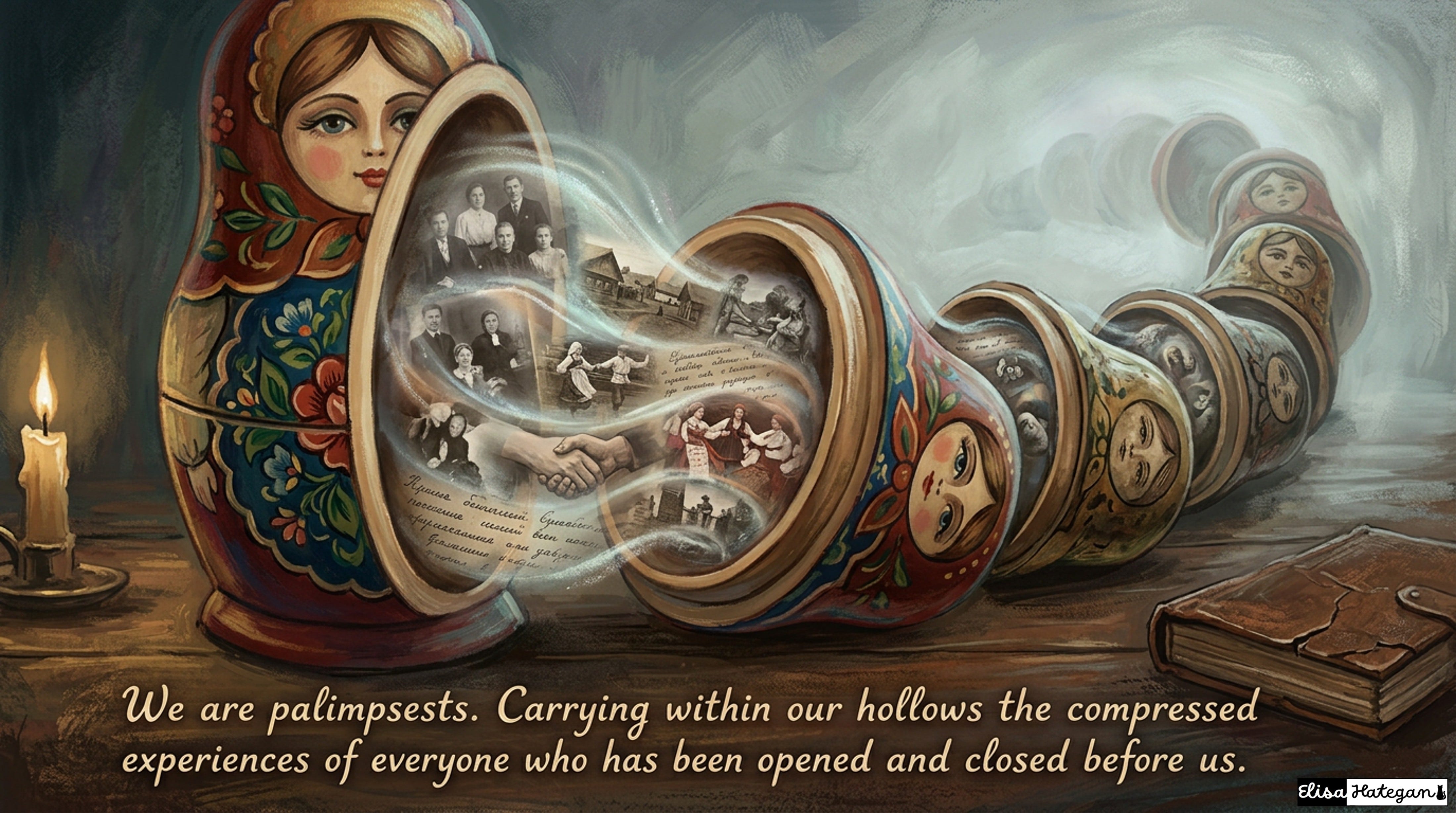
We are not, any of us, a first edition. We are palimpsests. We are the latest nesting doll in an infinite set, carrying within our hollows the compressed experiences of everyone who has been opened and closed before us.
We are their conduits. Our survival is both echo and testament to their endurance.
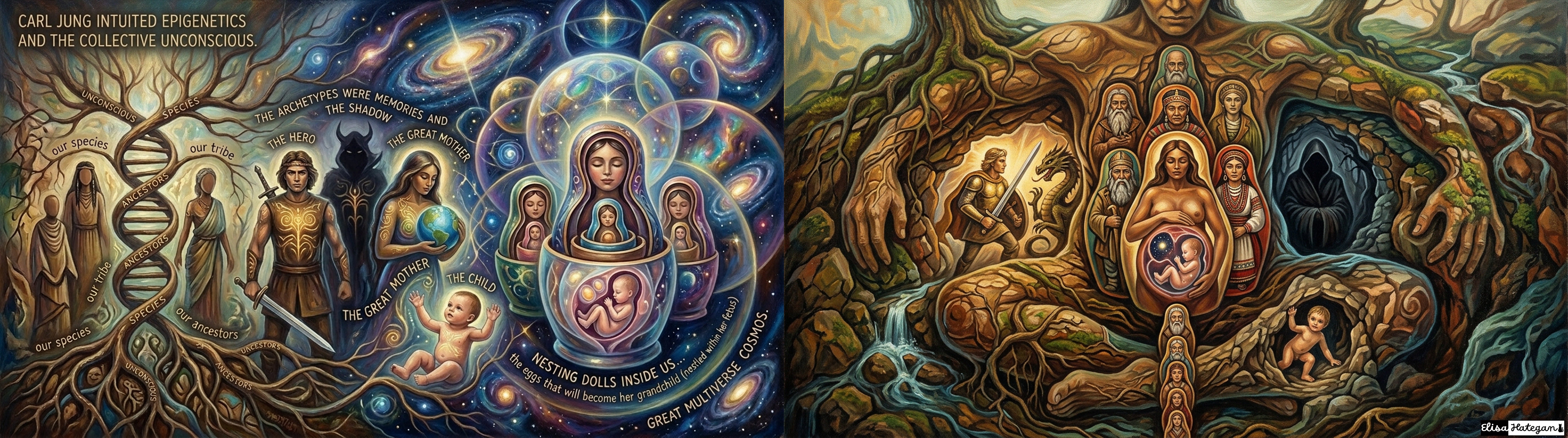
Carl Jung intuited something like this when he wrote of the collective unconscious — that stratum of the psyche that we do not construct from personal experience but inherit from our species, from our tribe, from our ancestors. For Jung, the archetypes were not inventions of individual minds but memories so old and so repeated that they had become structural. They were built in – The hero. The shadow. The great mother. The child. Just as every pregnant woman who carries a female fetus is also carrying the eggs that will become her grandchild (nestled within her fetus), all of them were dolls inside us before we were born.
— III —
The Kabbalists understood this long before the scientists arrived.
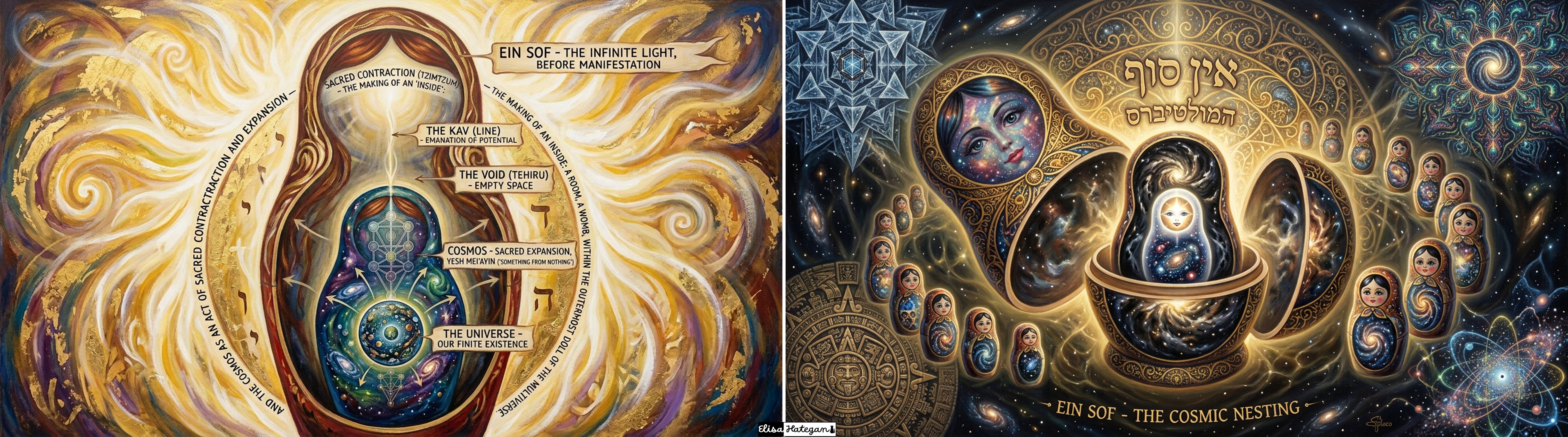
In the mystical Jewish tradition, there is a concept called tzimtzum — the contraction. Before creation, according to the Lurianic Kabbalah of sixteenth-century Safed, the infinite divine light — the Ein Sof — filled everything, everywhere, without boundary. In order for the world to exist, God had to withdraw, to contract, to make a hollow space within the plenum of divinity. Into that hollow, a ray of light entered, and from that light, creation unfolded. The world was born inside the cavity made by God’s self-reduction.
Think of it: the universe as the innermost doll, resting in the space that God (or the Oneness, as I call it) created by pulling inward. The cosmos as an act of sacred contraction and expansion — the making of an inside: a room, a womb, within the outermost doll of the multiverse. If there is a more precise metaphysical description of the matryoshka analogy, I have not encountered it.
The Talmud, in Tractate Sanhedrin, makes a related claim about human beings: “Whoever saves a single soul, it is as if they have saved an entire world.” The reverse is equally implied – Whoever destroys a single soul destroys an entire world.
The teaching does not speak of souls as units in a population, as points on a ledger. It speaks of each soul as a complete universe, sealed inside a body the way a universe is sealed inside a cosmic egg. Every person you have ever met, or failed to meet, or killed, or saved — every one of them was a world. A whole cosmos, a brand new timeline of probabilities waiting to unfold.
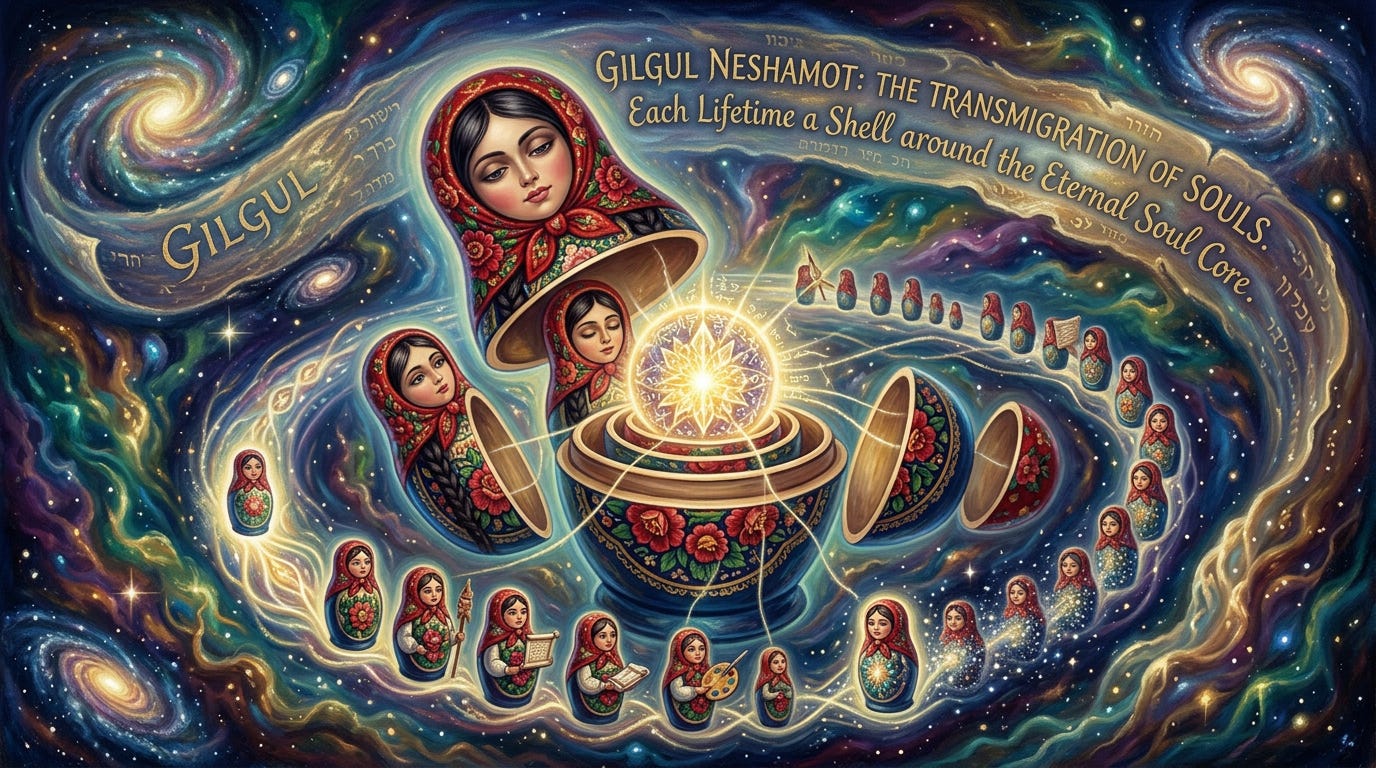
There is also the concept of gilgul neshamot — the transmigration of souls — which runs through the mystical tradition with more force than mainstream Judaism is comfortable acknowledging. The soul, in this understanding, does not make only one journey. It passes through multiple lives, accumulating experiences, working out unfinished spiritual business, returning to the world again and again until it has, in some sense, become whole. The soul, too, is a nesting doll: each lifetime a shell around the core that moves beneath them all.
And then there is tikkun olam: Repair of the world. The idea that we are each responsible not simply for our own lives but for reassembling the broken vessels of creation — the shards of divine light that scattered at the moment the world was made.
You carry the damage done or suffered by your ancestors. You also carry, in your very existence, the obligation to do something with it. To transform it. Not to erase it, but to gather the broken pieces and make something new from the gathering.
My grandmother never spoke about the things that had happened to her people. But I believe now that when I sat at her table and absorbed her silences, her quality of alertness, her habit of keeping the pantry stocked as though scarcity could return at any moment — I was receiving something. A transmission without words. A Yiddish parable whose language I would spend decades learning to read.
The old stories also speak of a haunting image: the tzaddik nistar — the hidden righteous one, the person in every generation who sustains the world by their secret goodness, who nobody recognizes, who walks among us unannounced. The Talmudic tradition holds that there are thirty-six such people alive at any given moment, and that without them, the world would dissolve. You may have passed one on the street this morning. You may have been one, in some moment you have already forgotten.
What’s striking about this image is the nesting logic it implies — the righteous person contains, in their hidden interior, the entire weight of the world. They are small. They may be very ordinary to look at. But inside them is the thing that holds everything together. The innermost doll, which is not nothing but everything.
— IV —
The Greeks and Egyptians had their own version of the cosmic egg, and it is older and beautifully stranger than almost anything in the Western canonical tradition.
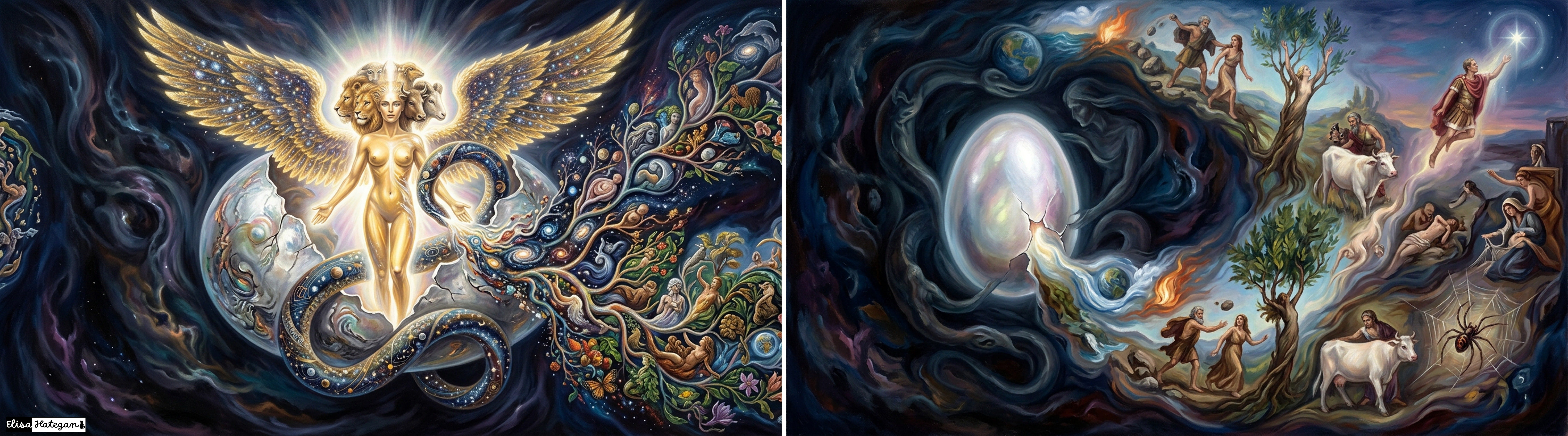
The Egyptians believed that the sun god Ra (and by extension the universe) hatched from a “cosmic egg”. In the Greeks’ Orphic cosmogony — the creation myth of the mystery religion devoted to the figure of Orpheus — the universe also began as an egg. A silver egg, floating in the darkness before time, formed from the union of the primordial elements. From this egg hatched Phanes, also called Protogonos — the Firstborn, the Shining One — a hermaphroditic deity of light who carried within its divine body the seeds of all subsequent creation. Phanes was, in the most literal sense, a world hatching from a shell. And this first hatching set off the chain of worlds: every subsequent god and creature emerging, in some sense, from the same originating rupture.
Ovid, writing in the first century before the common era, did not subscribe to the Orphic egg myth, but he was obsessed with transformation. The Metamorphoses — his great, shape-shifting encyclopedia of change — is structured as an unbroken chain of transformation: one thing becoming another thing becoming another thing, from the formation of the world out of chaos to the deification of Julius Caesar. In Ovid’s universe, nothing is stable, nothing is finished, everything is always already in the process of becoming something else. The world is not a static arrangement of entities but a continuous verb.
This is the Roman version of what epigenetics is telling us: that you are a process. That you are not who you are but who you are becoming, and that the becoming is already underway in the molecular memory of your cells, inherited from people who are dead.
The Phoenix, that most famous of mythological birds, is not strictly Egyptian in origin. The Greeks called it the Phoinix and positioned it at the margins of the known world, in Arabia or Ethiopia. They were specific about its transformation: the bird lived five hundred years, then built a nest of myrrh and frankincense, ignited it with the beating of its wings and the sun’s flames, burned itself to death, and was born again from its own ashes — as a young, new, immortal phoenix.
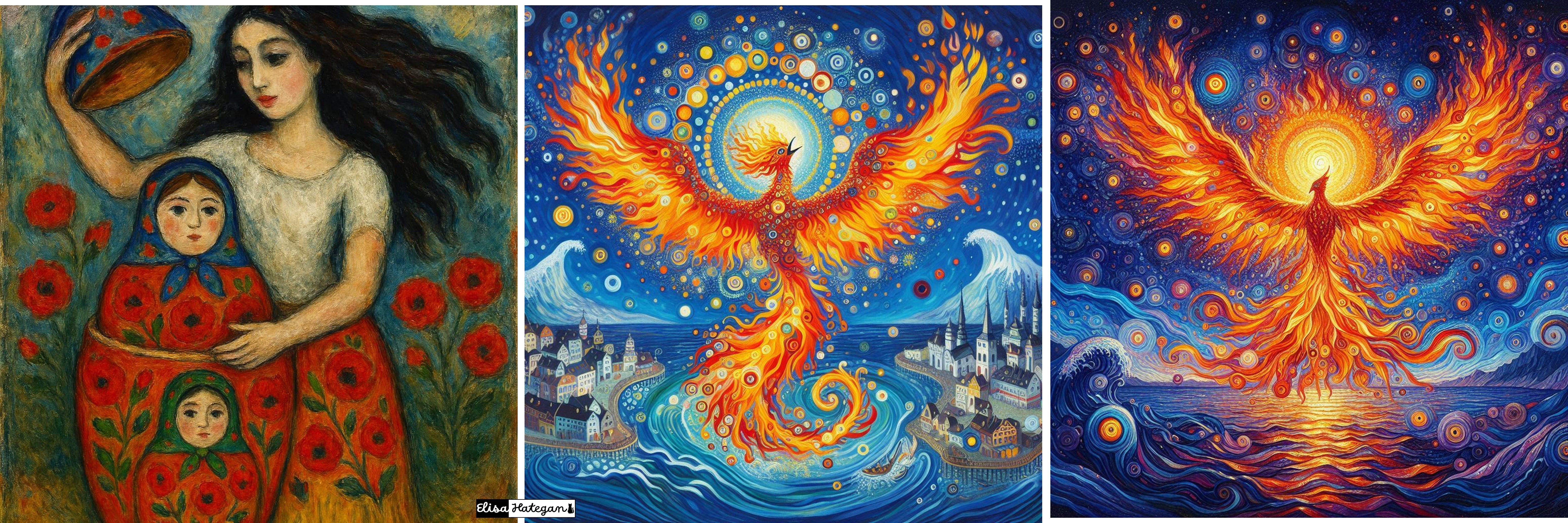
It did not escape destruction. It required destruction. The new creature could only emerge from the absolute dissolution of the old one.
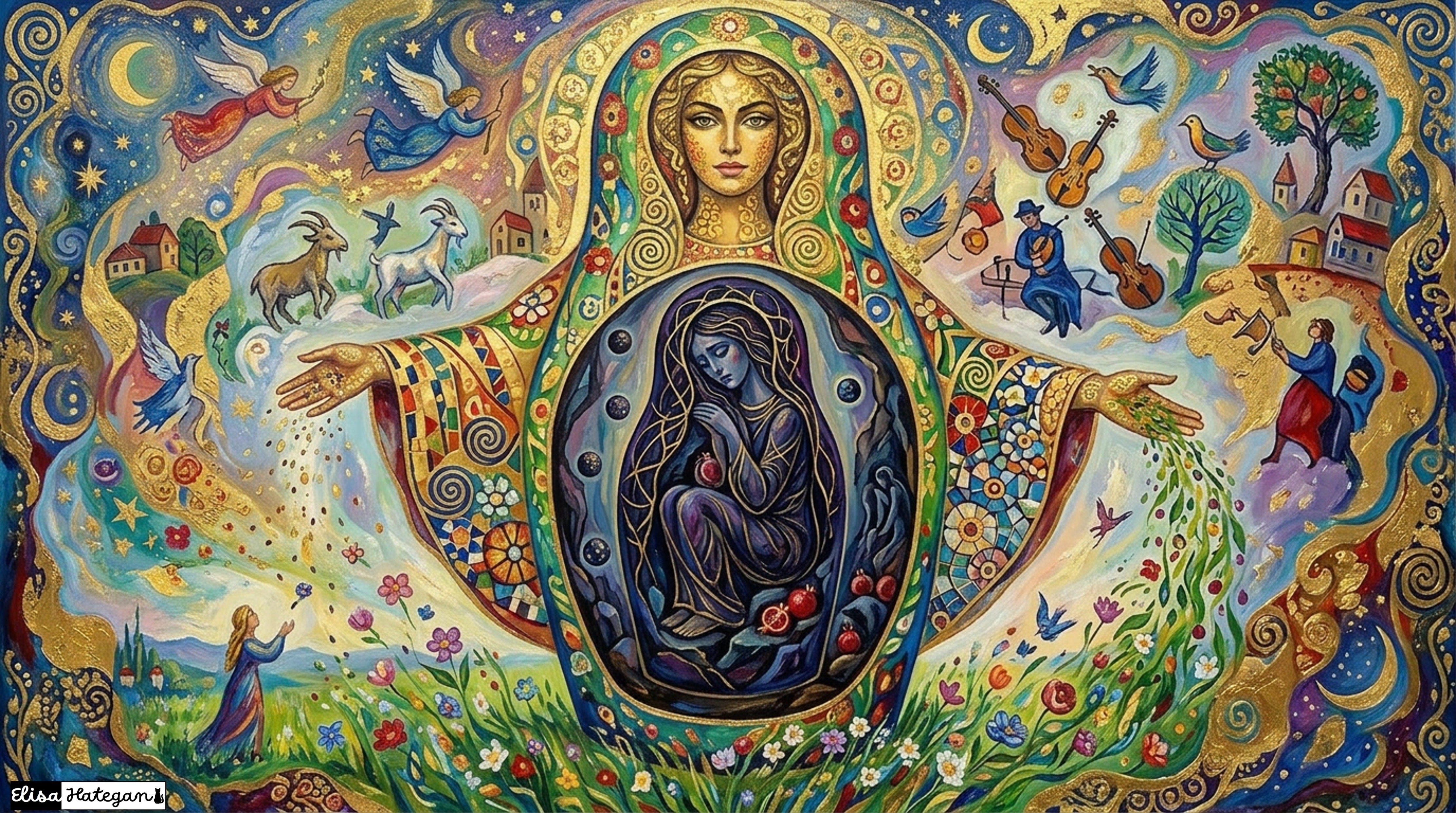
And Persephone, the beautiful and fierce daughter of Demeter, who was taken down into the underworld, where she ate six pomegranate seeds and was thereafter bound to spend six months of every year in darkness. She is not simply the myth of the seasons - she is the myth of the self that descends, that suffers, that cannot return exactly as it was, but returns nonetheless. Every spring she rises, carrying six months of shadows inside her. Her transformation is not elective. It was done to her. And yet here she is, greening the earth again, because she survived the descent and came back, carrying her darkness like a nesting doll inside her light.
— V —
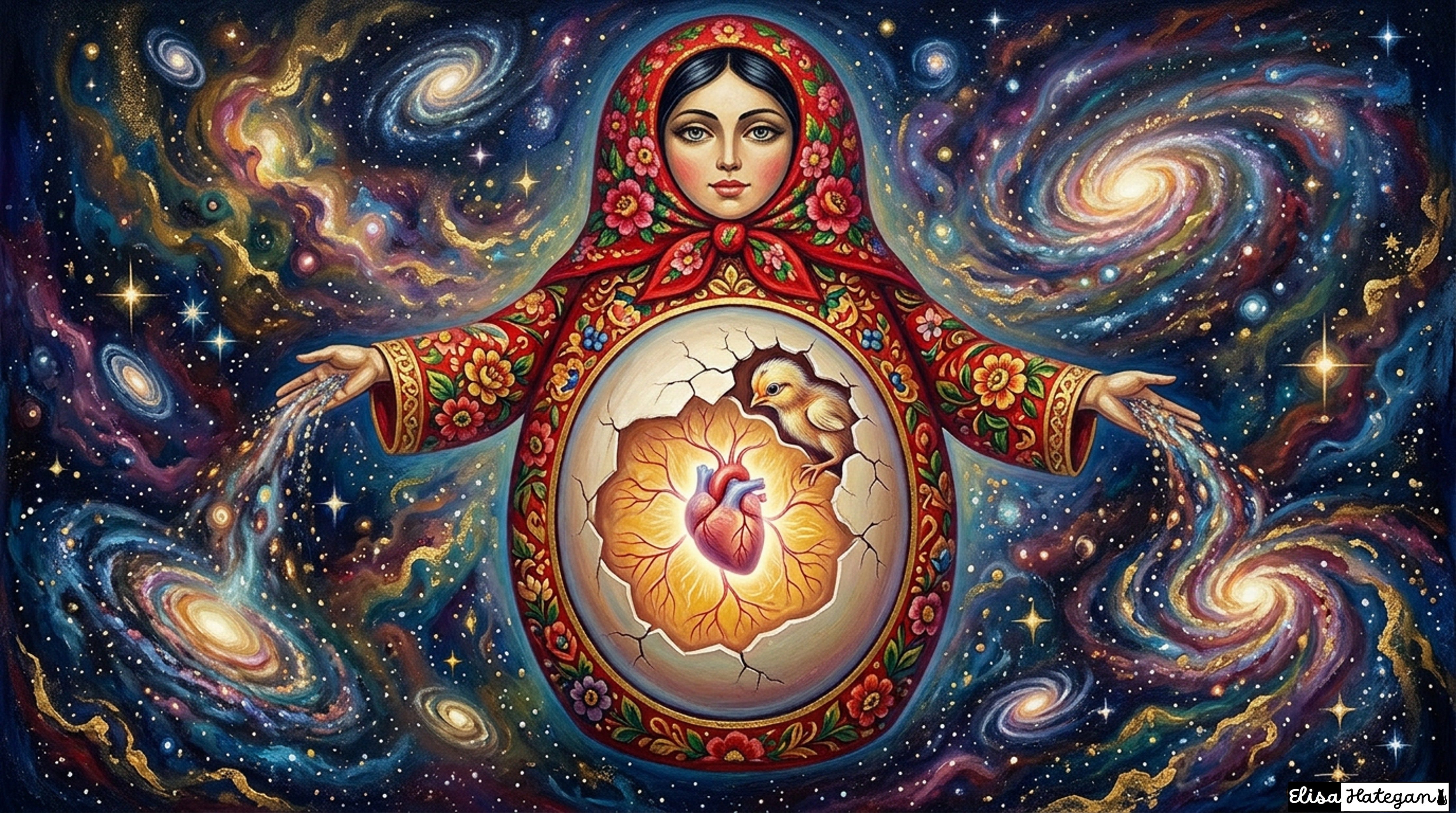
On the Seder plate — the ceremonial arrangement of symbolic foods at the Passover meal — there is an egg. It is called the beitzah. It is roasted, hard-boiled, and it is the one object among all the objects on the plate whose symbolism is most deliberately paradoxical. The egg represents the korban chagigah, the festival offering brought to the Temple in Jerusalem. It represents mourning — for the Temple’s destruction, for all the catastrophes that have befallen the Jewish people across millennia. And it represents hope: the cyclicism of life, the promise that what appears finished is not finished, that the shell is not the whole story. Its roundness is intentional: no beginning, no end. The conversation is still going.
Did you know that the egg is the only food that becomes harder the longer it is cooked? It’s true. Everything else softens, dissolves, breaks down in the heat. The egg hardens. The rabbis interpreted this as a description of the Jewish people themselves — that every oppression, every furnace, every attempt to dissolve them through heat and force, produced only further consolidation. You cannot boil the life out of an egg. You can only change its texture.
An egg is a sealed world. It contains, in its millimeters of calcite shell, everything necessary for the emergence of a new creature. It requires warmth and time and otherwise it simply waits, in the darkness, doing the slow, unobservable work of becoming. Inside, a heart forms first. Always the heart first.
The egg does not know, from the inside, what it will encounter when it cracks. The chick has no information about the world beyond the shell. It pecks blindly, driven only by the imperative to get out, to get through, to break the surface. Like a snowdrop seed bursting through mud and snow and ice, to spurt into an incandescent spring. The whole of life compressed into that blind, necessary hammering.
The Hebrew word for egg — beitzah — shares a root with the word for desire, for longing, for the want that precedes its own object. The egg does not know what it wants to become. It only knows that it must.
— VI —
Here is where the scales shift, and the metaphor begins to breathe in all directions at once. The egg is the universe.
The dominant model of cosmological origins holds that all of existence — all matter, all energy, all space, all time — was once compressed into an unimaginably dense singularity, a point so small it had no interior – and then it expanded. We call this the Big Bang, though the name is misleading. It was not an explosion in space. It was the creation of space. A shell cracking outward. A universe hatching.
The Orphic egg was more than myth. The ancients were describing, in the only language available to them, something they had somehow sensed: that the universe began as a sealed potential, and that everything we know is the consequence of a single, radical opening.
And if our universe hatched from an egg — if the Big Bang is the cosmic equivalent of the chick breaking through the shell — then what are we to make of the possibility that our universe is itself nested inside a larger structure?
This is the terrain of multiverse theory – still contested, still deeply strange, but a theory that makes absolute sense to me. The hypothesis holds that our universe is not the only one, that there may be a vast and perhaps infinite ensemble of universes, each with its own physical laws, its own constants, its own history of hatching. Our universe inside a larger structure inside a larger structure, each scale of existence nested within the next like a set of matryoshkas spiraling into a Fibonacci-esque infinity.
The physicist Andrei Linde, one of the architects of inflationary cosmology, has described this as “eternal inflation” — the idea that the process that generated our universe is still ongoing elsewhere, spinning off bubble universes as a pot of boiling water spins off bubbles, each bubble a new cosmos, sealed from the others, evolving according to its own logic. Fractals birthing fractals.
We cannot see the other dolls. We can only infer them from the structure of the one we inhabit. But the structure insists: we are not the outermost shell.
I find in this image something that isn’t diminishing, but exhilarating. To be one doll in an infinite set is not to be insignificant. It is to be part of a pattern that repeats across every scale of existence. The double helix, which carries the code of life, is itself a nesting structure: two spirals wound around each other, each rung of the ladder a relationship, an entanglement, a message passed from one strand to the other. The atom, which we once thought the smallest possible unit of matter, revealed itself to contain protons and neutrons and electrons, and those in turn revealed quarks and gluons, and physicists now suspect there is more structure below that, all the way down to the Planck length, where spacetime itself becomes granular, pixelated, a kind of frozen foam.
This is not merely a feature of the very large and the very small. The principle of nesting symmetry — the same pattern repeating at every scale — is the organizing grammar of life itself, written into every level of the biological world with a consistency that borders on insistence.
A single human cell is not a building block in the architectural sense, a passive brick stacked among other bricks. It is an ecosystem: a bounded world with its own governance, its own energy economy, its own internal communication networks firing in coded pulses across distances that are, at the cellular scale, enormous. Inside the cell, the mitochondria — those ancient bacterial refugees who struck a bargain with our ancestors two billion years ago and never left — maintain their own separate genome, their own evolutionary memory, nested within the larger genetic story of the organism that houses them.
Cells within cells. Histories within histories. Every living body is a federation of formerly independent worlds that agreed, at some point lost in time, to share a fate.
Scale outward and the pattern holds. A forest is not a collection of trees. It is a civilization — networked through fungal threads that run for miles beneath the soil, exchanging sugars and phosphorus and chemical warnings about insect attack, a kind of planetary nervous system conducting information in the slow grammar of chemistry. Remove a single species and the network rewires itself, compensates, grieves in the only language available to it: altered chemistry, altered growth.

The ecosystem is alive in the same sense that a cell is alive and a body is alive (and the microbes within it too) and a coral reef is alive — each one a container for complexity, each one held inside a larger container, each one contributing its particular frequency to the hum of the whole. And above all of it, the photons: those massless travelers that carry energy across the unfathomable distances between stars, that make photosynthesis possible, that wrote themselves into the first eyes ever to open on this planet and have been doing so ever since.
A photon is not an inert messenger. It is entangled with the history of its source. It carries, encoded in its wavelength, information about the star that produced it — a star that may no longer exist, speaking across time in the only medium available to the dead: light. From the mitochondrion to the mycorrhizal network to the photon crossing four billion light-years to reach your retina, the same declaration repeats: I am nested. I contain. I am contained. I am not the boundary. I am only the current shell.
Shells within shells. Dolls within dolls.
We live, all of us, inside a set of nesting structures that extends from the scale of our cells to the scale of the cosmos, and at every level, the same principle operates: what appears to be a boundary is actually a container, and what appears to be a container has something living inside it, and that something is also a container, and so on, forever.
The Jewish mystical tradition caught a glimpse of this when it described the Ein Sof — the infinite without end — as the ground of everything. Not a god who is outside creation, looking in. A divinity that is the nested structure itself: infinite layers of containing, each one making room for the next, all the way in, all the way out. The dolls do not end. They only become too small, or too large, for us to see.
— VII —
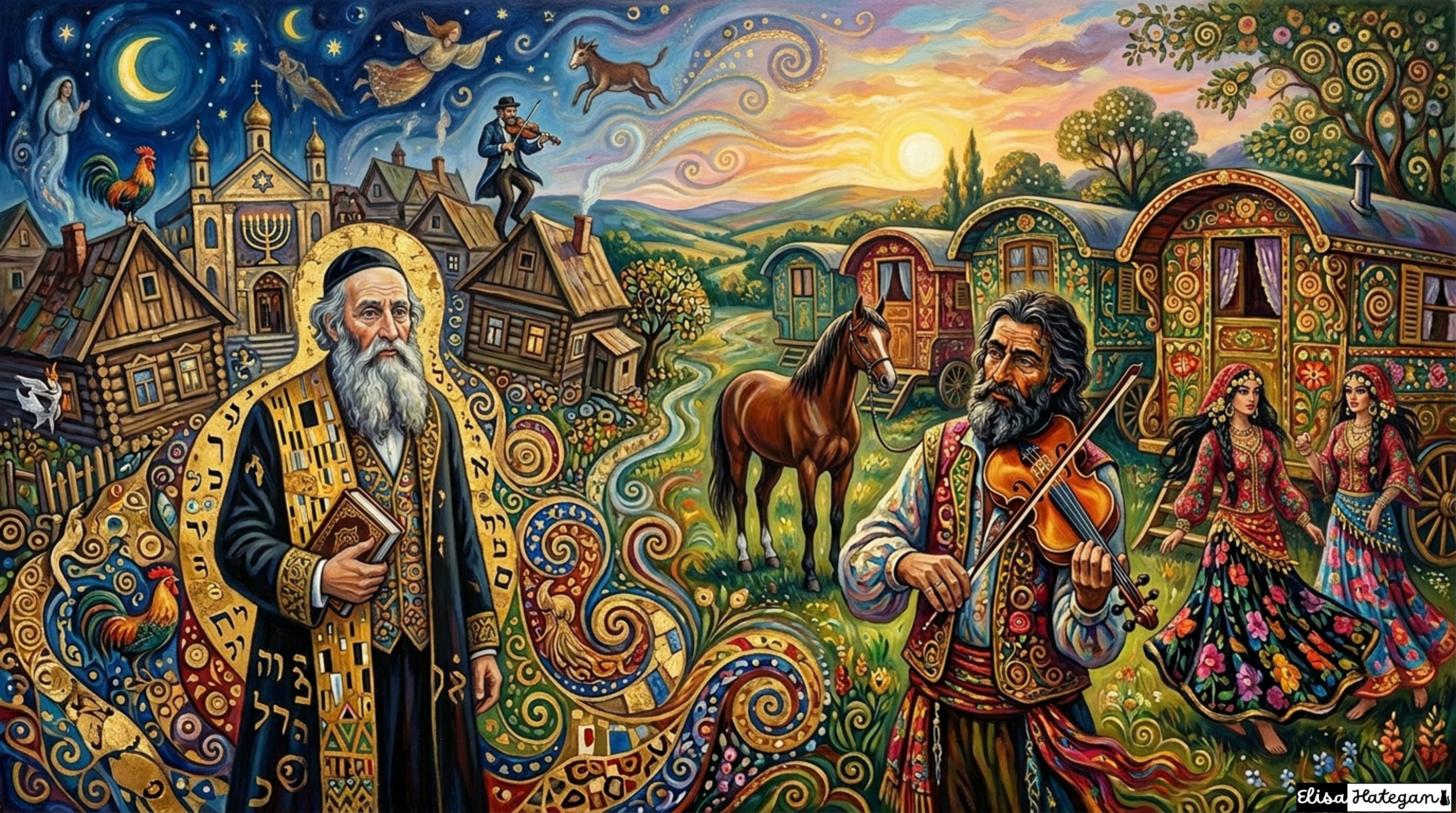
My great-great-grandfather lived in a shtetl in the Carpathian Basin, in a region that has been claimed by four different countries over the course of the last hundred years. He almost certainly did not know what a multiverse was. He almost certainly did not know about epigenetics. He prayed in Hebrew, sold cloth or grain or metalwork, and told his children the same stories his grandparents had told him.
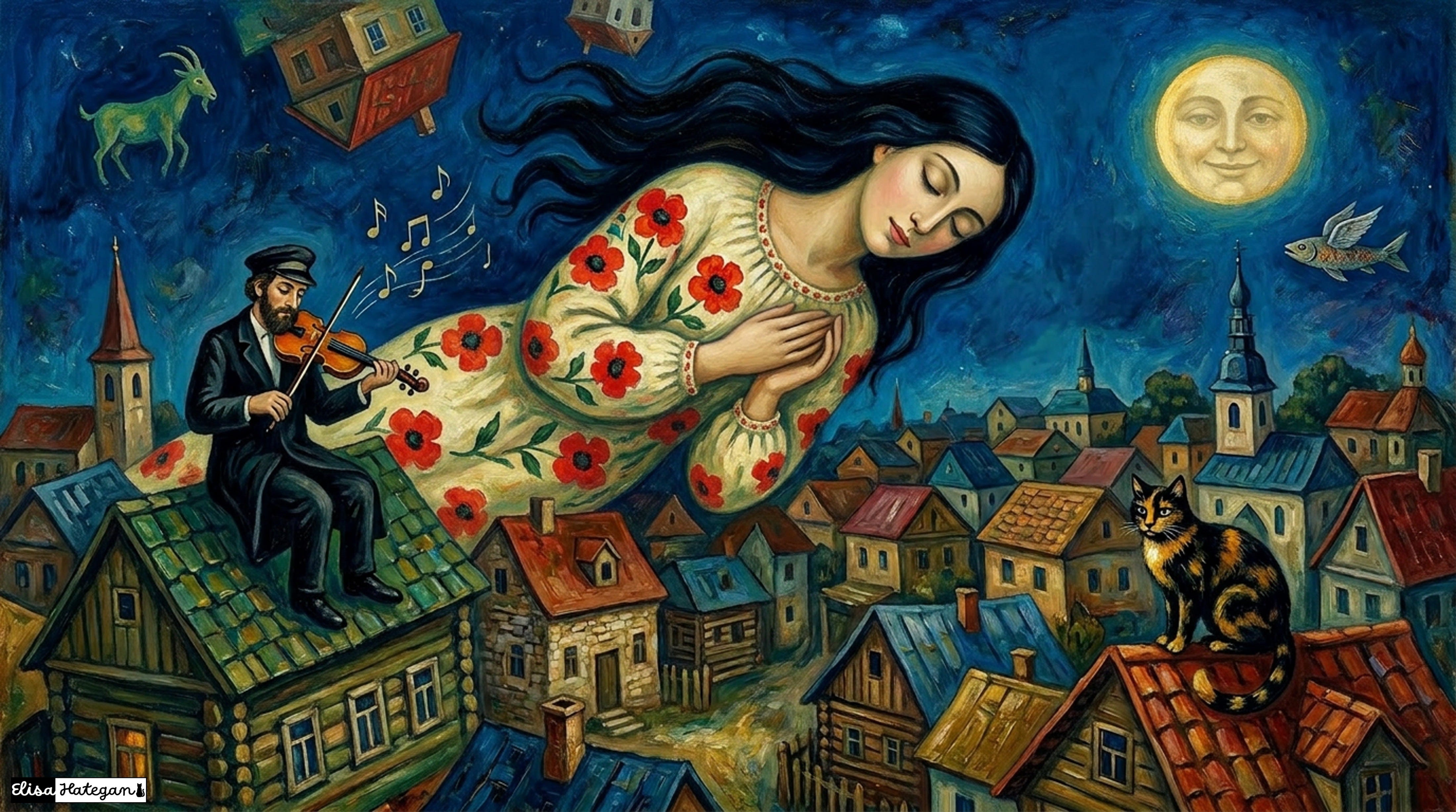
And yet he is here. He is here in the particular quality of anxiety that rises in me when I hear certain combinations of minor-key melody. He is here in the way I hoard cans in the pantry, not because I am hungry but because some deep stratum of the body remembers hunger as a recurring guest. He is here in my tendency to watch doors. To know where the exits are. To keep one part of the mind always scanning, always calculating the distance to the edge of the room.
And there is another ancestor I cannot name, who walked a different kind of road. My Romany great-great-grandfather — a man who exists only as an echo in my blood — almost certainly sold horses, or played the fiddle, or did both. The Roma traveled not in flight but in a kind of sovereign restlessness, a freedom that the settled world has never quite forgiven them for. His people had come, over centuries, from the Punjab, from Rajasthan, from the northwestern reaches of the Indian subcontinent — carrying in their language and music and relationship to fire and to horses the entire distance of that migration, encoded not in documents but in the body, in the wrist’s particular looseness on the bow, in the ear’s attunement to the microtones that European scales leave unnamed.
He moved through green Romanian valleys that were, to him, just the latest iteration of everywhere he had ever been. The Romani word for non-Roma is gadje – a word that means “those who stay”. Those who anchor themselves to a place and call it home. My Roma great-great-grandfather did not stay. He moved – and in moving, he mapped the world onto his nervous system, and then he passed those maps to me. I feel them sometimes when I am restless for no reason, when my mind is most at home in motion, when a certain minor-key melody unravels something in my chest that I could not explain in any language I officially speak. The roads he traveled are in my legs. The music he played is in my hands.
I am his outermost doll. He is my innermost one. Between us stand generations of women and men who suffered or survived or fled or adapted, each one depositing in the cellular archive something that was then passed forward, unopened, into the next iteration. I did not ask to receive these deposits. But I have them. They are mine in the way that a language can be yours even if you learn it by immersion rather than by study: it is in the body now, and you cannot give it back.
The question that interests me is not whether this inheritance is real. The science has established that it is. The question is what we do with it. Whether we become its prisoners or its inheritors: people who receive an estate not to be buried in it, but to live in it, change it, leave it better than they found it.
Tikkun olam. Repair. Not avenge, not pass on destruction upon destruction.
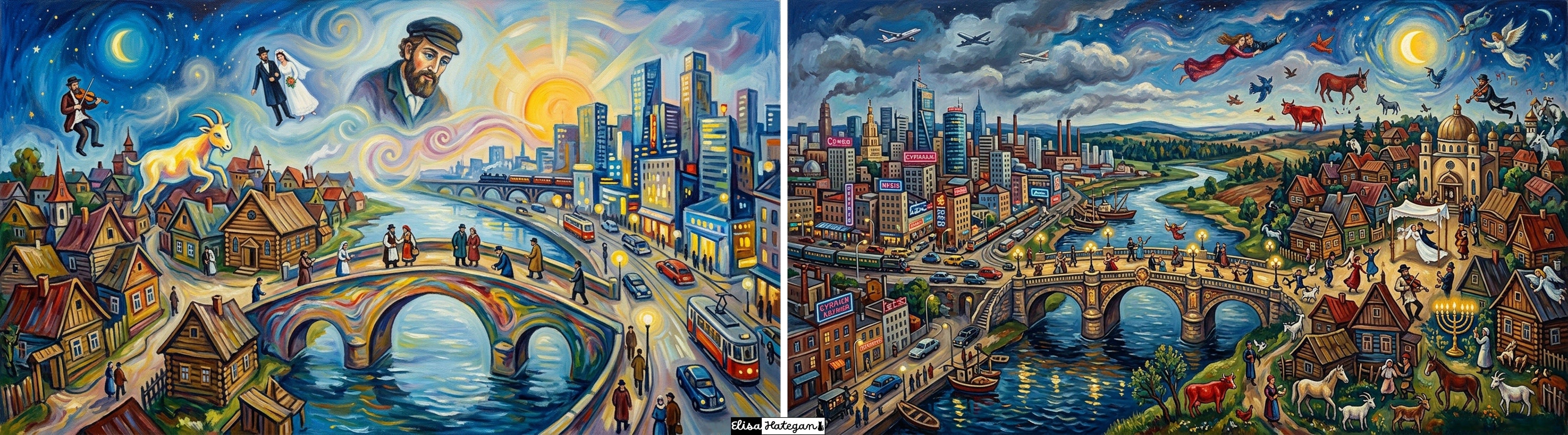
Each year, the Passover Seder asks Jews to experience the Exodus as though it happened to us personally. Not to remember it academically, as a historical event that occurred to other people long ago, but to feel it: the narrow place, the bitterness of slavery remembered in the horseradish bite, the affliction, the parting of the waters, the terrifying freedom. We are commanded not just to inherit the story but to enter it. To pass through it again and emerge, as our people emerged, changed by the crossing.
And then the egg. Always the egg, waiting on the plate. Reminding us that the end of suffering is not the end. That what emerges from the fire is something different from what went in. That the shell will have to crack.
— VIII —
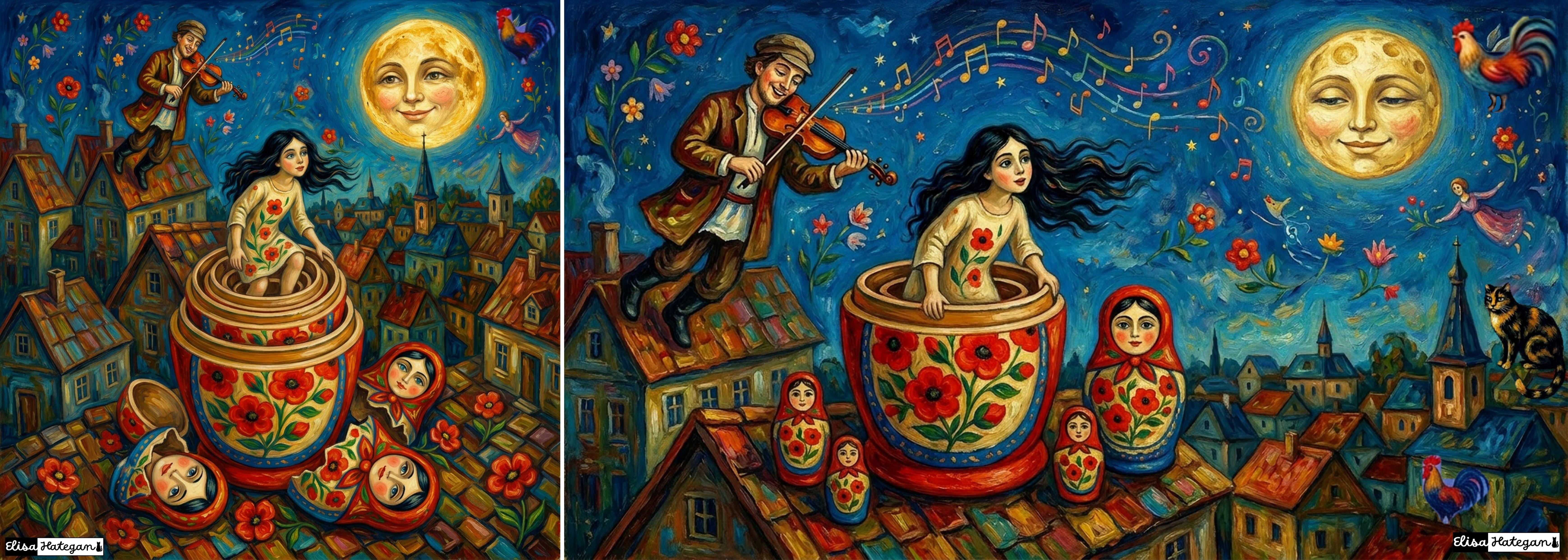
There is a moment in the ritual of taking apart a matryoshka doll when you realize you are almost there. The dolls have been growing progressively smaller, each one still wearing the same painted face — the rosy cheeks, the wide brown or blue eyes, the red floral headscarf — but in miniature, in compression, in increasing stillness. And then there is the last one. The one that will not open.
This final figure is not a doll in the same sense as the others. It is solid. It has no interior — or rather, its interior is indistinguishable from its exterior; it is all the way through itself, with no hidden room, no further contraction.
The baby at the center. The original, before any of the concentric shells were added. The self before inheritance, before history, before the long accretion of everything that has been passed forward and packed around it.
But the innermost doll is not a self before experience. It is not a pristine soul untouched by ancestral trauma, awaiting its liberation from the shells. That’s not how this works. The baby at the center is made of the same wood as all the others. It is turned on the same lathe. It carries, in its solid body, the grain of the same tree.
What the innermost doll offers us is not purity. It offers us completeness. The sense that there is a core, a coherence, a something that persists through all the openings and closings, all the rifts and enclosures, all the handing-forward of pain and survival. The baby at the center is not an escape from the inheritance. It is the inheritance, compressed into its most elemental and essential form: the original impulse to persist. The original warmth around which everything else accreted.
And that inheritance is not a burden to escape, but a depth to inhabit.
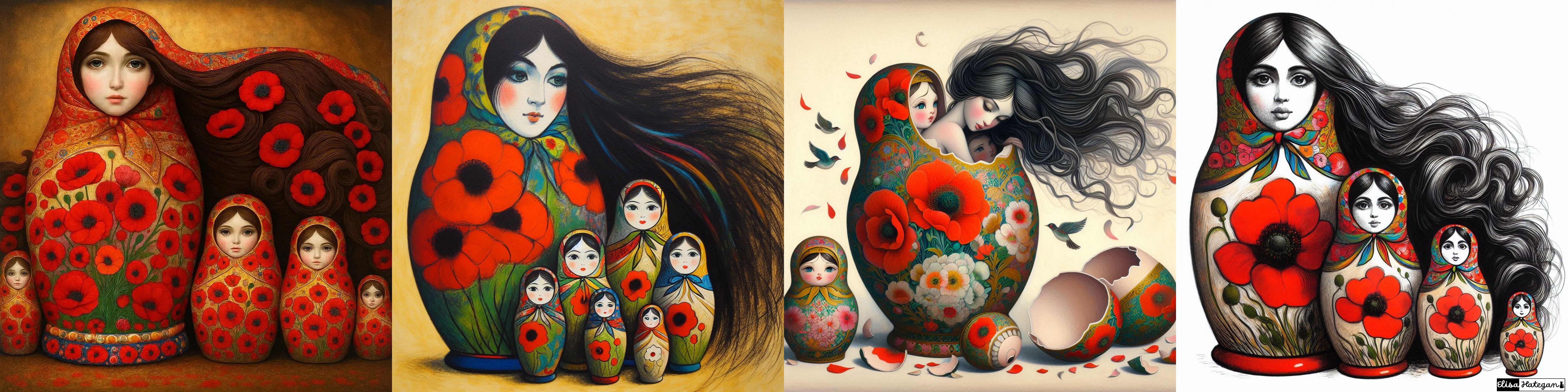
When I think of my DNA results, and of the Ladino song I knew without knowing, and of the smell in the barracks that was older than my body, I am not thinking of trauma as a curse I must outrun. I am thinking of it as information. As the most precise kind of knowledge I possess about who I am and where I come from and what has been required to make me possible.
Every one of my ancestors who survived — through the expulsions from Spain, through the pogroms in eastern Europe, through the wartime catastrophes of the twentieth century — every one of them cracked a shell open and lived. They did not emerge unchanged. The egg that hardens in the heat is not the same egg that went in. But it persists.
And what has the egg always held? Not just the promise of a new creature. The egg holds the whole pattern — the instructions for building, from the most basic cellular machinery, a being that can feel music it has never learned, fear places it has never been, love with an intensity that seems disproportionate to any single life.
The egg holds the entire preceding library. It holds every grandmother, every tongue, every prayer spoken into the dark. It holds the shtetl and the ship and the new country and the new silence and everything that came after. It holds all of it, and it is still small enough to hold in one hand.
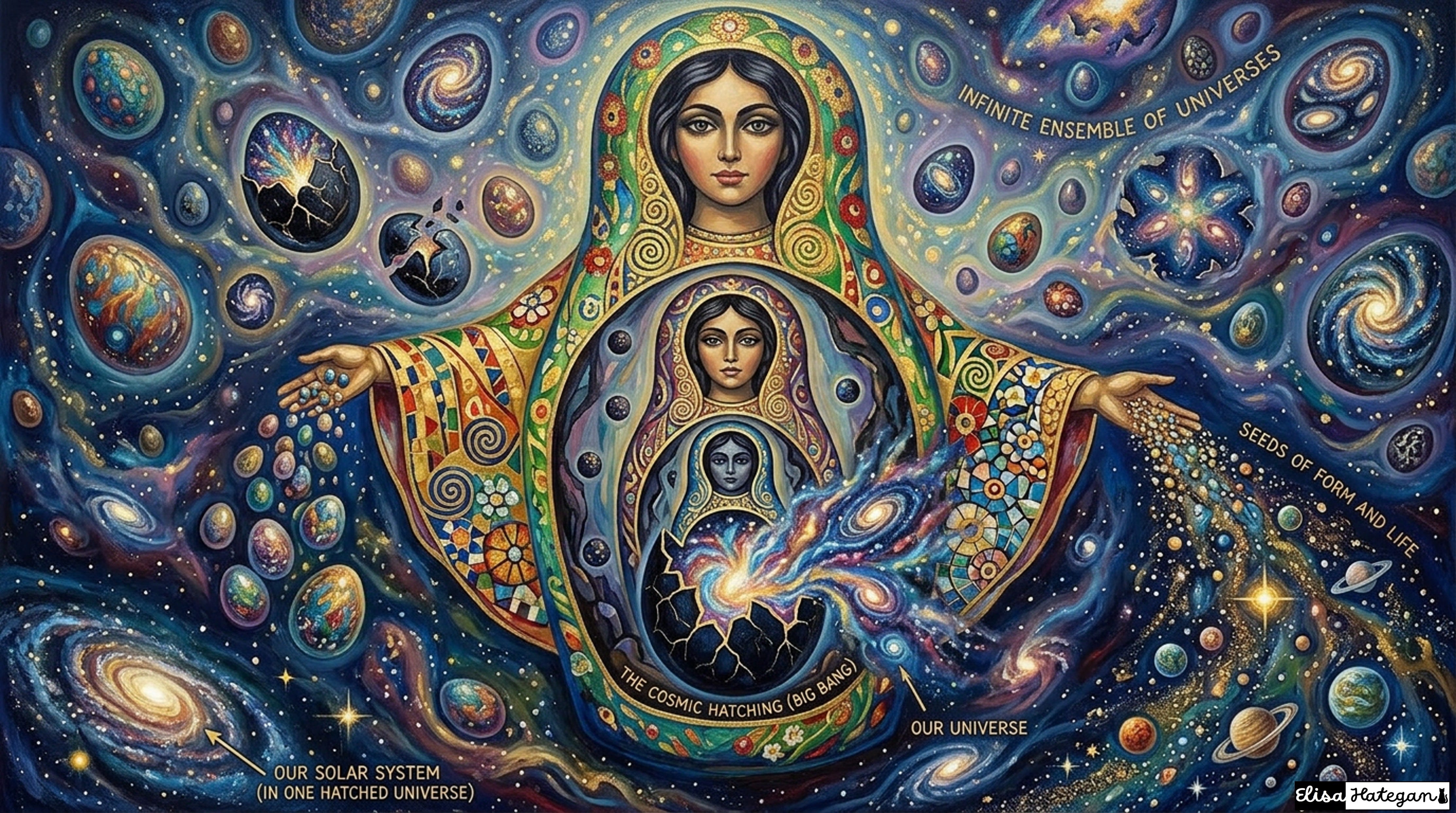
The multiverse holds all the universes in the same way. Each bubble universe is complete in itself, ignorant of the others, governed by its own physics, its own laws of cause and effect. And yet they are all nested within a structure that contains them — the inflationary spacetime that is still expanding, still spinning off new bubbles, still hatching new worlds.
We are one hatching among an infinite series of hatchings. This should terrify us, assuming our brains can even conceptualize that kind of scale. But it also — if you are the kind of person who collects nesting dolls, and who finds comfort in the logic of shells within shells — settles something.
We are not anomalous. We are not alone. We are the expected outcome of a universe that is, at its deepest level, organized around this principle: something contains something, which contains something, which contains something, which contains something, all the way down to a core so small we cannot see it, all the way out to a boundary so vast it has no edge. And at every scale, life finds a way to happen. To crack through. To add its few degrees of warmth and make another generation possible.
My great-grandmother did not know that I would exist. She could not have known that a descendant of hers would sit a century later in a city across the ocean, writing about nesting dolls and cosmic eggs and the molecular memory of cherry blossoms. But inside her, folded into the cells she passed on to whoever survived and passed them on again, was a small and solid figure, unpainted and smooth, that was already, impossibly, also me.
We are all, always, the outermost doll. And we are all, always, carrying the innermost one.
The shell cracks. The light gets in. Something hatches that has never existed before and will never exist again: a creature made entirely of what came before, becoming entirely something new.
This is not metaphor.
This is what it means to be alive.
✦ ✦ ✦
If you enjoyed this article, please like and subscribe. Please also consider making a small contribution to my fundraiser to raise legal funds for my lawsuit against Caryma Sa’d.
PLEASE HELP. Every dollar helps, and you can donate anonymously. If you can’t spare a dollar, please share this post so others can hopefully help.
https://gogetfunding.com/support-my-lawsuit-against-caryma-sad/
Comments
Nothing yet. Say the first thing.
Sign in to join the conversation.