
Hi everyone! First up, a couple of links: here is a video of the panel I was on last month at the Toronto library with Sheila Heti, Patricia Lockwood, and Gwendoline Riley; and here is a recent episode of Selected Shorts, where my Kafka-inspired story “The Board” (from this volume) was read by the actor Cindy Cheung.
Otherwise, today I wanted to share a writing tip that helped me make surprising book progress, in the middle of a swirling maelstrom of extraliterary distractions. The short version is: I found a way to use dialogue-writing to access a calmer part of myself who turned out to have some good editing ideas.
To convey the full picture, I’m going to start by describing my eventful transit to Berlin, also last month. Depending on your level of subscription, you may already be aware that, on arrival, one of my cats was confiscated by German customs. This has been a ballooning surreal episode, and if I do ever get another commission for a Kafka-inspired short story, please know that “The Quarantine, oder Mein großes Katzenproblem” is basically queued up and ready to go. And I think the story has to start back in New York, with the Lyft ride to the airport, in the aftermath of the February blizzard. The driver, who was visibly Russian, really went “above and beyond” helping transport two cats and four suitcases over the massive snowdrifts. When we were finally in the car, thanking him profusely and crying a little bit, I blurted that he was a “geroi truda” (a hero of (socialist) labor). I’m not sure why I said that (I guess it’s something one of my teachers said in the 90s?), but it launched the driver onto a ninety-minute discourse, starting with an overview of Soviet orders and ranks, segueing into his teen recollections of screwing refrigerator doors onto refrigerators in a factory in Moscow in the 80s. Next came a comparison of his wages to those of his mom, who was an engineer in the same factory; then a general survey, surprisingly detailed, of different peoples’ wages throughout the USSR (“listen, then there’s the woman who went in at four in the morning to milk the cows…”). At first it all seemed kind of random and chaotic, but gradually I made out a poignant through-line: “Was it fair?” (“What was fair and what wasn’t?” “How could it have been fair?” “Where and when has it been more fair?”)
At some point we came to the story of our driver’s grandmother, a prosecutor after World War II, who had prosecuted people who stole food—“and at the same time, her own child died of starvation.” Her position gave her access to food; others would have stolen. But she was a “true believer.” Then came a couple more stories of true believers—people refusing to accept any “unfair” advantages (is any “advantage” intrinsically “unfair”?), on the grounds that it would invalidate the whole undertaking.
This was really resonating for me with the book I was reading, Christa Wolf’s City of Angels, or the Overcoat of Dr. Freud, which I learned about from a fascinating reader question. (I’m planning to do another Q/A video as soon as I get the AV situation sorted out.)
City of Angels is an autofictive novel based on Christa Wolf’s time as a fellow at the Getty Institute in LA in the early 90s. It opens with her arrival at LAX with a passport from East Germany: a country that no longer exists. Everyone she meets in the US is then basically congratulating her on joining the free world and escaping dictatorship. In fact, we learn, at the time of the partition, Wolf herself had tried to get to the West; it was only by chance that she ended up in the East—and yet, that then became her identity. She suffered a lot with the secret police and wasn’t, like, a fan of dictatorship—but she was a committed socialist, and when the wall came down, she wasn’t unambivalently happy.
Now, in the US, she felt oppressed when people expected her “to make a pious face at the mention of the word ‘unification’”; she had the troubling sense that there was nothing left blocking the global spread of consumer culture; that now, “daily life in America was the norm for the rest of the world; that it was normal to live for profit and success,” and that “after the collapse of Communism, all of this is valid for all eternity.”
Meanwhile, every day at the Getty Center, helpful staffers were bringing her German newspapers, and she would read letters from West German readers, complaining that the East Germans weren’t sufficiently pleased: “For heaven’s sake, all this screeching about so-called values that they wanted to preserve from a state that had fallen apart, what was that supposed to mean? What can you preserve from a dictatorship?”
In 1990, I was a middle-school student in the US. Reading about Wolf’s reaction felt like seeing the opposite side of a tapestry. All I remember hearing was the West German perspective: “What can you preserve from a dictatorship; how sad that these people got Stockholm-syndromed by their dictator.”
And doubtless that was part of the story. But there was also more—that’s what I felt reading Christa Wolf, and hearing about the “true believers.” At some point, there was a promise that felt revelatory to a lot of people, a promise of some way of life other than constant striving for economic growth—not through trying to deny “natural human self-interest,” but through learning to identify self-interest and happiness in some other way.
Of course it’s cartoonish to identify the “American way of life” just with buying dumb stuff (or with Trumpism); there are lots of good things about US culture. (I think this comes across in Christa Wolf’s portrayal of LA in the 90s—a lot of beauty and freedom and diversity, and also some amount of terror, and unfreedom, and lying). One of the things I’m the most grateful for, in the opportunity to spend time outside the US, is to get to think about which parts of my usual “way of life” that I value, and which parts I don’t value—the luxury of looking at the big picture.
The Lyft driver, like Christa Wolf, was always circling around this implicit comparison to the US. (Wolf quotes extensively from Thomas Mann’s diaries from his time in LA (1942-1952), which I was really excited to read—but I think so far only the 1918-1939 diaries exist in English, though of course they are also very resonant with life in the US now.) With our driver, the book he kept coming back to was the 1935 travelogue One-Story America, by Ilf and Petrov. I didn’t know anything about this book but I’m now excited to read it, too—these pictures really reminded me of Lolita, and made me realize that Nabokov arrived in the US only five years after Ilf and Petrov.
Returning to the driver’s life story: it turned out that his grandmother had had another child, who had already been killed during the war: Germans were randomly shooting people as they got off a train, and one of them was her kid. Because of the loss of the second child, the grandmother married a man whom she wasn’t hugely excited about, whom she wouldn’t have married under other circumstances, except that she wanted to have more children—and that’s how our Lyft driver came to be born. “We’re all here because of who knows what terrible things in the past.”
As I was trying to wrap my head around this, the driver, Mikhail, was checking 3 different GPS units, all showing dire traffic delays. He said he could save us thirty minutes by taking a different exit, to a parking garage that seemed far away, but had a walkway to the terminal. We said we wouldn’t be able to carry all our stuff over a walkway, but he said he would help us. And he did—he found a parking spot in the crowded garage (“It’s free, for fifteen minutes”), and carried our suitcases, not just across the walkway, but up all the elevators and escalators to the check-in line, so tell me if this man was not a hero of labor. We definitely saved at least thirty minutes, which was great because the airport was in chaos—we made it through security with just enough time to buy two $17 turkey wraps from an unmanned kiosk that was somehow charging $17 for turkey wraps, and within half an hour, we were flying towards Greenland.
We had been hoping to sleep on the plane, but this turned out to not be possible, because the place where a person’s feet would normally go was occupied, in our case, by cats. Though drugged, the cats would periodically start yowling so then we would comfort them. One was comforted by petting; the other preferred tiny installments of $17 turkey wrap (thank you paid subscribers!).
Then it was sunrise in Berlin, we deplaned, did the passport check, waited for all the suitcases, dragged everything to customs—and that’s where our problems really began. The food-motivated cat (Grover) got through OK, but with the cuddly cat (Mixie), the guards kept scanning her microchip again and again. Then they said we had a big problem and should go sit in some chairs.
After due sitting, we learned that the problem was that Mixie’s US paperwork—both the rabies certificate from her regular vet, and the USDA travel papers from the USDA-certified vet—had a misprint in her fifteen-digit microchip number: the last three digits were incorrect. I was cognitively not at 100% and couldn’t understand how this was possible, I seriously thought reality had split off; I had seen both vets in New York scan her, and compare the numbers to the paperwork, it didn’t seem possible. We spent the next 3 hours with the Berlin airport vets, investigating different theories, like: what if the US microchip needed a scanner of a different frequency; or what if Mixie had “a second microchip” somewhere else on her body.1
After scanning every inch of Mixie’s person with three different scanners, the vets said that they couldn’t accept her rabies certificate; it was for “not this cat.” They took her away, revaccinated her, and placed her in an undisclosed quarantine facility for 3 weeks, for the vaccination to take effect.
The staff at DAAD, where I am a fellow this year, were super-kind and helpful; one person called the veterinary authorities to request that Mixie be quarantined with us at home (it didn’t work); another waited for us outside customs for 3 hours, took us to a pet store to buy litter, and then brought us to “our” apartment, which is quite beautiful, and where a plaque in the foyer shows the names of former residents who were killed in camps. We were then told that a previous fellow, staying in this same apartment, had one day received a visit from an older Jewish woman who wanted to look inside: she had lived here as a toddler in the early 1940s, before escaping Germany. Apparently, when she came inside, she didn’t remember anything—until she saw the glass sliding doors in the living room: “I remember those big doors—behind them was the Christmas tree.”
Then there we were in this huge apartment; two people, one food-motivated cat, and the idea of the Christmas tree.
I spent the next few days trying to get the US vets to send new paperwork to the German vets, in the (vain) hope that this would motivate them to release Mixie early. I started to get really emotional and at some point the German vet emailed that of course she believed me, she had never thought I had been trying to introduce an unvaccinated cat into Germany using another cat’s papers; but what could she do, she couldn’t accept a retroactive rabies certificate. Which made a person think: “Why?”, and led to various fruitless nationalistic thoughts, e.g. “Is there something ‘German’ about this attitude towards rules”; or: “Our detained cat is receiving much better treatment in Germany than detained humans are in the US.” (They sent photos; she had a private room with a window.)
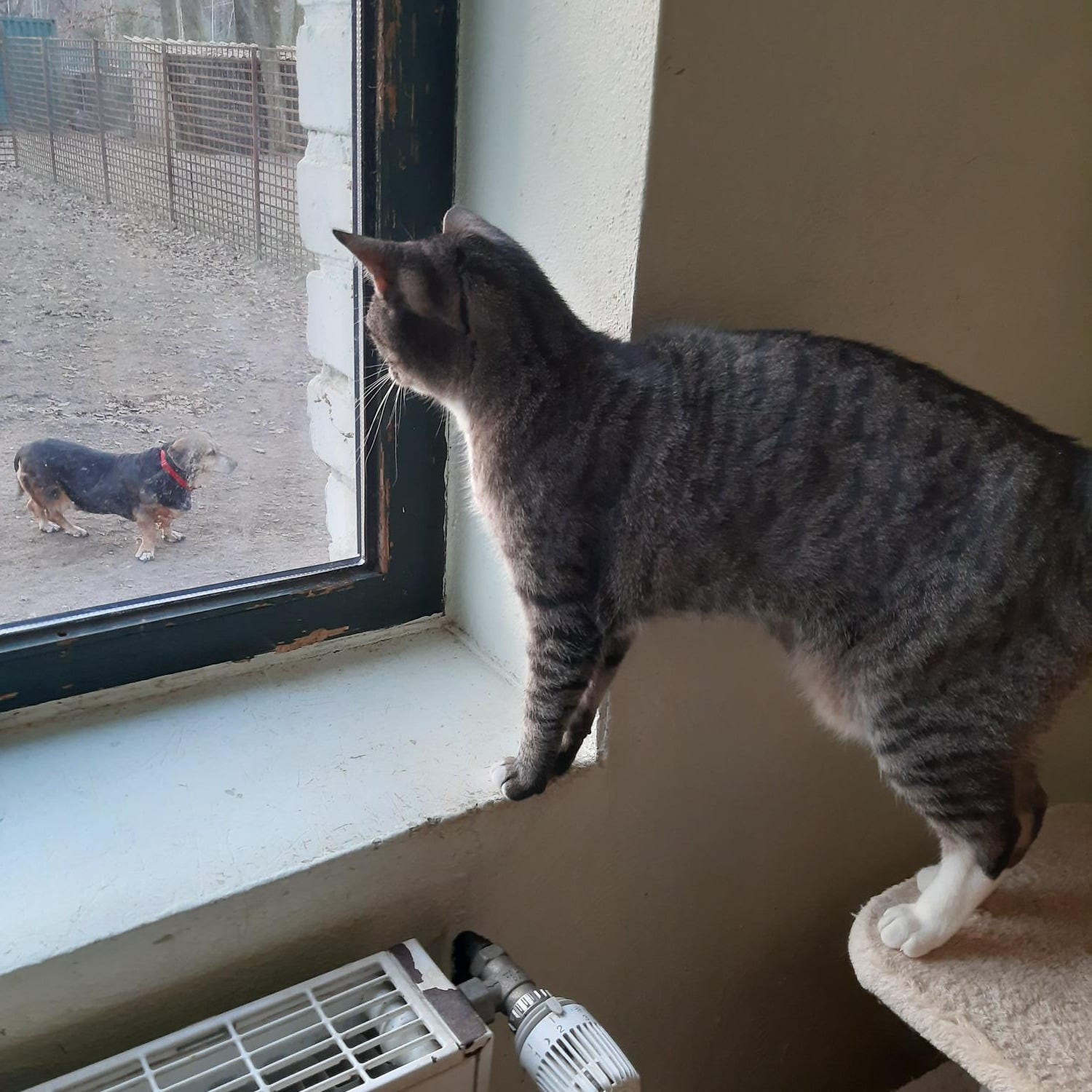
On the morning of the day of Mixie’s release, we finally learned where she had been all this time: it was in Brandenburg, near Fürstenwalde/Spree. We took a train to Fürstenwalde, then a taxi to what seemed like the middle of a forest. Google had predicted that we would get there in two hours and forty minutes, but we made it in two hours and twenty minutes—at which point we rang the bell at the gate, and weren’t let in, because it wasn’t yet the exact time when we said we would be there!
Luckily, it was a beautiful day so we spent the 20 minutes walking around the grounds, which had once been a Red Army Tanklager.
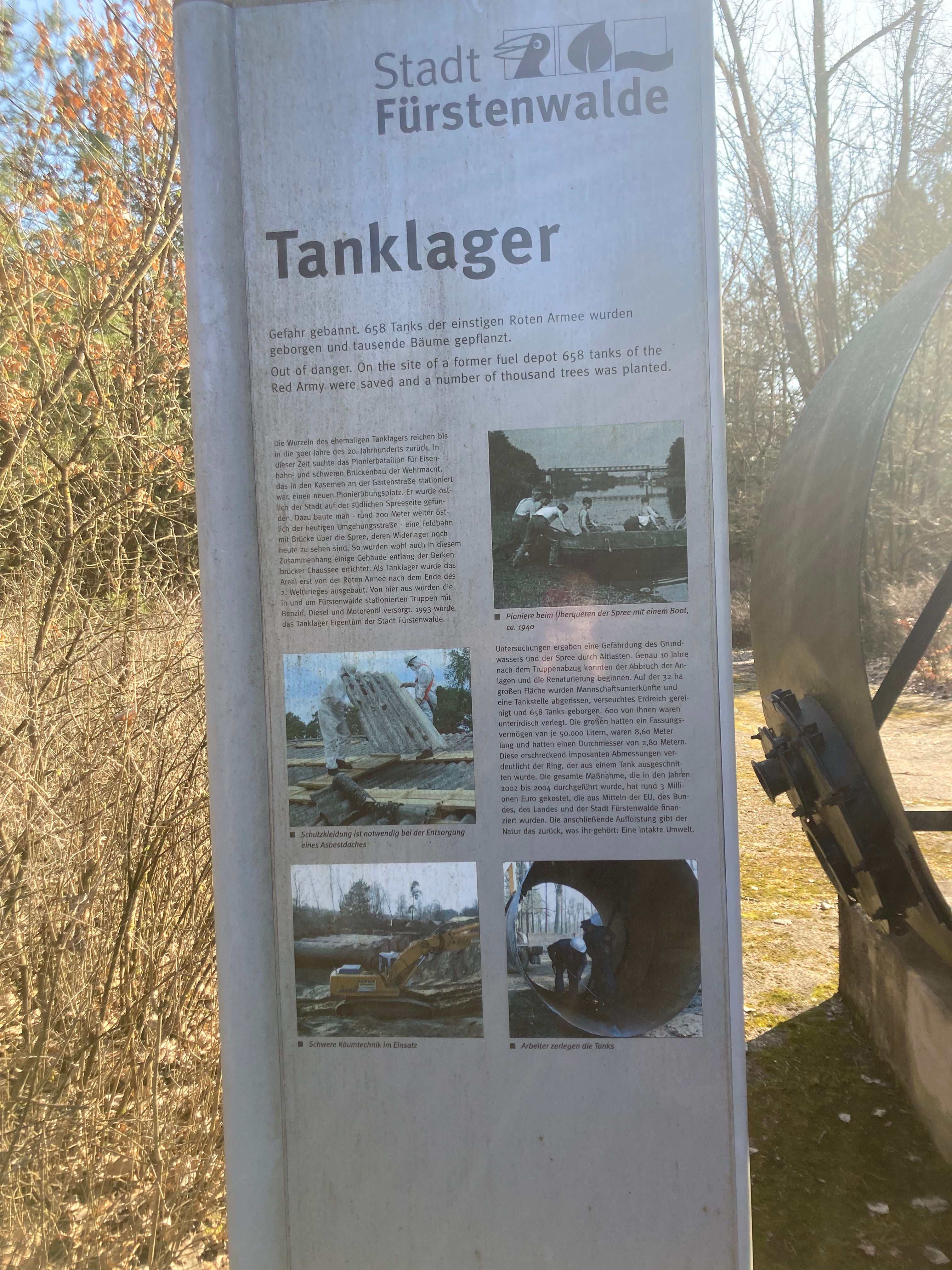

Eventually we recovered Mixie, got a cab back to the train station, and a train back to Berlin… and then the worst part started. As is apparently normal when one cat goes away somewhere and comes back smelling differently (I must say Mixie still smells terrible), the other cat didn’t recognize her. Mixie and Grover are sisters and had previously always enjoyed each other’s company, and in fact Mixie seemed to remember Grover just fine—but Grover took one look / sniff, expanded to 3x her normal size, and generally started to lose her shit. We were advised to spray the apartment with “feline pheromones” and to keep the cats in separate rooms until they reacclimated to each other, “usually in 1-2 weeks.”
This was a true nightmare, because we didn’t know how long it would last; any time we opened a door, Mixie would run in, and Grover would go nuts and attack her, like she was a ghost/ zombie; then Mixie would also go berserk. Grover is now missing a tiny part of her ear, and my wife and I have cuts and scratches from our peacekeeping efforts.
[Amazingly, at some point I saw my wife texting someone a photo of her hand, covered with cuts: it was the bloody hand! Was it a message? Maybe the earlier bloody hand was a figuration, like Auerbach talks about wrt Dante?]
On the seventh day, the cats were finally able to spend an hour in the same room, and even though Grover was giving Mixie the stink-eye, and Mixie was prowling around with a terribly hurt expression (“Do you mean EVERYONE ON EARTH ISN’T ALWAYS HAPPY TO SEE ME?”), no violence ensued. The next day, Grover fell asleep in Mixie’s presence, so it seems peace may be at hand.
What I’m getting at is, over the past month, there have been a lot of obstacles between me and book.
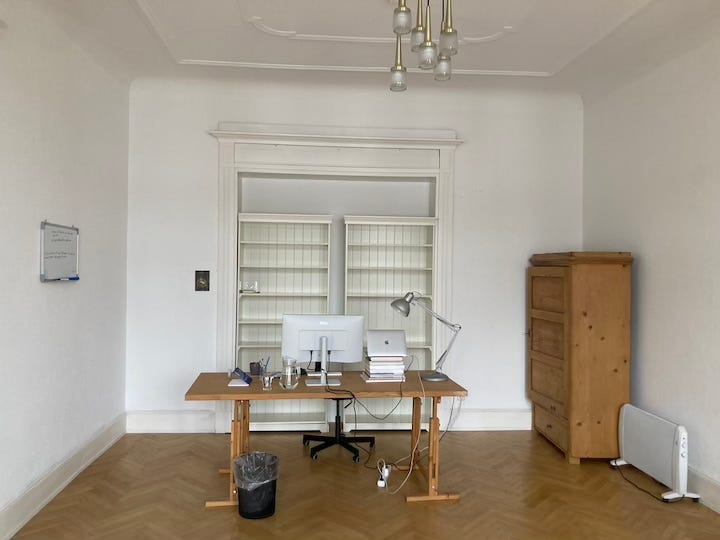
The writing tip that helped me, under these circumstances, is a variant of an exercise I may have talked about before on here—one I learned from the brilliant Shelly Oria. It involves writing out a dialogue between yourself and the book (or other writing/ artistic project)—generally when you’re feeling stuck or anxious or afraid or have some question of how to proceed. In the dialogue, you tell the book how you feel—and the book replies. Even though it’s you writing both parts, the book often says things that “you” wouldn’t normally have thought of.
There are lots of things I find exciting about this exercise—e.g. the premise is that the book, in some sense, already exists; it’s already an entity. Likewise, the writing isn’t something you’re doing TO the book; it’s something you and the book are undertaking together—a journey or adventure. You’re less of a “geroi truda,” as it were, than a “sputnik.” The relationship isn’t hierarchical: it’s not parent-child or creator-creation. You’re companions. This also means that the book isn’t identical to you. It doesn’t contain every single one of your thoughts. It has limits; and it has some independent volition.
That said, when it comes to actually doing this exercise, I have sometimes encountered difficulties. My question would often be “Does such-and-such thing belong in the book or should I leave it out”; and I would start thinking, “If the book already exists, doesn’t it know already what’s in it? Why can’t it just tell me?”
In these past weeks, the thing I was trying to do, against the backdrop of cat angst and various forms of guilt, was to put together different sections of the book that were written at different times, about different times, but involving some of the same backstory. I was running into the same kinds of problems as with nonfiction: how to handle exposition; how much data to dump up front; which particular parts to put first versus keep for later; how much to remind people when things come back.
Everything was starting to feel intractable—like, “no matter where I put it, it’s going to be boring and alienating; if I do this, then there’s that problem; if I do that, then there’s this problem.” At some point I was working with two sections, where each one seemed to have to come before the other. It was making me feel crazy—but when I started telling the book, the book was basically like: “Oh, that’s a good way of formulating the problem. Let’s go to that other section. Let’s look at the two sections. Let’s look at them together.”
The book basically told me that what I was doing was a normal part of writing—and not a sign that I did something wrong and now had to do damage control. The editing itself became fun. Pre-dialogue, whenever I saw an echo or repetition that I didn’t want, it was like finding a termite—“THERE’S ANOTHER ONE, this infestation is even more thorough than I thought.” Post-dialogue, it felt more like solving a fun puzzle.
So, the short version of the advice is: if you feel frazzled or despairing about something with your book (or other project), try writing a dialogue with it. See if “the book” has a different, perhaps calmer, attitude than you do, and knows what you should be doing next.
After the paywall, there’s another 1000 words with an explanation of how I think this advice works, with an illustrative example from P.G. Wodehouse.
Thanks for reading!
Comments
Nothing yet. Say the first thing.
Sign in to join the conversation.