
In Hotel Monterrey, Chantal Akerman takes long shots of a cheap New York City hotel. It’s 1973.
Peering into a room we see a figure laying on a bed, the outline of black hair is truncated by the white sheets. The door consumes the frame as its shut. The camera doesn’t move.
Everything is composed expertly.
The film comprises visual poetry. It is silent. Nothing is said exactly, but this place and, in particular this moment is documented and in doing so an inner voice pipes up. We see corridors, elevator windows, and cigarette butts that land on the checkerboard vinyl flooring as a trio of elderly women finish off their conversations. They head off out of frame, presumably to bed. People come and go. The camera, for the most part, doesn’t move.
This film is a document of sorts, its not quite a documentary but not-not a documentary either.
Elements of it reminded me of Agnes Varda’s Daguerreotypes, which documents Rue Daguerre, the street she lived and worked in Paris, depicting its shopfronts and the people who ran them. She documents them without imposing intent or too much inquiry, simply watching them with her extended organ: the camera.
Unlike Varda, Akerman does not give us sound. There is no resolution. The black haired figure we see in the bed does not reappear.
This film documents the liminal—hallways, yes, but also the moment between waking and sleep, and like Varda, the spaces of thought and memory. The film spans an evening, and the shots are long enough for the mind to wander.
I’m taken to Spring St. in DTLA, 2017. To the old apartment I used to live in. I remember its hallways, textured floors with dark amber ceramic and small checkered edges in black and green. Walls, in pallid shades of maroon and cream. I remember the rectangular blocks of stretched black, recently glazed to match the rest of the flooring, and how they seemed to mark the spot where walls once stood. They made me imagine phantom men in Hi Vis vests taking hammers to them.
I could almost hear the cracking of the old, long-absent plaster.
In the film Akerman moves her camera only three fourths of the way in, after memory has sequestered the viewer’s mind, as if to jolt you back into her space. She inches towards a closed window at the end of the hallway, bleary exit sign above it. A sliver of light is seen through a crack and I feel the impulse to peer in.
In my amber corridor, with my VHS camera, I zoom into the rectangular blocks, its misshapen edges between the blocks and dark amber. Back and forth. I was trying, with the action, to find something in the negative space. The whirr of the camera demarcated my movement.
I’ve always had an affinity for zoom, as if the act could correct my poor vision, let me into a secret not made for the eyes of people.
Akerman doesn’t zoom. She places the camera at her waist, above her head, but she doesn’t zoom. The overhead lights from the corridors bleed against the gloss of the walls.
She is shooting film. I shot VHS. The impulse to go back and view my fragments of video fills me with an itch that I cannot scratch.
All my film, books, records, my clothes from that time are gone. The man I lived with, and loved then, took them with him when I left him. He hurt me because he was hurting, and being young and naive and running away from all the other things that reminded me that I too was hurting, I let him.
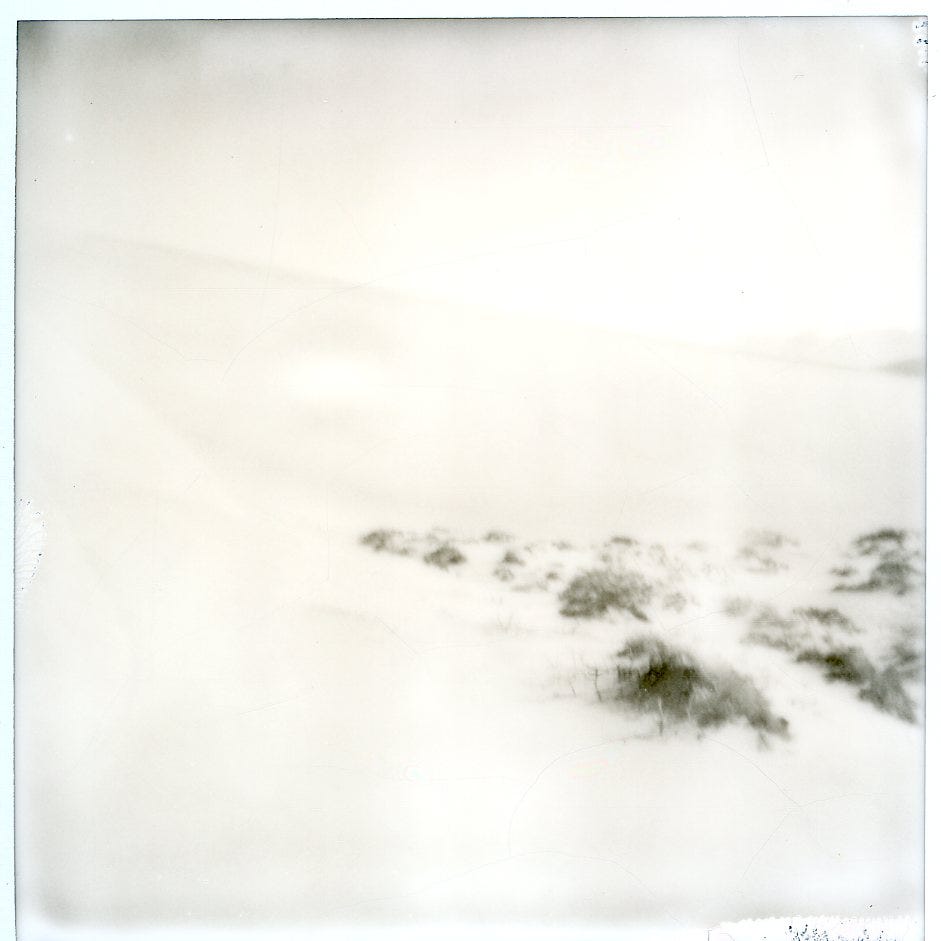
All I have left from that time are digital scans of photographs I took, like these polaroids of Death Valley.

The negatives, physical copies and the VHS tape are gone but this is not about him. Its about the hallways.
To escape his yelling, his anger, I would linger in these maroon hallways on the way to the laundromat or the trash shoot. I was meticulous with cleaning then, now, less so.
Something in the movement through these hallways, the relief I found there, gave me the space to create. I shot these hallways on that VHS camera until the tape was full.
Akerman did not work in a hotel. I don’t know whether or not she ever experienced something like I experienced. She traveled often between Paris and New York, but this isn’t about her life and its not necessarily about mine either.
Its about the hallways.
At the moment I am trying to understand this feeling, where this feeling is trying to take me. What is it that I cannot see?
Akerman doesn’t zoom in. Her camera points to the inside of the elevator that we, as her creatures captured within the confines of her camera, have just been inside.
I think back to Spring St. He was a photographer, and would often tell me that I could not be one because it was “his thing” and by virtue of being his I could not pursuit it. At the time that argument made sense to me. Now I recognize his fear, and my willingness to shrink.
What he couldn’t take were my eyes. My ability to see into the liminal. Perhaps this is an inherently feminine trait. Or rather, it is a perspective reserved for those pushed from one space to the next, never belonging to either one. Those constantly in motion.
When Akerman finally zooms in she does it in the sky where the texture of an overcast day masks the action. We are brought into the city without seeing the eager gesture. The desire to know is changed into one of depicting.
Writing this now I am attempting to flip between my own desire to know for one of depiction.
I am writing a novel, and in the novel there is a moment that I cannot quite decipher. I am writing this to you now in order to find a new configuration to tell this age old story—man feels threatened by the capabilities of woman and in an effort to suppress them he beats her down until she does, and like a fly who has hit its head too many times over the lid of a glass jar, it does not fly past it once the obstacle has been removed.
My characters are not me, they live their own fictive lives and push against their own obstacles. Their memories are there own.
Akerman is her own woman. Her hallways are her own, but the invitation inward is ours.
I go to the facebook page of my building which a neighbor created when we found stamped envelopes slipped through our doors. The landlord sold the historic building to a redeveloper. We had two months to move out.
Clicking through these messages from nearly a decade ago, I see Mr. Baker, one of the original tenants message: ‘One positive note: We got our full deposit back.’ I sank further into myself, what did I get?
No, I was zooming in. I retrace my steps. Write a new sentence.
When Akerman zooms in, she zooms in with the camera pointed at the sky. She is deliberate, trying to bring us closer to the street, to what she is seeing, without letting us know that she is doing this. It is subtle, measured, intentional.
Nothing about me feels intentional. Writing this now is not an act of intention but of intuition. The novel which I am almost done with (first draft that is) has been one big rush through the corridors of my mind. She shot this on film. She had to have known what she was doing because it cost money and money has always been precious. Didn’t she?
Time is precious too, isn’t it?
She shows us what she wanted to show us. The long lingering shots. The man with the pink-reddish shirt with oversized lapels coming out of the elevator. The woman who looked at her and spoke, words we cannot hear and cannot decipher from the distance, before stepping into the corridor.
She made us look through her eyes and through them I remembered my own. There is no way to end this entry. Its a collection of thoughts that crossed the corridors of my mind as I watched her film. They are an account of the film itself, but there are no spoilers.
The film is what happens inside the viewers’ wandering mind. The stories that exist behind the closed doors in these hallways.
Comments
Nothing yet. Say the first thing.
Sign in to join the conversation.