
Field Notes from Chapter Two of The Open Door
These essays began while writing The Open Door, but they are not excerpts from the book. The book tells a story. These essays investigate the questions that story raised. They are invitations to compare observations, explore ideas, and let curiosity lead a little farther than certainty.
One of the most important discoveries of my life began as something I almost ignored.
Not because it seemed extraordinary.
Because it seemed embarrassing.
That’s an uncomfortable thing to admit.
Some experiences arrive wrapped in respectability.
Others arrive wrapped in shame.
Curiously, nature seems completely indifferent to the wrapping.
It simply keeps doing what it has always done, waiting for someone to notice.
People often assume curiosity is the opposite of ignorance.
I don’t think that’s true.
Ignorance simply means we don’t know.
Curiosity survives ignorance quite well.
Its real enemy is premature certainty.
The moment we believe we’ve already explained something, we stop looking.
We stop noticing.
We stop asking better questions.
Every meaningful investigation I’ve ever been part of has begun the same way.
Not with an answer.
With something that didn’t quite fit.
Every day, millions of people participate in one of the largest uncontrolled experiments in human consciousness.
Almost nobody thinks of it that way.
Neither did I.
Most conversations about prolonged sexual arousal begin with questions of morality, addiction, health, or culture.
Those conversations matter.
But they are not the first question an investigator asks.
The first question is simpler.
What is actually happening?
Large numbers of people, independently and without coordination, repeatedly enter a distinctive physiological and psychological state.
Their reasons vary enormously.
Their beliefs vary enormously.
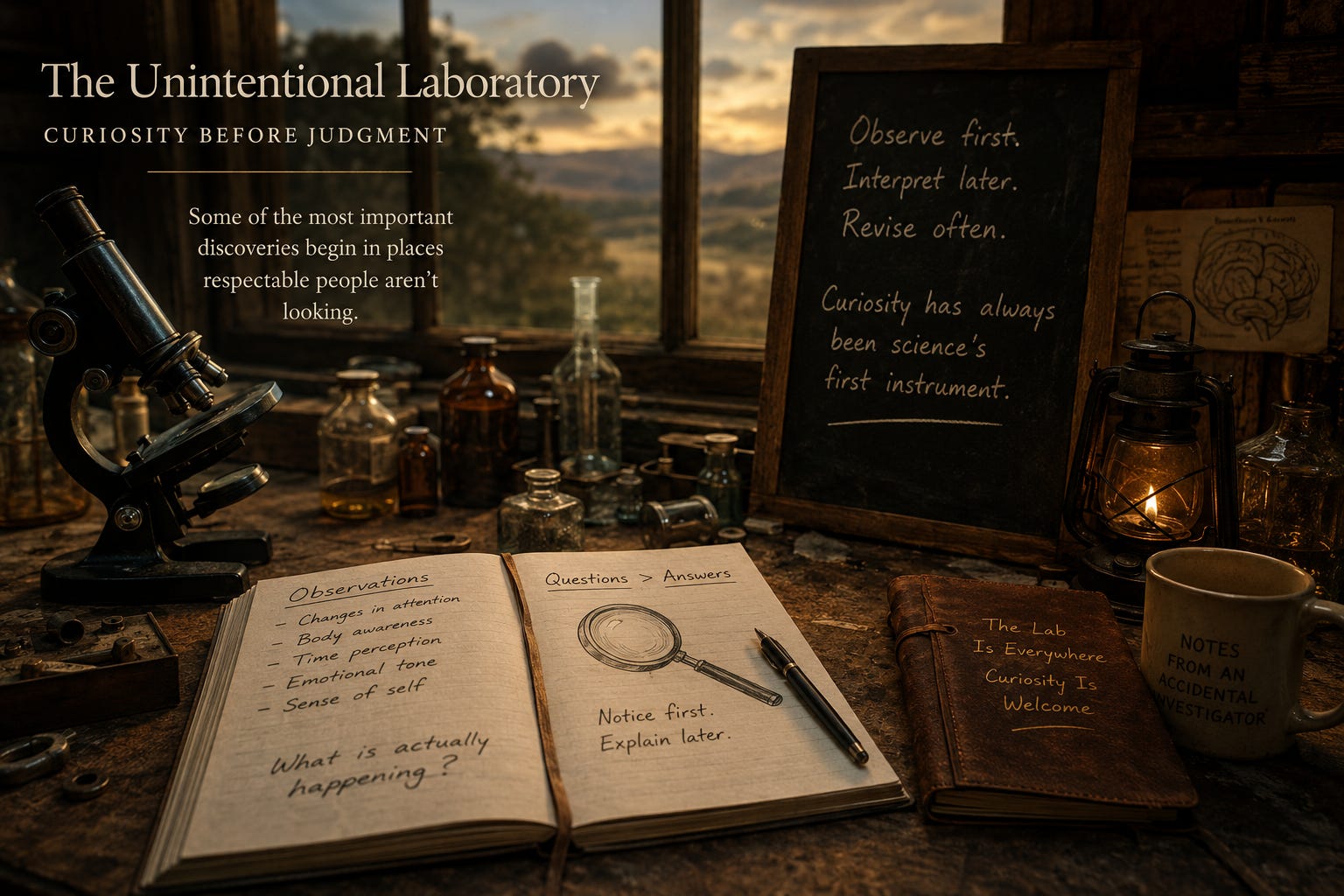
Yet many describe changes in attention, body awareness, time perception, emotional tone, and sometimes even the ordinary sense of self.
That observation doesn’t prove anything profound.
It doesn’t need to.
Observations come before explanations.
I didn’t discover this territory because I believed sexuality was spiritual.
I stumbled into it while trying to calm a nervous system that had become trapped in chronic hypervigilance.
Years later I discovered that Taoist practitioners, Tantric traditions, Western esoteric writers, and contemplatives had all described neighboring territory using entirely different languages.
That didn’t convince me any of them were correct.
It convinced me that the landscape deserved another look.
History has an interesting habit.
Many important discoveries begin in places respectable people weren’t looking.
Not because scientists lack intelligence.
Because every culture quietly teaches its investigators where not to look.
Sometimes those blind spots are religious.
Sometimes political.
Sometimes economic.
Sometimes deeply personal.
Shame has a remarkable ability to hide interesting questions in plain sight.
The location of a phenomenon tells us almost nothing about whether it deserves investigation.
One of the quiet lessons I’ve learned over the past few years is that explanation is most useful when it arrives after careful observation.
Not before.
When we explain too quickly, we often stop paying attention.
When we continue paying attention, patterns begin to emerge that our first explanations completely missed.
That has become my working method.
Notice first.
Interpret later.
Revise often.
Perhaps the most interesting laboratories aren’t always built with grants and white coats.
Sometimes they emerge accidentally wherever human beings repeatedly discover the same conditions and begin reporting similar experiences.
Most of those observations will ultimately have ordinary explanations.
Science is full of examples where curiosity led to surprisingly simple answers.
Occasionally, however, curiosity uncovers something no one realized was there.
The only reliable way to tell the difference is to keep looking.
This essay isn’t an argument for a particular practice.
It’s an argument for a particular posture.
Curiosity before judgment.
Observation before explanation.
Humility before certainty.
I don’t know whether this accidental laboratory will ultimately teach us anything profound about consciousness.
Perhaps it won’t.
But history suggests that discovery rarely begins with certainty.
It begins when someone notices something that doesn’t quite fit... and resists the temptation to explain it too quickly.
Curiosity has always been science’s first instrument.
Everything else came later.
-Elias
Comments
Nothing yet. Say the first thing.
Sign in to join the conversation.