
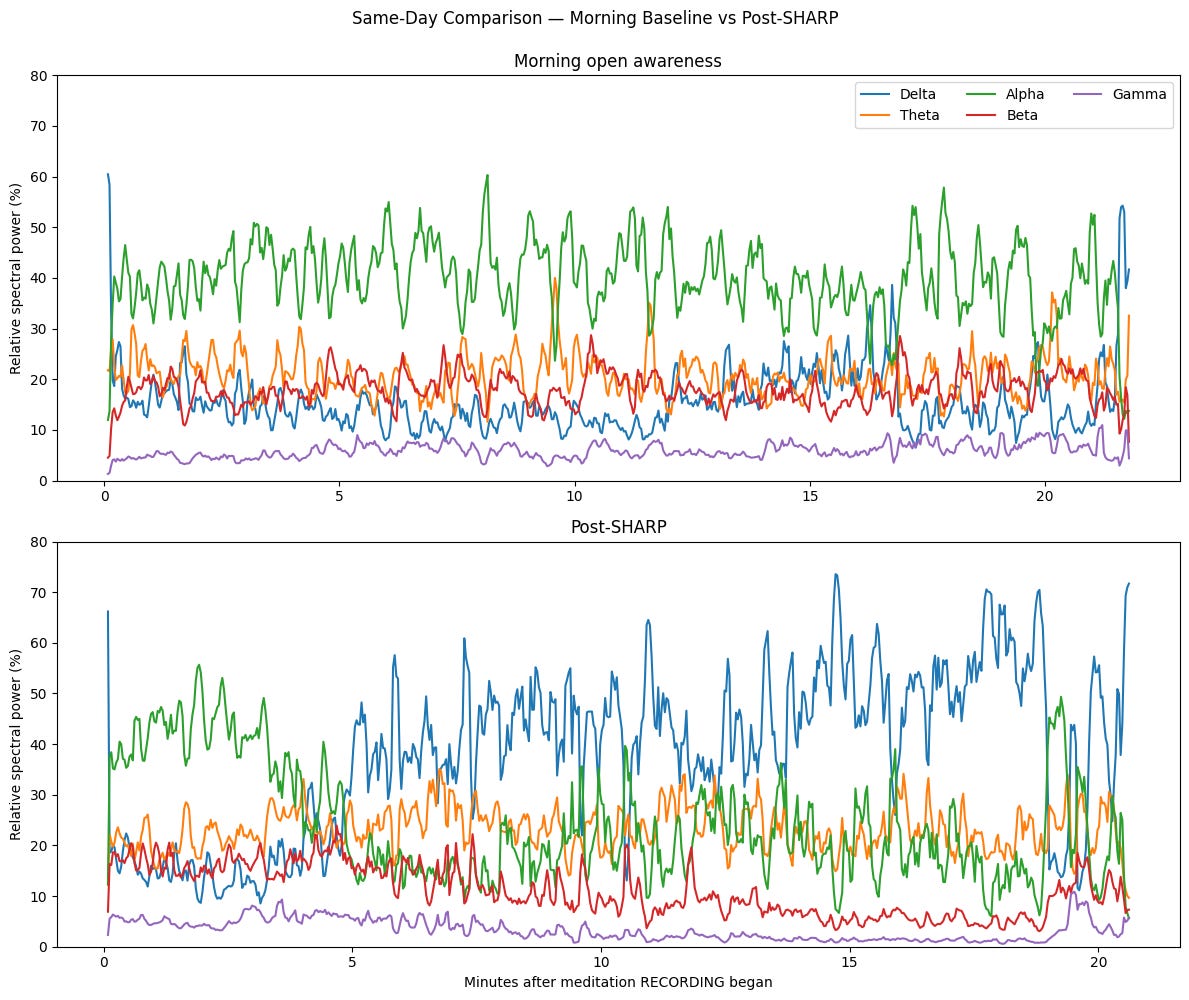
Two EEG recordings were obtained from the same subject on August 21, 2026 using the Muse S Athena and Pineal recording system. The first recording, beginning at 11:37 a.m., represented an ordinary morning open-awareness baseline. The second, beginning at 3:05 p.m., followed an unusually intense voluntarily generated SHARP session.
The recordings were analyzed independently from Pineal’s proprietary harmonicity and jhana metrics using the four Muse EEG channels TP9, AF7, AF8, and TP10 at 256 Hz.
The recordings revealed markedly different electrophysiological regimes.
The morning open-awareness condition was characterized by sustained alpha dominance, a stable low-alpha oscillatory peak near 8–8.5 Hz, minimal spindle-like sigma activity, and relatively low delta power.
The post-SHARP recording initially resembled an enhanced version of this baseline state but subsequently underwent an objectively identifiable transition into pronounced delta dominance accompanied by recurrent spindle-like sigma events, dream-like imagery, partial loss of experiential continuity, and preserved awareness through portions of the transition.
Inspection of Pineal’s exported phase labels resolved an important timing issue.
The raw EDF files begin during the device’s calibration procedure rather than at meditation onset.
For the morning recording, the Pineal RECORDING phase began approximately 64.6 seconds after EDF onset.
For the afternoon recording, RECORDING began approximately 63.6 seconds after EDF onset.
Accordingly, all analyses reported here were aligned to the beginning of Pineal’s RECORDING phase rather than to EDF time zero.
This also means that Pineal event timestamps such as “jhana detected at 2 min 5 sec” refer to meditation-recording time and must be shifted by approximately 64 seconds when locating the corresponding interval in the EDF.
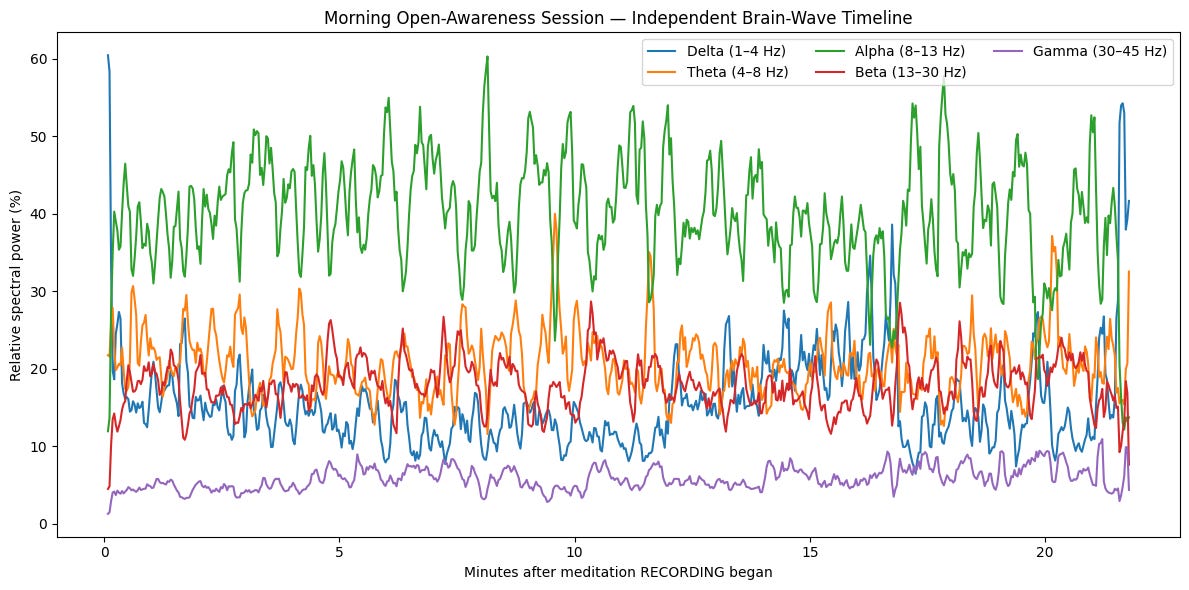
(Condition 1 Band Power Graph)
The subject closed his eyes and entered his ordinary open-awareness baseline.
Attention was permitted to move spontaneously among external sounds, bodily sensations, and thoughts. No object was deliberately sustained. When attention moved toward an object, the movement itself was noticed without prolonged engagement.
The phenomenological emphasis was therefore not on concentration but on maintaining meta-awareness while allowing attentional contents to remain mobile.
The state was described as clear, sharp, and ordinary relative to the subject’s established meditation baseline.
Across the recording, independently calculated relative band power was approximately:
Band - Relative Power
Delta, 1–4 Hz17.4%
Theta, 4–8 Hz18.5%
Alpha, 8–13 Hz39.3%
Beta, 13–30 Hz18.5%
Gamma, 30–45 Hz6.2%
Alpha was therefore the dominant spectral component.
When examined over time, median delta power was only 14.6%, with an interquartile range of 11.7–17.5%. Delta exceeded 50% of total analyzed power in only 0.9% of windows.
The temporal channels demonstrated particularly strong alpha dominance, with approximately 49% alpha at TP9 and 45% at TP10.
Fine-resolution spectral analysis identified a persistent low-alpha peak centered approximately between 8.2 and 8.5 Hz across the temporal electrodes.
TP9 and TP10 also demonstrated measurable bilateral organization around this rhythm, including increased coherence near 8.5 Hz and a non-zero-lag phase relationship.
A conservative 11–16 Hz transient-event screen identified only a single candidate at TP9 and none at AF7, AF8, or TP10.
No meaningful bilateral spindle-like activity was present.
The morning recording can therefore be characterized as a relatively stable, alpha-dominant waking open-awareness state with minimal sleep-like sigma activity.
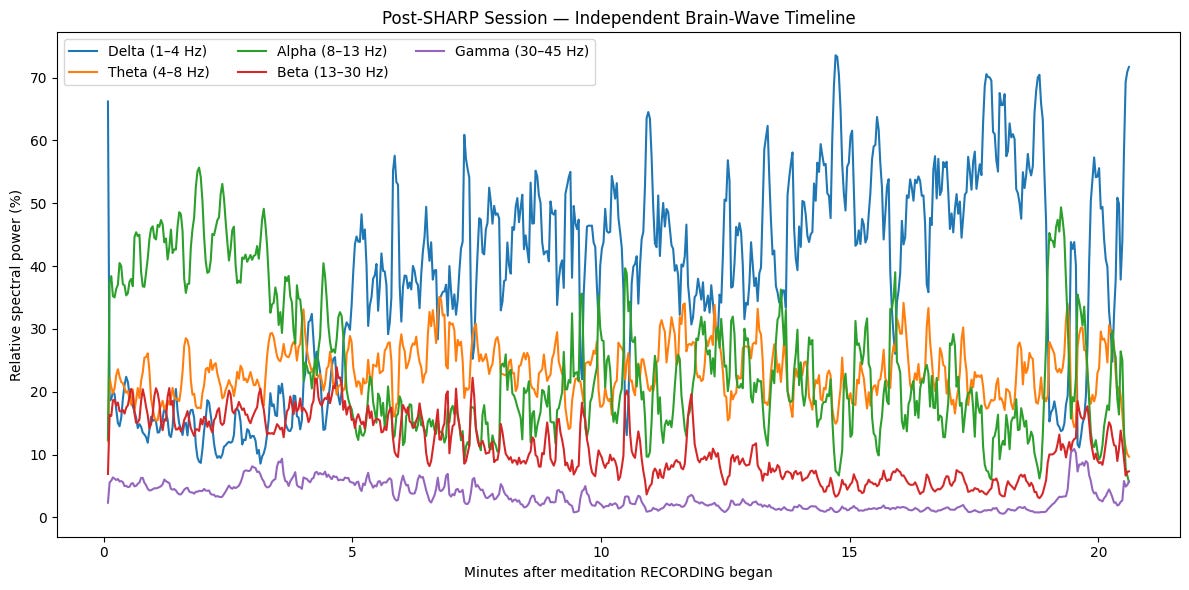
(Condition 2 - Band Power Graph)
The afternoon recording followed an exceptionally intense cultivated SHARP session.
(Sustained High Arousal Resolution Protocol)
The subject reported that voluntarily produced SHARP events are increasingly able to approach orgasmic intensity levels previously associated primarily with spontaneous episodes.
The EEG recording began after the SHARP event rather than during its peak.
The opening portion of the meditation was described as an intensified version of the normal baseline state.
The subject reported increased bliss, joy, and pleasant bodily sensations while maintaining broad, non-fixating awareness.
Attention moved through these experiences without becoming strongly locked onto any individual sensation.
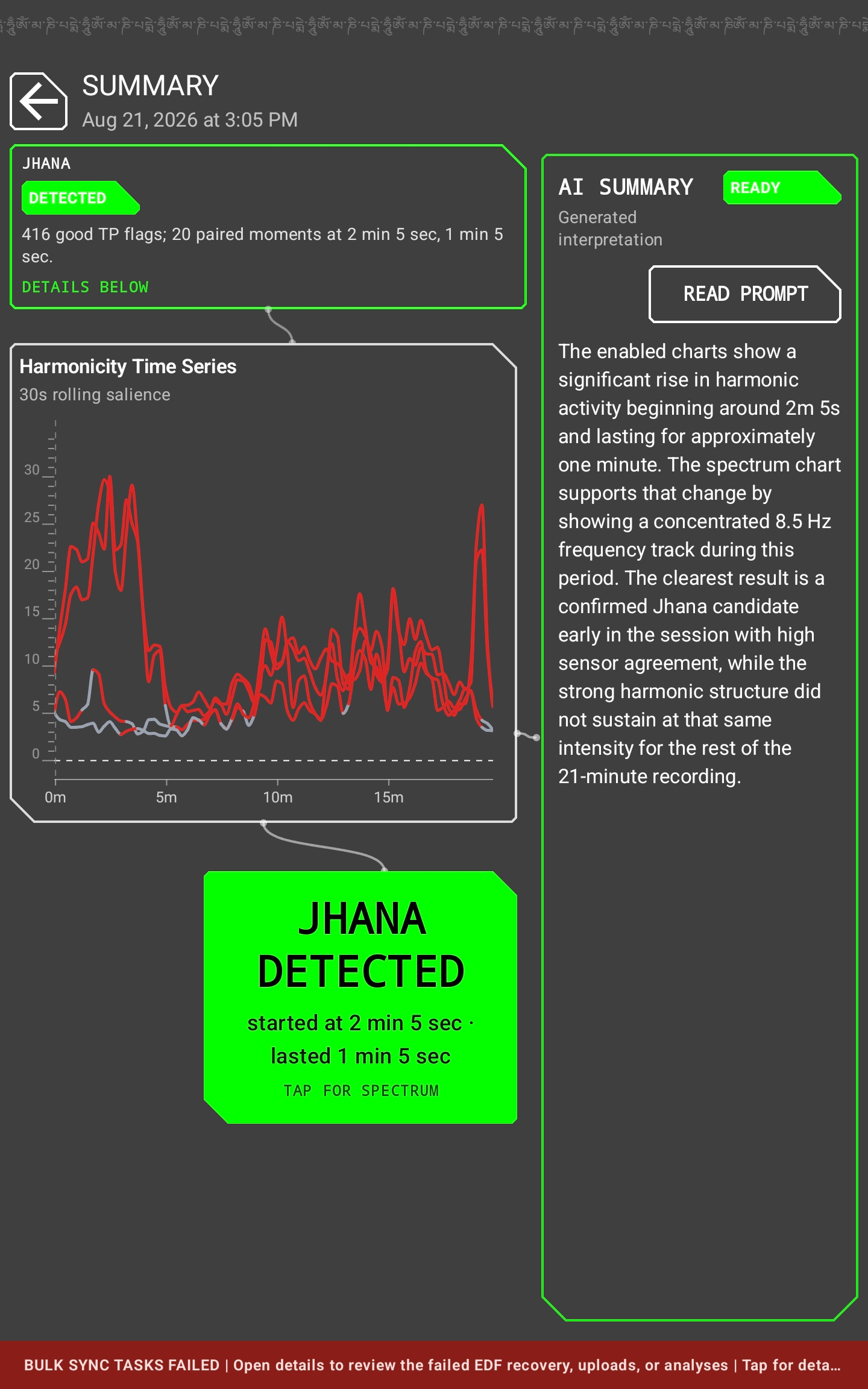
Pineal independently identified its strongest harmonic interval during this early period, beginning at approximately 2 min 5 sec and lasting approximately 1 min 5 sec, with a reported concentrated frequency track near 8.5 Hz.
Independent spectral analysis of this same interval found median values of approximately:
Band - Relative Power
Delta - 12.2%
Theta - 21.9%
Alpha - 41.8%
Beta - 17.0%
Gamma - 4.8%
Thus, Pineal’s strongest harmonic interval occurred during a clearly alpha-dominant physiological state resembling an enhanced version of the morning baseline.
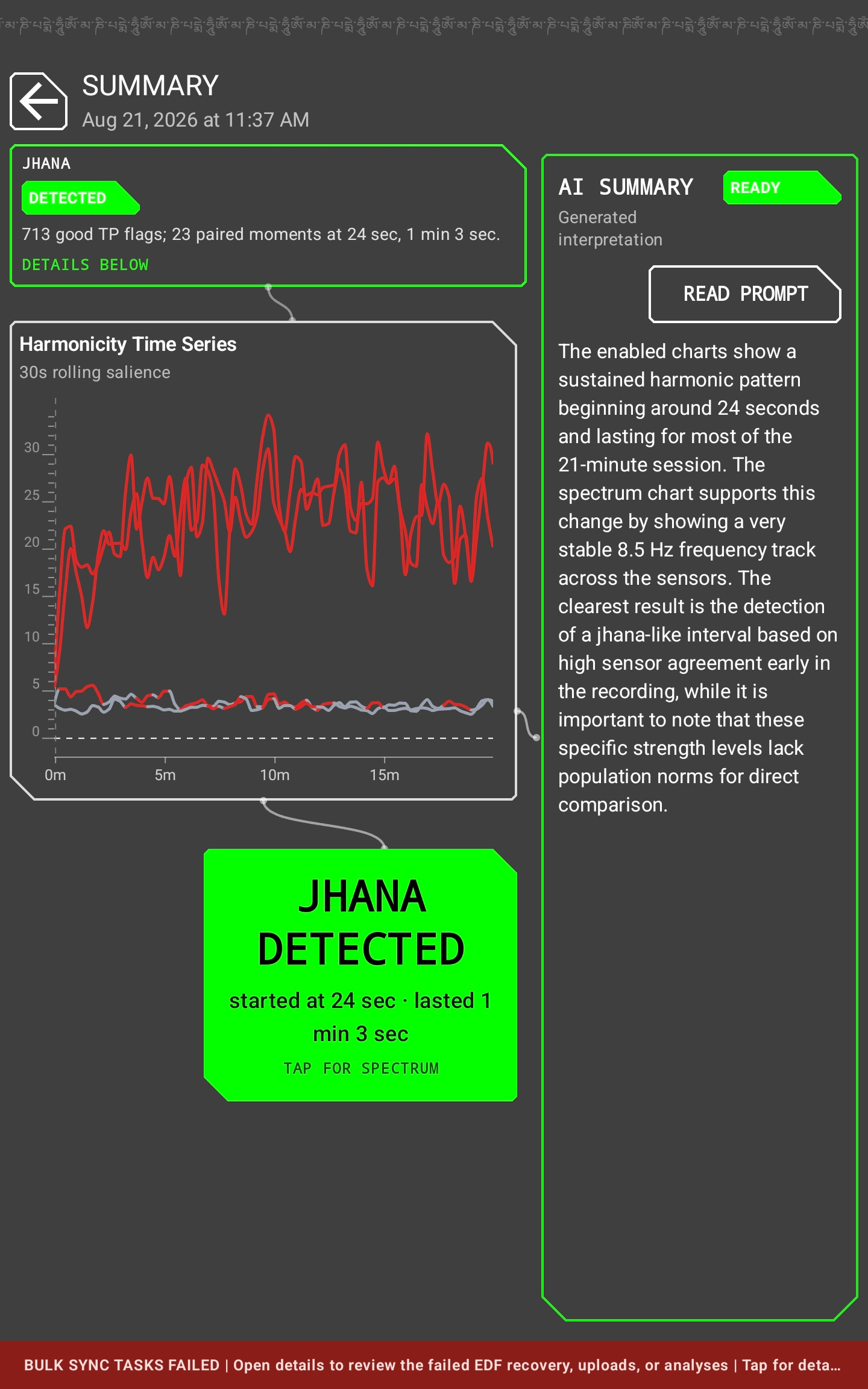
(Condition 1 Harmonicity Analysis)
(Condition 2 Harmonicity Analysis)
Following the early alpha-dominant period, both phenomenology and EEG changed substantially.
The subject reported increasing fuzziness, reduced clarity, and progressive movement toward sleep.
Short dream-like sequences began appearing while awareness was retained. These became numerous and difficult to catalog individually. On several occasions the subject reported nearly becoming completely immersed in the emerging dream.
There were also intervals in which experiential continuity appeared to be missing. The subject was uncertain whether consciousness had briefly ceased or whether awareness had simply failed to encode the interval.
This territory was described as phenomenologically similar to previously reported “cessation-adjacent” states but less clear and distinct than the morning open-awareness condition.
A multivariate change-point analysis was applied to the evolving delta, theta, alpha, beta, and gamma distributions.
The strongest spectral transition occurred at approximately:
4.85 minutes after meditation RECORDING onset.
Comparing the two minutes immediately preceding and following this transition:
Band Before Transition VS After Transition
ChangeDelta17.8%38.5%+20.6 percentage points
Theta23.9%25.2%+1.2Alpha34.1%15.6%−18.5 percentage points
Beta17.2%15.3%−2.0
Gamma6.4%5.2%−1.2
The dominant transformation was therefore a reciprocal increase in delta and collapse of alpha.
This independently determined transition closely matched both the visual EEG time course and Pineal’s reported loss of strong early harmonicity.
Across the complete post-SHARP recording, relative band power was approximately:
Band - Relative Power
Delta - 44.2%
Theta - 22.0%
Alpha - 21.5%
Beta - 9.4%
Gamma - 2.9%
Median delta power over time was 40.3%, compared with only 14.6% during the morning baseline.
Delta exceeded 50% of total analyzed spectral power during approximately 26.4% of post-SHARP windows, compared with 0.9% during the morning recording.
The post-SHARP condition was therefore not simply a more intense version of the baseline state. It transitioned into a qualitatively different slow-frequency regime.
An additional pattern was repeatedly observed during the later recording.
Strong delta activity did not always coincide with complete alpha collapse.
Using descriptive thresholds, approximately 22.9% of the recording contained periods in which delta exceeded 45% while alpha simultaneously remained above 15%.
Some individual windows showed approximately:
58% delta with 19% alpha
58% delta with 18% alpha
57% delta with 17% alpha
57% delta with 20% alpha
Several sustained runs of this pattern lasted approximately 20–30 seconds.
A separate deeper slow-wave-like condition, defined by delta greater than 55% with alpha below 15%, occupied approximately 9.7% of the recording.
These observations suggest a possible continuum between alpha-dominant waking awareness, slow-wave intrusion with residual alpha organization, and more complete slow-wave dominance.
The relationship between these states and subjective continuity of awareness remains unresolved.
A testable working hypothesis is that subjective “dropouts” may become more likely as delta intrusion strengthens and residual alpha organization decreases.
The post-SHARP recording contained substantially more transient 11–16 Hz activity than the morning baseline.
Candidate counts were:
Channel - Sigma Candidates'
TP9 -15
AF7 - 36
AF8 - 50
TP10 - 37
Morphological analysis showed median center frequencies near 12 Hz across all channels.
Median event durations ranged from approximately 0.65 to 0.86 seconds.
Representative events demonstrated recognizable waxing and waning amplitude profiles in the sigma-band-filtered signal.
Bilateral temporal coincidence was observed in 10 TP9–TP10 events, while 19 AF7–AF8 events occurred within ±0.5 seconds across the frontal channels.
These events are therefore appropriately described as spindle-like sigma transients.
Because the recording occurred during a subjective transition toward sleep and dream imagery, conventional sleep-onset physiology represents a plausible explanation for at least some of these events.
Formal classification as N2 sleep spindles cannot be established from this four-channel consumer EEG recording alone.
The subject deliberately entered the post-SHARP meditation with the intention of remaining aware as the state developed.
Unlike some previous post-SHARP sessions in which the subject reports apparently going “offline” abruptly into deep delta-dominant states, this recording involved a comparatively gradual transition.
Awareness persisted through numerous dream fragments and through at least portions of the slow-wave transition.
The subject nevertheless reported uncertain or missing periods during which it was unclear whether consciousness itself had ceased.
These intervals should not presently be classified as meditation cessations.
Possible explanations include microsleep, transient unremembered sleep, dream-state discontinuity, or another form of altered conscious processing.
The phenomenological similarity between these intervals and previously reported cessation-adjacent states warrants further investigation but does not establish physiological equivalence.
Following the post-SHARP recording, the subject reported feeling unusually refreshed and well rested.
The aftereffect was comparable to awakening from a highly restorative nap, yet the preceding state did not subjectively resemble an ordinary nap.
There was also no significant post-sleep fogginess or sleep inertia.
This restorative quality has reportedly occurred following similar post-SHARP states on previous occasions.
The two recordings provide an unusually useful within-subject comparison because they were obtained on the same day with identical hardware.
The morning open-awareness condition showed:
sustained alpha dominance, stable low-alpha organization, low delta, clear phenomenology, and essentially absent spindle-like activity.
The post-SHARP condition showed:
an initially enhanced alpha-dominant state followed by an objectively detectable transition into strong delta dominance, recurrent spindle-like sigma events, dream imagery, partial experiential discontinuity, and subsequent subjective restoration.
The strongest objective spectral transition occurred approximately 4.85 minutes into the post-SHARP meditation.
The observations are compatible with a transition involving altered thalamocortical organization.
Slow-wave activity and sleep spindles are conventionally associated with changes in thalamocortical gating and cortical responsiveness during sleep transitions. The combination of progressive delta dominance, approximately 12-Hz spindle-like events, dream emergence, and changing conscious continuity therefore provides a plausible basis for interpreting the recording within the existing thalamic-gating framework.
However, scalp EEG does not directly measure thalamic gating.
The present data therefore support the narrower empirical conclusion that an intense SHARP session was followed by a reproducible-looking transition toward slow-wave and spindle-like electrophysiology while some degree of awareness apparently persisted through portions of that transition.
The thalamic-gating model remains a proposed explanatory mechanism rather than a directly demonstrated physiological cause.
The most important observation is not simply that delta activity increased following SHARP.
The recording captured a temporal transition.
The post-SHARP state began as an intensified version of the subject’s characteristic alpha-dominant open-awareness baseline.
Approximately five minutes later, this organization shifted sharply toward delta dominance as phenomenology simultaneously became fuzzy, dream-like, and discontinuous.
Spindle-like sigma activity became abundant during the later state.
Periods of strong delta frequently occurred without complete disappearance of alpha, raising the possibility that residual waking-type oscillatory organization may accompany partial preservation of conscious continuity during some slow-wave incursions.
This possibility remains preliminary but generates a clear experimental prediction.
Future post-SHARP recordings should prospectively record SHARP intensity and whether the subject deliberately intends to maintain awareness.
Comparisons can then determine whether stronger subjective discontinuities correspond to:
greater delta dominance, greater alpha suppression, increased spindle density, or differences in the duration of delta-plus-alpha transitional states.
A particularly informative repeated design would compare otherwise similar post-SHARP sessions performed with an explicit intention to remain aware against sessions in which no such intention is maintained.
The central question is no longer merely whether SHARP alters the EEG.
It is whether the depth of slow-wave intrusion and preservation or collapse of residual alpha organization systematically predict the continuity of subjective awareness.
-Elias
Comments
Nothing yet. Say the first thing.
Sign in to join the conversation.