
Hi from blue New York. The other day, someone asked me why I care so much about the difference between fiction and philosophy. To phrase the concern as a question: what qualities distinguish the two, on principle? I’ve been thinking and writing about it for ages.
My recent post on Leif Weatherby’s Language Machines: Cultural AI and The End of Remainder Humanism looks at it through the lens of language’s formal features. So did my old book project, following an interest in structuralism, computation, and literary theory that started back in undergrad. The book is on indefinite hiatus, but it explains why I’m so excited by Language Machines and the research agendas that surround it.
The answer has to do with power. To put it crudely, I see fiction as belonging to the category of art, which means that its main “product” or contribution to the world is beauty. While it’s often beautiful, philosophy isn’t art; it belongs to knowledge, which is a separate domain.
One of my ironclad philosophical premises (or “priors” if you’re a Bayesian) is that knowledge is always a façade of power. Everything we label “knowledge” calls attention to certain realities while denying others, which is a power operation. I would add that all knowledge is political, although this depends on how you define politics. (For what it’s worth, this is Foucault 101, where people either become lifelong believers or start getting annoyed.)
With that, here’s the gist: if there’s no formal boundary that prevents art — all forms of art, not just fiction — from being rendered as knowledge, then nothing in principle falls beyond the remit of what can be wielded as power. At least nothing that’s intelligible to human beings, anyway.
Back in 2024, I ran a poll on Mastodon related to this question:
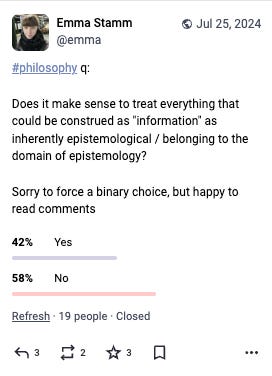
This was motivated by my suspicion that, thanks to the slow creep of computation into all areas of human activity, a process that inevitably leads to AI, the purview of the epistemic — or that which falls on the side of knowledge/power/politics rather than beauty — was expanding to include everything, quite literally. A scary thought.
I am playing fast and loose with words here. Some would say that AI’s substantive matter (what’s it built from and what it produces as output) doesn’t count as “information,” which is an unquestioned assumption of the poll as it’s phrased. I think about the lines between data, information, and knowledge a lot — in the courses I used to teach, I’d present students with the hierarchical schema data - information - knowledge - wisdom, first as something that they should accept at face value, and later as a matter of debate. There’s plenty to get into here, but for present purposes, using “information” as the term for “what AI consists of and produces” is fair enough. A more serious treatment would have to highlight Claude Shannon.
I’m not sure what to make of the fact that most people said no. I am happy about the level of engagement, though; 19 responses to a question like this is pretty good. If nothing else, it tells me that I’m not the only one who finds it interesting. (Caveat: Mastodon is terrible for sampling the general population.)
The book may never happen, but since I’ll probably write more about this in the future, I thought I’d lay out the stakes. For now, here’s some news.
News
As part of a push for visibility, The Lenox Institute for Advanced Study is now on Instagram, and I’ve decided that I’ll start posting to the personal account I’ve had for years. My personal account has basically been a burner: I’ve used it to follow artists and small businesses, checking it infrequently while studiously avoiding anyone I know IRL. Aside from that, Instagram is mostly a mystery to me. I am aware that in terms of marketing usefulness, it may be past its prime, but we still need to have one. So: please subscribe to Lenox’s account, and no hard feelings about following my personal account or not (I have no idea what I’ll post there, tbh.)
Relatedly, the next Elf Theory post will be about Lenox’s educational philosophy. I don’t want to cross the streams too much, but while we get started, sharing more about Lenox here seems like a good idea. Once we start doing promo for our first event, I’ll share the registration info and details. You can already mark your calendars: it’s Wednesday June 10 at 7pm in lower Manhattan. Writing to info@lenoxinstitute.org will get you on our mailing list, where we’ll send detailed updates and calls for collaboration at a sane pace (no more than 2x a month.)
The newest LEPHT HAND is about one of my favorite topics of all time: the critical reception, philosophy, and politics of prog rock. I was really excited when Dave Mandl — famed WFMU DJ, bassist, and prog apologist — accepted my interview invitation. Sereptie and I are both big prog fans; I had to pitch this episode idea eventually.
The second-to-newest LEPHT HAND is with Bob Langan: The PBS Unconscious: Childhood Wonder, Nostalgia, and the Collapse of Shared American Culture. I like Sereptie’s description for it, but I’ll add that we spent a lot of time discussing late-night diners, Wawa, Buc-ees, and Sheetz. So east coast, I even got to talk about my hometown. (I am a Poughkeepsie apologist.)
Last but not least, I joined Acid Horizon for an episode that puts Mark Fisher in conversation with David Foster Wallace. Our guest was DFW expert Hannah Smart, and I’ll share the YouTube link because I really like the comments.
The next post won’t have nearly so many links or any promo, although the hope is that it’s welcome and not too aggravating. In any case, it’s all part of a necessary work hustle. Also, if you’re so inclined, please know that I like hearing from readers. Even if you don’t subscribe! Emma.stamm@gmail.com or you can message me here. Thanks!
Comments
Nothing yet. Say the first thing.
Sign in to join the conversation.