
I voted for Atiku in 2023 for two reasons. The first is that I erroneously believed that Nigeria’s democracy depended on bad parties and horrible governance being punished by election loss. Bola Ahmed Tinubu foisted Buhari upon the nation, and he even bragged about it in the lead up to the elections by saying he was the one who went to Daura to beg Buhari to run again. Buhari consequently drove the country into two recessions, and kicked his legs up as his family members ran the country into the ground. Why would any sane citizen reward the party that did that with four more years?
According to folks like Rotimi Amaechi and Adebayo Shittu, former ministers under Buhari, the man didn’t even care whatsoever about what their ministries were up to and left them to do as they like. He also allowed Godwin Emefiele and Abubakar Malami, two cartoonishly corrupt individuals, to have their way with the country. It was like they had Nigeria in a perverted party-of-three, with Malami stealing off every lawsuit he could find, and Emefiele becoming the patron saint of dollar roundtripping.
I did not believe anyone with a good conscience would reward that behavior, so I voted with the candidate with the best chance of removing the APC and teaching Tinubu and the APC a vital lesson in statesmanship. The second reason was that Atiku had some experience running the country during its “golden democratic era”, and was no fan of the socialist policies that Buhari used to grind the economy to a halt. I also had no doubt that he would sell off the horrible capital sinks we had masquerading as infrastructure, such as the Ajaokuta Steelmill and our three refineries (if we could even see anyone to buy them). He also spoke seriously about delegating even more power and resources to subnational units, which was a more structural solution to many of the institutional problems Nigeria faced.
I know Atiku has his own baggage, such as serious corruption allegations levied against him by Obasanjo. However, I have looked at the finances required for elections in Nigeria, and have reached the conclusion that no sane person would ever get involved without seeking to recoup their investment. Like Wike says, before harmattan, there was cold. If our election financing remains the way it is, leaders, whoever they are, will recoup their money with interest. Even Buhari, who claimed to be the most honest man in Nigeria (and many seriously believed him), also repaid his cabal who must have financed part of his election, by giving them juicy posts from which they can stuff their pockets. It is the price of playing the game, and anyone who tells you otherwise thinks you are 10 years old.
In 2027, the same three men who battled it out four years ago have presented themselves again. And this time I want to really see what they look like. This is the first in a series of review articles looking at the performance of the top three presidential candidates at the NESG sessions that held in Lagos. These sessions had captains of industries, finance professionals, and basically the movers and shakers of the Nigerian economy. The goal was to have each candidate interface with this group, present their economic plans, and answer questions on them. In essence, it was a test of their intellectual mettle. This wasn't a campaign ground where they had to pander to the lowest common denominator of the country's polity, neither was it a conference where they had practiced a speech prepared by others.
Here is Atiku, in all his glory.
The host is seated, alongside Atiku, on an elevated platform. The room is quite small and hosts maybe 50 people. Atiku’s lieutenants at the time were sat in the front row. This includes Saraki, Obaseki, and Tambuwal. The host wears a wig that is probably not of the greatest quality, and Atiku is in the sharpest suit you have ever seen, interrupted by a monster of a belly. The mood is very serious. People are making noise.
The first question is from the host, and she wants to know what he will do in his first hundred days. This should be a fairly simple question, I suppose, and Atiku answers it as well as he can. He says he will form his cabinet by choosing the best of his best in the country. He then adds that the unity of the country is paramount to him and he would even appoint nominees from different parties.
This may seem altruistic, but we must understand that politicians are never so. They are humans, just like us, and they are even more cutthroat. They never give without reason, and Atiku had a very good reason for proposing a government of national unity. The man was campaigning on a fractured party that had five PDP governors dancing in unfortunate anko attire all around the country to spite him. If he had won the elections, he would still need to build a new political base to campaign for his reelection, and there was no sign that the people against him would suddenly change their minds — and even if they did, only a fool would trust them as they had betrayed him once before. His government of national unity idea was therefore a plan to save his own skin and make new alliances, not one borne out of his selfless nature and love for his country. However, it was still a good idea, as Nigeria needs less political infighting, not more.
Asides from that, he says he will focus on security and the economy. Now, the main theme of Atiku’s answers here, as you will find out, is an astonishing lack of details. Any inbred fool — perhaps, someone just like me — can go on any podium and say he would focus on security.
Atiku never says the how, or even expresses any novel insight into the security situation of the country, and this is a big deal, as I have written elsewhere. Nigeria is at war, and security should be the first, and perhaps only, focus of anyone campaigning for elections. Can you imagine an election, in the middle of the civil war, where a candidate simply answers the question of security by merely saying he will focus on it? If you cannot imagine it then, why accept it now?
I try not to overestimate my intelligence (even though many people think I do), so I approached these interviews with the assumption that these men are smarter than me. And yet, despite living in Lagos, far removed from the worst of the security malaise bedeviling the country, it felt like I knew more about the scope of the problem than Atiku. In fact, it felt like he was measuring his words and had been coached not to say more than he did. This is possible, and perhaps good advice from people who didn’t want him to talk himself into a viral meme. But it wasn’t convincing at all.
He says his third priority within the first hundred days would be the economy, and argues that the economy can only function in a peaceful and united country. It seems like his argument was that a lack of unity is the reason why Nigeria is at war, but that makes absolutely no sense. Mohammed Yusuf was already preparing for a grand Jihad before anyone knew of Nnamdi Kanu and IPOB (which is what I assume he was referring to), and the Mujahideen in the North do not care whatsoever for Nigeria’s unity nor the unity of its political class. So even a government of “ultra-super-magnificent-unity” wouldn’t even come close to solving the problem.
Thankfully, he gets down to some specifics after the host presses him on what exactly he would do within his first 100 days. He says he would stop the regime of multiple exchange rates and consider the issue of fuel subsidy. A few notes on that before we continue.
The first is that, in 2023, Buhari had battered the economy so badly that even if we wanted to continue the double exchange rate regime, we really couldn’t. The real economy would come to depend on the actual (not CBN mandated) exchange rate for probably 95% of its needs, and we would suffer the inflation that Buhari was running from all along. This was as clear-cut a decision as any president would ever get. It was just not possible to continue that doomed regime for another year, let alone another four years.
Secondly, on the consideration of subsidy: I have lived in Nigeria for some time now, and I know discussing with “stakeholders” on how you plan to steal their loot is an effort in futility. There is no point in “considering” the issue of subsidy (his exact words). In fact, discussing it with them would only motivate them to find ways to block it, or to go big for one last payday from the Nigerian tax-payer. Removing it on the first day, in his inaugural speech, as Tinubu did, was difficult for most Nigerians, but it was the best way to guarantee it would go at all. And it nearly didn’t even work, as the government likely paid subsidies at some level for about a year after his inauguration.
Here is a good example of why “talking with stakeholders” in matters where they have something to gain is a waste of time. After Obasanjo approved the sale of our refineries in 2007 for nearly a billion dollars, Yar’Adua came on the scene and revoked the sale. When Obasanjo asked why, he said NNPC officials had convinced him that they could run the refineries and selling them would be against national interest.
That, of course, was very stupid. And Yar’Adua unfortunately didn’t live long enough to see the results of that foolishness. In the end, we refunded Dangote and we have now spent billions in trying to fix those refineries. Who can guess who became stupendously wealthy from those billions? It is the story of Nigeria.
The funniest thing about this episode is that Nigerians absolutely love Yar’Adua, despite his retarded economic instincts. He reduced the pump price of fuel by 10 naira, and got applause from the people and to pay for that applause he shelled out 1.8 trillion naira in subsidy over just two years. That is about 19 trillion in today’s naira terms, in other words, about a third of this year’s budget, and about 60% of last year’s revenue. If the same number holds this year, it would mean we spent about 30% of the country’s present revenue on subsidy payments per year. This is fiscally irresponsible, no matter how you cut it.
This is something Atiku should ordinarily know, since he is no greenhorn in Nigerian politics. Maybe this was just a political answer to assure stakeholders in that industry that he wasn’t really coming directly for their food, but that doesn’t assure me. In fact, it just tells me he has no idea of the scope of the severity of the problem, something I, a random twenty-something-year-old outside government, already knew. That seems a bit arrogant, no? That is precisely the point.
The host moves on and asks Atiku how he plans on addressing unemployment. He says his government will discuss with the private sector and ask what incentives they need.
Atiku probably spends millions in salary every month — there was really no one who could give him more details on this question? Unemployment isn’t a niche problem in our national destiny. He owns companies and employs people. What experience does he have from his own companies that can influence his answer? If the government sat him down today, what incentives would he ask for his own companies? So it is until he gets into office that he will know the incentives the private sector needs? Really?
Anyway, Atiku goes into details and we immediately learn why he has avoided doing that all this while. He gives us Gbatiku Nugget 1#.
GBATIKU NUGGET 1#: Atiku says he will offer a tax reduction and ask how many more people companies can employ. Asides from the fact that this idea is so pedestrian, it is also retarded in the sense that A) there is no guarantee that reducing tax would lead to more employment in any individual case, as money saved could be spent on more efficient machines, systems or infrastructure therefore it could set up another arbitrage system where companies employ people at low wages to do nothing and B) it risks the government’s balance sheet, and this is a horrible idea for a country that doesn’t want to drown in even more debts.
When later asked about how this will affect the balance sheet, Atiku somehow manages to crap the bed with an even worse reply. He says the employees will pay taxes so it all balances out in the end.
First of all, that is not how it works. Second of all, CIT, which is the tax companies pay, goes to the federal government, while PAYE, which is the tax employees pay, goes to the state government. If even I, in the comforts of my flat, can figure out how dumb this idea is, why am I hearing it from the lips of a presidential candidate?
A much better idea would be to relax regulations, or run a simulation to see what regulations can be relaxed to lead to more growth without putting the sector at risk. Nigeria is shockingly highly regulated, and a smart fellow armed with enough money and time should be able to point to one or two that proves this point.
In fact, if companies expand faster under relaxed regulations, they would not only need to employ new people, they would also pay more in taxes, so it is a win-win! More importantly, this was a perfect chance to raise the issues of multiple taxations, which used to plague the country, and he doesn’t even do it! The fact that Atiku has just provided the same sort of answer you would get from someone discussing trending topics under the tree does not fill me with confidence at all. How can someone without a job even know how stupid this idea is than a billionaire like Atiku?
Next, the host asks him about revenue generation. He says we have to rationalize public expenditure, whatever that means. This is an incredible answer, given that he didn’t give a straightforward reply to the removal of subsidy which is the main reason the government’s balance sheet looks sick. When pressed for more details, he says that fiscal and monetary policy will be based on private sector incentives. Now, I know I am not the sharpest tool in the shed, and that this may actually mean something. However, it just seems like a mix-match of buzz words.
He is asked how he will attract FDI to the country, and he says, well, security is key. This is a good answer, but I am not sure he knows just how bad insecurity is — or if he does, he has no idea what to do about it. When pressed for even more details, he says, well, he will make sure the fiscal and monetary policies are stable. Would anyone come here and say they would make sure the fiscal and monetary policies are unstable? The fact that he gives no details, or even examples of how fiscal and monetary policies have destroyed FDI is bothersome. I studied history, and this sort of answer is tantamount to me saying “well, the war was really bad but the allies won” if asked about the history of World War II. Yes, I would be correct, but what lecturer worth his salt wouldn’t tear up my exam paper?
The host is clearly unimpressed, so she presses further. Then, I swear to God, he says this; “our policies will remain stable and consistent”. Well, I better hope they do! Is that all? Really? If I wanted to listen to pedestrian analysis, I would go to Reno Omokri’s instagram. The fact that he cannot give one example of a fiscal or monetary policy he would change, even as horrible as Buhari’s handling of the economy was, is shocking. He cannot even recall his own proposal to unify the exchange rate!
At this point, I am wondering why I even voted for him in the first place. But I would wonder even more as the session gets even worse for the distinguished Waziri Adamawa.
After the host is done with drilling (and it was really a drill) Atiku, she opens up the floor to others who may want to have a taste of that. And they really seem to be eager to have their way with him.
The first question is a question of performance — a man wants to know Atiku’s personal KPIs. This is an interesting question, and is one this man, who found a way to be in this room, would probably have asked people he sought to employ. But he is making a big mistake here; there is absolutely no reason to believe the Nigerian president, or people who aspire to become the Nigerian president, believe they are serving Nigerians. Leading? Yes. Instructing? Probably. Saving? Most certainly. But serving? No.
In their heart of hearts, they believe that they are doing the country a favor, and are obviously so much better than the alternative that the question of underperformance doesn’t even compute. How can they underperform when no other Nigerian could possibly do better? Why would they set targets for themselves when they have already saved the country by the mere fact of becoming president?
So it came as no surprise to me that Atiku didn’t seem to have an answer to that question. Why would he? If I were applying for a job that depended on outcomes I could track, I would have KPIs for myself, or expect them to be provided to me. However, if I were applying to save someone from themselves, I would expect them to be grateful. In reply, Atiku says this; “I don’t seem to understand your question”. Alas.
The man repeats it again, and spends triple the time breaking down the question. In the end, he even gives Atiku an example of a KPI — for example, you can say GDP — and it looks like he finally got the clue. This, of course, is ordinarily bad. Your professor would never explain seminar questions to you during a presentation. He also certainly would never grant you an easy expo to get out of it. So what does Atiku eventually say?
The top three KPIs are economy, security and unity. I am not sure he understands the question. These, as you may notice, are not KPIs. You need to be able to measure and indices before you can use it to rate your performance, and if you don’t give us that measure, you are, respectfully, saying absolute nonsense. He eventually wanders into his point and says he will try to decentralize security and consider either state, regional or local police. This is a great idea I wholeheartedly support, but it isn’t a KPI. For the economy, he says, well security is fundamental to the economy. And then he says we should judge him by the unity of the country. What does that even mean? Is this some sort of boomer Nigerian joke that I am too retarded to understand?
Nigeria’s reliance on oil has been a running theme for most of our existence, and there are some academics who speak about it in hushed tones like it were some curse. This is such an important problem that I expect anyone who wants to be president to have some interesting ideas on how to diversify the economy, and with numbers to back it up. When the question is read out, the camera pans over to Saraki, Obaseki and Tambuwal in front, men who are probably more conversant with the question and can give better answers. They looked like hardworking members of a project group who have to listen to their friend deliver a presentation they aren’t quite sure he can handle. However, I am happy to say their friend didn’t totally put them to shame.
GOOD IDEA NUKE 1#: Atiku has his first great idea, and the crowd goes wild! His solution to this is modernizing and industrializing agriculture. While he doesn’t give any details, as usual, this is at least somewhat different from the usual agriculture talking point I am used to from Nigerian politicians. Agriculture cannot be a mass employer of labor like Buhari wanted — instead, to unlock our potential, we need fewer people working directly on the land and more machines.
Next, he says his government will focus on ICT. We all know he means tech, but ICT is such a boomer way to say it. Is that what Saraki and Obaseki told him? Unfortunately, like his other answers, that is where it ends in details. You, again, get the sense that he has been told to not talk past himself, as an underwhelming but still competent showing would be miles better than talking himself into the limits of his knowledge. The bad thing about this strategy is that it makes it seem like he has no clue about what he is talking about.
The second question is about the level of debt in the country. We want to know just how Atiku plans to deal with this problem. And from this episode, we learn that you may try to teach an old dog new tricks, but it is quite difficult to do.
Atiku immediately speaks about rescheduling, or asking for debt forgiveness just like the Obasanjo regime did. But it doesn’t really work that way. First of all, banks never forgive debts out of generosity. They usually only do so when there is a perceived or actual deterioration of the borrower’s ability to pay back. And if Nigeria indeed gets to that stage — or if the problem needs that solution — we are already in bigger hot water than the debts themselves. Even rescheduling, which is the less extreme version of this plan, is in itself a market signal, and any administration that has to reschedule debts upon resuming office has to think very carefully about it, as it often means we pay more for longer, thereby increasing the debt burden in the long term while reducing the effect on the balance sheet in the short term.
Secondly, the recall to the Obasanjo era is unnecessary in this case, as we only got that debt forgiven by a perfect storm of advantageous factors. Tony Blair had promised more third world assistance during his campaigns, we had the cash to pay off 12 billion upfront, the broader G8 had committed to even more debt forgiveness in third world nations earlier that year, and we owed the debt to the Paris Club, a committee of developed nations who had more political wiggle room to cancel debts outright. There is no reason to believe Atiku can replicate that perfect storm, so his solutions do not work and he is grasping at straws. Of course, since this is the Nigerian Economic Summit Group, every single person in the room knows it as well. I was surprised no one was snickering. And for this, we get Gbatiku Nugget 2#.
GBATIKU NUGGET 2#: Nigeria is not a broke baby-mama of 12, you need to pay your bloody debts and stop crying about it. If you always have excuses on paying your debts because of this or that, very soon no one will lend you anything! Bad idea Mr Atiku! And also, most of the Paris Club debts were from the 70s when we borrowed against the miracles of the oil boom. Most of our debts today are not even 20 years old yet — who would even try to discuss forgiveness with us! We need to become serious people in this country!
But it gets even worse, if you can believe it. The question on indebtedness also contains a question on how to improve revenue on the fiscal side. And you won’t believe that Atiku tries to kill one bird with two bad ideas, as he says his debt forgiveness/debt rescheduling plans will take care of that as well!
GBATIKU NUGGET 3#: How can your third bad idea come from building on your second bad idea? Well, it looks like this is just how we run things in the Waziri School of Errconomics! You cannot fix your fiscal problems by hoping on debt rescheduling that will just make the problem worse in the long term and debt forgiveness that will literally never happen. You cannot build a castle in the air.
Nigeria has a lot of interesting characters, and one of them is a fellow named Bismarck Rewane who is a well respected economist. The queer thing about Rewane is that he just sometimes dresses like A Pimp Named Slickback in Boondocks. If you have no idea who that is, here is a picture clue

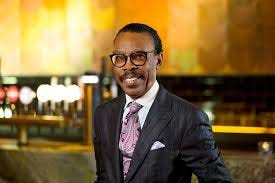
Yes, he doesn’t have the hat, or the earrings, but what is with the jerry curls. Seriously? What’s going on here?
Anyway, Mr Rewane is here, and he has interesting questions for Atiku.
Mr Rewane says Atiku hasn’t said anything differently from other candidates, so he wants to know what the man would do differently. First of all, one wonders where Mr Rewane put his ears when Atiku spoke about a government of national unity, a proposal that no one else made.
His second question is quite interesting. He starts by dropping some statistic he may have heard from Twitter; “1% of the world has 66% of the world’s wealth”, he says, and wonders how Atiku will solve the problem of wealth inequality. I wonder how someone can dress like a pimp, call himself an economist, and still ask questions like some 21-year-old white socialist from the jungles of New York. Is this the twilight zone, I wonder.
What answer does Mr Rewane want? He wants Atiku to seize the means of production or what? Or does he want the poor man to quote from Das Kapital like some dirty communist? Maybe he wants him to raise a hammer and sickle and proclaim that all the workers of the world must unite. But Mr Rewane doesn’t end there. He has a third question, you see.
His third question is to ask Atiku why he doesn’t want to separate banking policy from monetary policy as it is done elsewhere. At this point even Saraki, who is usually quite stoic, can be seen holding back a laugh. He cannot believe they dragged him all the way from Kwara for this nonsense. Obaseki, on the other hand, looks like he would appreciate a cane to flog this fellow. Tambuwal puts his face in his hands. Ya Allah, why have you cursed me with so many retarded co-nationals, he probably wonders. The rest of the room lets out a spiritual groan.
Atiku thanks him very much for the questions, and says what he did as VP is quite enough to show that he will pursue different policies from the present government. He then says he will look at what the government needs to do to achieve success. Well, I hope he does? That is such a non-answer, but I cannot blame him as Mr Rewane probably deserves that sort of answer with that type of question.
My main grouse here, despite the type of question from Mr Rewane, is that if Buhari were so retarded, and we all claimed so, it should not be that difficult for Atiku to provide specific policy choices that he would overturn on his first day of office. When Trump regained the White House, for instance, he overturned over seventy policy choices from the Biden era. I have been listening to Atiku for the past forty or so minutes, and he hasn’t mentioned one specific policy choice that he thought was retarded and would immediately change upon assumption of office (asides the parallel exchange rate but as we have discussed, that was the most obvious situation in the world).
This is bad for several reasons, but the most ridiculous of them is that Atiku ran for this same position four years ago. If he doesn’t yet have real specifics, despite the hours of prep for that run, and the last four years in-between, how do we know he has any clue about anything?
Atiku goes on to say: “I will insist on an improvement because that is the hallmark of leadership”. What does that even mean? Anyone can say they will insist on excellence. We want details, not just more promises of commitment. On the question of separating monetary policy from banking policy, Atiku says; “it is an another approach we can introduce in our economy”. Again, my friends, what does that even mean? Even if the question sounds dumb, Atiku should be able to tell us why.
The good news here, and the one redeeming quality he has, is that he chuckles at the inequality question and kindly told Mr Rewane to get out of his face with that bullshit in formalinese. However, he satisfies the man’s socialist instincts by saying he would consider increasing the minimum wage. But we must ask ourselves one vital question, does anyone think a pimp named — sorry, an economist named Rewane cares about minimum wage increase?
The next question is from Foluso Phillips, a former chairman of somewhere, who asks what is Nigeria’s value proposition to the world: “what is it that we wake up every morning to say we want to be to the rest of the world?”
This is a non-detailed question that any random person can answer with a lot of nice sounding rubbish, and it’s no surprise that Atiku excels here. His second question is how Atiku plans to ensure that the civil service works with the private sector. He complains that many of the agencies that the private sector interacts with are openly hostile to businesses, and he wants to understand how Atiku plans to tackle this.
This question is especially insightful because a lot of the problems the private sector faces in Nigeria is the open insanity of the civil service, which is staffed by some of the most corrupt people in Nigeria. If Nigeria ever plans to get working, this problem has to be solved one way or the other. His last question (for some reason, everyone asking questions never has just one question, instead they have a bevy of complaints), is how Atiku plans to get the sub-nationals to align with what the federal government wants.
Here is Atiku’s best moment in the entire session. He answers by saying he has proposed restructuring which, to him, includes giving sub-nationals more autonomy to decide matters on their own. This answer is clever, as it allows states to compete against each other and drive their own growth policies. If this is done, it should ideally make Nigeria more resilient as we will have more “sandboxes” to try out policies, and winning ideas would get adopted by other state governments as time goes on. In the end, capitalism is all about efficient allocation of resources. And what better way to do that than a “free market” of economic environments where winning policies can get a better allocation of capital and human Resources.
GOOD IDEA NUKE 2#: One of the reasons America is so prosperous is that it isn’t just one huge country, it is fifty different countries trying out different things at the same time. Some may work, and some may not. What is certain, however, is that the entire country isn’t stuck in a dumb direction, as all 50 sub-nationals are unlikely to be foolish in the same way at the same time. If Nigeria tries out the same, we will likely get similar economic results as all 36 states cannot be foolish at the same time. Or can they? You never know with this country, and anything you see you probably have to take it like that.
Atiku goes on to say he will propose a constitutional amendment to limit the federal government to maybe just ten sectors of public life so that the rest of the country can chart its own destiny. This is an extremely good idea, and is one of the reasons I voted him in 2023.
On the civil service question, he answers that the civil service takes a cue from political leadership, and if the leadership prioritizes the private sector, the civil service will as well. I don’t know if Atiku is up to date on the Twitter ramblings of noted human psychology professor, Mr Josie Elewa, but if your plan is “the people will just…”, then you have no plan, as the people will never “just”. Even under Tinubu, noted state capture expert, civil service employees still protest against political leadership. The real answer here, and one I am disappointed Atiku doesn’t point to, is Civil Service reform. We need that reform yesterday.
On the selling point question, he goes on a boomer tangent about how Nigeria used to send soldiers to other African nations to keep the peace, and under him the government will restore ECOMOG to prevent coups. Now, I have very little experience in the comings and goings of international politics, but this strikes me as an extraordinary lack of priorities, as Nigeria is currently fighting its own quasi civil war, and it is losing badly. We simply don’t have the time, standing or money to act like Africa’s big brother. This should ordinarily earn Atiku a bad idea nugget, but it could very well be that the instability of our neighbors is one of the reasons we are losing the war against bandits and Jihadists, so there is a decent chance I could be wrong in my analysis.
Nigeria is an interesting place indeed, as there is a king — who is dressed in his royal attire — in attendance. My grouse is this; if you believe you are indeed a king, there is no reason to show up at this event and sit amongst the plebs to ask questions. A king should be sovereign. Or should at least look like it. And if you know you are not actually a king, and not sovereign, why are you showing up in your royal attire? It just seems like a farce for a king to stand up to address someone sitting down.
Anyway, this king has a couple of complaints. First he brings attention to Gbatiku Nugget 1# and tells him that is not how taxes work. He then asks how Atiku plans on dealing with manufacturing, as that was the “real economy” and he has said very little on it. This is a good question too, and I would prefer if most of these politicians stop promising us food from the farm and promise manufacturing instead. But you see, they won’t, because manufacturing is hard, and since it doesn’t employ as many people as agriculture in Nigeria, a lot of politicians have no incentives to even bring it up.
Atiku says when he was VP he used to meet with leaders of every sector every month, and as such he will continue that tradition and give their complaints a listening ear and their issues will be solved by regular dialogue. To me, this just sounds like a promise for more committee-ism. Nigeria may not be Soviet Russia, but we are still going to be killed by rule of committees. There was probably an inauguration of a committee to prep this man for this session as well. Just our luck. To round off this episode, another fellow asks if Atiku really means that he will renegotiate our debts (the man probably couldn’t believe how bad that idea was), and Atiku repeats it. The man shakes his head and probably just leaves Atiku to God. I can feel his pain.
The next comes from a future loser of the Edo gubernatorial elections, Asue Ighodalo. I suspect this is a planted question, and I hope Atiku respects us enough to have a good answer to his own plant. Asue asks about state capture and wonders how Atiku will deal with cabals. The man responds that if you try not to form a cabal, he will put you in jail. Ah, it must be so easy then! Wonder why no one has ever done that and the “state” still gets captured by faceless people in Aso Rock. They must all be wicked and stupid people.
He also uses this opportunity to launder his grievances against Tinubu, as he says the PDP isn’t even allowed to erect their posters in Lagos. He insists that this will never happen under him. I didn’t become a Nigerian last night, so I doubt this.
The next question from Asue is about regulations, and Atiku says he is a believer in less regulation. This sounds like a good idea, but I won’t be praising him for it as he could have easily given us an example of a regulation he thinks needs to go. This man runs several businesses — are there no examples he can give from his experience of running those businesses? It is all so tiresome.
The next question is on how Atiku plans on marketing Nigeria and dealing with corruption. This question is ironic as it is the equivalent of asking a police officer how he plans to deal with police brutality. To answer this question, he is possessed by the wandering spirit of his former VP, and he tells how he went to England to see the Archbishop of Canterbury who tells him that London is the capital of money laundering. His big lesson from this episode is that crime does not impede development, and that he would reach an agreement with corrupt people to bring their money back into the economy in return for amnesty. What can I say? If Niger Delta militants can get amnesty after killing and kidnapping so many people, why shouldn’t we extend that facility to others? It is the Nigerian way. Of course, this answer here is why my father hates Atiku with all his might. He is never one to look a chance to pay-for-play in the mouth.
Another future loser of the Edo elections, a rotund fellow named Olumide Akpata (a fellow who believed a poll by Tunde Ednut meant he had a chance at being governor) raises a point about the state capture of the judiciary. I wonder if lawyers are actually allowed to speak of judges this way in public, but this is Nigeria so who knows, really. He says that an opaque appointment process means that people who shouldn’t even be clerks become judges.
Atiku has an interesting answer to this. He says he took the president, his boss, to court 11 times, and won all his cases (this is interesting, as independent research tells me he actually won 14 cases, not 11 — can he not even remember how many cases he won? Was his legal steak so juicy against Obasanjo that he cannot even keep track of his victories? God when? ). He says he never had to bribe a judge to get these judgements, and they all became landmark cases in the constitutional history of the government. This is an incredible accomplishment, no matter what you think of the guy and this shows that this is a fellow who isn’t scared of a fight and has a good grasp of the law. He then says he recently spoke to an appeal court judge who only earns a million naira per month, and doesn’t even get a car or house out of it. In such circumstances, one can expect corruption, and he says he will focus on judicial welfare if elected. This was a really good answer, as he at least gave some details.
GOOD IDEA NUKE 3#: One way to fix the judiciary is by not turning them into literal paupers. While the proletariat may not like it, it is actually important for our judges not to be bothered by searching for their daily bread. If they are, then you shouldn’t be very shocked if they sell judgements. This is Nigeria after all.
This was an extremely underwhelming performance, and by the end I wondered if my decision to vote him in 2023 was flawed. However, none of it changed my priors about the situation. Atiku was over 70 — exactly how sharp do I really expect him to be? He still remained the best chance to punish APC, and the alternative was a similarly old guy who, from what I saw during campaigns, was even less mentally astute than Atiku.
More importantly, elections aren’t a test of the smartest Nigerian, but of the best options. We won’t import candidates from heaven, and if these two near dead old men are what the Nigerian political class have offered up to us, we have to limit our choices to them. It is somewhat tragic, as I have no doubt that his lieutenants in the room — Saraki, Tambuwal, Obaseki, and even Asue, are all sharper and have a better grasp on these issues than Alhaji, but they are not on the ballot. It is the Nigerian way.
In the end, Atiku had three very bad ideas, and three very good ideas, so I suppose it was a draw. Would you ask for more from your 75-year-old grandpa? I wouldn’t. In my next article in this series, I will be looking at the performance of Twitter darling, Mr Peter Obi. I wonder how he will hold up under my extraordinary gaze.
Comments
Nothing yet. Say the first thing.
Sign in to join the conversation.