
Goals don’t get you anywhere.
Not on their own.
You set a goal, feel a brief dopamine spike from writing it down, then stare at the enormous gap between where you are and where you want to be and feel worse than before you set the goal.
That’s not a motivation problem.
That’s what goals without structure always produce.
Most people operate with one level: the goal.
“I want to get fit.”
“I want to build a business.”
“I want to learn a new skill.”
And then they wait.
For motivation.
For the right moment.
For clarity that never comes.
The goal creates the destination but zero path to get there.
Your brain sees the gap between where you are and where you want to be and activates avoidance.
Not because you’re lazy.
Because a goal without a clear next action is just a source of anxiety dressed up as ambition.
The fix isn’t to set better goals.
It’s to decompose the goal all the way down to the specific action you can take in the next five minutes.
Here’s how.
Every goal needs to be broken into four levels.
Each level is more concrete than the one above it.
Most people only have Level 1. That’s why most people stay stuck.
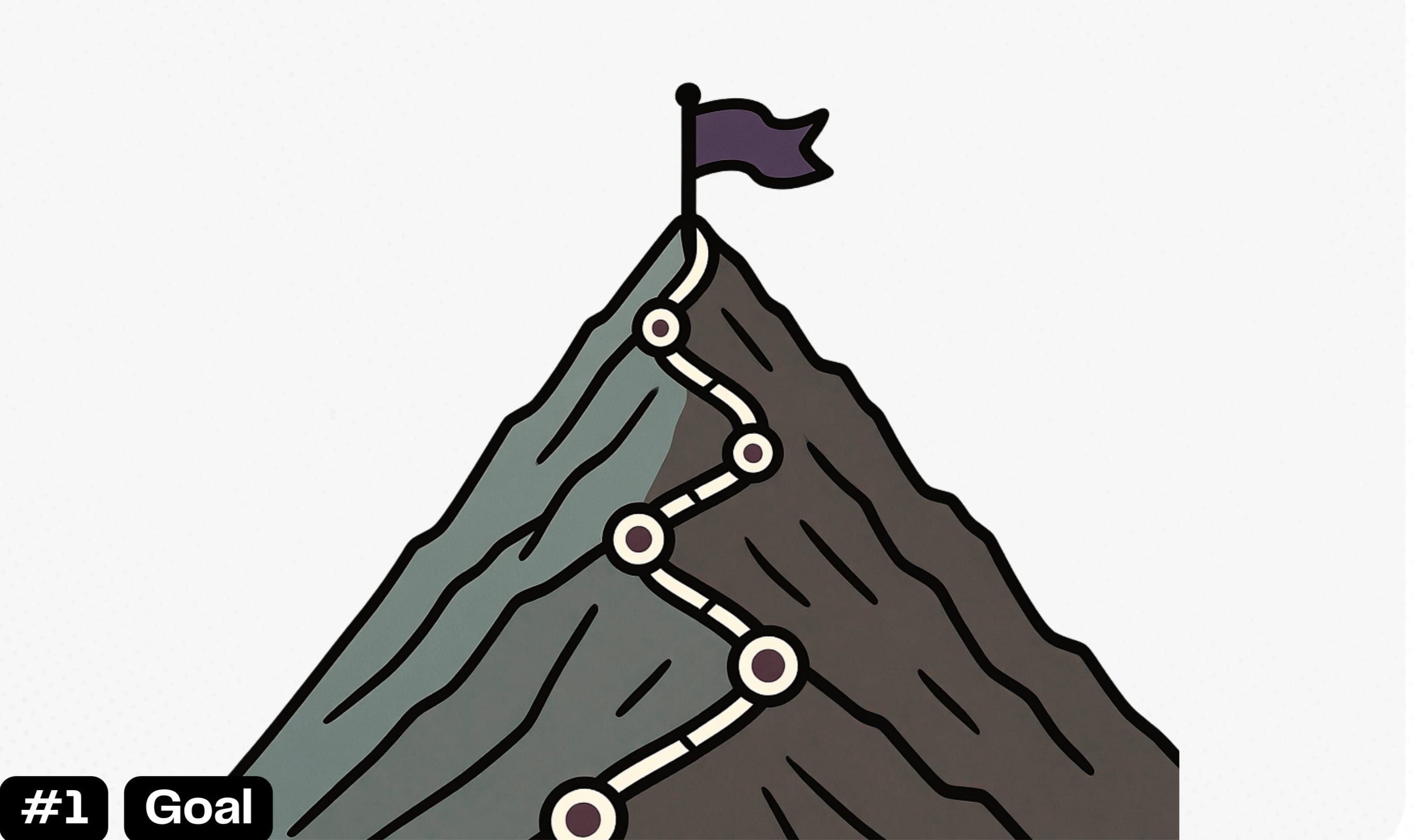
The destination. What you ultimately want to achieve.
“I want to speak Russian fluently.”
“I want to launch my own business.”
“I want to get in the best shape of my life.”
It’s inspiring and completely useless on its own.
A goal tells you where you’re going. It tells you nothing about how to move.
Every morning you wake up with a goal and no path, you add another day to the gap and another layer of guilt.
Can you take action on your goal directly, right now?
No. Because goals aren’t actions. They’re directions.
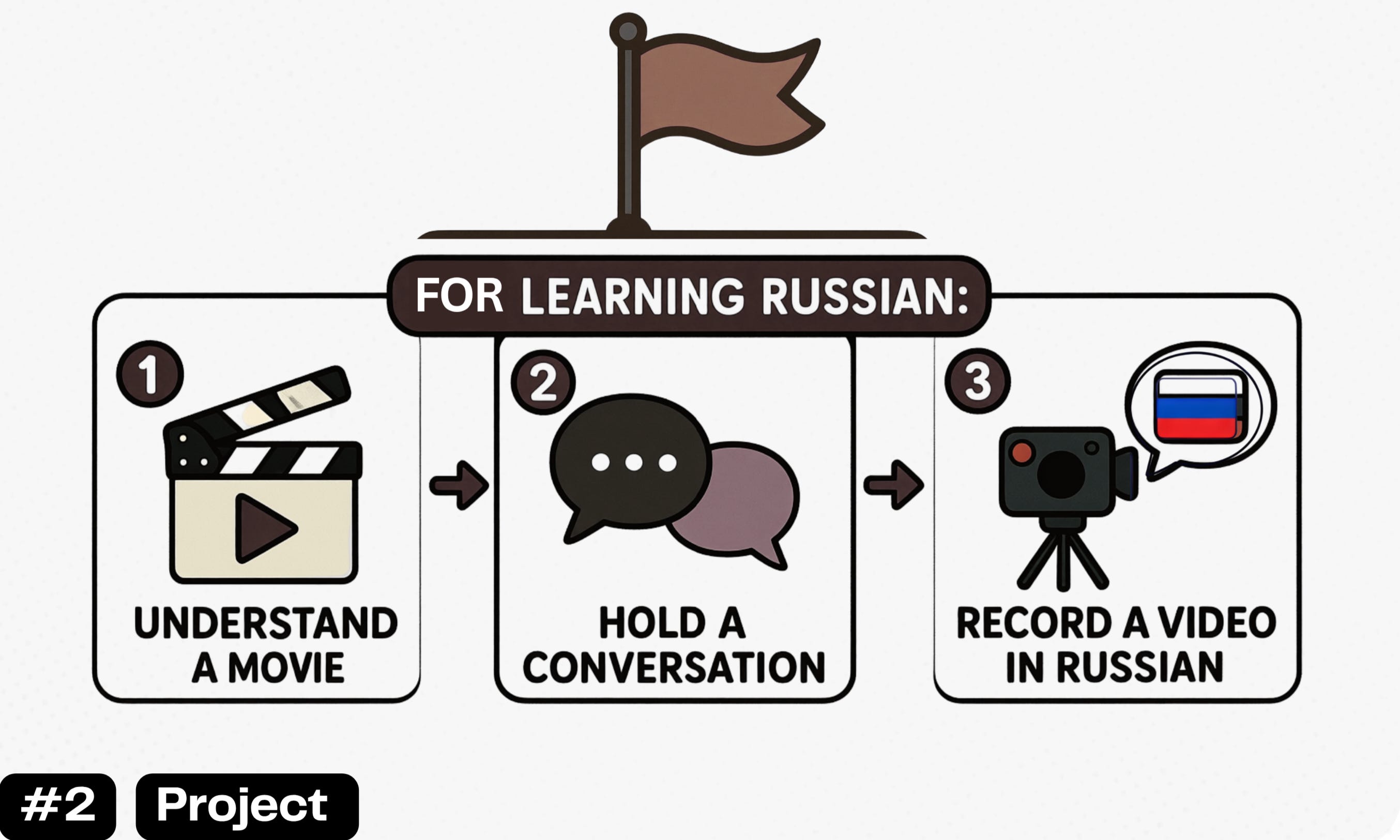
The major milestones between where you are now and achieving the goal.
Each project is a specific, completable outcome that proves you’re making progress.
Goal: Speak Russian fluently.
Projects:
Watch a Russian film and understand it without subtitles
Have a 10-minute conversation with a native speaker
Film a 5-minute video entirely in Russian
Projects break the goal into chunks your brain can actually work with.
Instead of staring at “become fluent” which could take years, you’re working toward “understand a film”, which has a clear finish line.
Could you complete each project independently and know when it’s done?
Yes. That’s a project.
If the answer is “it never really ends,” you’re still at goal level.
Go more specific.
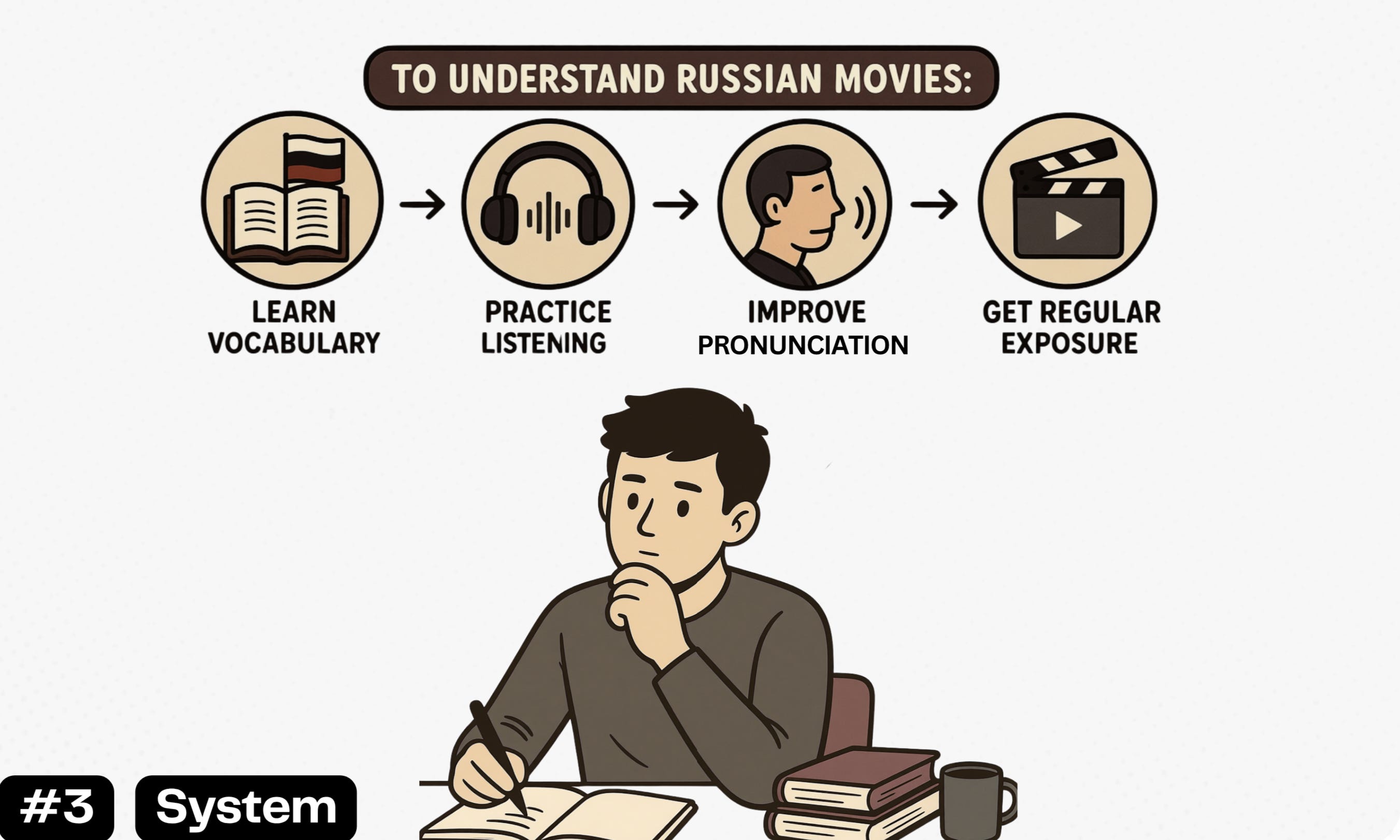
The recurring practices that make each project possible.
Not a one-time task an ongoing process you run regularly until the project is complete.
Project: Watch a Russian film and understand it without subtitles.
Systems needed:
Build vocabulary daily (so you recognize words when you hear them)
Practice listening daily (so your ear adjusts to the speed and accent)
Review what you learned weekly (so it moves to long-term memory)
Projects don’t happen by accident.
They happen because you built the infrastructure to support them.
Without systems, you have a project and no engine to drive it.
You end up doing random bursts of effort with no compounding effect.
Does this repeat?
Does it build over time?
Does skipping it for a week set you back?
If yes, it’s a system.
If it’s a one-time action, it belongs in the project, not here.
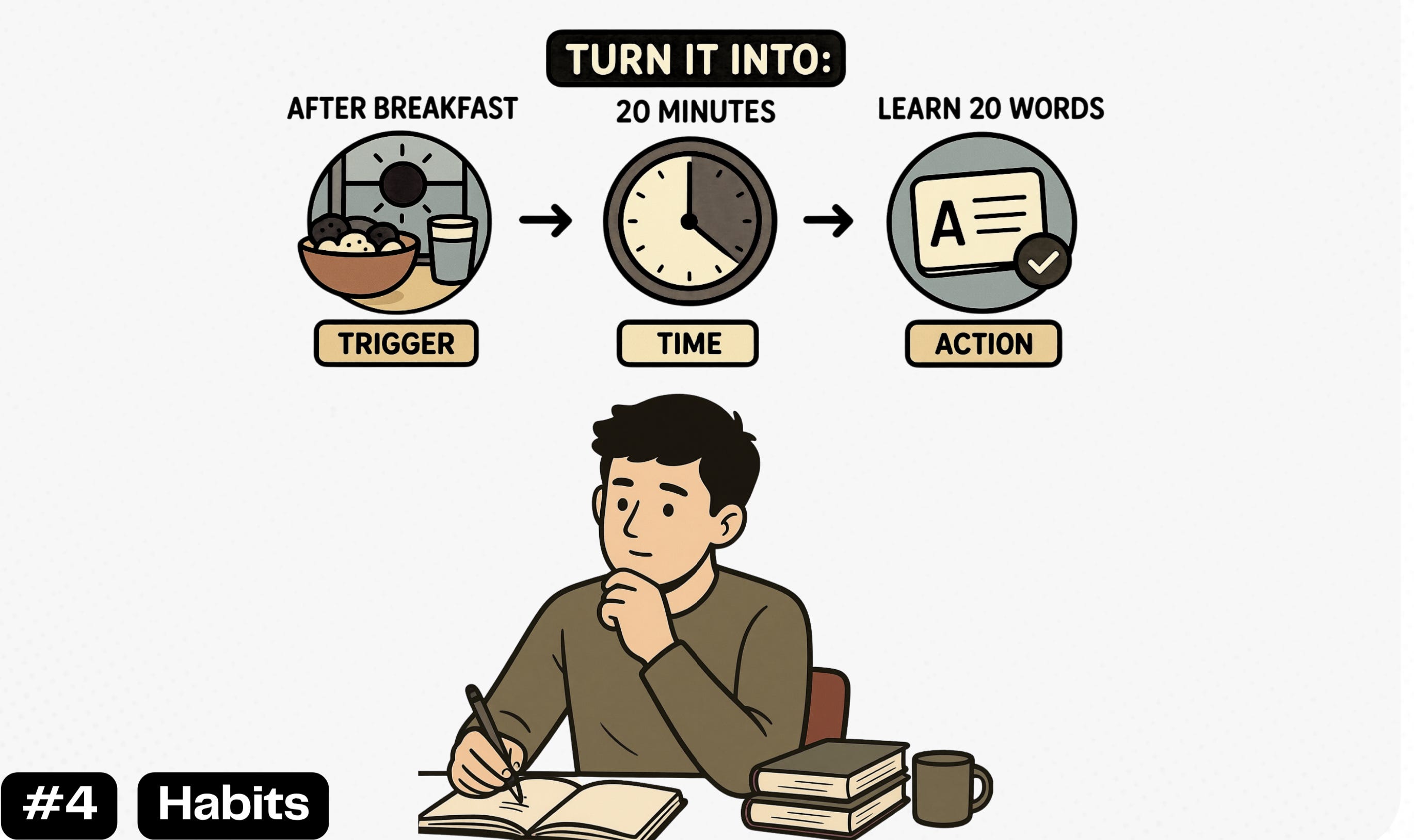
The most specific level.
A habit is a system made concrete, it has a trigger, a duration, and a non-negotiable place in your day.
They confuse systems and habits. “Build vocabulary daily” is a system.
It tells you what to do but not when, for how long, or what triggers it.
That ambiguity is where the behavior dies.
System: Build vocabulary daily.
Habit:
Every morning, immediately after breakfast, I open my vocabulary app and learn 20 new words for 20 minutes.
Every night, immediately before brushing my teeth, I test myself on those same 20 words for 10 minutes.
See the difference?
What exactly am I doing? (Learn 20 words. Test myself.)
When am I doing it? (After breakfast. Before brushing teeth.)
What triggers it? (Finishing breakfast. Picking up my toothbrush.)
How long does it take? (20 minutes. 10 minutes.)
How do I know it’s done? (20 words learned. Self-test complete.)
If someone watched your day, could they see this habit happen at a specific moment?
Could you check it off?
If it’s still vague, “I’ll try to do some vocabulary practice”, it’s not a habit yet. It’s a wish.
Let’s run through the complete pyramid with one goal so you can see what the finished version looks like:
Goal: Get in the best shape of my life.
Projects:
Complete a 5K run without stopping
Lose 8kg by month 4
Build a visible upper body within 6 months
Systems (for Project 1: 5K run):
Progressive running training 4x per week
Strength training 2x per week
Nutrition tracking daily
Habits (from the running system):
Every Monday, Wednesday, Friday, Saturday at 6:30 AM → put on shoes, step outside, run for [current program distance]
Every Sunday evening → plan next week’s meals and log calories for the coming day
“Get in the best shape of my life” became “put on shoes at 6:30 AM on Monday.”
That’s not a life transformation.
That’s a Tuesday morning. And that’s exactly the point.
The pyramid is how you build systems specific enough to actually execute.
When you only have a goal, your brain sees the full distance between now and the outcome.
That gap activates avoidance behavior.
The task feels too big.
The path feels too unclear.
When you have Level 4 habits your brain only has to process the next 5 minutes.
Put on shoes.
Open the app.
Pick up the vocabulary cards.
Resistance lives in ambiguity. Specificity kills it.
And here’s what happens when you stack the levels correctly:
The habit runs the system.
The system drives the project.
The project proves the goal is real.
The goal gives the habit meaning.
Each level feeds the others.
Remove any one of them and the whole thing collapses back into “I have this goal I keep meaning to work on.”
Take your most important goal right now. Run it through all four levels.
Start here:
Write the goal in one sentence.
Ask: What are 2–4 completable milestones that prove I’m moving toward it? (Projects)
For each project: What recurring practices make this possible? (Systems)
For each system: What specific action, with a trigger and a time, will I do daily or weekly? (Habits)
Work top-down to plan.
Work bottom-up to execute.
The process takes 20 minutes the first time.
It replaces months of vague effort, guilt, and restarting from zero.
Core Insights:
Goals create direction but zero momentum - they need three more levels to become real
Projects are completable milestones with clear finish lines - not ongoing efforts
Systems are the recurring infrastructure that drive each project - they compound over time
Habits are systems made specific: a trigger, an action, a duration, a way to know it’s done
Resistance lives in ambiguity - the more specific the habit, the less your brain can argue with it
The pyramid works top-down for planning, bottom-up for daily execution
Right now, think about your most important goal.
Do you have projects?
Systems?
Daily habits with specific triggers?
Or do you just have the goal?
Because if all you have is the goal, you don’t have a plan. You have a preference.
And preferences don’t build businesses, get people fit, or teach languages.
Habits do.
Specific, triggered, timed habits - built on systems, aimed at projects, pointed at goals.
That’s the full pyramid.
Now build it.
I love hearing from readers and I’m always looking for your feedback.
How I’m doing with the Elevated Path.
Is there anything you want to see more of or less?
Which aspects of the Newsletter do you like the most?
Hit reply, say hello, and let me know what you think of this newsletter edition.
I’d love to chat with you !
All my best,
#1 Premium Newsletters FREE Access - Free access of the Premium Newsletters reading by top 1%, exclusive for Elevated Path readers.
#2 The Art Of Habits FREE GUIDE - A blueprint on how to Build Habits that Stick & Break Bad Ones.
Untill next letter
~ Elevated Path
P.S. If you’re thinking “I’ll do this decomposition later” that’s the gap.
Right now, open a notes app or grab a piece of paper.
Write your goal at the top.
Spend 15 minutes working it down to one daily habit with a trigger.
That habit starts tomorrow morning. Not next week. Tomorrow.
No posts
Comments
Nothing yet. Say the first thing.
Sign in to join the conversation.