
Hey, it’s Rohit. Welcome to my weekly newsletter on elevating your career and enriching your lives.
This week, Elevate360: Elevating Careers, Enriching Lives, asks the question most leadership programs are afraid to ask. You know what good leadership looks like. So why isn't it showing up when it counts? If you've ever walked out of a difficult moment knowing you could have handled it better, this one is for you.
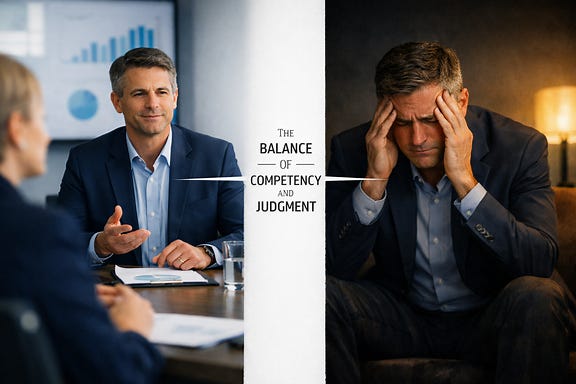
You’ve sat in the leadership development session. You’ve done the 360. You’ve read the frameworks, maybe even built a few of your own. You know what good leadership looks like — the language, the behaviors, the principles.
And yet, last week you left a meeting where something went sideways. A conversation you handled in a way that didn’t match who you think you are as a leader. A moment where the version of you that showed up wasn’t the version you’d describe if someone asked.
That distance — between the leader you know you should be and the one who actually showed up — isn’t a knowledge problem. It isn’t a competency problem either, despite what a decade of global research might suggest.
A few years ago, Harvard Business Review published one of the more credible studies on leadership competencies I’ve come across. Researcher Sunnie Giles surveyed 195 leaders across 15 countries and 30 global organizations, asking them to pick the 15 most important competencies from a list of 74.
The top five themes that emerged were:
• High ethical standards and creating psychological safety.
• Empowering people to self-organize.
• Building connection and belonging.
• Staying open to new ideas and tolerating failure.
• Committing to others’ growth.
Hard to argue with any of that. These aren’t buzzwords. They’re grounded. They came from real leaders reflecting on what actually works.
And yet — something in that list stopped me.
Not because it’s wrong. But because of a sentence buried in the research itself, a sentence that most readers probably skimmed past.
These competencies are difficult to master, the study noted, because improving them requires acting against our nature.
There it is. The most important line in the whole piece. And the research stops right there, as if naming the obstacle is the same as solving it.
It isn’t. And that gap — between knowing what good leadership looks like and actually doing it under pressure — is exactly where most leadership development falls apart.
Take the first theme: high ethical standards and psychological safety. Most leaders would say they value both. Very few would say they deliberately undermine either.
So why does psychological safety remain one of the most cited gaps in organizational research? Why do people in high-performing teams still report that they hesitate to speak up, challenge decisions, or admit mistakes?
Not because their leaders are malicious. Because under pressure — when a project is late, when a senior stakeholder is watching, when the leader’s own credibility feels exposed — the behavior shifts. The leader who believes in safety starts signaling urgency in ways that feel like a threat. The tone changes. The questions become loaded. The room goes quiet.
The competency didn’t disappear. The judgment did.
This is the pattern across all five of the HBR themes. Empowering self-organization sounds good until a team moves in a direction the leader wouldn’t have chosen. Openness to failure sounds right until it’s your budget, your timeline, your name attached to the outcome. Commitment to others’ growth sounds genuine until your own position feels uncertain.
The competency is espoused. The behavior, under pressure, is something else entirely.
Here’s the first principle the HBR study circles without quite landing on:
Leadership isn’t a set of attributes. It’s a set of decisions made under conditions that actively work against your best instincts.
Which means the question isn’t “do you value psychological safety?” The question is “what happens to your behavior when the thing that threatens psychological safety is your own anxiety, your own need for control, your own fear of being wrong in a room full of people watching?”
That’s not a competency question. That’s a judgment question.
The Judgment Gap — the distance between what a leader knows is right and what they actually do when the pressure hits — is the variable that competency research consistently underweights. Not because researchers don’t see it. Giles herself points to it. But because closing that gap is harder to package into a training program, harder to measure in a 360 review, and harder to discuss without it feeling uncomfortably personal.
So we talk about the competencies instead. And the Judgment Gap stays open.
Look at those five themes again, through this lens.
Psychological safety isn’t a value you hold. It’s a choice you make in the moment when someone pushes back on your idea in front of your peers. Do you engage with genuine curiosity, or do you explain, deflect, or subtly dismiss? That choice, made consistently over time, is what safety actually is.
Empowering self-organization isn’t a management style. It’s what happens when you’re sitting on your hands while your team moves toward a decision you’re not sure about. Can you hold the discomfort of not being the answer in the room? Or do you step in, frame it as support, and quietly take the wheel back?
Openness to failure isn’t a cultural value. It’s what you communicate in the thirty seconds after something goes wrong. Not in the post-mortem. In the hallway. In the Slack message. In the tone of your voice when someone tells you the numbers are off.
Connection and belonging aren’t HR initiatives. They live or die in whether people feel like you actually see them — not their output, not their title, but them. That requires a kind of attention that is genuinely hard to sustain when you’re busy, distracted, or managing your own stress.
Commitment to growth isn’t a stated priority. It’s a question of whether, when your best person comes to you with a development goal that doesn’t serve your immediate needs, you say yes anyway.
Every single one of these requires the leader to act against something: ego, anxiety, habit, self-protection, the need for control. Giles was right. The research just doesn’t tell you how to get there.
Not more competency training. Not better frameworks.
What closes the Judgment Gap is honest self-examination of your behavior in the moments that matter. Not the moments you planned for. The moments that surprised you.
Start here. Think back to the last two weeks. Pick one situation where your leadership could have gone differently. Not a big failure. A small moment — a conversation, a decision, a reaction — where something felt slightly off afterward.
Now ask yourself two questions:
What did I actually do in that moment?
And what was I protecting when I did it?
The second question is the one that matters. Because behind almost every leadership failure — not the dramatic ones, the quiet daily ones — there’s something being protected. Reputation. Comfort. Control. The appearance of confidence. The need to be seen as the one with the answer.
Name that thing, and you’ve found your real development edge. Not a competency to build. A pattern to interrupt.
Do that honestly, across enough moments, and you’ll start to see what your leadership actually looks like — not the version you’d describe in an interview, not the version that shows up in your best moments, but the version that shows up when it’s hard.
That version is where the work is.
To be fair to the HBR study, there’s something genuinely important in the fact that the top-ranked themes are all about others. Safety for them. Growth for them. Connection between them. The research is pointing away from the leader as the central figure, which is exactly right.
The leaders who close the Judgment Gap fastest are rarely the ones most focused on becoming better leaders. They’re the ones most focused on what the people around them actually need — and willing to examine, honestly, whether their behavior is serving that or serving themselves.
That’s the competency the list can’t capture. Not because it’s too soft. Because it requires a level of self-confrontation that most leadership development programs aren’t built to facilitate.
The HBR research tells you what great leadership looks like from the outside. The Judgment Gap is what it costs on the inside. Close that gap, and the competencies take care of themselves. Leave it open, and no amount of training will move the needle where it actually counts.
Thanks for reading Elevate360: Elevating Careers, Enriching Lives! This post is public, so feel free to share it.
Comments
Nothing yet. Say the first thing.
Sign in to join the conversation.