
I originally wrote a version of this for a friend who was pregnant and asking what money bits she actually needed to sort before the baby arrived. Then more friends asked the same thing, and I realised it might be useful for more of you too.
Because baby admin is a lot and the finance bit can feel weirdly vague. Everyone talks about prams and hospital bags, but not always Child Benefit, parental leave pay, childcare costs, wills or where to put money for the baby.
So this is the calm version (not financial advice and your own situation matters), but a simple guide to what to sort first, what can wait and what your options are if you want to start saving for the baby.
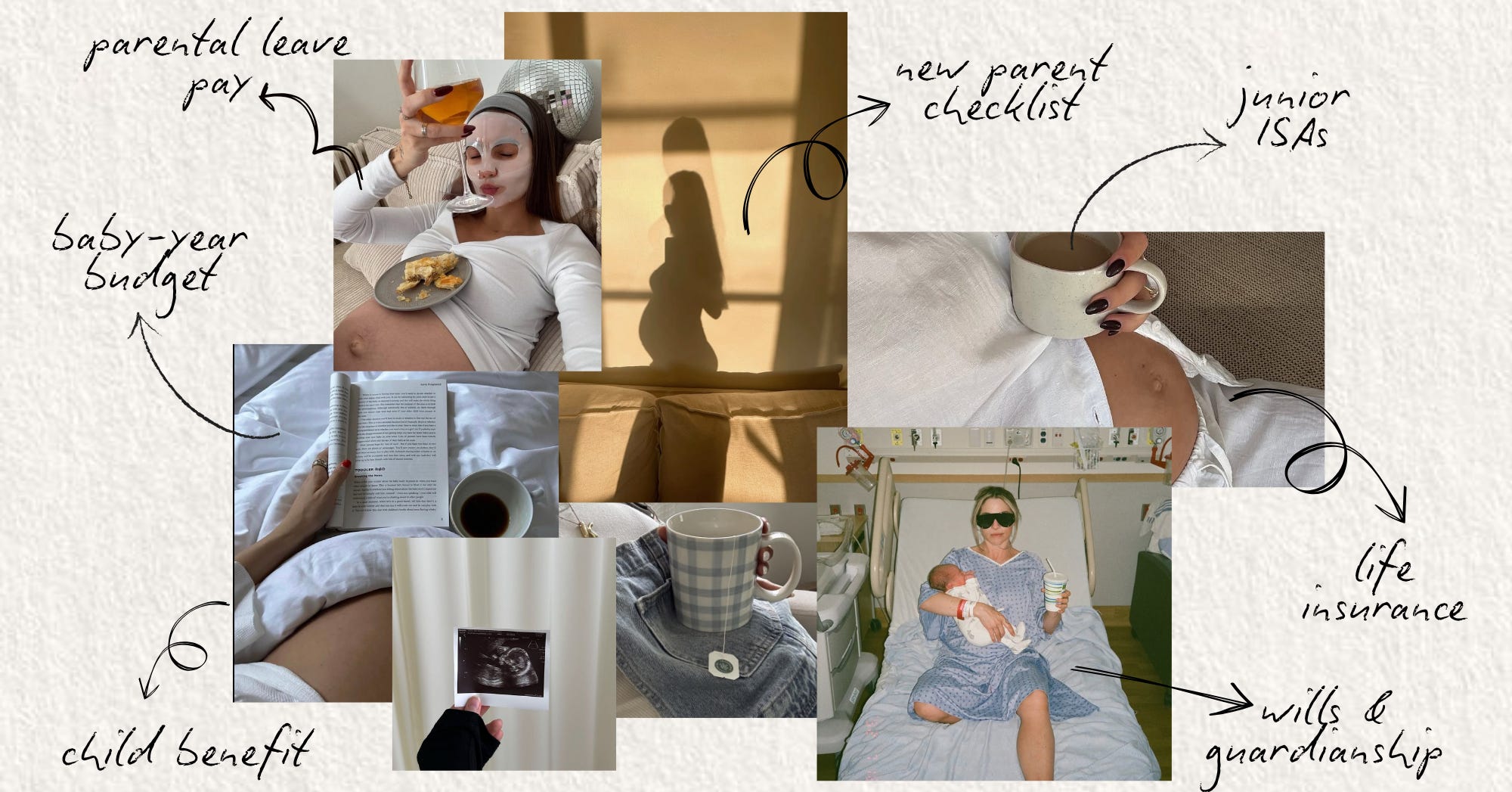
If you do nothing else, do these three things first:
1. Check your parental leave pay. Know what income is coming in, when it drops, and how long your savings need to last.
2. Claim Child Benefit after the baby arrives. Even if higher earnings mean you opt out of payments, claiming can still protect National Insurance credits.
3. Review life insurance, wills and guardianship. Deeply unsexy, very loving and one of the most grown-up things you can do for your child.
Everything else is useful, but these are the foundations. You don’t need to become a finance guru overnight, you just need a few sensible decisions that future-you will be very grateful for.
Before opening a cute little account for the baby, look at your own financial position (I know, it’s the less cute bit). Opening a Junior ISA feels nicer than reviewing your pension or insurance, but your stability is part of your child’s security.
First, I’d ask yourself “do we have an emergency fund”, “can we cover the lower-income months of maternity/paternity/shared parental leave”, “are expensive debts under control”, “are we still paying into pensions if we can” and “would the household be okay if one parent couldn’t work for a while?”
This isn’t about having loads of money, it’s about reducing future panic. A baby doesn’t need financially perfect parents, they need parents who have made a few boring-but-protective decisions before life gets very loud.
The first year can be financially odd because spending and income both change at exactly the moment your brain is operating on crumbs of sleep. You might spend less on going out, but more on nappies, formula, baby kit, clothes, convenience food, parking, coffees and all the tiny things nobody warned you about. At the same time, your income may drop if one or both parents take leave.
Do a rough baby-year budget, nothing fancy, write down what each parent will be paid during leave, when full pay drops to statutory pay or unpaid leave, what savings you might use, what bills stay the same, what new costs are likely and when childcare might begin. You don’t need to predict every penny, you just need to spot the tight months before they sneak up on you.
Also check what happens to student loan repayments while you’re on leave. Student loan repayments are usually taken through payroll if your pay for that week or month goes over the threshold for your plan. But in a baby year, your annual income might end up lower than usual because of maternity, paternity or shared parental leave. If repayments were taken in some months but your total income for the tax year ends up below the annual threshold, you may be able to ask the Student Loans Company for a refund once the tax year has ended. Deeply boring, potentially worth money.
The other thing people forget is annual leave. In many cases, you keep building up holiday while you’re on maternity, paternity or adoption leave, and this can include bank holidays. Some parents take, say, nine months of leave and then use accrued annual leave at the end, which means they are back on payroll and being paid before they physically return to work. This can make a real difference to your budget and childcare start date, so ask HR what you’ll accrue, whether bank holidays are included, what you can carry over and whether you can tag holiday onto the end of your leave.
In the UK, Child Benefit is paid to the person responsible for bringing up a child. For 2026/27, the weekly rates are £27.05 for your eldest or only child and £17.90 for each additional child. Only one person can claim for a child.
Here’s the bit people miss, if you or your partner earns over the High Income Child Benefit Charge threshold (£60k). The charge starts once one partner’s adjusted net income is over £60,000 and all of it is effectively clawed back once income reaches £80,000. You may have to pay some or all of it back, but don’t ignore it just because you think you earn too much. Claiming can also give you National Insurance credits if you’re not working or not earning enough while caring for your child and those credits count towards your State Pension (they can also be passed onto another carer like a parent). You can claim Child Benefit and opt out of receiving payments if you don’t want to deal with paying the charge back.
Plain English: you can make the claim, then decide whether to take the money.
Childcare is often the bill that makes new parents blink twice and say, sorry, is that monthly or for the whole year? Even if you’re still pregnant, it’s worth checking local nursery or childminder costs, waiting lists, when you might need childcare to start, whether your employer offers any support and whether you qualify for Tax-Free Childcare or funded childcare hours.
Tax-Free Childcare is worth knowing about. If you’re eligible, for every £8 you pay into your childcare account, the government adds £2, up to £2,000 per year per child, or £4,000 if your child is disabled. You usually need to reconfirm eligibility every three months and your childcare provider needs to be signed up to the scheme.
Nobody wants to think about worst-case scenarios while buying newborn clothes, but once someone depends on you, protection becomes love in paperwork form.
Look at life insurance, income protection, critical illness cover, wills, guardianship and pension nominations. If one parent died, could the other parent or guardian pay the mortgage/rent, childcare and living costs? If you couldn’t work because of illness or injury, what would happen? Who would look after your child if both parents died? Who receives your pension benefits if you die?
You may not need every product, you may already have cover through work, but having the conversation matters. It’s one of those admin jobs that feels heavy until it’s done and then it feels like relief.
Once your own foundations are in decent shape, then yes, let us set the baby up (it’s obvious I’m not a parent… I’m making them sound like IKEA furniture…). There are four main options, and they each do a different job.
Junior ISA: long-term, tax-free saving or investing for children. For 2026/27, the Junior ISA allowance is £9,000. Parents or guardians with parental responsibility can open and manage it, but the money belongs to the child. They can take control at 16 and withdraw at 18. Cash Junior ISAs are lower risk. Stocks and shares Junior ISAs invest the money, so they can go up and down, but may be worth considering for a newborn because the timeline is longer and when they’re 18 they can access it all.
Children’s savings account: more flexible than a Junior ISA and useful for birthday money, school trips, clubs, clothes, a first phone or money you may want to access before age 18. Watch the tax rules, if a child earns more than £100 interest in a tax year from money given by a parent, HMRC may treat all of that interest as the parent’s for tax. That rule doesn’t apply to Junior ISAs.
Premium Bonds: fun-ish, safe-ish, but not guaranteed. You don’t earn interest, each £1 bond goes into a monthly prize draw and prizes are tax-free. You can buy from £25 up to £50,000. Parents & Grandparents can buy Premium Bonds for a child under 16 and a nominated parent or guardian looks after them until the child turns 16. Lovely for gifts, but I wouldn’t make them the entire plan.
Junior pension: the very long game. You can open a pension for a child, often called a Junior SIPP, but the money is locked away until retirement age. For most families, I would put this below emergency fund, parent pensions/protection, childcare support and Junior ISA/savings. Baby’s retirement fund is lovely. Your own stability comes first. This is capped at £2,880 a year and the government automatically boosts with 20% tax relief to £3,600.
Need access before they turn 18? Use a children’s savings account.
Happy for it to be locked away until 18? Look at a Junior ISA.
Saving for 10+ years and comfortable with investment ups and downs? Consider a stocks and shares Junior ISA.
Want a gift option from grandparents or family? Premium Bonds can work well.
Already sorted the main stuff and want to think very long term? Look into a Junior pension.

Once the baby arrives, people will ask what to buy. You’re allowed to say: “Honestly, if you would like to contribute to their future, we’re putting money into their savings.”
Choose where birthday and Christmas money goes, share details with close family if you are comfortable, decide whether bigger gifts go into the Junior ISA, savings or Premium Bonds and keep a simple note of what has been gifted. This is how you stop baby money disappearing into random envelopes, old cards and “I’ll sort that later” piles. We’ve all had a pile, the pile is not the plan.
For example, if you contribute £100 per month and an additional £100 on birthdays up until the child is 18, invested at an average of 7% per year, the pot at 18 would be ~£47k, and ~£617k at 55 even if they add no more money after 18! Not guaranteed, obviously, because investments go up and down, but it shows why small, regular gifts can quietly become something quite meaningful.
Before baby arrives: check parental leave pay and dates, build or review your emergency fund, estimate your baby-year budget, review life insurance/income protection, make or update your will, choose guardians, check pension nominations and research childcare costs/waiting lists.
First month after birth: register the birth, claim Child Benefit, add the baby to relevant health or workplace benefits, update your household budget and start a baby admin folder.
First year: check Tax-Free Childcare eligibility, look into funded childcare hours, open a Junior ISA if you want long-term savings, open a children’s savings account if you want flexibility, decide how family gifts will be handled and review everything once your income settles.
Nice-to-have extras: Premium Bonds for gifts, a Junior pension for the very long term, an annual money date with your partner and a plan for teaching your child about money as they grow.
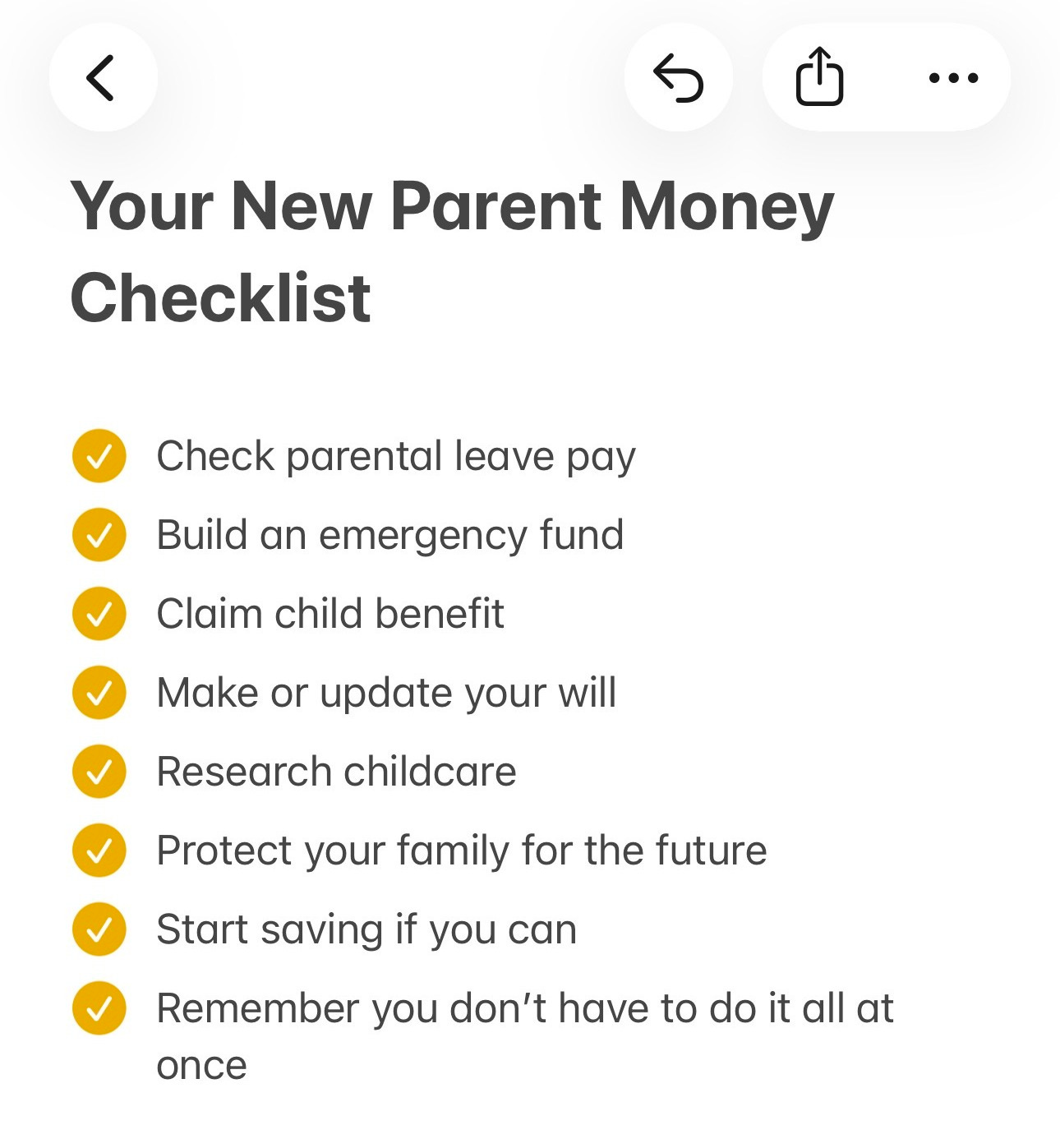
You don’t need to do all of this in one go. Please do not read this and decide you have failed because you have not sorted every box by tomorrow. Pick the next sensible step, then the next one.
Claim what you’re entitled to, protect the people who depend on you and save what you can. Keep it simple enough that you will actually do it.
That is how you build the foundation: quietly, steadily, one boring-but-loving bit of admin at a time.
With love,
Abi x
P.s. Send this on to anyone you think needs to know. This isn’t “one parent's job”, it takes a village.
Rates, allowances and rules change, so check these before opening anything or quoting numbers.
GOV.UK: Junior Individual Savings Accounts - https://www.gov.uk/junior-individual-savings-accounts
GOV.UK: Interest on savings for children - https://www.gov.uk/savings-for-children
NS&I: Premium Bonds - https://www.nsandi.com/products/premium-bonds
GOV.UK: Child Benefit - https://www.gov.uk/child-benefit
GOV.UK: High Income Child Benefit Charge - https://www.gov.uk/child-benefit-tax-charge
GOV.UK: Tax-Free Childcare - https://www.gov.uk/tax-free-childcare
GOV.UK: Student loan refunds - https://www.gov.uk/repaying-your-student-loan/getting-a-refund
GOV.UK: Holiday entitlement - https://www.gov.uk/holiday-entitlement-rights
Acas: Holiday and maternity leave - https://www.acas.org.uk/statutory-maternity-leave-and-pay/holiday-and-maternity-leave
No posts
Comments
Nothing yet. Say the first thing.
Sign in to join the conversation.