
You know that feeling when you come home from work, draw yourself a bubble bath, light some candles, get in the tub, but instead of feeling ahhhh, you feel “… I feel like I should be doing something”?
That needling, subconscious undercurrent of “I’m not allowed to relax yet,” despite the number of rubber duckies surrounding you.
All external, environmental signs point to: I should feel relaxed. But for some reason your brain and body just aren’t quite there.
This is the reminder that intellectually understanding we are in a “safe” environment doesn’t always lead to the felt sense of physiological safety.
Some may say it’s because bodies are dumb and irrational. I prefer the idea that our bodies are actually highly sophisticated learning machines hell bent on surviving.
In other words, our nervous system, and our felt sense of safety is not just dependent on the present moment. Our brains are constantly reading the world around it and comparing that to our lived experience, and in doing so, is constantly predicting what might matter based on prior patterns, sensory cues, and learned associations.
So fill the tub with rubber duckies if you want, but if you’re clenching your jaw, ruminating on the embarrassing thing you did in elementary school and listening to the dulcet tones of your partner in a protracted, heated work meeting talking about “Q1 deliverables”… as you can imagine, your body might not take the cue to relax.
But this doesn’t make you a problem, or mean the duckies gotta go. It means there are multiple things informing your nervous system, both present and past.
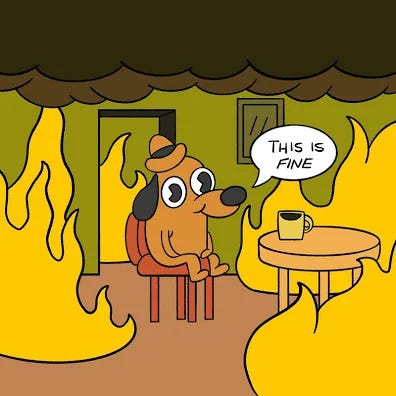
So yes, I am a fan of positive self-talk. It has its place.
But when we’re talking about the dissonance of “I’m in a bubble bath but I still feel really on edge,” we have to give ourselves permission to dig deeper.
Here’s what’s true about our bodies & brains:
Physiology lags behind cognition: we can know conceptually we are in a safe environment (at home, with loved ones, etc) but not always feel this to be true.
Our body trusts both repeated experiences and outcomes… (childhood environment, parental dynamics)
It also trusts very meaningful, acute experiences and outcomes… (a car accident, medical scare, falling off a swing)
And it trusts both of the above way more than a one-time reassurance. This means old survival patterns can persist even after the threat is long gone. And stress chemistry, muscle tone, breathing patterns, and vigilance don’t necessarily vanish on command or just because we had one relaxing day at the spa.
To add more fun complexity, if our system has learned that relaxation itself is unsafe, slowing down with the rubber ducks can feel threatening in itself.
It’s why we get a free afternoon and fill it with to-dos, or we’re with our safe partner but constantly bracing for conflict.
But the important takeaway is that your body is not just a high school theater kid. It’s being consistent with what it’s learned.
If having one nice day at the beach or an evening in the spa is only one drop in the bucket, then what the heck do we do if we want to actually enjoy life, not just survive it?
We gotsta relearn. One drop in the bucket might not do it, but a lot of drops… well, let’s science it out:
Essentially, we must engage with newer, “safe” learning to compete with older associations. Often the newer learning feels more fragile, which is why repetition is key. Think of it like well-worn tracks: if you want to make a new path, you’ll have to bushwhack. A lot.
The body usually starts trusting safety through repeated experiences of “nothing bad happened” after rest, softness, slowness, support, or stillness.
That also helps explain why context and environment matter so much. If the environment still carries cues of urgency, interruption, unpredictability, evaluation, or demand (or what I like to call “general spookiness”) then your system has less evidence that it can update. The brain’s job in allostasis (the process of achieving stability through change) is to integrate both internal and external signals and regulate accordingly, which is why context is not a decorative extra here, it is part of the mechanism. Said less academically: if your body is being asked to relax in conditions that still feel like pressure, it’s just reading the room.
What actually helps bridge the gap, then, is usually less dramatic and transformative than whatever Instagram gurus claim. We need repetition over revelation. More predictability. More support instead of performance. Slower transitions. Consistent cues. Enough experiences where rest feels okay enough that the body can start collecting different evidence than what it’s maybe used to.
So if your brain + body have trouble with the idea of safety, or fully committing to rest, please know this is not a sign you are doing it wrong or that your brain is broken. You also don’t need to go buy a more expensive scented candle.
It may simply mean your physiology hasn’t had enough patterns and evidence to update its understanding of safety.
Safety, for a body, is often less like a switch flipping and more like how we deepen relationships: quietly, consistently, and through lived experience. While we might see the beginning of this through a dramatic revelation or breakthrough, the reality is that this ease and safety manifests through something similar: jaw unclenching, eyebrows softening, and your shoulders settling just a little more away from the ears.
Love + Snacks,
Elena
P.S. This is part of the thinking behind Panama, too. Bodies tend to respond to conditions, not just intentions.
Comments
Nothing yet. Say the first thing.
Sign in to join the conversation.