
Psoas: the muscle responsible for hip tightness, low back pain, posture, stress response, and, depending on who you ask, your trauma in a past life.
While it does play a role in some of those things, it's been given a level of mystique it hasn't quite earned. So let's talk about what the psoas does and doesn't do, why it's become everyone's favorite problem area, and what we can actually do about it.
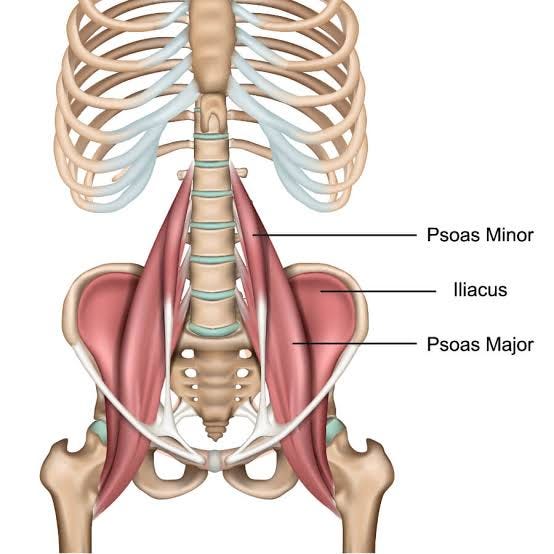
Anatomy Nerd Time:
The psoas starts on the lower back and runs down the front of the hip, attaching onto the lesser trochanter (a bony sticky-outy bit on the inside of the thigh). It’s an important connector between the trunk and the legs, and because it attaches directly to the lumbar vertebrae, it can contribute to controlling and stabilizing the lower spine as we move.
It’s part of what allows us to lift our legs up to meet our torso: think climbing a rock face, or hauling yourself up a tree. Its exact effect on the spine changes depending on our position and what we’re doing, which is already more interesting than the usual story that it’s simply pulling everyone into bad posture.
It’s also active during our gait cycle — specifically when we swing the leg forward — meaning it’s doing something with every single step we take.
Which makes it all the more interesting that this hardworking, deeply embedded muscle has become the thing we blame for everything from back pain to bad posture, usually starting with the sentence “you probably sit too much.”
It’s an interesting cultural phenomenon (says the anatomy nerd) to see a muscle get so much flak across multiple demographics: runners, cyclists, desk-sitters, to people who drive a lot.
How can one muscle be so pervasively problematic? What’s important to remember is that it’s never just one muscle. Nothing in the body works in isolation. And what may be even more important to remember is that just because our hip flexors get tight, it doesn’t necessarily mean our story ends there. Just because we feel it there, doesn’t mean it’s the culprit - and certainly doesn’t mean all we need to do is stretch it to high heaven.
The most common story goes like this: sitting, cycling, running (whatever your thing is) shortens your psoas, and that’s why it hurts. Done, tidy, wrap it in a bow.
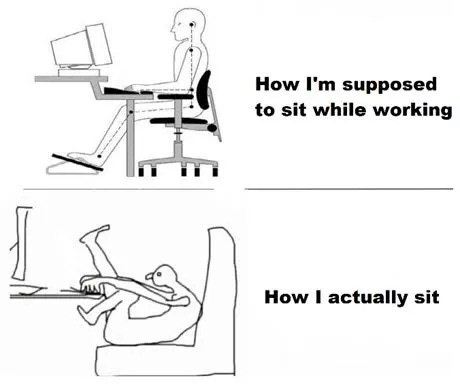
But as we know, body-stuff, especially when it comes to chronic tightness or pain, is rarely that simple: For people who sit a lot, the assumption is that prolonged hip flexion shortens the hip flexors over time... if we’re sitting in the “ideal” posture. We may all sit down at our desks or on the couch with the best intention, but given enough time, how do we actually sit?
Slouched, one leg dangling down, the other on the desk, spine rounded. This means: the hip flexors aren’t always in their most shortened position. So what are other things to consider? See: prolonged positioning, load, and how the nervous system responds to being in one place for a long time, especially while doom scrolling or taking a million meetings with corporate bozos.
For athletes, runners, cyclists, hikers, the mechanism is different. Here we see repetitive hip flexion under load, fatigue, and the cumulative demand of asking one area to do a lot of work. That’s not the same thing as sitting-induced shortening. It just lives in a similar neighborhood. Different populations, different mechanisms, leading to the same conclusion: your psoas is tight, go stretch it.
That should give us pause.
Here’s what “my psoas is tight” actually does tell us: something is going on in that region. Could be nervous system tone, fatigue, biomechanics, or maybe it’s because you’ve been hunched over a laptop for an entire work day followed by a 60 minute spin class set to Butt rock.
Buuut, it doesn’t actually tell us that it’s the psoas that’s solely the problem!
Yet the most common response is to stretch it aggressively and buy a $200 piece of plastic to lie down over. Which is fine, except for the people who’ve been stretching their hip flexors forever and are somehow still tight (which leads to my forever-commentary on “if it’s not working, it’s because I need to do it more and I am the problem” style-thinking).
Fun nerd bit: this isn’t unique to yoga, it shows up in the research too.
In a recent study (2026), researchers studied 99 elite gymnastics and wushu athletes. Those with chronic low back pain had greater psoas stiffness on the painful side, but their psoas strength and hip-extension flexibility were no different from the pain-free group.
Because the study only captured one moment in time, we still don’t know whether the stiffness contributed to the pain, developed because of it, or reflected the demands of those sports. It also didn’t test whether stretching, strengthening, or “releasing” the psoas would help.
So yes, stiffness may be part of the picture. But it still doesn’t prove that feeling tight means the psoas is the problem inherently, or that smashing it with an expensive piece of plastic is the answer.
So on our never-ending, windswept journey to release the infamous psoas, we must ask other questions like: what else is part of this picture? How stressed are you? How recovered? What does the rest of your movement life look like? Are you doing anything other than stretching the thing that hurts?
But what about when a psoas release does feel good?
Listen, y’all, if you have spent even ten minutes with me you’ll know I am a forever proponent of balls. Get some myofascial balls under them hip flexors and I am a happy camper. Even just lying in constructive rest and breathing, or getting a deep tissue massage, or a deeply satisfying lizard - all of these can do the trick in the moment.
Real talk: folks often feel better with these interventions. That’s real! Though what we need to remember is that we can’t always clearly point to the mechanism. Is it nervous system downregulation, truly the stretch itself, circulation, or something else we don’t have the words and scientific terms to account for?
Interventions are wonderful, we just need to remember our experience in the moment is often incomplete.
Here are some things to try instead.
If you’ve been stretching your hip flexors for months and nothing is changing, try the opposite: engage them instead.
A few places to start:
Active low lunge knee drags — in a low lunge, drag the back knee forward along the floor against resistance. You’re asking the hip flexor to actually work.
Crescent lunge knee taps — from crescent lunge, lower the back knee toward the floor and lift it back up. Slow and controlled.
Bridge with straight leg lifts — from a supported bridge position, extend one leg and do small controlled lift and lowers of the straight leg. The psoas is working to hold the leg in space and go through a stretched position.
Single leg Tadasana with thigh press — standing on one leg, press your lifted thigh into your hand while your hand presses back. Isometric engagement.
Or better yet, come practice with me. We do this stuff all the time ;)
Movements like these ask the hip flexors to produce force in different positions, rather than only asking them to lengthen. That can help build strength, coordination, and tolerance for load, and it may change how the area feels. All regardless of whether or not we can prove the psoas is the original culprit. So just remember: the goal isn’t outright fatigue. This isn’t Orange Theory: Psoas Edition.
And if something has been persistently painful or limiting for more than a few weeks, get it assessed by a doc or PT who can actually put eyes and hands on you.
So give your dang psoas some credit! It’s been holding you upright, letting you roam around the planet, and keeping your spine in one piece (and connected to your legs), yet social media would try and convince you that it needs to be released into the void.
Here’s your invitation to think differently about it.
Love & Snacks,
Elena
Comments
Nothing yet. Say the first thing.
Sign in to join the conversation.