
I don’t like hormonal birth control. I never have. I started my first round of daily estrogen pills, as many of us do, during my first year in college. I remember the nurse assuring me that there were virtually no side effects. But from the moment I started taking them I felt bloated, nauseated, and exhausted. I had always been naturally thin, but I started gaining weight. Cellulite appeared out of nowhere on my thighs and butt. When I returned to the campus health clinic to complain about these symptoms, the nurse told me that there was absolutely no way they could be related to the birth control pills I was taking. But if I didn’t like taking pills daily, she suggested I get an IUD instead.
Because the copay was so low, and so many of us young college women were experiencing nasty side effects from hormonal birth control pills, the IUD quickly became a popular option. A good friend of mine got hers inserted about a week after my visit with the nurse, who had assured me it was a quick and painless process, and then ended up in the hospital because she had such painful cramping that she was literally vomiting. Having witnessed that, I decided I did not want the IUD.
Instead, I ended up using something called the NuvaRing—a small, plastic vaginal ring that I inserted once a month, and removed the week of my period. It had a lot of advantages. For one thing, I didn’t have to remember to take a pill every single day. For another, the daily dose of hormones was lower, and felt gentler. The daily peaks and troughs also felt less extreme. My weight stabilized. I was generally happy with it.
Then, on a trip back from California to visit my family on the East Coast, I was browsing the news stand for something to read on the airplane and there, in the center of the rack, was that month’s copy of Vanity Fair with a giant headline splashed across the cover, “Is the Contraceptive NuvaRing Killing Thousands?” I immediately bought a copy and spent the next half hour, while waiting at the gate for my flight to arrive, pouring over a series of horrible stories about young women killed in the prime of their life by pulmonary embolism, a side effect of NuvaRing. Why had no one even thought to mention this risk to me? I was horrified, but I was also so scared of the IUD insert, and I had hated birth control pills so desperately, that I kept on using it. Obviously, I am here to tell the tale.
Later, in my late twenties, I started wondering whether some of the digestive concerns I was experiencing were perhaps linked to my use of hormonal birth control. By now, I had completed my degree in biology, and I knew my way around the academic research. I started looking into what the academic literature had to say about the side effects of hormonal birth control. Low and behold, all of those things that the school nurse had insisted were “in my head” were well-supported by scientific studies. Nausea, bloating, indigestion and reflux are all common side effects of the pill (source). Other research suggests that use of combined oral contraceptive pills (containing both estrogen and progesterone), is associated with higher risk for the development of Crohn's disease and ulcerative colitis (source). And new, emerging research suggests that they may also reduce the diversity of the gut microbiome (source). I decided I would stop for a while and see if my symptoms improved. They did.
Clearly, I am not alone in feeling that birth control has unwanted side effects. Over the years, I’ve watched as an increasingly vocal anti-birth-control movement, spearheaded by wellness influencers, crunchy moms, and MAHA types, has slowly gained steam. Women have taken to the internet to express the same discontent I felt, to talk about medical gaslighting, to ask why we don’t have better options. And the response to this—as this Atlantic piece points out—has often been to shout these women down, to call them bad feminists, or to accuse them of narrowing access for other women. This is nonsense. These are necessary conversations.
On the other hand, I am worried that this movement, which is born out of a legitimate concern over side effects, and a desire to improve women’s healthcare options, is being hijacked by conservative thought-leaders who do not always have women’s best interests at heart. For instance, according to this article, the right-wing wellness podcaster Alex Clark declared last year “If you want women to be feminine again, and soft again and beautiful, they need to be ovulating.” Yikes.
Meanwhile, big money is being poured into apps that support women seeking to leave birth control behind. In September 2022, Brittany Hugoboom, editor-in-chief of Evie Magazine—a publication that positions itself as a conservative alternative to Cosmopolitan but that every conservative woman I know actually hates—launched an app called 28 that allows women to track their natural cycle and get associated health advice. Peter Thiel is the primary investor (you know, the guy who launched the political career of JD Vance).
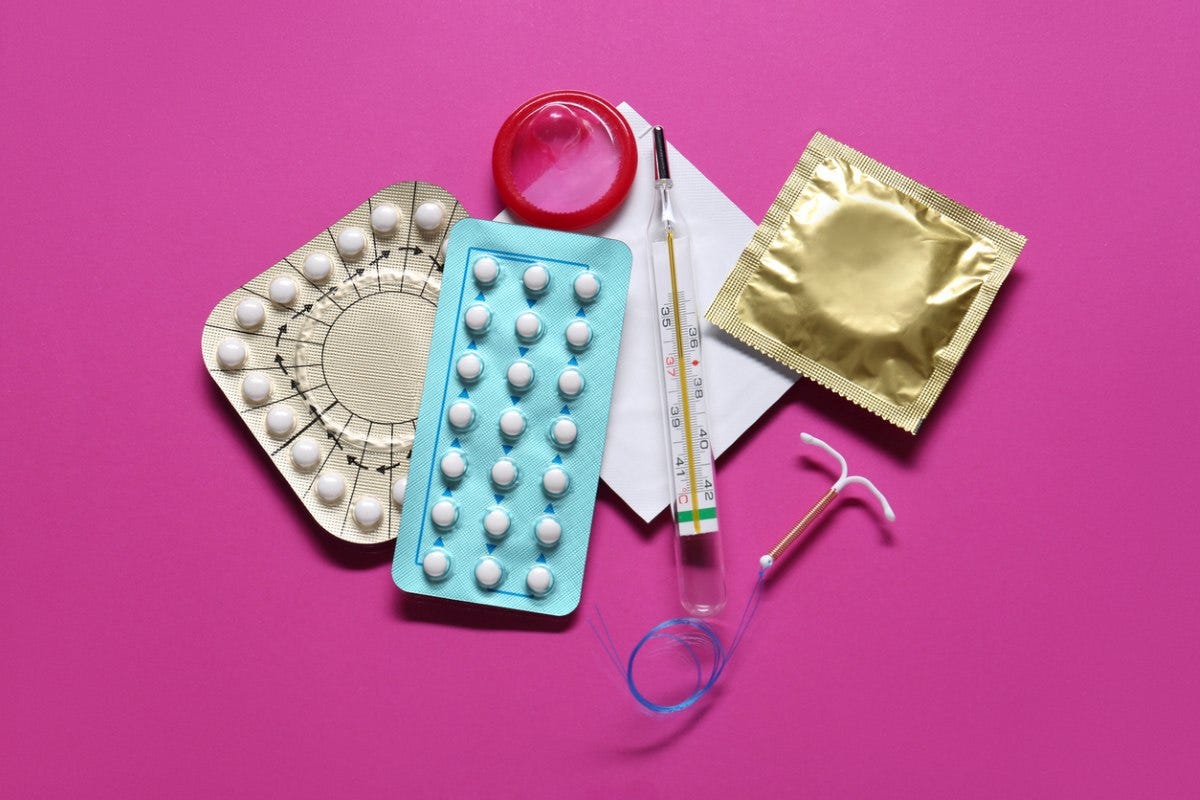
Ultimately, my feeling is that birth control generally sucks, the side effects are real, we all deserve better, but it’s still one of the best things that ever happened to women. Without it, my life would look very different. I would probably have at least five kids by now, not much of an education, and no writing career to speak of. Or I might have just gone to the nunnery to the avoid the whole ordeal.
But the argument that birth control is good because most women don’t want 12 children has been made many times. The argument that gets made less often is this: having 12 children is not at all natural, from an evolutionary standpoint.
The pill is unnatural, sure. But so is a thirteen-year-old getting pregnant. So is having babies eighteen months apart, over and over. So is ovulating 450 times over the course of a life. Every one of those carries real risk—often far greater than the digestive discomfort that made me quit—and not one of them is something most ancestral women ever had to worry about.
Which raises a question I don’t think we ask often enough: what if birth control isn’t the intervention? What if it’s the correction?
To answer that, we need to go back to a question a young anthropologist asked in the Kalahari desert in 1967—and to the woman who actually answered it.
Comments
Nothing yet. Say the first thing.
Sign in to join the conversation.